/
/
43 min
The creative process
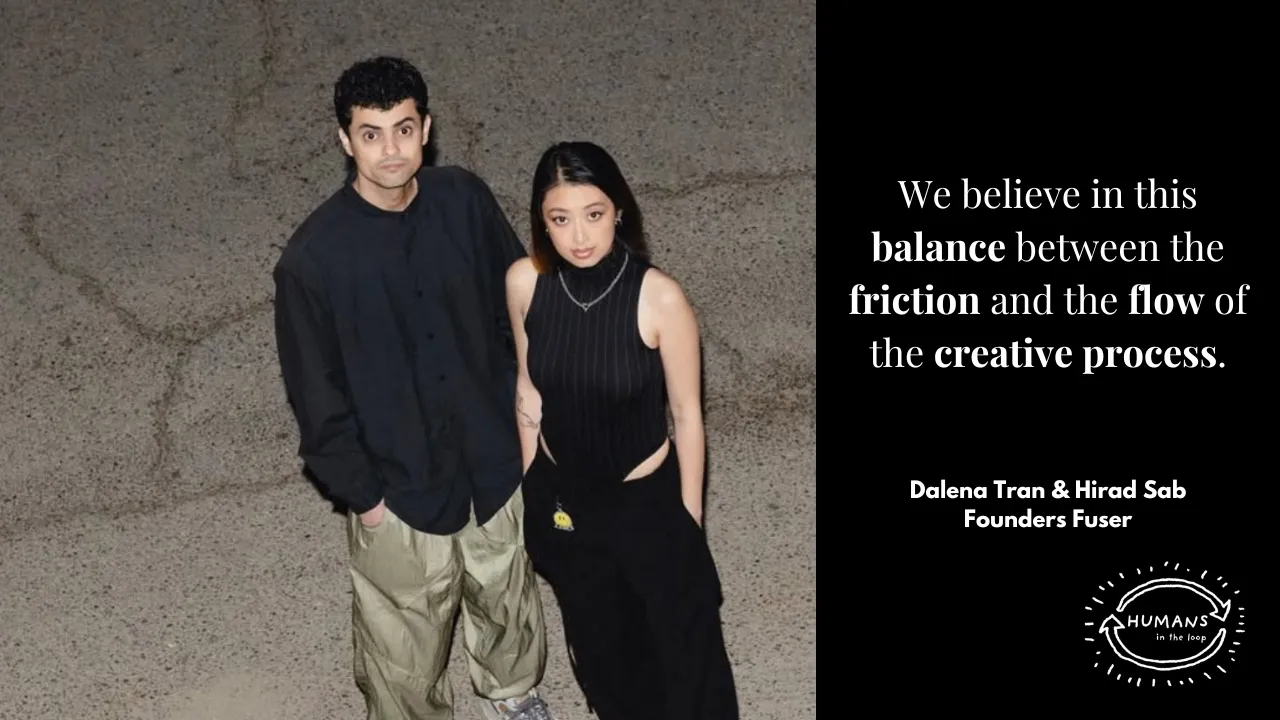
Dalena Tran & Hirad Sab
Co-founders, Fuser
About this episode
My guests today are artists, film makers, educators, technologists and founders of Fuser, a company building an AI workspace for creatives.
With so much noise around what AI should or shouldn’t be used for, and where human creativity starts and ends, I wanted to get Dalena and Hirad on to talk more about the creative process in this technological moment.
Full transcript
Humans in the Loop
Seb (00:00)
And also, of course, feel free to drink water and do whatever you need as we go here. Keep yourselves comfortable. Right, Dalena Hirad thanks so much for coming on. Why don’t you kick us off first and foremost just by introducing yourselves, telling us a little bit about who you are and what it is you’re building at Fuser
Meet Dalena and Hirad
Dalena Tran (00:27)
Thanks for having us. Yeah, so I’m Dalena I’m the co-founder of Fuser and we are an aggregate of AI models and my background is in film and media arts. And I also have taught at places like UCLA, CalArts and OSU using creative software, computer graphics, and yeah, head it over to you, Hirad
Hirad Sab (00:55)
Hi Seth, so I’m Hirad, I’m the co-founder and CTO at Fuser. I’ve been like a creative technologist for a while now. My background is actually in computer science, but throughout the past decade, I’ve been doing a lot of work in real-time graphics, 3D animation, short films. Dalena and I are actually partners, so a lot of that work we’ve been doing together. And yeah, excited to be here. Thanks for having us.
What Fuser actually does
Seb (01:28)
Awesome, well thanks for coming on and yeah, partners in work and life. I’m in deep admiration for you both that you seem to make both of those things work. So we touched on like Fuser, I mean, I guess let’s go a little bit deeper on specifically, what is Fuser? Who’s the target? audience target kind of customer or user of Fuser and what is it that they are using the product for today.
Dalena Tran (02:04)
Yeah, so Fuser is, yeah, I don’t know if you want. yeah, yeah. So Fuser is you know, aggregate of all these AM models. actually started, because we, Hirad and I, we were working, you know, building out technical pipelines at the time for our own music video work, but also for clients. And we were using early machine learning. I would say, I think Hirad, didn’t you use like the first GPT-1?
Hirad Sab (02:05)
Should I take it? Okay. No, go for it.
Seb (02:24)
Mm-hmm.
Dalena Tran (02:33)
for your own portfolio.
Hirad Sab (02:33)
I mean, even before that, I think we started getting into machine learning when there was this kind of like resurgence of deep learning after the whole AI winter thing. This was early recurrent neural networks and concurrent neural networks. And you were getting image outputs that were like 32 pixel by 32 or 64 by 64. So I think this was like…
Seb (02:48)
Mm-hmm.
Hirad Sab (03:03)
very late 2016, early 2017, we were kind of like looking at these ideas. And the technology really accelerated quickly, even for that time. So we went from 32 by 32 very quickly to 256. And it got to a point where with a little bit of like massaging, you could actually put it into production.
Seb (03:30)
Nice, nice.
Dalena Tran (03:30)
Yeah, and so we would basically take these experimental outputs and turn them into kind of creative works, but also building out these technical pipelines. You learned how to think about tools in a way similar to like VFX or compositing. They would use node-based kind of systems. And when this latest kind of season of AI kind of kicked off, we were already integrating a lot of these tools and trying to, I mean, it was a very practical reason why we built Fuser It was a lot of subscription fatigue. We would jump between all these different platforms and softwares and try to run comfy UI on like an older computer and realizing that it wasn’t just like a technical limitation, like your own technical limitation, but it was also like hardware limitation. So, and it was not comfy at all, although we highly respect the tool itself and the community. So we ended up building Fuser as like a browser-based platform that brings all these different AI models together for creative work. So the people that use it are creative professionals. A lot of them are creative directors, art directors. They are also just general directors. It’s kind of like a visionary software. You ideate in Fuser.
Seb (04:45)
Mm-hmm.
Dalena Tran (04:56)
And you can also go all the way to producing media and content. But really, it’s a really good place to explore because of its canvas capabilities and because you can see the process in everything. So if you can imagine, I would say that it’s similar to something like Zapier where you can have all these different integrations and it meets Figma, where you have creatives and designers using the. platforms. So it’s kind of like this bridge bud for AI.
Seb (05:29)
Mm-hmm. So you’ve got the like visual canvas kind of component like Figma style, but you’re like, yeah, rather than having to jump around all of these different AI tools, you’re like bringing that all together into like one workspace where these creative folks can kind of interact and work with it.
Hirad Sab (05:35)
second.
Hirad Sab (05:49)
Yeah, I would say we kind of operate like a composition layer on top of all the existing AI providers that are out there, as well as a visualization and interaction layer. And if we’re thinking about the ideal kind of target profile, it would be sitting somewhere in a Venn diagram of creatives that use AI.
Dalena Tran (05:49)
Yeah, exactly.
Hirad Sab (06:17)
that generate artifacts. We could call the artifacts content. I just want to elevate it a little bit because content has its own connotations too. But we’re essentially a multimodal tool. So that means audio, video, text, images. When it comes to text, we support conversational modes of interaction with LLMs.
Seb (06:24)
Mm. Mm.
Seb (06:40)
Mm-hmm. Mm.
Hirad Sab (06:42)
And as well as using that to augment other modal generations. So for instance, like using an LLM to be like, hey, can you help me with this prompt? Or I’m trying to ideate for creating this poster or building this trailer or advertisement, kind of like short video and taking that output and then passing it forward. And we also support 3D, although like when it comes to 3D, we want to be pushing it as much as we can. It’s been a little bit neglected. Part of it has to do with the general availability models and how much you can do with browsers in that context. But there are some exciting works in the pipeline that we’re looking forward to pushing out.
Rave posters to Stranger Things drone shows
Seb (07:28)
Yeah, yeah, yeah. So you mentioned just a few of the different types of artifacts that people might be creating through Fuser. Do you guys have any particular favorites that you’ve seen or have been spotlighted of stuff that’s been created through the product so far?
Dalena Tran (07:47)
Yeah, actually, I think one of our users created, ideated a drone show for Stranger Things. That was really cool to see the workflow for and the evolution of, because I think it started as early as, I don’t know if I’m allowed to talk about that. But yeah, no, it’s out now. I saw the video, it’s out now. Yeah, so it was really cool because,
Seb (07:59)
wow.
Hirad Sab (08:09)
Yeah, I don’t know.
Seb (08:11)
It’s up. Okay.
Dalena Tran (08:16)
It’s interesting what people actually use it for. Oftentimes it’s to do some kind of like large scale installation or visualization that takes a physical component. could be like a product, like a physical kind of hardware product ideation, but it’s, it’s because like you can use Fuser very cost effectively to come up with as many ideas and iterations as possible before you move forward to producing some kind of large scale production. And so we’ve seen it for stage designs. We’ve seen it for just general pitches to clients being used. But then also, you know, people are using it to generate like UGC and this kind of work. But what we’re really excited by is these kind of like larger visions that can be somewhat evolved within the platform itself before it actually makes it out. And that’s a big part of the the creative process that oftentimes people don’t get to see, you know, having been artists, but also designers and also working in film, like there’s so many parts to the production process that gets kind of hidden away for this kind of clean output of like a feature length film or even what gets posted on social media. They’re all really refined. And what’s nice about Fuser is you can actually see where you branch out, where ideas kind of like start and they may end and you might actually take a different turn and all the iterations that come through. So we want to really double down on that process moving forward. Yeah.
Hirad Sab (09:55)
Yeah. Yeah, I would add also, generally, think AI has made the cost of iteration and prototyping very cheap. So one of the areas that we see FUSER generally use a lot is in the ideation phase for projects that are going to cost a lot in terms of like multi-million dollar projects in collaboration with kind of like titans of industry and the AI can name everyone.
Seb (09:55)
Mm.
Seb (10:05)
Mm.
Hirad Sab (10:24)
But we’ve seen it both in terms of stage design, live even live installation and interactive shows. But then at the same time, we see people use Fuzer to make posters for raves and warehouse parties. So it’s interesting having this kind of like generalized tool that can cover such a wide spectrum of use cases.
Dalena Tran (10:37)
Yeah.
Ideation tool or end-to-end production?
Seb (10:48)
Yeah, yeah, yeah, that’s a very cool spectrum from rave poster to live installation and stranger things, everything in between. And do you guys see the tool and what you’re building as, there’s like the, in my mind at least, there’s kind of this creative process, ideation, iteration, sort of figuring out, okay, what is this thing I’m trying to create? And…
Hirad Sab (10:54)
Stranger things.
Seb (11:16)
then at some point that moves into execution. Actually, if it’s a film I’m creating on some sort of animation, for example, then obviously I’ve got to make the thing, I’ve to put it together. So are you end to end from idea through to execute the thing or is it just the idea and sort prototyping phase?
Hirad Sab (11:38)
Yeah, ideally, I’d say we would want to be end to end, but at the same time as artists and creatives ourselves, we yearn for that kind of like human interaction, human intervention, and, you know, like having a direct input in the process. So that’s something that we always want to elevate in the product and in terms of our own philosophy is that this is not, this is just like another tool in your repository of tools. Right. The other aspect of the whole end-to-end conversation is generally the capability of existing models. Right. And I think end-to-end is very kind of grounded in the context. Right. So if you are a Etsy mom and pop shop that’s trying to generate content for socials, UGC, maybe like very nice product shots. You can definitely use something like Fuser for end to end. The standards there are very low, right? But if you’re kind of like a studio like Netflix, Dreamworks, or if you have certain requirements when it comes to fidelity, when it comes to the output, this is something that is restricted at the model level. Like right now you cannot generate a video that would meet the standards for theatrical screening, you know, or even online streaming for streaming platforms. So those restrictions are something that will be resolved sooner or later, although I think some of them require a lot of computational investment, which is monetary investment in terms of like model training, having access to datasets and GPUs. Some of these datasets are pretty difficult to find too. because as you get closer to production, you get closer to more kind of like protected IP and proprietary work that’s not just out there in the open for you to.
Seb (13:30)
Mm-hmm.
Hirad Sab (13:41)
scrape and train on. But when that happens, think, when the models get to that level of output, I think the conversation about the human intervention becomes even more important. How does the tool center and ground you as the creative in this process, rather than kind of like reducing that? entire fulfillment of creative exploration and creation to just one-shot prompting and clicks. And that’s not something that we’re interested at all, to be frank. And I think it’s partially why we opted for this note-based interface, because it makes the process so clear and visible and at the forefront of everything that you do.
Seb (14:28)
Yeah, it’s interesting because a lot of people have described this experience and I’m sure we’ve all had it to some extent ourselves of like the kind of 80 % phenomenon with AI of just, oh, it gets you really quickly to kind of pretty close to maybe like that thing that you wanted. And then the last 20 % can either be sometimes impossible or just infuriatingly difficult and slow and get to and you can kind of get stuck in these like iterative loops that feel like they’re getting you nowhere. And so yeah and to your point I guess there’s very different standards and I imagine the creatives that you types of people that you’re working with are going to be amongst the folks with the kind of highest level of eye for detail particular kind of attention to those standards. And yeah, so, so yeah, I imagine that they’re the hardest to please on that front.
Hirad Sab (15:27)
We try our best.
Dalena Tran (15:28)
Yeah. But I mean, like, I think a lot of people, mean, at least for me coming from film and working with students, like having people in the creative process other than yourself is really meaningful to what gets made in general. And we really believe that. mean, it’s like, it’s kind of the fun part of making work, you know, is all the different people that bring their own set of skills and value to a project that make it substantially better than if you were to do it alone or just with AI. I even just think if you were trying to make a short film and you’re just trained on an actress or an actor and the talent is just kind of controlled through these interfaces, you lose a lot of the qualities of what is the art of acting. right, like of performance. I mean, so there’s like all these different ways to think about creativity, but we highly encourage you to go after using Fuser, you know, ship it out of Fuser and touch grass and turn it into something actually real. So.
AI’s place in the art world
Seb (16:46)
Yeah, It’s maybe, yeah, I’m interested to go a bit deeper because you both have experience in the art world. You are of that world and AI is a topic. I’m someone who’s pretty much outside of that world looking in, know a few people, but it’s not my world as I’d consider it. But to my understanding, that’s just one of those kind of worlds and communities where AI is clearly divisive. mean, you could argue that there’s very few communities where it’s not divisive these days, but yeah, it clearly divides opinion about its role and what should be left to the human and almost like what level of abstraction can we operate at and still call it human creation, et cetera, et cetera. Yeah, I guess I’m just curious to get your take on what do you see as the role of AI in the creation of art?
Dalena Tran (17:51)
Yeah, I mean, it’s actually a good question that continues to evolve because actually art was always, know, when you talk about art and technology, there was always like some for frontier technology that people were experimenting with, artists were experimenting with all the time. I think the more recent issue with AI relates to labor, the current. kind of socioeconomic issues that are pretty real and they’re not something that I would dismiss at all. Where it fits is, yes, constantly evolving. When it comes to art, think, you know, there’s always the question of how people adopt a new frontier technology. Like VR was really big a few years ago and I don’t know where it fits now, but there are places, you know, in medical industries, like it has a space for it. What we tried to do actually very early on was we had like a kind creative residency program and we explicitly told the participants of the first cohort last year in the spring that you guys are all artists. So we invited artists and creatives, designers from like very different industries. So we have game designers, we had like fashion and people who did performance art, people who did like 3D sculpting, illustration, photography, right? And we showed them FUSER and said, see where this kind of fits in your process because you guys work on very different things. You have a different way of working totally in your medium. And if it fits, like let us know how it does. And if it doesn’t, you know, like, we would also love to know that as well. And it’s still evolving. Everyone’s creative process is different. Like, Hirad and I, we make art, maybe not so much lately. We build products right now. last year, I was making art. But for many years, we were making art separately and together. And we have very different processes of working.
Hirad Sab (20:14)
Yeah.
Dalena Tran (20:14)
The way that we even, even though the outputs might be like a music video, they’re very different from each other. How we get to what idea we land on, what kind of visual aesthetic kind of arises from that process is also very different. And each project is different because you’re working with other people. So I think like the main thing for us is like to keep things open. think the main problem was like all these executives on LinkedIn telling creatives how like, you know, they’re going to be out of a job. We know this process better than you do because we now we can replace you because they could generate an image in their style. But I actually think the work that creatives have put in to refining their sensibilities and their taste for things comes in handy moving forward because
Seb (20:45)
You
Hirad Sab (20:47)
you.
Dalena Tran (21:10)
It takes experience to know what feels good. And it’s like a trigger on the pulse. It’s like, do you know how design trends change? How aesthetics are actually like, they manifest not from manufacturing them, but through constraints, material constraints, but also cultural constraints and what people are trying to say in that moment.
Hirad Sab (21:34)
Cultural currents. Yeah, exactly. You know, I also think there’s a question of kind of like materiality here, like very tangibly. I think this has been ongoing for a long time, you know, like you had the naturalist painting painters beefing with the emergent photographers that were doing landscape photography and then you had photographers beefing with people that started using Photoshop and all that or
Seb (21:43)
Mmm. Mmm.
Hirad Sab (22:03)
Even before that, there was this huge battle between is DSLR and digital photography really actual photography or not? And there’s like theses and like dissertations and like theories like around all of this stuff. But I think, you know, given the trend towards producing artifacts digitally over the past, let’s say 30 years, you know, when I started using Photoshop was like version seven. I think they like open source that or something at this point or it’s free. But given that trend, think a vast majority of artifacts that are being produced, like probably like over 90 % of artifacts that are being produced are digital artifacts. If you take that into consideration of the labor that is required there, I think a good chunk of people that are using digital tools to produce these content are actually happy about the emergence of AI to some degree. know, like personally speaking from my own experience, like I was never excited about re-topologizing a 3D model and optimizing it to be able to put it in a game engine or, you know, like taking a sculpt of a 3D model from a software like ZBrush and bringing it into Maya and like… redoing that entire work to fit a certain kind of like computational constraints of like memory and GPU and all of that or even texturing. So a lot of like redundant time consuming and soul sucking labor has been automated by AI. And like when we’re seeing, what we’re seeing within our own network is that a lot of people that are kind of like in the similar vein to us in terms of like how they approach their artistic practice are excited by being more efficient and pushing it forward. On the other hand, I think there’s also this this chokehold on value of artifact that to some degree is institutional, is imposed by the art world to a large degree. I think we saw this also with the emergence of NFTs and people were saying what is art, what is not art, what is trash.
Seb (24:23)
Mm. Mm-hmm.
Hirad Sab (24:25)
But a good chunk of that revolves around the fact that the financial primitives built around art require it to be materially tangible. So you can put it in front of your or behind your $50,000 sofa set, you know, in your huge mansion. like those things are difficult to do with with kind of mass generated content. And at the same time, that rate of generation
Seb (24:43)
Yeah.
Hirad Sab (24:55)
is going to reduce the scarcity of how the market kind of like values everything. So I think there’s a lot of different things at play. We have labor, we have kind of like traditional ways of looking at art and how it relates to value, materiality. But it’s an exciting time and we’ll see how it evolves.
Seb (25:15)
Yeah, yeah, yeah. And, you know, of all the people defining what art is and isn’t, I’m pretty sure the LinkedIn executives are kind of the worst reference point to your point, Alina. So, yeah, I mean, I hear you and I agree. I guess what I take from that is…
Hirad Sab (25:24)
Yeah.
Do artists push back?
Seb (25:39)
think what I hear from a lot of people is just when it comes to AI, there’s just so much, you know, there’s just so much noise. There’s just so much noise. I think so many people are kind of sick of the noise and you know, the people who almost like take themselves out of the internet doom scroll and are just out in the world doing something that they were previously doing and figuring out like. whatever it’s labeled AI or not, like do I have a tool that makes my life easier in producing this thing? You know, those are often people kind of saying, yeah, you know what? There are actually just tools out there that make my life easier and don’t threaten my status necessarily as artist or creator or whatever I choose to call myself. They just take away the bits that I was, you know, I didn’t value to begin with. They take away the bit that was just sort of we all have those things in our jobs, right? The things that are kind of time-sucking and don’t feel like the place where we can add ourselves or what makes us human or the things that are unique to us. But yeah, it’s an interesting one. you guys get any, Dalena, do find that you get any pushback in artistic communities, people who are just almost here the world, AI now, and are like turned off from the whole thing?
Dalena Tran (27:06)
Yeah, I because it’s a larger technology other than creative tools. think AI is like a new market, right? Like I think it’s has like an at least in the US has been the main investment in the last three years, three, four years. And it is exhausting to hear about also because it I can imagine it being very exhausting. You hear about it not just in creative tools. which I have a very different opinion of because I come from a different space of where like, I do believe creatives can have more power here, especially if they have the right tools. But then you also have, you know, surveillance and you have the other kind of ecosystem, which AI also is a part of. yeah, and I think like they’re a combined kind of conversation that over time, I think will evolve because… I’m always thinking, why are people so, like even with NFTs, I’m like, why are people so upset that digital artists can now monetize their work when before they were just doing it for free? Like for me, was just, I never released anything of NFTs of that sort, but like it allowed for a new market of artists to have an audience. And I think that’s really valuable. But yeah, but you know, all these things come with upsides and downsides. We do. I don’t hear it personally. You know, like I don’t ever introduce Fuser and people are like, you’re you’re doing AI. If anything, like a lot of the people I work with already are professionals to some degree. They’re either working in the creative industry and they they see it as a tool. And the main people that I’ve noticed actually that had some kind of a reaction are students, much younger people who again, because they never started working in the creative field, already felt like they were closed off from it when they hear about AI.
Seb (29:14)
Hmm.
Dalena Tran (29:28)
We luckily never had to deal with that when we were in school. If you’re in the creative field, you’re like, well, you’re not going to get paid the big bucks, right? You’re doing it because you love doing it. That’s very obvious. But I think it really depends on the economic situation at the time. And I think they all come into play. And it is scary to be very young not having even freelanced and hearing that the thing you love doing is gonna, you’re gonna be replaced by some foreign, I don’t know, some like, yeah, like, kind of like an alien, right? It’s like, what is this tool? Like, what is this thing that’s gonna replace us? So I think it creates a bit of like xenophobic reaction, but.
Seb (30:09)
Yeah. Yeah.
Dalena Tran (30:19)
I think big part of FUSER too, other than being a tool is as educators previously to remind students and younger creatives that you should focus on developing your voice because tools always change. It might be AI now. It could be, I don’t know, like could be the chips in your head. Yeah, neural link in three years.
Hirad Sab (30:41)
Neuralink, you just think of it outside.
Dalena Tran (30:47)
Not saying that I promote that, but just saying that like tools constantly change and there will always be people at the forefront being critical of them, but also using them productively in their creative practice. And it’s a matter of really seeing how it fits for you individually where, if it even fits at all, right? And again, it goes back to like, like everyone works differently. There’s no one way to do it. You can automate some things, but. We believe in this balance between the friction and the flow of the creative process. Oftentimes, you need a little bit of friction in order to stop and think about, in the research process, that’s a lot of friction. And that’s the most important part. If you’re automating your mood board, you’ve lost the point there. Because that’s where you as a human and you’re developing your sense of style, you’re discerning what you like and what you don’t like based off of certain constraints. If you get rid of that, it’s like really, who’s gonna view that? It’s just bots. Bots creating something and bots consuming it. It’s just a cycle that is not related to any kind of audience at all.
Taste as the new scarce skill
Seb (32:10)
Yeah, yeah, it’s interesting for me to you name like the students and the younger generation being the one that like push back on it because, you know, I don’t sort of teach I don’t necessarily mix with like a whole bunch of people of that age group. But yeah, I mean, if you just look at the stats, if they are to be believed that they are the generation probably most socio economically feeling the impact of it. I know if you guys are familiar with like Kyla Scanlon who writes a good, a really great newsletter on economics and she’s fairly young herself. And yeah, she wrote this great piece about like the kind of barbell theory as it applies to sort of like Gen Z and Gen X and like how they’re so constantly being fed news. Some of it true and real and some of it probably hyped up that kind of your life is going to be really hard and really difficult. And it’s sort of pushing them to two ends of the spectrum, you one being almost like the, right, I’m going to, I’m going to go and train to like have a trade and something that like AI can’t replace me because I’m a plumber, for example. And then the others who go kind of total other end of like the risk spectrum who go all in on kind of like crypto. madness, you know, they’re almost like the gamblers in the casino and then you have like the total other end of it. So yeah, it’s kind of just interesting for me to reflect on people hearing some of that pushback coming from that particular generation. I guess one thing here, so you know, a while back now, I can’t remember how long, maybe a year ago or so, I wrote this essay called like a time for creative outsiders. And for me, was sort of partly starting to see glimpses and it was partly a kind of looking in the crystal ball and like seeing, you know, the trajectory I could see rolling out. And basically what I was naming in that essay was this idea of, you know, because of the technology of, you know, primarily AI that different skills
Seb (34:34)
become valuable in this new economy. Like if we look at the history of sort of tech companies, they have mostly been built by engineers of some description, but you know, and it was kind of engineering skills that almost was like the scarce commodity. And actually it feels like design, creativity, taste, like these things almost feel like they are becoming the scarce commodity. It’s not. the barrier is not creating a thing. It’s like knowing if it’s good and knowing if it will kind of resonate. But also there’s something I think structurally here that basically, you know, to build a tech company, for example, like most there’s been a very well established kind of playbook, you know, places like Y Combinator are like the kind of pinnacle of this playbook. And it’s like, right, you go through these stage gates.
Hirad Sab (35:25)
Right.
Seb (35:32)
You prove these things by each stage gate and then we give you some more money. And basically that money puts more bums in seats so that you can keep the thing growing. And then, you know, some point in the future, you sort of turn the dial from growth to like profit and everyone’s happy. Like we live in some like capitalist utopia, like dreams are realized, whatever happens there. I guess my experience of you, however brief, is that you are not necessarily trying to follow that playbook and you’re not necessarily of that world. So I guess I’m just interested to know how you think about like company building here because you know you’re not a not for profit as far as I’m aware. So you got to make money out of this thing you got to kind of do the things necessary to make that happen. So yeah how do you hold this kind of artistic integrity and like what I can sense in both of you is something you have deep conviction in, whilst also like the pragmatic realities of, we’ve got to build a company that’s got to make some money.
Dalena Tran (36:41)
Yeah, I mean it’s a… Yeah. No, go for it, go for it.
Hirad Sab (36:41)
Yeah, I would say it’s just… go ahead. I would just say it’s not even just artistic integrity, it’s generally integrity, you know? And kind of like maintaining that. A lot of what we try to replicate is inspired by software that we love ourselves, right? And we love them in one way or another, maybe some of them for their affordances, like something like Figma. We’re not a fan of the subscriptions and how they work, but we love the tool.
Seb (36:51)
Yeah. Yeah.
Hirad Sab (37:15)
It’s a pleasant thing to work in. Something like Blender, we love it because it’s shaped so much of our career, but at the same time, it has shown us what it means to have a vibrant community around the piece of software. Something like Obsidian, because it shows us what it means to have a software that’s extensible and flexible and kind of, again, a pleasant experience to work with. So we try to bring all of these things together and at the same time also getting inspired by, know, like when it comes to investors, they just want to see the lines go up. Everything’s green and yeah, and you’re just like turning a profit. You’re growing your users, but excuse me. I think we’re at a point right now, like where, especially when it comes to software and products, it’s the era of post novelty. Like nothing is, There’s no idea that’s new really anymore. Anything that you look out there, there are 10 different competitors and we are seeing that kind of differentiators also changing in and of themselves in the sense that you can look at a company like, what is it like Clueli? And you know, like that type of distribution model did not exist. if you, five years ago, like you went to a VC and you were like, Hey, this is my distribution model. I’m just going to rage beta everyone.
Seb (38:33)
Mm, mm.
Hirad Sab (38:43)
to get them to use my product, they’re going to be like, get the hell out of this office. Go be a serious person and come back. And now it’s a completely different era where they’re actually looking for that kind of economy of attention built into the product itself. Does it scale long-term? I don’t know. It’s something to kind of like wait and see. But at the end of the day, I think the approach that we want to take is just to maintain that integrity across all the different surfaces that the product touches. from our community to the UI, UX, design, the experience of the software, how it interacts with the outside world, with the outside ecosystem, our pricing model, and how we value our users and how we see them and how we perceive them. And that is that they’re not just purely revenue source for us. There are people that are in the same shoes as us in one way or another at some point of our lives. We’ve been there and we want to bring that mindfulness to all the facets of the product. And I think it’s generally for us, it’s a long play. We’re not focused. I mean, we should be because that’s what the masters want and that’s what markets want. But we’re not that.
Seb (39:38)
Mm.
Hirad Sab (40:07)
we’re banking on like five years from now rather than what’s going to happen in three months, what’s going to happen in six months. And a lot of our strategy and thinking and how we approach development and building, be it community building, software building, company building, team building, has that kind of like long-term mentality behind it.
Finding investors who actually get it
Seb (40:29)
Yeah, yeah. And Dalena, I believe you guys raised some money, good amount of money not so long ago. So I’m, yeah, I guess I’m curious just about the role of investors here, because obviously there are many, many people in the world who set off with some sort of ideology, however loosely or tightly held and believed in by them. And then whatever happens on the way, right? Investors are one way in which these things can kind of either stay very aligned or it can also knock things quickly off course. So Yeah, how have you how have you found, you know taking on external investment and I suppose how do you think about the role that investors play in in the story of fuser?
Dalena Tran (41:18)
Yeah, I think that’s a really good question. And I think it leans back into what Hirad was talking about. We actually have really great investors. It was a hard process to get into the whole fundraising coming from art. You’re like, wow, I’m pitching like every day for like three months almost. And you have to put the users a little bit on the sideline when you’re doing that because you’re just so focused on like vision making and communicating that to people who might not even understand the role that this tool plays. So finding the right investor is very difficult, but once you do, it’s really easy. They believe in you, know, like the ones that we have, our lead investor is a collab currency and we are really happy with them because they took a chance with us knowing that we weren’t like a Stanford dropout, we didn’t go to YC. We had a very different background for why we developed Fuser, but they believe in community building. They believe in the long-term game of how growth actually works. And that takes a little bit of time, but it compounds very quickly once you actually put the effort into it. an interesting process because for pre-seed, you’re kind of like pitching an idea. You might have an MVP, but there’s no like money involved yet. Like an investor doesn’t really know if like this is gonna like, if this is even wanted. So we would have to do these like, go to like studios and get a letter of intent and all these things. And, and even when we did that, didn’t pan through, they didn’t have enough conviction to understand this market.
Hirad Sab (43:07)
I don’t know what I’m saying.
Seb (43:10)
Mm.
Dalena Tran (43:17)
this niche market well enough. And it was really only investors that either had a strong sense of understanding community building or creative tooling and software that we really aligned really well. I would say that while like on the larger scheme of thing, a lot of VCs, you know, look for certain indicators, which is good. I think it’s better than, you know, just doing it because vibes, think like it’s important to really make thoughtful investments. finding the right partner for us is really important too. So we finished our pre-seed last year and now we’ve been growing the team and that’s also really important. I think team building. is one of the most important things for a successful company, simply because we’re very small and someone who might be incredibly talented, but not work well with the rest of the team can really slow the momentum down. And so we’re really particular about that and that makes us very capital efficient. So we only want to really… the role of the investor comes in when we really need to grow substantially. So we have some key features coming out that we are hoping will help us kind of sustain a longer term business model for us that users are going to really appreciate and really like just based off of our conversations with them. And then we will grow and basically take off and try to do another round sometime this year.
Hirad Sab (45:13)
Yeah, no. would just also add like culture is like, think a big part of it and cultural alignment and vision alignment. And it just permeates everything from the investors that we find. You know, so like our lead investor, they, him and his wife, they have their own gallery, they support artists, especially a lot of like digital artists and people that work with kind of like emerging technology. And
Seb (45:13)
exciting. Sorry, go ahead.
Hirad Sab (45:41)
before kind of getting the term sheet, his team used FUSER for I think 20 hours in two days. Yeah, so that was kind of exciting. And they were coming back to us and they’re like, hey, we just made this. We think we’re gonna do this and that. So that level of cultural alignment and alignment in terms of vision and where you’re going is something that we’re always seeking, both in terms of people that we wanna partner with. Because when you’re talking about an investor, you’re talking about someone who you’re bringing on to become part of the company, they’re gonna be a long-term partner with you, unless they decide to kind of like exit at some point. And same goes for team building, know, like, yes, you could bring on a very cracked engineer that used to work at Salesforce or something, right? But do they understand the creative process? You know, are they kind of like aligned aesthetically? ambitiously with what you’re doing or are they purely an executioner? And I think this goes back to the conversation that you were bringing on with AI is that we are past the point of people being sought after purely because they’re good at execution. Because what we’re seeing is a lot of intellectual work. The execution is being offloaded to LLMs and AI in general. So you’re seeking people that are articulate
Seb (46:55)
Mm.
Hirad Sab (47:07)
in terms of how they hold themselves, what they align with, their culture, their aesthetic, their style, and how much can they operate in a kind of like managerial, directorial role, you know, and kind of like orchestrating the work and also kind of like passing that upstream. Yeah, just wanted to kind of add some context to our lovely investors.
A future where everyone can direct
Seb (47:35)
Yeah, yeah, no, I appreciate you doing that and look, they get a bad rap quite rightly in lots of cases, but it’s always nice to hear stories of people who have, you know, great experience with their investors and yeah, you know, an investor who’s going to use your product for 20 hours over two days and be rooted in the world that you’re operating in. Sounds like a great fit to have found. So yeah. Kudos to you and kudos to your investors as well. So we’ve talked obviously quite a bit here about like the current state of Fuser and kind of the work that you guys doing, the world that you’re operating in. I always like to spend kind of the last section of these conversations looking ahead in, you know, an optimistic fashion and sort of thinking about What is in your context, what is the future version of the world that you’re hoping to see? If you guys, if user as a company is kind of fulfilling its potential, what do you hope that kind of ushers into the world?
Dalena Tran (48:54)
I will say my personal vision, you know, when I was really young, I had this like deep belief that everyone could be an artist and that everyone wanted to be an artist. And then, you know, as I got older, I realized that like that wasn’t financially very feasible for a lot of people. But I still have that belief in me. And, know, something that’s the difference between a company that like believes you can automate.
Seb (49:05)
Mm-hmm.
Dalena Tran (49:22)
creative labor away versus some, what we’re trying to do at Fuser, which is like trying to give, trying to augment your creative process and do not necessarily automate just the tedium, but really add to the abilities that you never had before. So an illustrator all of a sudden can animate without having to rig. They can enter new mediums. And I, I really believe if they’re not, you know, in a future where your Fuser is like, incredibly successful is we develop a better context for how we think about the creative process, what gets outputted, also within a larger kind of ecosystem, the media ecosystem of things and how that kind of changes and shifts depending on our consumption of content and these behavioral habits. But yeah, like the perfect world, everyone can finally become director instead of just a gaffer. I know so many, we live in LA, we know so many people in production that had these dreams of, you know, of sharing their vision of a good story to the world, but they didn’t have the means to do it. And I do think that it, if all goes well with the way that we are trying to approach AI, it will allow for a lot more creatives to really enter the space without the traditional means to have done something. Producing is always trying to cut costs anyways, but who can actually become a director in the traditional world? It’s very fractional. You have to either have gone in through nepotism or, I don’t know. or like be incredibly talented and be discovered for that talent and really advocated for. And so I really believe that this is like a new way to get people thinking about themselves bigger than before. Like you can become a director now, you know, whether it’s an art director, creative director, or like a film director, like you can start thinking a bit bigger because you can collapse a lot of these.
Dalena Tran (51:42)
pre-production processes down before you move on to something more expensive and more costly. But I don’t know. This is very practical, but yeah, I just see like people being able to make things that they wouldn’t have been able to before.
Hirad Sab (51:58)
I also see this as part of a kind of like larger trend, you know, it reminds me of the SoundCloud days and Ableton, right? Prior to that, it was like very hard to be a musician, but you had a piece of software that made it very viable. You know, there was the emergence of like bedroom producers, right? Which if you think about it in hindsight, it’s pretty crazy because like in the sixties and the seventies, you have to go to a studio with all these different instruments and like super expensive racks and kind of like analog equipment. Now 16 year olds doing it in their bedroom. And then the other aspect of that is a distribution channel, right? Which is why I was thinking of SoundCloud. And I think we’re kind of like operating in a similar era right now where like pre-AI you had all these distribution channels that were predominantly kind of packed with UGC and You don’t get the same kind of quality of output as something you would see on a cinematic experience or experimental animation or things of that nature. Now with AI, you have both the means of production outside of just recording something with your phone. So the ability to be able to take those ideas, that creativity and kind of really externalize it out there for others to see. while simultaneously having access to things like YouTube and TikTok and all of these different distribution channels out there. And I think that’s why to some degree, like all of this stuff is scary for, I mean, I totally recognize and respect that like a lot of people see this as scary from an individual perspective when it comes to labor and am I going to be replaced or not? But I think it’s also scary at the status quo. institutional kind of like hegemonic chokehold and gatekeeping that you have over the production and distribution of these artifacts, you know, from kind of film studios to traditional art worlds and superstar galleries and all of that. think everyone’s kind of like grappling with this idea that we’ll
Hirad Sab (54:14)
Will this persist long term like this form of gatekeeping and it’s something to be seen, you know.
Seb (54:22)
Yeah, yeah, very well put, very well put. So yeah, I think the world in which people are empowered to pursue their creative pursuits and yeah, it kind of breaks down and democratizes some of those kind of gatekeepers industries. I think that would be a very cool place for us to land. I hope we get there. I hope that you guys can play your role in that, if you’re a… I guess what I will say from my end as well is, you know, had Alex Komoroski came on the podcast a couple of weeks ago and he’s amongst other things, one of the people who created a thing called the resonant computing manifesto. I don’t know if you’ve come across it at any point. And basically, you know, the manifesto, So it’s checking out. just an articulation of how it feels like technological products have been kind of hollowed out and a lot of the people building them, Alex before he did what he’s doing now, he spent a long time at Google and Stripe. And so he’s been an insider as it were in the heart of tech. And yeah, I think a lot of people, myself included have had that experience of Yeah, feeling, you know, the thing that you’re building is somewhat hollowed out and your experience of building it, it’s somewhat hollowed out. And so, yeah, on my end, I am very interested in not just what you’re building, but I think I’m hoping Fuser could almost be like a poster child amongst many others of like the way you build it is like people rooted in a thing that they really care deeply about who maybe have some opportunities to like build in a way that is perhaps more like capital efficient and therefore they don’t just get sort of pushed by the wrong types of investors into kind of hollowing themselves out along the way. So yeah, I will be rooting for you on that level as well and just curious to see how you guys get on. But yeah, really interesting conversation today. I’m really grateful for you both coming on and sharing your perspectives.
Wrap-up and where to find Fuser
Seb (56:47)
Before we wrap up, is there anything that we should make sure that we include in show notes? Anything, if people wanna kind of find out more about your work and the two of you, they should go.
Hirad Sab (57:05)
Probably our websites. Yeah, go to pzr.studio.
Dalena Tran (57:06)
Go to Fuser. No, sorry. Yeah, my life is Fuser right now. So even my personal website, I’m like, yeah, I haven’t updated that in a year.
Seb (57:08)
Yeah, go defuser.
Seb (57:15)
It’s all wrapped up in Fuzer. Cool, we’ll include that. Yeah, I will also make sure to include the link to your guys’ video, if that sounds like the right thing to link to. But yeah, thanks again for taking the time and I will follow up on my end, once I’ve done a bit of a first edit. Yeah, we’ll share that with you. No obligation to listen to it if you don’t like the sound of your own voice, but yeah, I will share that with you kind of ahead of time. And like if there’s anything that we need to kind of edit out or amend, we can do so. yeah, really enjoyed having you both on.
Hirad Sab (57:53)
Yeah.
Hirad Sab (58:05)
amazing. Thank you so much for giving us the platform set.
Dalena Tran (58:08)
Yeah, thank you so much, for the platform and giving us space to have this conversation. It was really fun.
Seb (58:16)
Yeah, no, I loved it. I loved it. And yeah, I guess last thing I will say here is just, yeah, on your travels, if there are folks that, you know, I kind of bracket this, what I’m doing here under the title of like thoughtful technologist, which can mean many different things. But yeah, if there are folks that you think either you’d be really interested in listening to on a podcast or folks that you know that, you you think would be willing and a good fit. any intros or anything like that. Yeah, that’s always, it’s always a rich source of like finding interesting people to speak to. So yeah, but yeah, so keep that in mind on your travels.
Hirad Sab (58:50)
feel something your way.
Dalena Tran (59:00)
Absolutely, I have someone already that popped up so I’ll send you an email later this week
Hirad Sab (59:00)
Most definitely.
Seb (59:06)
Awesome, awesome. All right guys, well, appreciate you both for doing this and enjoy the rest of your day and I’ll follow up very soon.
Hirad Sab (59:14)
Been a pleasure. Thank you, sir.
Dalena Tran (59:14)
Thanks, Seb. Bye.
Seb (59:16)
All right, bye bye bye.
Hirad Sab (59:17)
Bye.


