/
/
1 hour 4 min
What quantum computing is good for
Scott Aaronson
Computer scientist · Complexity theorist
About this episode
Scott Aaronson is a Computer Scientist, Complexity Theorist and leading authority on Quantum Computing.
As he says himself, he’s spent twenty years trying to dispel some of the commonly held myths about it.
As a non-scientist, I’ve spent some time trying to wrap my head around quantum mechanics and it still blows my mind everytime I try to think about it. This conversation was as close as I’ve ever been to properly understanding it.
I sat down with Scott to discuss topics such as:
Quantum mechanics and probability
Quantum superposition and interference
Building reliable quantum hardware
Quantum algorithms like Shor’s and Grover’s
Cryptography and post-quantum security
Quantum error correction and scalability
Implications for AI and societal risks
Full transcript
Humans in the Loop
Seb (01:31)
Welcome back, Humans in the Loop. Today we’re going to be talking about the weird and wonderful world of quantum. Quantum computing has long been touted as a transformative technology for humankind. Despite billions in funding over decades, quantum computers doing meaningful things in the world are only really starting to materialize now. So to help me understand more about why that is and all things quantum besides, I’m excited to be joined by one of the world’s foremost authorities on the topic, Scott Aaronson. Scott, welcome to Humans in the Loop.
Scott Aaronson (01:58)
Hi, thanks for having me.
Quantum computing for a five year old
Seb (02:00)
So Scott, I I heard someone say once that with quantum computing, if you’re confused, that means you’re getting it. So I’m gonna prep
Scott Aaronson (02:07)
th I I’m I’m not sure that that’s true. I mean th the there’s
Seb (02:10)
Okay.
Scott Aaronson (02:10)
the you know th there was a famous quote by Niels Bohr, like, you know, if you’re not shocked or confused by quantum mechanics, then you don’t understand it, right? But that but
Seb (02:19)
Cool. Yeah.
Scott Aaronson (02:20)
but but that but that doesn’t necessarily imply the converse statement. You know, some people might just be confused. Yeah. Yeah, yeah. Yeah. Yeah.
Seb (02:23)
sure. Yes, yeah, it’s very true. Well I’m I’m hoping I’m hoping we can we can help people understand a little bit more, but I’m also gonna start with that as a preface for this whole conversation. So let’s
Scott Aaronson (02:35)
Mm-hmm.
Seb (02:36)
start as basic as we can. How would you explain quantum computing to a five year old?
Scott Aaronson (02:43)
boy, a five year old is is tricky, right? I mean a a a a a a ten
Seb (02:46)
Okay. We c we can go to we can go to ten, we can go to twelve.
Scott Aaronson (02:49)
a ten year old that’s already a lot easier, you know, especially
Seb (02:52)
Okay.
Scott Aaronson (02:52)
you know, depending on the ten year old, I might be able to explain quite a lot. Okay, you
Seb (02:57)
Yeah.
Scott Aaronson (02:57)
know, I mean I mean for for look for for for a kid, the truth is I would start with classical computing, right? Like that’s
Seb (03:03)
Mm-hmm.
Scott Aaronson (03:04)
the that’s the first thing you have to explain. You have to explain about, you know, what is a bit. You know, what is a a Boolean logic gate, like, you know, and or and not. Okay. And then what’s a computer program, you know, what do we care about with computer programs? Often it is minimizing the running time, right? Minimizing how many elementary steps you need, you know, to arrive at the solution, and especially minimizing the scaling of the number of steps as the input gets larger and larger, right? for a five year old, that could already take some time to explain, right? And all of that is just, you know, you have you haven’t even started yet on the quantum part. Okay. you know, and then, maybe the next thing I would explain to our child is classical probability, right? I would explain, you know we’re not sure if something is going to happen or not. But you know maybe we’re we’re we’re willing to place a bet on it. You know, then we can assign a number between zero and one that quantifies, how likely do we think this thing is to happen. Right. If I roll a pair of dice. Could say, you there’s a one in thirty-six chance of getting snake eyes, right? Or I could say, you know, this candidate I think has a 30% chance of winning the election, or polymarket thinks so, right? But I would never say there’s a negative 30% chance, right? That would just be nonsense,
Seb (04:27)
Mm-hmm. Mm-hmm.
Scott Aaronson (04:29)
Or even less would I say there’s a square root of minus one percent chance, like what are you smoking, right? I’m not I’m not sure if I would say that to the five year old. Okay. But but but but then you know finally you could start talking about this incredible thing that the physicists discovered, a little more than a century ago when they were trying to understand the behavior of atoms and electrons and photons, which is that nature at the fundamental level uses a different kind of probability. people have heard that that quantum mechanics somehow involves probabilities, right? They’ve heard that Einstein didn’t like that, you know. He said, I can’t believe that God would play dice with the universe. And then Niels Bohr said, you know, Einstein stopped telling God what to do, right? But you know, but the truth is that if it were just a matter of probability, it wouldn’t be such a big deal, if electrons were just flipping a you know a tiny little coin or rolling a a little die, you know, to decide whether to jump to a different energy level or not. You know, physicists were already using statistical tools, to understand behaviors of large numbers of particles. They could do that for individual particles, wouldn’t be such a big deal. The big deal is that the way that nature calculates these probabilities is totally alien to our experience. It is like nothing that that our pre-quantum intuitions, you know, even gave us the right words for. Okay, but you know, we can we can write it down mathematically, and once we do, it’s it’s not even that hard. Right? So, you know, the key is that nature keeps track of this new type of number, which we call an amplitude. Okay. And amplitudes are closely related to the probability that something is going to happen. Like for example, the probability that if you look, you know, then you will see a photon here, or that you’ll see it there, or that you know you will see this particle spinning clockwise or spinning counterclockwise. about this axis. we use these amplitudes to calculate the probabilities that we’re going to see different things, when we make a measurement, that’s what quantum mechanics sort of does for us. You know, at the core, it lets us calculate the probabilities that things will happen. Okay, but these amplitudes are not probabilities. Okay. And the key difference is that amplitudes can be positive or negative. Okay. In fact, they can even be complex numbers, you know, involving the square root of minus one, right? So I’m assuming that I’ve already explained to our five-year-old what is a what is a complex number. the key thing about these amplitudes is that you have to add up you know all the possible amplitudes by which something could happen. Okay, so just like you know in in probability, right? If I say how likely is this particle to show up at a certain spot on a screen, you know, then then there might be different ways that the particle could have gotten there, right? Different paths that it could have taken that have
Seb (07:38)
Mm. Mm.
Scott Aaronson (07:39)
different probabilities. Classically, what I would do is I would just add them all up. Like if it has a 10% chance of having gotten here this way, 20% chance of having gotten here that way, then overall there’s a 30% chance, right, that it that it gets there. Okay.
Seb (07:54)
Mm-hmm.
Amplitudes and interference
Scott Aaronson (07:55)
but now this is the key thing that quantum mechanics changes. Okay, because qu quantum mechanics particle might have like a 0.1 amplitude of taking this path to get to this point. Okay, it might have a negative 0.1 amplitude of taking that path to get to this point. Okay, and what happens in that case is that these two amplitudes interfere destructively. They cancel each other out, which means that the total amplitude for the particle to get to this point is now zero. Okay? Which means that the particle never gets there at all. Okay, so this is what amplitudes can do, that classical probabilities can’t. They can cancel each other out. there’s a famous experiment that Richard Feynman used to say that all of quantum mechanics is contained in that one experiment. It’s called the two slit experiment, right? It’s where you literally shoot a particle at a screen with two slits in it. So you give it two different paths that it could take to reach a certain point, and then you see that there are these certain dark spots where the particle never ends up because the two ways that it could have taken. Are canceling each other out. yet if you close off one of the slits, now the amplitude is only positive or it’s only negative, And now the particle can appear there. So to say that again, by decreasing the number of paths that the particle can take to get to a certain place, you can increase the chance that it gets to that place. That’s the signature that we’re dealing with. sort of a a new rule of probability, And this is really the level where quantum mechanics changed our whole picture of reality. Okay. And you know, how
Seb (09:38)
Mm-hmm. Mm-hmm.
Scott Aaronson (09:40)
do you calculate the probability that something will happen? some people like to describe this by saying, the particle took both paths at once. Right. But it didn’t do it in any sense that we’re used to, Because if you looked to see which path the particle took, you’ll only ever see it take one of the paths. You’ll never see it take both. Okay? But the point is that the two paths that it could take can interfere with each other. this is the core of it. And like basically the you know the youngest child that you know you can explain quantum mechanics to is the youngest one who is able to understand that. So, you know, so you could have this particle, right, that has all these different amplitudes for being in different places. Okay. And when it does, we call that a superposition. This means the particle has all these different amplitudes for being in different places, right? And and again, some people describe that as it’s in all the places at once, okay?
Seb (10:38)
Mm-hmm,
Scott Aaronson (10:38)
Other people
Seb (10:38)
mm-hmm.
Scott Aaronson (10:39)
describe it as, well, it’s it’s really in one of them, but you just don’t know which one, right? Neither of those quite matches the reality. Okay. You
Seb (10:48)
Mm. Mm.
Scott Aaronson (10:49)
know, the reality is it’s this complex linear combination. It’s this superposition. It’s this thing that we didn’t have a word for before quantum mechanics came along. Okay.
Seb (10:58)
Hmm. Hmm.
Qubits, entanglement and exponential complexity
Scott Aaronson (11:01)
And now, you know, if you measure, then you force the the the particle to decide where does it want to be? Right? And now this whole superposition collapses to a single state. But if you leave the particle isolated, then these amplitudes just evolve in time by their own rules. by a linear differential equation. that’s called the Schrödinger equation. Right, which is you know basically just says that these these amplitudes undergo some kind of linear evolution, and that’s where this cancellation happens. Okay, that’s where. You know, if something could happen in many different ways, but the amplitudes of those ways are pointing in all different directions, then they can all cancel each other out. so now the total amplitude is zero and that thing doesn’t happen, Whereas if the amplitudes are all pointing in the same way, then they can all reinforce each other, right? Giving that event a very large probability to happen. So now At this point, you know, we could say, what is a qubit? And a qubit is just any kind of quantum system that has two different states that we could label zero and one, and that can also be in a superposition of those two states. Okay, so it has an amplitude to be zero and an amplitude to be one. there are many, many different physical systems that could serve as a qubit. So for example, a photon. an atomic nucleus, you know, could be spinning clockwise or spinning counterclockwise or a superposition of the two, right? An electron could be in its lowest energy state, call it its ground state, or in the next higher energy state, or it could be in a superposition of the two. And and a qubit is the basic building block of a quantum computer in the same way that a bit is sort of the basic building block of a classical computer. but now the key point is that you know if I have one qubit, I need two amplitudes to write down its state. Right? I need amplitude of zero, amplitude of one. Okay, but now if I have two qubits, now I need four amplitudes. If I have three qubits, I need eight amplitudes. Four, I need sixteen amplitudes, and so on. Right. And quantum mechanics has told us this for a hundred years. we’ve understood this for a very long time. And and if people have heard of quantum entanglement, this is what this is about. when you have multiple particles, multiple qubits, you can no longer think of their states as being separate from each other, because you have to write down an amplitude for every possible combination. of all of the particles together. Schrödinger in the 1920s realized that that was the only way to make the math work. Right. And yet like this, this already was sort of a dramatic expansion of our of our picture of reality in some sense, right? Because what are we saying? We’re saying that if you have a thousand particles, which is not that many, you know, a thousand particles could, fit on my, you know, Fingertip without me know being able to see them, right? But just to keep track of what those thousand particles are doing, I could easily need two to the thousand power amplitudes. now two to the thousand power is much more than the number of atoms in the whole observable universe. quantum mechanics has been telling us for a century that. to keep track of what these thousand particles are doing, nature off to the side somewhere, you know, where we can’t see, has to maintain some scratch paper with two to the thousand parameters. Right? And
Seb (14:33)
Mm-hmm. Mm-hmm.
Scott Aaronson (14:34)
anytime something happens to those particles, nature has to cross off those two to the thousand parameters and replace them with new ones. Okay? That is
Seb (14:43)
Mm-hmm, mm-hmm.
Scott Aaronson (14:44)
a staggering amount of effort for nature to be going to just to keep track of these you know, thousand measly particles. And chemists and physicists who’ve known known about this for generations, they knew it mostly as a practical problem, That if you’re trying to, apply quantum mechanics, beyond like the simplest cases, like the hydrogen atom, let’s say, right? Even if you want to understand, you know, helium or, you know, carbon, or you know, you want a a molecule with several atoms, right? you know, the number of parameters really starts to explode. So it’s like in
Seb (15:20)
mm.
Scott Aaronson (15:20)
principle, we’ve understood, how to model all these systems, for a century. But but in practice, the number of parameters that you have to plug into this Schrödinger equation, is going up exponentially with the number of particles.
Seb (15:34)
Mm-hmm. Mm-hmm.
Scott Aaronson (15:36)
I’m not using exponentially as a figure of speech. I’m, you know, I mean literally. you know, like it it doubles
Seb (15:40)
Mm, mm.
Scott Aaronson (15:41)
or more with with each particle that you add. Okay,
Seb (15:44)
Mm.
Scott Aaronson (15:44)
and so so a lot of what chemists and physicists, have been doing for generations has been coming up with hacks and heuristics and approximation methods for coping with that exponentiality, But it was only in the early nineteen eighties That a few physicists, so most famously Richard Feynman and David Deutsch, started saying, Well, look, if nature is giving us this computational lemon, right? It’s you know, telling us that you need two to the thousand parameters to simulate a thousand particles, Then why don’t we make lemonade out of it? Why don’t we build a computer that itself would take advantage of that same exponentiality? In the number of amplitudes, you know, in these same phenomena of entanglement, superposition, interference. And that was what they called a quantum computer. Okay.
Seb (16:41)
Mm-hmm.
Scott Aaronson (16:42)
And of course, you know, they then immediately faced the question: well, supposing that you built such a quantum computer, what would it be good for? And at the time, they really only had one answer to that question, which was It would be good for simulating quantum physics itself. And now,
Seb (16:58)
Mm.
Scott Aaronson (16:59)
you know, I would say that the truth is, you know, more than 40 years later, simulating quantum mechanics is still the economically most valuable application of a quantum computer that we know, you know, that we’re that we’re really confident about. but you know, in the 1990s, people started to understand. That a quantum computer could also give advantages, at least sometimes, for purely classical problems, problems that have nothing to do with quantum mechanics. Okay, and that was really what created the much more widespread interest in the in this idea and in and in what would it take to actually build a quantum computer. Okay, so so the big discovery that really put quantum computing on the map. For most of the world was called Shor’s algorithm. and that was in 1994. So it’s when I was 13 years old. Okay.
Seb (17:54)
Mm.
Shor’s algorithm and internet encryption
Scott Aaronson (17:55)
And Shor’s algorithm was a method, if you had a quantum computer with thousands or millions of qubits for quickly finding the prime factors of huge numbers. this is a very famous problem. we don’t know. of a classical method that is fast, right? Like if I give
Seb (18:14)
Hmm, mm.
Scott Aaronson (18:15)
you a number with a thousand digits, and I tell you it’s a it’s the product of two five hundred digit prime numbers, you know, and now you have to find those primes. of course you could try, you know, just trial division, right? Like, you know, you say, does two go into it? Well no, no, it’s odd. Okay, does three go into it? No. does five go in? No. and on and on and on. Okay, that would take longer than the age of the universe. in principle it would eventually work, but not in any reasonable time. we do know methods that are somewhat better, but they still take time that grows exponentially with the number of digits. But now why do we care so much about factoring? What so happens that anytime you are sending data over the internet, you know, using, you know, let’s say HTTPS on your web browser, right? So for example, you’re sending your credit card number to Amazon, or let’s say you’re sending a chat message in Signal, right? Your data is encrypted by a cryptographic code. That depends on the belief that factoring is hard. Or that a few closely related problems in number theory are hard. this has been sort of the foundation of electronic commerce, you know, since the since the 1970s, really. Okay, is these these amazing cryptographic codes, called public key codes But the catch is that they only work, you know, they’re only secure if these number theory problems are hard. Okay? Now what
Seb (19:49)
Yeah. Yeah.
Scott Aaronson (19:50)
Peter Shor discovered 32 years ago is that if someone could build a large quantum computer, then that’s no longer true. These particular problems have a structure. that you could exploit with a quantum computer to solve them efficiently and you could thereby break you know almost all of the encryption that protects the internet so that was that was kind of a big deal. and then people started writing about this for the popular press, but unfortunately, you know, what what what happened was that they fell into like a way of talking about it that that you know everyone loved and it was just not true. Right? So what
Seb (20:27)
Mm, mm.
The myth of trying every answer at once
Scott Aaronson (20:28)
everyone wanted to say, you know, and and like still to this day, what that what they want to say is that well, quantum computer gets its dramatic speed up by just trying every possible solution in parallel. Right?
Seb (20:41)
Mm-hmm. Mm-hmm.
Scott Aaronson (20:43)
So for example, Shor’s algorithm would work. you know, by just try you know, given the huge number to factor, just trying every possible divisor, you know, two, three, five, seven, and so on, you know,
Seb (20:56)
Hmm. Hmm.
Scott Aaronson (20:57)
all of them in superposition, and then somehow just magically zeroing in on the best one. if true, that would be amazing, That would work for way, way more than just factoring, Like that would
Seb (21:08)
Mm, mm.
Scott Aaronson (21:08)
revolutionize everything in computer science.
Seb (21:12)
Hmm.
Scott Aaronson (21:12)
Right, that you would just get this this unlimited free parallelism, right? it’s true that with a quantum computer, you can create a superposition over every possible answer. You know, even if there’s exponentially many of them. Okay, that that’s even an easy thing to do, like a superposition over all possible keys, you know, for your cryptographic code. Okay. But for a computer to be useful, at some point you have to look at it. You have to measure, you have to get an output. And if you just measured an equal superposition, you know, not having done anything else, then the rules of quantum mechanics are very clear that all you’re gonna see is a random answer. And if you just wanted a random answer, well, you should have just flipped a coin a bunch of times. Or you know, used
Seb (21:58)
Mm-hmm.
Scott Aaronson (21:59)
a random number generator in your classical computer, right? You could have saved the billions of dollars to build this whole whole new quantum computer. The only hope of getting any advantage from a quantum computer over a classical one is to exploit the way that these amplitudes being complex numbers. work differently from probabilities. Okay. And this
Seb (22:24)
Mm, mm.
Scott Aaronson (22:25)
is why I spent so much time talking about those basics, because they actually matter. Right?
Seb (22:29)
Mm, mm, mm.
Scott Aaronson (22:31)
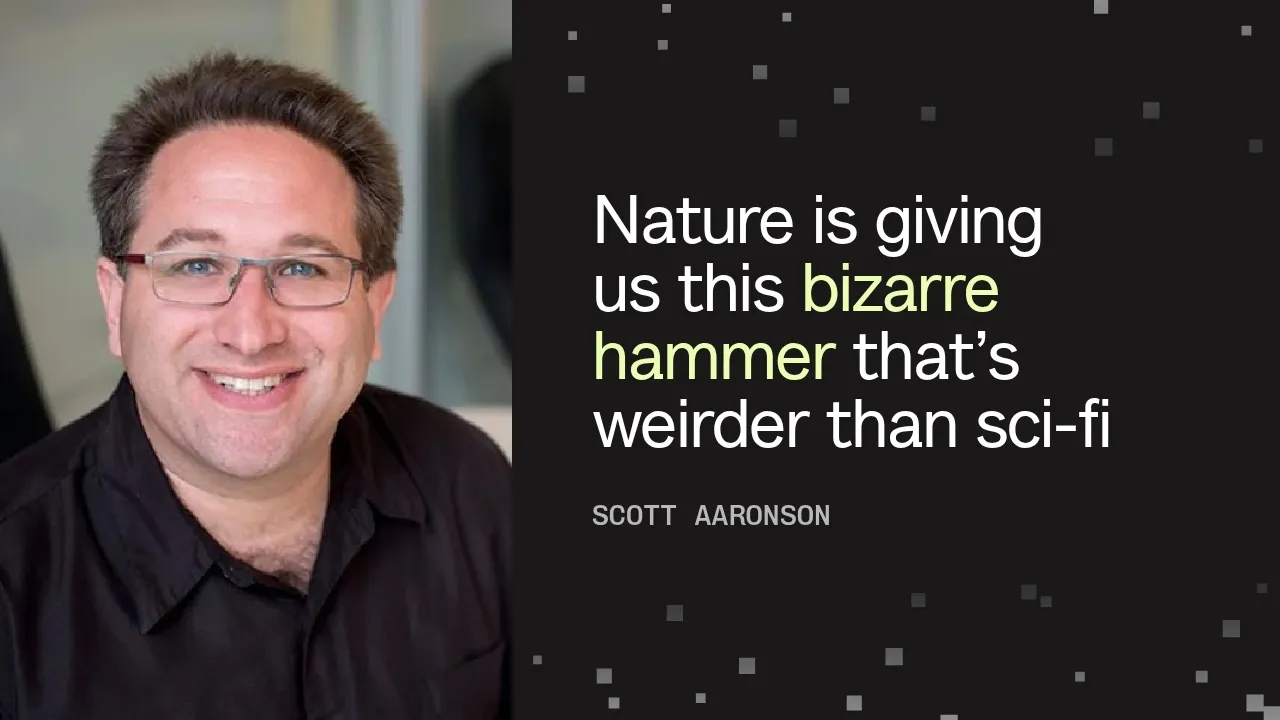
They actually determine, you know, where a quantum computer gets an advantage and where it doesn’t. Right. And like so much of the world, because they don’t know those basics or they think they know it, but they don’t, they’re then led into all these wrong beliefs about what a quantum computer is or is not good for. And this is what I’ve been fighting against for twenty years. here’s the key point, right? to get an advantage with a quantum computer, the game we’re playing, it’s always to choreograph some kind of pattern of interference. So what we’re trying to get is that for each wrong answer, some contributions to its amplitude are positive and others are negative, let’s say. you know, or they’re pointing like every which way in the complex plane, right? So they cancel each other out. And then the total amplitude on that wrong answer is zero or close to zero. Okay. Whereas for the right answer, we want all the contributions to its amplitude to be pointing in more or less the same direction. So they all reinforce each other. And then you know if we can do that, then when we measure only the right answers will have large amplitudes. So we will see the right answer with a large probability. Okay. If we don’t see it, we can always just repeat the computation several times until we do, which which is exactly what happens in Shor’s algorithm. But we only get an advantage if we use this interference to boost the probability of the right answer, you know, beyond what a classical computer could have given us. what makes this tricky is that we have to do all this even though we ourselves don’t know in advance which answer is the right one. Right? If we already knew, what would be the point? Right? so we need to sort of do some kind of you know weird choreography that just for some mathematical reason is going to concentrate amplitude onto the right answer, whichever answer that is. So this is like nature is giving us this bizarre. hammer that’s like more bizarre than any science fiction writer would
Seb (24:37)
Yeah.
Scott Aaronson (24:38)
have had the imagination to invent, you know,
Seb (24:40)
U
Scott Aaronson (24:41)
and then we have to figure out like which which nails can that hammer hit, you know, if any, right?
Seb (24:45)
Yes. Yeah. Yeah.
Scott Aaronson (24:47)
And and it turned out that for better or worse, you know, we base the internet on these cryptographic codes that just happen to be vulnerable to this very specific hammer, right?
Seb (24:58)
Yeah, so it’s all that huh.
Scott Aaronson (24:59)
And that was the big discovery in the ninety you know, and since then we’ve been trying to expand the list of applications of a quantum computer beyond that. We’ve had some limited successes, you know, but it but it’s tough. It’s it’s it’s not at all obvious what is the set of problems that a quantum computer is good for. So that was that was sort of my minimal honest explanation. Yeah.
Seb (25:21)
Yeah, well I hope I hope our five year old is still with us. and maybe some some of the broader audience. I’m gonna take a step back and and kind of play a few things back here and
Scott Aaronson (25:28)
Yeah, yeah. Yeah.
Seb (25:31)
hopefully not totally offend you in my comprehension of the topic, but feel free to step in where I’m where I’m getting this totally wrong. So i
Scott Aaronson (25:36)
Mm-hmm, mm-hmm.
Seb (25:40)
i if we play it back, we’re basically saying that in nature, nature has this means of kind of handling probabilities that
Scott Aaronson (25:47)
Yes.
Seb (25:48)
is very different to what we comprehend when we think about probabilities and and amplitudes is is the
Scott Aaronson (25:55)
I mean I mean I mean I mean we can comprehend it, but it’s a new thing that has to be learned. Yes. Yes.
Seb (25:58)
Sure. Yeah, got it. Got it. So, you know, nature has this sort of mechanism for for
Scott Aaronson (26:05)
Mm-hmm.
Seb (26:05)
for computation, for prediction, that is you know different to our our current application when we think about or how we currently apply probabilities. So we’ve got a i this kind of probabilistic means of of computing
Scott Aaronson (26:20)
Mm-hmm, mm-hmm.
Seb (26:22)
that is yeah, maybe maybe hard for us to comprehend, but but is nevertheless comprehensible if you if you learn how. and in a quantum computer we are essentially, I guess, leveraging this probabilistic way In which nature computes
Scott Aaronson (26:39)
Yeah, we’re we’re we’re we’re we’re le we’re we’re leveraging, you know, the the combination of the enormous number of amplitudes that you need to keep
Seb (26:48)
Mm, mm.
Scott Aaronson (26:49)
track of the system and the fact that these amplitudes can interfere with each other. Right? So
Seb (26:54)
Sure. Sure.
Scott Aaronson (26:55)
there’s kind of like you know, there’s this this whole you know integrated package, right, that of of of abilities that, you know, using all of them together, you can, you know, sort of evade. the capacity of a classical computer to simulate what is going on in in a reasonable amount of time. Right? And and
Seb (27:13)
Mm, mm.
Scott Aaronson (27:14)
and and if you’ve evaded that, then there’s a hope that you are going to get a speed up. You are going to do something much faster than a classical computer could have done that same calculation.
Seb (27:27)
Yeah, okay. So that is what we’re leveraging and I guess the nature by which we are you know, th the the the mechanics of that, the thing that we are leveraging,
Scott Aaronson (27:36)
Mm-hmm. Mm-hmm.
Seb (27:37)
w I guess the key point I hear you saying is then there is a common narrative that is wrong, which is Hey, quantum computers basically try everything at once. for example, you ask a traditional computer to solve a complex maze, and there’s a common narrative of like, a quantum computer would just basically try every possible solution to the maze at once, and it would solve it like that. And therefore there’s this
Scott Aaronson (28:00)
Yes, yes, yes. Right, right.
Seb (28:05)
generalizable like computing speed just gets unlocked in all these different areas. Well,
Scott Aaronson (28:07)
Right. Right. Right.
Seb (28:10)
actually what you’re saying is that is fundamentally untrue, quantum computers can be incredibly fast, but in this very limited sort of or much more limited set of things that align with us.
Scott Aaronson (28:19)
That’s right, that’s right. I mean I mean you you can think of it as trying everything at once, you know, you can use that
Seb (28:25)
Mm-hmm. Mm-hmm.
Scott Aaronson (28:26)
language, but you have to be very, very careful because the hard part is extracting the needle from the haystack, right? Like,
Seb (28:31)
Mm. Mm.
Scott Aaronson (28:33)
you know, even if one of those paths, you know, happens to have found this the correct solution, how do you actually observe that path when you look? Right? You need
Seb (28:41)
Mm. Mm. Mm.
Scott Aaronson (28:43)
to do something to boost its amplitude relative to all of the other paths. You know, the the the that did not find the solution. And that is where the interference comes in.
Why quantum computers are so hard to build
Seb (28:53)
Got it. Got it. And and I guess the other thing we we haven’t touched on yet, but but in terms of what makes this hard, walk into a big IBM facility or one of Google’s facilities or one of these big places where where quantum compu computers are actually being built. And as I understand it, in order to control the state,
Scott Aaronson (29:14)
Yes.
Seb (29:14)
you know, these things have to be cooled to absolute
Scott Aaronson (29:16)
Mm-hmm.
Seb (29:17)
zero, which I think is about minus two hundred and seventy.
Scott Aaronson (29:22)
Mm-hmm. Yeah, depending on the architecture. Some of them don’t have to be cooled to quite that temperature, but some of them do. Right? So
Seb (29:29)
Mm, mm.
Scott Aaronson (29:30)
yeah, so when you walk into a quantum computing lab, a lot of what you see, you know, is is often just big refrigerators. Okay, and so now to come back to your question, what is so hard about building this? Right? Well first of all, getting physical systems to sort of behave in a reliable, programmable way, right? This was hard even classically, I mean Charles Babbage had, all the basic ideas for what we today we would call like a programmable universal computer, you know, back in the eighteen twenties or so. Right. know, this was his analytical engine. Okay, but it took more than a century for engineering to really catch up to his vision. it was not obvious to smart people whether that would ever happen, you know, whether we would ever get components that were reliable enough to do, large scale classical computation. Okay. What what eventually made it really practical was well first the electromechanical relay and the vacuum tube, but then eventually the transistor. ironically the transistor, you know, required quantum mechanics. to discover in the nineteen forties. Okay, but then we just used it as a basic building block for classical computing. so now you know we have a whole new engineering challenge, right? Of how do you build a system that lets you reliably manipulate qubits, and people started asking this in earnest, you know, after Shor’s algorithm came out. in the in the nineteen nineties. what they quickly realized was that with quantum computing there’s a new difficulty even on top of all the engineering difficulties that there were in building classical computers. Right. Which, we’ve finally, you know, solved right, you know, but but I mean the the the chip fabs, at like let’s say TSMC in Taiwan or or places like that. I mean, these are some of you know the technological marvels of our entire civilization. but what’s the what’s the new challenge with building a quantum computer? Well it’s that superpositions in in a sense are very very fragile okay and and it all comes back to this this thing that I said much earlier in the conversation which is that when you look at a quantum state you force it to decide which outcome it wants to show you and it makes that choice probabilistically but then once it makes the choice then it sticks with it so if you had a qubit You know, it could be in a superposition of zero and one before you look, but then if you ask it whether it’s a zero or a one, you know, it suddenly has to snap to one or the other. we know what the probabilities will be. But once it picks one, then you know the then the zero branch is no longer accessible to you. Okay, like
Seb (32:18)
Hm, mm.
Scott Aaronson (32:19)
it’s gone. Okay. So okay, but now now the key point is it doesn’t have to be a person who’s looking, right? And you
Seb (32:28)
Mm.
Scott Aaronson (32:29)
know, and and this this confused people for a very long time about quantum mechanics, right? Because you know, people would say, well, you know, the act of observation, changes the state. And then people would say, Well, wait a minute, the laws of physics actually care whether like a a a conscious being is looking at the system or not? What if a frog looks? You know, what if a bacterium looks, right?
Seb (32:51)
Mm. Mm.
Scott Aaronson (32:53)
the modern understanding of this is actually any any interaction between the qubit and some larger system that carried away the information about whether that qubit was a zero or a one would have the same effect on the qubit as if someone had measured it. Okay?
Seb (33:14)
Mm-hmm. Mm-hmm.
Scott Aaronson (33:15)
And so that means it doesn’t have to be a person, you know, who’s who’s deciding to look, right? Any stray radiation in the room, or any sort of stray atoms you know on your wafer, on your device, you know, that you haven’t ful you know totally controlled that could interact with your qubit, cause the qubit to leak, whether it’s a zero or a one. That’s going to have the same effect as if someone had measured your qubit. Okay, and that effect is to collapse its state. So now its state reverts to being classical. Okay, it’s no longer a superposition. and you can no longer do quantum computation with it. So what
Seb (33:54)
Mm, mm.
Scott Aaronson (33:55)
this means is that if you wanted to build a large, reliable quantum computer, then you need to keep the qubits incredibly well isolated. from everything in their environment that could learn about, you know, the state of those qubits, like whether
Seb (34:13)
Mm-hmm.
Scott Aaronson (34:14)
they’re zero or one, right? So you need this incredible degree of isolation. Okay, but at the same time, the qubits can’t be perfectly isolated from their environment. Why not? Because you know, if they are, they’ll just sit there doing nothing. Right? Something has to come in and tell which qubits, you know, how they should interact with which other qubits at which times. Right? Something has to choreograph the specific quantum circuit that you want. And yet do it in a way where where it doesn’t carry away any information about whether the qubits are zero or one. So that’s the new requirement. And that’s so hard that you know there were distinguished Physicists, in the nineteen nineties who said this is never going to work. You know, this is just
Seb (35:01)
Mm, mm.
Scott Aaronson (35:02)
fundamentally impossible. Okay.
Seb (35:04)
Mm, mm.
Quantum error correction
Scott Aaronson (35:06)
you know, maybe you know you can get it to work with like three or four qubits, but you will just never get it to work with thousands of qubits, right? Because you will never have that that that kind of perfect isolation. now what changed most people’s minds was a further huge discovery in the nineteen nineties, which came a year or two after Shor’s algorithm. And that further discovery was called the theory of quantum error correction. So basically what people realized in nineteen ninety five, nineteen ninety six, and actually, you know, Peter Shor himself was one of the main instigators of this. was that to build a large reliable quantum computer, you don’t actually have to get the qubits perfectly isolated from their environment. you only have to get them very, very, very well isolated. it doesn’t have to be perfect, right? it’s enough if they’re about ninety-nine point nine nine nine nine percent reliable.
Seb (36:04)
Mm.
Scott Aaronson (36:05)
Okay. you know, if they have about a one in a million chance of failure, Then people were able to design these extremely clever quantum error correcting codes that can sort of take care of the rest. for most of us that answered the in-principle question, right? That said that building
Seb (36:23)
Mm. Mm.
Scott Aaronson (36:24)
a quantum computer is merely this staggeringly hard engineering problem, right? You don’t
Seb (36:30)
Mm, mm.
Scott Aaronson (36:31)
need any, you know, any exotic physics to make great, but what it doesn’t tell you. Is, you know, will that engineering problem take 10 years to solve or will it take a thousand years to solve? Right?
Seb (36:41)
Sure, sure.
Scott Aaronson (36:42)
so what’s happened in the 30 years since then, you know, since we understood all of this, is that first of all, people design better and better quantum error correction methods, that can cope with larger levels of error. I said before that okay, it would be enough if your two qubit gates were 99.9999% accurate. And then, you know, by the mid-2000s, people realized actually if it’s just like 99.99% accurate, that’s that that should be good enough. and now we think even 99.9% accurate, that should be good enough. But now the other thing that’s happened is that the experimentalists have gotten better and better. at controlling the physical hardware, right? At actually controlling qubits. So back in the 90s, you know, it would be great if you could do a two-qubit operation that was 50% accurate. Like that would be your your your science or nature paper, right?
Seb (37:43)
Hm.
Scott Aaronson (37:44)
You know, we we so it just seemed pathetically far from you know what
Seb (37:49)
Mm, mm.
Scott Aaronson (37:50)
what would be needed in this theory of quantum error correction, right?
Seb (37:54)
Mm, mm.
Scott Aaronson (37:55)
But you know, a theorist like me would look at it and say, well, that’s just that’s merely a finite gap, right? It’s you know, that that it’s merely, you know, you know, some some number, you know, it’s some reliability number that you have to achieve. And you know, the engineers are gonna get better and better at it. And and indeed, by let’s say the mid-2000s, you had, more than ninety percent accurate gates. That became ninety-five percent, you know, ninety-nine percent. Right. And then when when Google did its now famous quantum supremacy experiments in twenty nineteen, they were able to to show two qubit gates that were ninety-nine point five percent accurate. Okay, so really good and and now. Within the last year or two, companies like like Quantinuum, there may be you know a leading in this metric, but also QuEra, Google, you know, others, they’re really at or or above ninety nine point nine percent accuracy. Okay. So now,
Seb (38:53)
Mm-hmm. Mm-hmm.
Scott Aaronson (38:55)
within the last couple of years. If you just look at the gates in isolation, they are basically at the critical point. Right. They’re sort of at the threshold where quantum error correction should work. And now what remains is merely, you know, the engineering problem of scale up to a system of, thousands or millions of physical qubits that you can shuttle around at will, you know, do you know any desired circuit with. while maintaining that ninety-nine point nine percent accuracy of two
Seb (39:30)
Mm-hmm.
Scott Aaronson (39:31)
qubit gates and while doing all of the error correction that you need to keep the underlying logical qubit stable. This is the thing that companies including Google, IBM, Microsoft, all these startups like Quantinuum, PsiQuantum, and so forth are all racing to do now and what they’re spending billions of dollars to try to do.
Seb (39:53)
So each of these, again, just to kind of join join some dots here.
Scott Aaronson (39:57)
Yeah. Yeah.
Seb (39:59)
So each of these qubits, I guess part of the reason this is fundamentally hard is to your point, these qubits kind of I guess like Schrodinger’s cat, right? They’re they’re they’re kind of whilst it’s shut in
Scott Aaronson (40:11)
Yeah. Yeah.
Seb (40:12)
the book in the box, there’s like some probability
Scott Aaronson (40:14)
That’s right.
Seb (40:14)
that the cat is alive or it’s dead. And then this like superposition is kind of the the you know. And
Scott Aaronson (40:19)
That’s right. That’s right. It’s very important with Schrödinger’s cat. If you want it to be in a superposition of alive and dead, you’ve got to not open the box. Right? But it but it’s worse than that ’cause right.
Seb (40:27)
Yeah. So so that’s so that’s the challenge here is like we kinda need to manipulate without opening the box and then forcing and basically learning is the cat alive or it’s dead.
Scott Aaronson (40:32)
Mm-hmm. That’s right. That’s right. That’s right. And and right. And and we can add it’s not only you who has to not open the box, right? Like there there has to be no stray atom that carries away the information about whether that cat was alive or dead.
Seb (40:49)
Okay, okay. And so the thing that kind of it sounds like restores some sanity for people working in this space is this moment of realizing that that actually you can correct somewhat for quantum error. It doesn’t need to be perfect isolation.
Scott Aaronson (41:00)
No. Yeah, that’s right. If the if the right. It w what what we learned was that if the rate of leaking into the environment is small enough, then we can then we can deal with it using these quantum error correcting codes.
Seb (41:16)
and then it sounds like, you know, the latest and greatest advancements here are that those quantum correction calculations are getting closer and closer to the point of being where they might need to be.
Scott Aaronson (41:27)
Yeah, I mean we we’ve now you know now like like the the the the the basics of quantum error correction have now been experimentally demonstrated within the last couple of years. Like, you know,
Seb (41:37)
Yeah. Yeah.
Scott Aaronson (41:39)
Google was able to show they can take one logical qubit, encode it into like a bunch of physical qubits, on their chip, and the more physical qubits they use for the encoding, the longer that underlying logical qubit is staying alive. and what remains at this point, I would say, is a massive engineering problem of scaling it up.
Seb (42:03)
Sure. Yeah.
Scott Aaronson (42:04)
But I think I like there are there are still a few skeptics who continue to say that this is never going to work. and at this point I just l like to have fun with them. And I like to say like, well, like, you know, if if there’s some exotic new physics that’s going to prevent this from working, like why haven’t we seen it yet? You know?
Seb (42:23)
Mm, mm.
Scott Aaronson (42:24)
Why has there been no sign of it so far? When do you expect it to show up? Like I think, you know, the ball is actually in the skeptics court at this point, right? Like like articulate, you know, what it is that is going to break in this in this theory.
Post-quantum cryptography
Seb (42:38)
we talked a little bit about implications so if if we if we work on this assumption, it’s gonna happen in some form at some point.
Scott Aaronson (42:46)
Yeah, I think it will actually.
Seb (42:48)
to go back to earlier in our conversation, so sod’s law, we kinda picked a method of encryption for basically most of the data on the internet that involves multiplying large prime numbers. that if you put a traditional computer and say, try and solve this, it’ll
Scott Aaronson (43:02)
Yeah. Yeah.
Seb (43:04)
basically take, a universe’s lifetime to solve it. And and
Scott Aaronson (43:06)
We think so. I mean no no right no no no no actually n no one has proven that there couldn’t be a fast classical method, right? For for factoring. But but but but but no one but right, but but
Seb (43:14)
Sure, sure. Okay. But but that’s the theory. That’s the theory.
Scott Aaronson (43:19)
that’s right. No one but but no one has discovered such a method and so we we we base the security o of the internet on the belief that there is no such method. And you know and and and to be fair, there were good reasons for that, right? These cryptographic codes had, you know, really remarkable convenient properties, that came from all the the mathematical structure that problems like factoring have. Right? But you know, the the the the other edge of that blade was that that same mathematical structure was what Peter Shor exploited to give his quantum algorithm for for solving these problems. the big challenge now is to upgrade our encryption to to new forms of encryption that you know are at least hopefully not vulnerable to being broken even by quantum computers. Okay. And
Seb (44:11)
Mm-hmm.
Scott Aaronson (44:11)
and there’s a whole field that that’s grown up to try to do this, which is called post-quantum cryptography or quantum resistant cryptography. Okay. So these
Seb (44:21)
Mm, mm.
Scott Aaronson (44:22)
are crypto systems, you know, that that most of which we would just do purely with our classical computers, right? But,
Seb (44:29)
Mm-hmm.
Scott Aaronson (44:30)
you know, which are based on, harder mathematical problems, that not even quantum computers seem to be able to solve. we do now have very strong candidates for these quantum resistant public key cryptographic codes. based on problems involving high-dimensional lattices. and actually NIST. which is the you know the federal agency in the US,
Seb (44:54)
Mm-hmm.
Scott Aaronson (44:55)
like National Institute of Standards, you know, had a competition from twenty seventeen until twenty twenty-two to agree on standards for post-quantum encryption. And some of the contenders were actually broken, but you know, there were some survivors by the end, you know, and and you know, the main survivors were these lattice-based crypto systems. And so that is now what NIST, you know, and the the US federal government more generally has been recommending that people should upgrade to. some companies have already done this. you know, I think Google, Amazon, you know, are already starting to migrate their systems to post-quantum cryptography. Okay, but we now have. like a giant headache, for the those of us who were old enough to remember the the Y2K issue in the year two thousand, right? It’s like this
Seb (45:45)
Mm-hmm.
Scott Aaronson (45:46)
is kind kind of a bigger version of that, right? And you know,
Seb (45:48)
Yeah. Yeah.
Scott Aaronson (45:49)
with Y2K, the advantage is that we all knew exactly when the deadline was, right? And here
Seb (45:54)
Sure, yeah, yeah, yeah.
Scott Aaronson (45:55)
we don’t know exactly what’s the deadline, right? But you know, we think that at some point people will build scalable quantum computers. They will break much of our existing cryptography. You know, and by the way, that that includes the digital signature schemes that protect Bitcoin, that protect Ethereum, you know, that protect all of these cryptocurrencies, right? And so you’ve
Seb (46:17)
So yeah, yeah.
Scott Aaronson (46:19)
got hundreds of billions of dollars, at stake in, you know, can we just agree to upgrade all of our systems in time? and I have, given the progress of the last few years, like I have sort of switched to saying people should do this now.
Seb (46:34)
just on implications. So, you know,
Scott Aaronson (46:36)
Mm-hmm.
Seb (46:37)
one implication we’re talking about is okay, basically quantum computers come along in the wrong hands. It can basically decrypt the world’s data, on the assumption that people hadn’t moved to these new cryptographic methods, which sounds like exists.
Scott Aaronson (46:52)
That’s right. Now now to right. That the so so so just just to be clear, like quantum computers, you know, don’t break all encryption. And you know, th there’s a whole other type of encryption, like symmetric key encryption, right, where we do have a pre shared secret. And quantum computers have much, much less effect on that. Okay. But Yeah, yeah, right, right. But it’s just the
Seb (47:10)
So so we’ve got we’ve got alternatives, I guess is what we’re saying. But if if we
Scott Aaronson (47:14)
the the the public key encryption that was convenient for us to use, like up until this point in time. You know, that’s all based on these mathematical problems like factoring a few other problems in number theory that are vulnerable.
Seb (47:30)
So this is one of the big risks. sounds like a mitigatable risk, but a risk nonetheless.
Scott Aaronson (47:35)
Yeah, that’s
What quantum computers are actually good for
Seb (47:36)
what about the positive applications here? If if you were, you know, if you were to if you were to yeah, you know, take your knowledge
Scott Aaronson (47:38)
Yes, good. Yeah, Yes, good question.
Seb (47:42)
and say, like however many, I don’t know, five, ten, twenty years from now, quantum
Scott Aaronson (47:46)
Yeah. Yeah.
Seb (47:47)
computers are in the world, like what what are the good applications that quantum computers make a meaningful difference on?
Scott Aaronson (47:49)
Yeah. Yeah. Yeah. Okay. I mean, I lo I like to joke that for me personally, the number one positive application is just disproving all the people who said this was impossible. You know, like I think like this is gonna be the most severe test of quantum mechanics itself that we’re ever going to see. like all the people for for, you know, a century who said, Okay. I guess quantum mechanics works for, making these predictions, but it’s just too weird. It can’t really be the reality of how of how nature is, I mean a quantum computer is kind of the put up or shut up moment for that. Okay, but now in terms of actual economic applications, as I said earlier, I think that the number one economic application that we are confident about remains the one that the physicists were talking about back in the 80s. And that is just simulating quantum physics and chemistry themselves. a quantum computer would give us this whole new window into sort of simulating nature, at the atomic and molecular scales. And why is that useful? Well, like if you are trying to build, let’s say, a better battery or a better solar cell, or you know, a high temperature superconductor, or a better chemical reaction for making fertilizer, maybe a better a drug, like a protein, you know, that binds to a receptor in a particular way. Okay, these these all involve many body quantum mechanics problems, So these are all things where like, okay, you know, we have methods today that that that sometimes work. You know, we can simulate these things on classical computers. resorting to all kinds of hacks and approximations. sometimes we get a good enough answer, especially nowadays using AI, we can sometimes get a good enough answer without even understanding how we got it. or we can just do the experiment in the lab. And, if the calculation is too hard for a classical computer, you know, we can just, measure the system itself, but then you have to maybe like like synthesize, you know, a new molecule, every time you want to do a new test, right? Kind of like in the old days when people would try to understand, the design of an airplane using a wind tunnel, right? And every time they wanted to change the design of the wing, they would have to, put the thing back in the wind tunnel and and try again. Okay. But wouldn’t it be nice if you had a single programmable system? for just quickly simulating any quantum mechanical process. Okay, so that’s that’s the that’s the hope, right? The hope is that you know there are lots and lots of new discoveries in material science, in chemistry, in in biomedicine that this could potentially enable. You know, it’s very
Seb (50:41)
Mm-hmm.
Scott Aaronson (50:41)
hard to be specific about what, because we don’t even know like what new molecules or what chemical reactions are out there, you know, what what
Seb (50:49)
Yeah. Yeah.
Quantum hype and the limits of speed-ups
Scott Aaronson (50:50)
what what what what exists to be discovered. But it’s kind of like when you have a new telescope, With some dramatically better resolution. Like of course you’re gonna see new phenomena. And of course we would like to know, you know, what is a quantum computer useful for beyond that, what about for a lot of the the the workhorse problems of of computer science today, which let’s say would include you know optimization, like scheduling airline flights or vehicle routing or finding bugs in code, finding security vulnerabilities, or nowadays we would say like training neural nets, right? You know, doing doing the training for for AI models, right? Wouldn’t it be great if a quantum computer could help with all of those things? so yes, it would be great if it could, right? so about 20 years ago, when we started seeing a whole bunch of quantum computing startups, what they quickly learned was that if they wanted to raise a lot of capital, the way to do it was to tell investors that yeah, that’s what a quantum computer is going to help with. whatever problem you have, whether it’s like oil and gas exploration or it’s a financial portfolio planning, yeah, you know, quantum computer, yeah, just tries every answer in parallel, right? And people ate this up with mustard, People, you know, because they didn’t understand it, because they didn’t want to take the hour to understand the stuff that I was explaining to you, you know, earlier, right? They said, okay, I guess that’s what a quantum computer is. so they just they just believed that. Okay, the trouble, you know, those of us who who actually work on this, what we know is that like like yes, there are quantum speed ups that that sometimes, could work for these sorts of problems, but they tend to be either, you know, they only work for incredibly special cases of the problems. that’s like option one. Or number two, like, you know, there are speed ups that are speculative. there are algorithms that we can’t rule out the the possibility that they might give you a huge speed up for you know solving some optimization problem. Or some AI problem, right? But you know, we’ll have to build the the device and test it out, right? And you know, and the hard part in in this subject is always it’s not enough for the quantum computer to do something, right? It has to beat the best classical algorithm for the same thing, right? And so so
Seb (53:20)
Sure, yeah. Yeah.
Scott Aaronson (53:21)
again and again, you know, we have had you know, like people. Believing that there is a quantum speed up for some problem because they find some fast quantum algorithm. And then classical people say, we didn’t know you cared so much about that specific problem. But now that we know, now you know we’ve designed a better classical algorithm that matches the quantum algorithm’s performance. Okay. This is called dequantization. Okay.
Seb (53:45)
Mm-hmm.
Scott Aaronson (53:48)
And you know, I I had a actually an 18-year-old undergraduate named Ewin Tang. Who eight years ago had a breakthrough in dequantization. Right? She managed to take you know, a large fraction of the, or she and then others building on her work, managed to take a large fraction of the quantum machine learning algorithms that were known at that time and dequantize them. Okay. So this is always a risk, so for some of these algorithms, we don’t actually know. how much quantum advantage there is, companies raising money learn to just, you know, make the most aggressive possible predictions. Right. And and say like like basically it’s on you to prove that there’s not a quantum advantage. And then number three, there’s There’s a whole bunch of problems where we know, you know, we’re confident that there’s some quantum advantage that you can get, but it’s a modest advantage. It’s just not a an enormous one. So there’s after Shor’s algorithm, there was another very important quantum algorithm discovered a couple years later, which was called Grover’s algorithm. And Grover’s algorithm, has enormously wider range of application than Shor’s algorithm. Okay. It you know, it worked not just for factoring, you know, not just for pro for these special problems and number theory, but for pretty much any search or optimization problem you like. so that’s amazing. Okay, the trade-off is that you know Shor’s algorithm was an exponential speed up, right? Which really is a com you know a total game changer, Grover’s algorithm is not an exponential speed up. It’s a square root speed up. Okay, so like where a classical computer would need n steps, you know, a quantum computer running Grover’s algorithm needs something like square root of n steps. the issue is that running an error corrected quantum computer involves such an immense overhead, so many of the real-world problems that people want to solve with a quantum computer, in machine learning, in AI, in optimization, you know, the the truth of the matter, there is a Grover speed up, right? which which eventually gives gives you some advantage with a quantum computer, right? But it’s probably quite a while before that becomes a win in practice over a classical computer, Like it’ll take much longer than for Shor’s algorithm to be a win.
Seb (56:16)
Sure.
Scott Aaronson (56:17)
For example.
Seb (56:17)
Sure.
Scott Aaronson (56:17)
Okay. You know, and then there are these these other quantum algorithms that might give you bigger advantages than Grover, but we don’t really know. It’s speculative, right? Or when we do know, it’s usually for very, very special cases of the problems that that might or might not, you know, ever be be important in practice. this is this is not, you know, what you’re gonna hear if you go to like the websites of some of the big, Quantum computing companies. Okay, but you know,
Seb (56:45)
Course, of course.
Scott Aaronson (56:48)
my I I feel like my job is to tell you the truth. Yeah. No.
Quantum computing and AI compared
Seb (56:49)
I that’s and and I appreciate you you for doing so. Scott, I’m I’m last question just to wrap us up here. I
Scott Aaronson (56:56)
Mm-hmm. Yeah.
Seb (56:57)
I’m it feels to me like there’s a lot of parallels with AI in the sense that you have, you know, central claims of a transformative technology that is also happens to be incredibly capital intensive to build.
Scott Aaronson (57:12)
Yeah.
Seb (57:13)
You have a bunch of people saying that this technology poses some major threats. You know, in the case of of AI, it might be more societal, job replacement, etc. In the case of in the case of quantum computing, you we talked about mass
Scott Aaronson (57:27)
Mm-hmm.
Seb (57:28)
decryption of data. And then
Scott Aaronson (57:29)
Yes.
Seb (57:30)
you have this sort of geopolitical dimension, particularly between the US and China, which and
Scott Aaronson (57:33)
Yep. Yeah, sure.
Seb (57:36)
it’s often framed as a race. So I know you spent a couple of years at OpenAI and and have worked in that space as well. So I I I’m I’m just interested
Scott Aaronson (57:41)
I did, yeah. Mm-hmm. No.
Seb (57:44)
to get your sense of like having worked in AI as well as quantum, like how how do you see the two by comparison?
Scott Aaronson (57:50)
Sure. So yeah, so yeah, I mean I mean not only did I spend two years at OpenAI, I mean you know, I studied AI in grad school before I switched to quantum computing, you know,
Seb (58:00)
Mm.
Scott Aaronson (58:00)
back in two thousand. And the reason I switched, like I could say even in two thousand, like I could say, you know, AI is probably going to have, you know, big effects on the world, that’ll be much broader, you know, much sooner than the effects that quantum computing. Right. I mean, like I didn’t I didn’t even know the half of it. the thing that that that dissatisfied me about AI was that when it worked, no one really understood why it worked. you know, it it seemed like like progress in AI was so empirically driven, It’s just like you know, ki kind of like black magic, Like just trying things out like maybe a farmer who realizes that like if you fertilize your soil in this way, then the crops grow better, right? And you can, you know, make a bar chart that shows, the effect of doing this or doing that, right? But if you were some Babylonian farmer, right? then certainly, certainly you would not have understood, you know, what is it that actually makes this seed grow into a plant, And so that I think that property of AI, is even clearer today, you know, than it was then, AI is now changing the world, in ways that are that are too obvious for for anyone to deny anywhere. Right. And it’s still no one really understands why it works. in some sense we don’t build large language models, things like that. We grow them, right? We provide the training data, you know, we we set up an optimization process, and then this thing emerges from it, you know, that is able to talk to us, that is able to write code, that’s able to generate images, that’s able to, you know, translate between languages and do all these things, right? But but we don’t we don’t really understand why it works any more than like, you know, we understand how our own brains work. my own comparative advantage was was more in in things that could be understood, with enough effort and and quantum computing was full of clean mathematical questions, that had not been answered. I didn’t know if I could answer any of them. But then eventually I could, right? And that was what sort of drew me to quantum computing, But now, you know, AI has become so consequential, you know, to the future of civilization that of course I have to spend a lot of my time thinking about AI because it’s like, how could I not? and especially if we’re worried about how do we build this safely, right? How do we build this in a way that will be like reliably aligned with, pro-human values, let’s say, then maybe, doing everything empirically or doing things by the seat of the pants is not going to cut it anymore. You may build something that seems to work, you know, seems to be aligned, but then actually it forms a swarm of agents that breaks out of its containment. and hacks into a different company’s servers. for decades I knew the people who were talking about this and, people would, would make fun of them. Like, this is this is science fiction. You know, this is, you know, you’re just reading too too many novels or, you know, watching too much Terminator, right? This is all, you know, this is all pie in the sky. Okay, you know, you know, this past summer no one can say that anymore. Right? Now, now what’s actually happened?
Seb (1:01:10)
No, right. Yeah, yeah.
Scott Aaronson (1:01:13)
so I think there there is a huge need for for for theory, you know, in this space. but now you asked me like for a comparison between AI and quantum computing, So I would
Seb (1:01:23)
Mm.
Scott Aaronson (1:01:23)
say one of the biggest differences is that in quantum computing, theory has just been decades ahead of experiment. this whole theory of quantum error correction, Shor’s algorithm. We knew all of it in the nineteen nineties, right? And it’s only now, only thirty years later, that the you know experiment is just starting to catch up to where the theory was in the nineties. AI, I would say the situation is just the opposite. Like we have experiment that is decades ahead of theory. and that’s exactly what is so perilous about where we are now, right? That we are building systems, you know, or growing systems rather, that are so far beyond what we actually understand at any kind of principle level. so I would say that that is one to me, r really, really salient distinction. but the the other big distinction is that, with quantum computing, as we’ve been discussing, you can get these huge advantages for these few very, very specific problems, like simulating quantum systems, like factoring large numbers, that rely on this magic of of quantum interference. And you know, and we’re trying to expand the list of applications beyond that. You know, we’re having some limited successes at doing that. but it’s very hard because for a quantum computer to be useful, it has to beat the best that a classical computer could possibly do. And classical computing gets to fight back, right? So
Seb (1:02:51)
Yeah. Yeah.
Scott Aaronson (1:02:52)
With AI, I would say the situation is very different because in order to have a huge economic impact on some field, it’s enough for your AI to achieve parity with a mediocre human. it just, you know, has to be able to do what that human does, but do it twenty four seven without sleeping, parallelizable and for only the cost of, the electricity. to run your your GPU, right? And that, you know, it it it is very hard to name any field of human endeavor, that is not in danger from that. from AI doing just about everything that we do better than than we do it. Okay. So, that’s why the practical impact of AI, I think, could be, you know, so much greater So, you know, there are some commonalities. You know, AI, for example, AI and quantum computing both, heavily, heavily involve some of the same kinds of math, like linear algebra and probability, Which is why one of my biggest pieces of advice to high school students who reach out to me is always like study linear algebra, you know, study probability. whether you, you go into AI, you go into quantum computing, you go into a combination that’s going to be super useful for
Seb (1:04:09)
Good advice. Good advice.


