/
/
1 hour 3 min
British energy sovereignty
Sir Dieter Helm
Leading UK energy economist
About this episode
Sir Dieter Helm is the UK’s leading energy economist and Professor of Economic Policy at the University of Oxford.
He is also the first Knight of the Realm on Humans in the Loop.
As a proud Brit and European, I care deeply about British and European prosperity. Technology is not the only driver of that, but it is an important one. And given the geopolitical state of the world, there is going to be more and more importance placed on sovereignty i.e. our ability to stand on our own two feet.
I often run into this argument that one of the major blockers to sovereign British technology is the high cost of British energy, so I brought Dieter on to talk about British energy and what a more sovereign technological future might look like.
Dieter’s book - Climate Realism: Facing the Facts about Energy is out on October 8th:
I sat down with Dieter to discuss topics such as:
UK deindustrialization and its impact on emissions
Intermittent renewable energy and system costs
Cost structure of industrial energy in the UK
Global competitiveness and energy prices
The role of nuclear and firm power
Sovereignty and energy independence post-Brexit
Global energy resources and geopolitical risks
Technological innovation in energy and AI
Full transcript
Humans in the Loop
Seb (00:26)
Welcome back to Humans in the Loop and to this mini series on British sovereignty. Today we’re going to be talking about UK energy. UK energy is currently several times more expensive than US or European counterparts. And whether or not you believe the future depends on AI and data centers or manufacturing or on anything really, it’s clear we’ll need an abundance of affordable and sustainable energy to power it. So I’m excited to be joined today by the UK’s foremost energy economist, professor of economic policy at the University of Oxford and the first Knight of the Realm to appear on the show. Sir Dieter Helm, Dieter, welcome to the show.
Dieter Helm (01:25)
Thank you very much for having me.
The current state of UK energy
Seb (01:27)
I think it would be helpful, Dieter, if we start just by outlining a bit about the current state of UK energy. perhaps you can kind of paint a little bit of a picture of what kind of state is UK energy in right now.
Dieter Helm (01:40)
Well, if you’re looking at the UK from the outside and you take a sort stand back position, then what you’re looking at is an economy that’s been deindustrializing for 40 years. Since the end of the 1970s, we’ve been getting out of coal, which was our third largest user of electricity, and we’d largely got out of steel. We’re now getting out of petrochemicals. We’ve now got out of fertilizer. Our car production’s roughly back to where it was in 1950s. Glass making’s gone. and aluminium productions gone, etc. So we are, you know, if you like, on our way to trying to be a service economy. And because we’re a country in a process of, if you like, deindustrialization, the result is that it’s really easy to get your emissions down. Because, you know, basically, if you stop making steel and import the stuff from China, if you have a carbon target, which is net zero carbon production, which is what people have, then of course emissions are going to go down. And that’s the second thing that’s true about the British energy scene, which is that carbon emissions have fallen very sharply. It’s basically imported carbon now as opposed to produce carbon at home. And that’s enabled also a shift towards intermittent generation. particularly intermittent wind and having got out of coal, it’s a bit of gas. And so we are on the cusp of trying to be one of the first industrial economies to try and run itself primarily on wind and some solar. And the net result so far is amongst the highest electricity industrial prices in the developed world. So that’s the kind of where we’ve got to. Electricity demand has fallen over the period, but now we’ve confront a completely new world in which almost all the new industries are requiring firm power, not intermittent power, 24-7, and that’s precisely what we’re short of.
Seb (03:55)
I’m conscious as we have this conversation that there’s, course, when we’re talking about energy, there’s cost as one important factor, and we’ll come on to talk more about that. And then there is, of course, the sustainability of where we source our energy from. And I guess it’s worth making very clear upfront, as we get into this topic that neither you nor I in this conversation are denying climate change as an issue and denying the facts But as I understand your position, it comes from a place of, of course, deep understanding, but also deep importance on addressing matters of climate. But perhaps… some skepticism or realism about the current manner in which we’re trying to get there. Is that a fair characterization?
Dieter Helm (04:43)
I think that’s correct. mean, you know, anyone who doubts that climate change is taking place, you know, right now in Europe should think twice when they look out the window and see what the state of affairs is. change, the science of climate change is pretty much accepted by almost anyone who thinks about it. And my position, which is different from a lot of others, is that I don’t subscribe to the idea that one more heave of the policies we’re pursuing at the moment is going to crack the problem. On the contrary, what
Seb (05:19)
Mm-hmm. Mm-hmm.
Dieter Helm (05:21)
frightens me and what motivates my work on climate change and on energy is that since 1990, we’ve added at least two parts per million, that’s the world, to the concentration of carbon in the atmosphere. And now it’s three. There isn’t a blip for COVID, let alone for the financial crisis in 2007-2008. every single year. And what people forget, I talk a lot about emissions, that’s quite important. They talk a lot less about sequestration, which is equally important. But what they forget is climate change is the consequence of the increase of the stock of carbon in the atmosphere. It’s that concentration. And so it’s reasonable to say, looking from the 1990 forward, anyone who thought that policy was doing a good job and was then told, you know, every single year it’ll go up two parts a million. It’s 428 parts per million now up from 275 from the Industrial Revolution. This is a pretty serious disaster on the horizon. I just don’t buy the idea that the world is going to be able to run itself on intermittent solar and wind and batteries and EVs and so on. And that’s going to do the trick. especially given the wall of firm power, know, five nines, 99.99 % energy requirement for the new energy intensive industries of the future, which is AI data centers and all those kinds of things. The two just don’t add up.
Understanding intermittent power and system costs
Seb (06:58)
You’ve used this term intermittent power by which I presume you mean solar, sometimes the sun shines, sometimes it doesn’t wind. Same story. I guess I just want to check my assumption. When we’re talking about intermittent power, is it those renewables where the generation of power is not simply consistent all of the time?
Dieter Helm (07:21)
Yeah, I mean, that’s exactly right. So the sun doesn’t shine at night. And in the Northern Hemisphere, in a place like Britain or Germany, it doesn’t shine a lot in winter. It shines quite a bit in summer. Wind, get better wind in winter than summer, but intermittent again. Now we happen to have one of the best places in the world to have offshore wind. The wind flows are just perfect for it. So you might get up to 40%. If you’re in China, it’s more like 25 % of the time the wind generates and about 20 % for the solar. Now, if you have a system which has those energies, you’ve got to work out how to translate that 20 % or 40 % into 100%. Because when you turn the light switch on, or you turn your laptop on and type chat GPT or whatever into it, you expect it to work. You don’t want to know where the sun shining. And this is where people get totally confused about costs. So the marginal cost of wind and solar is nought. Doesn’t cost anything once you put the capital in place. But the system cost is much, much higher. And let me give an example from the UK, but I could draw it from elsewhere. So in the bad old days, when we used to have nuclear coal and gas, we had about a demand of about 45 gigawatts, just have that rough number in mind. And we had about 60 gigawatts of capacity just in case, you everyone wants to watch the advert show in the football or whatever. Now we have a demand which is below 45 gigawatts and we need 120 gigawatts of capacity. And on top of that, twice the size of the grid, because this is all decentralized, isolated, geographically remote stuff. And we need all the batteries and storage as well. Now in the old system, you only need one grid, not two. You only need 60 gigawatts, not 120. And you didn’t need any batteries at all. So when you compare the two systems, while it’s true the marginal cost of a solar panel or whatever is incredibly low, that’s not the system cost. And it’s the system cost we’re paying. That’s why despite having lots and lots of wind and solar, by the way, I’m not against putting those things on the system. But despite having all that stuff, our costs are much higher.
Seb (09:52)
And let’s talk about costs for a minute because, know, I for one, I’m not someone with a deep knowledge of the energy markets. most people listening won’t have that deep knowledge either. So when we’re talking about industrial energy costs, how does the cost of industrial energy meaningfully get set?
Dieter Helm (10:11)
Well, the first thing to say is that when we privatized the industry and therefore had group competition, etc., everybody was treated the same. So in the old days of nationalization and monopoly, etc., there were always deals for industry, you know, and it was industrial policy that you gave lower costs to chemical industry and steel industry and so on. And once you privatize them, everyone’s on the same position. So if you look at the average bill for large industrial player. So a big chunk is grid cost, transmission cost, fixed costs. A big cost is the fixed contracts for the wind and the solar. There’s the cost of gas that goes into that as well. There’s a little bit of nuclear that goes into that framework. The batteries, the storage, all the balancing costs of the system, you have to pay for those too. And the answer that comes out is that it’s not the variable costs of the old systems which are particularly high. It’s the cost plus all those system fixed costs, which we really didn’t have in the old system of the past. If you have a lot of wind on your system, You know, the 120 gigawatts I compared with the 60 gigawatts we used to have. When the wind actually blows properly, the right sort of speed, and when the sun’s out, we have a vast excess of supply. Because we have 120 gigawatts just churning out the power and all we need is 45. When the wind isn’t blowing and it’s at night, we don’t have enough. So therefore the gas power stations have themselves to be intermittent. because the wind and solar is. They just have to be the inverse of the intermittency of the sunshine and the wind. And that raises their cost too. So if you run a modern gas station in the UK system, unlike in the States or elsewhere, you’re trying to run the plant, you say, well, you know, I need some gas. What are you going to get it from? I’m not going to get from gas company. So they say, how much do you want? Well, I don’t know. What do mean you don’t know? Well, I want it when the wind isn’t blowing, when the sun isn’t shining, but I don’t know when that’s going to be. So I want you to provide me on-demand flexible gas. Whereas somebody else in the old system would have said, I just want a flow of gas permanently coming through. So once you have a lot of intermittency, the price goes all over the place. At times it’s pretty close to nought. And wholesale market, it’s not the full system cost, but in wholesale market it’s quite nought. Sometimes it’s really high. But within that, bouncing up and down, everything has to bounce up and down and not just the wind and solar. And that’s the issue going forward into the next decade. And we’re looking at trying to be completely net zero in energy by electricity by 2030. We won’t do that, but supposing we did and we carried on the pathway to 240, we’re going to have something like 250 to 350 gigawatts of this stuff to meet a maximum demand. even if AI and data centers really do come on fast, of what, 80 gigawatts? And so you can see this, you know, there’s going to be times when there’s always power on the system, right? And then there’s going to be times when there’s, you know, a constraint and it’s tight.
Seb (13:36)
So, so I guess if I understand correctly, the costs as you outline them here associated with these kind of renewable sources they don’t come in the form of marginal cost of sort of unit costs, they come in this kind of system cost of a whole system that has to account for this huge bandwidth of sometimes having much too much energy or more than you need and then sometimes having too little and then having to have something that fills the gap when there is too little.
Dieter Helm (14:11)
Yeah, yeah, it’s a great experiment. And, you know, contrary to what Boris Johnson used to say when he was Prime Minister, but others did, you know, contrary to the idea that the leaders of China and Russia are looking to us in our leadership to see how this is all done. Most world leaders are looking at us and thinking, how do I avoid making my electricity that expensive?
Seb (14:35)
Hmm.
Dieter Helm (14:36)
And that’s the bit you have to have in context because You know, if we in the UK decided we were going to pay a very high price for energy as consumers, well, we’d have a lower standard of living, but you know, we could do it. But the trouble is that we are an open economy and we need to compete. And if you look on the world stage, compared with the US or China, we have a massive energy uncompetitiveness. So the difference in the US and the UK is about a factor of four. It’s about a factor of two with China. And, you know, if you live by trade, which is what the UK has done since the middle of the 19th century, and desperately needs to do so now, if you live by trade, then the question is, you can’t just say, well, you know, I’m sorry, our goods are more expensive, but you must pay for them because our energy costs are higher. You just have to say, if we want to compete, we have to have prices which are internationally competitive. And if we don’t, we’re just going to lose out. And that’s what’s happening. That’s why
Seb (15:37)
Hmm.
Dieter Helm (15:38)
in the last couple of years, the deindustrialization has actually accelerated.
The myth of cheap solar
Seb (15:42)
Just in terms of what you’re saying here about the intermittency and renewables versus the costs. I guess just to probe at this a little bit, know, one narrative I’ve certainly heard is, take solar as an example, costs of solar panels themselves and their underlying technology has been decreasing significantly over the course of… last decade or so, I’ve heard some statistics in the region of say 90 % reduction in costs. And so, you know, if you’re looking at this some might say, okay, well, maybe we’re playing the long game here, you know, maybe we’re investing right now, these things are relatively expensive, but in future will we become the envy of all these other nations because we have this cheap energy which is more sustainable and produced on our shores versus abroad? So I guess, is that an argument you hear and if so, what do you make of it?
Dieter Helm (16:44)
Okay, so that’s the common argument and I think most people believe it. The premise is correct. Solar panels are now cheap as chips. They’re made in China, 80 % of the world’s solar panels are made in China. They use huge coal capacity to make them. They’re very, very carbon intensive to make. And there’s the question about forced labor and the Uighurs in Northwest China. But put that aside, You know, they’ve a massively subsidized solar business. They’re cheap as chips. So what? Right? If what you want is firm power, a cheap as chips solar panel isn’t the full cost of what you’re trying to do. What you need to do is to connect your solar panel and then you have to have the backup for it. So I’ll give you an example. I’ve got a wall of solar panels. I charge my car on it. I charge quite a lot of my household stuff, and I have Tesla batteries to back it up, etc. But of course I’m connected to the grid because that doesn’t solve my problem of making sure that when I turn the lights on, the lights are definitely going to go on. I can charge my car at different times of the day. It’s a nice sunny day today, so it’s all plugged in. But that’s not what industrial economy is like. And that’s not what a data center is like. Right. So I think there’s a really powerful role. for using solar panels. And I think there’s a powerful role for wind as part of an energy system. I’ll give you an example, two of data centers. mean, many data centers will use renewable power. After all, they have a huge roof space for solar, let alone anything else. But they might have a gas generator or a diesel generator to deal with a situation where they don’t have enough supply. or they have an expensive grid connection because they want the system as a whole to back them up so that when the solar stops, something goes in, you know, the system kicks in. And so is a world of difference between having some solar and some wind and having, you know, the vast bulk of your energy coming from these sources. And then you have to think about what you’re trying to do. And if you look at the industrial position and the global economy at the moment. It’s a bit like in the middle of the 19th century. In the 19th century, you know, along came steel and the railways and energy intensive stuff and energy had to respond to that to deliver to that power. And a lot of that power was 24-7, not least because the workers were made to work all night in horrible factories and plants and so on and so forth. But this is genuine energy intensive stuff. There’s a real sense in which a data center, is basically electricity plus data equals value. And that’s the bit that’s missing. And if you look at the United States, it’s a completely different story, because the United States is the lucky energy country in the world. It has been since the late 19th century. It’s got coal, it’s got oil. It’s got gas, it’s got nuclear, and actually it’s got quite a lot of renewables too. And it’s got great rocks, fantastic deposits of critical minerals, just hasn’t refined them or dug them up yet. But that’s what leads it into a world where it’s the largest producer of oil in the world. It’s the largest exporter of LNG gas in the world, and it has prices four times cheaper. And we could say,
Can Britain compete on energy?
Seb (20:31)
Just on that data, I guess you might draw from that, okay, well, lucky them, they’ve got all these natural resources, that’s driving costs. Can the UK be competitive on that basis? Do we actually have the natural resources to produce energy in a manner that is globally competitive?
Dieter Helm (20:57)
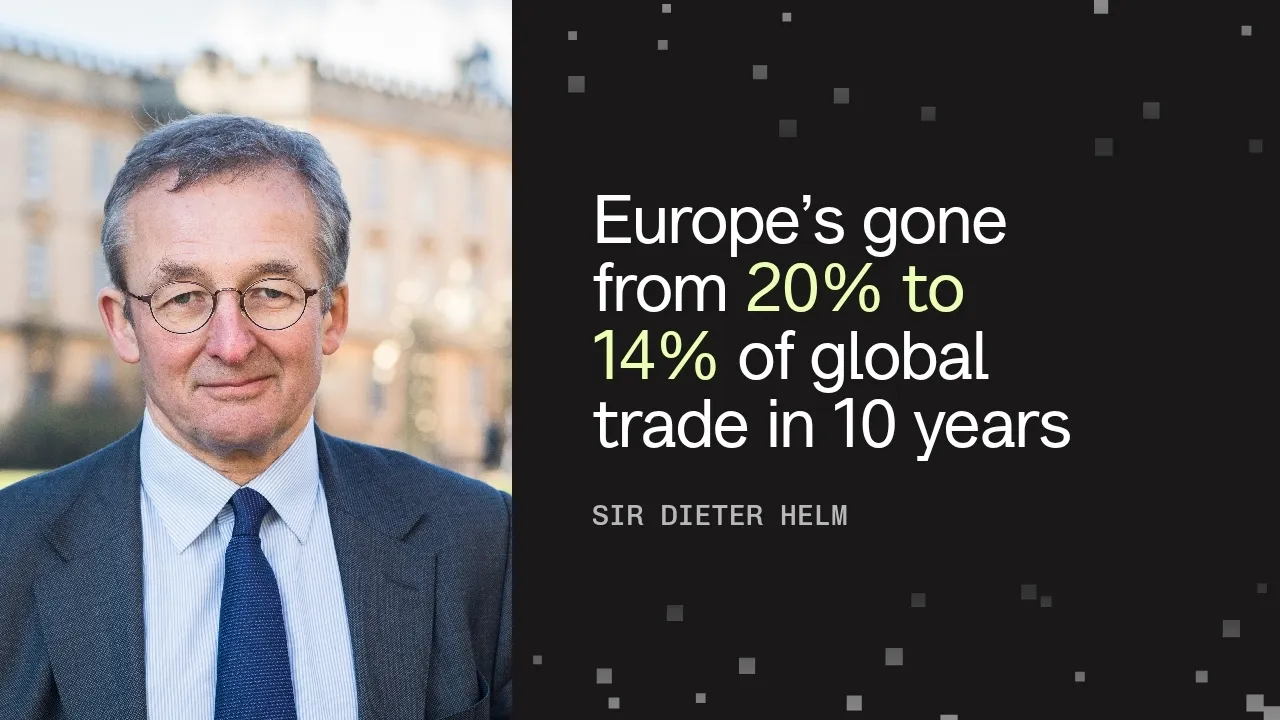
Well, could we we chase ourselves down to the domestic price of gas in the United States? The answer is no. OK. But there’s a world difference between being in a moderate band and adding value in different ways and being four times more expensive. Right. So, you know, to put it on a European scale, because I mean, the UK is a is a special case in a way, but Germany is nearly as bad in terms of costs. Right. They made a bet on gas from Russia as well as renewables and actually closed their nuclear power stations, apparently in some green ambition, which I’ve yet to discover what the rationale for that is. But if you look across Europe, you know, I used to say at conferences and so on over the last five or 10 years to the audience, you say, can you name me a single energy intensive investment taking place in Europe at the moment? And I always expected, you know, hands to go up, because, you know, it was a sort of one of those fractious questions, because you know that there must be some. But the remarkable thing is, there really isn’t much. And, you know, in the DRAHI report, which was produced a year or so ago, looking at the competitors of Europe, you know, it really is quite grim. And the growth rates reflect that, you know, our growth rates not in Britain, in Germany, it’s in recession. There’s been no real recovery actually since the financial crisis of 2007-2008. And you see this in the share of Europe in the world economy. In trade, we’ve gone from 20 % to 14 % in 10 years. These are really fast. And when you care about climate change, you sort of very well get terribly excited about whether the emissions in Britain have gone down a bit and been replaced by imported emissions a bit. But climate change is not going to be determined in Britain. or in Europe, you make a marginal difference. The places where climate change can be determined to the United States, China, India, Indonesia, Nigeria, Latin America. These are the places where the future of our climate lies. And so I say occasionally, and I must upset people, but I say, you know, if you had, you know, X billion to spend on climate policy, what you want to do is spend that where you get the maximum value for your money, the maximum bucks in reduced emissions, because it doesn’t matter where the emissions take place. Climate change is just global. And so if we concentrated on helping some of these developing countries not go through the scale of coal burn that China and India are engaged in, we might have a hope. And if we spent the money trying to stop the sequestration of the Amazon being destroyed in the Congo, These really would matter and compared with, you know, whether or not we use a heat pump versus a gas boiler in our homes, these are on a completely different scale. And that’s what we’d have to do if we were really going to address climate change. And that’s not what we’re doing. In fact, almost all of Europe is cutting their aid in climate change terms to developing countries.
Seb (24:16)
So I guess to summarize, we’ve got uncompetitive industrial energy prices, part of that is because we’re bearing the cost of this sort of intermittent system. And, the argument of this a cost we should just bear for the sake of the climate? A, you can argue against it from, I suppose, an economic point of view and sort of say, well, if the economy is in decline, that causes all sorts of other problems. B, to your point, you could say, well, in a sense, on a global scale, doesn’t really matter what we’re doing. because this is a global problem and we’re a tiny fraction of the emissions to begin with.
Dieter Helm (25:04)
So I certainly don’t want to suggest we shouldn’t be doing stuff about it here in the UK. I’m just saying when we think about making our contribution to this, and after we put a lot of carbon up in the atmosphere during the Industrial Revolution, so we have a legacy we should think about spending our money in a way that’s actually going to make a difference. So let me just cut into two other dimensions of this. First of all, just because you reduce emissions in the UK, does not mean that you’re reducing climate change. So if I close down my steel industry because my energy prices are much higher and I import the steel from, say, China, since China burns more than half the world’s total coal, you can reflect on that, half the total, it’s like 55 % of all the coal in the world is burned in China. And that coal is burnt to produce that steel. And then it’s shipped all the way back to here. and brought into the country. Have we increased or decreased our emissions? Our consumption, which is what matters, not where things are produced, but how much we are responsible for in our consumption, is soaked in fossil fuels. And some of the things we’re doing may even have perverse consequences. Remember, 85 % of the world’s energy still comes from oil, gas and coal. And in Europe, Britain is about 75 % because we have closed the coal industry. By the side, that was a very good thing to do. at least three quarters of almost any country’s energy is still oil, gas and coal 40 years after we started on this process to try to reduce emissions. These are stunning numbers.
Seb (26:49)
Which is a statistic. Yeah, it is a statistic that is quite shocking to hear, because I have heard you mention that statistic before, but I remember hearing it for the first time, and it was definitely not what I would have guessed that number as being.
Dieter Helm (27:07)
And just let me put it in context. Supposing we decarbonize territorial electricity production in Britain, that’s 20 % of our energy. There’s
Seb (27:17)
Hmm.
Dieter Helm (27:17)
still the other 80 % of our energy to go. So you really have to recognize that if we think we’re on the route to cracking climate change by 2050, even if we achieve, which would be a fantastic thing to decarbonize electricity and still provide the firm power, et cetera, We still have a hell of a long way to go, which means that, you know, I probably won’t be around, but for those people who are going to be around in the second half of this century, my children, my grandchildren, this is going to be hot. And you’re not going to avoid the two degrees at least of climate change, even if you persist with the current policies and think they’re going to solve the problem. Just the order of magnitude, you know, and India’s coal burn is stunning. And then you add Indonesia to this. Nigeria will have a population bigger than Europe as a whole by 250, 500 million. And you’ve got to think where all that energy is coming from. This is where the future of our planet is going to get determined. And that’s why, yes, we should make our contribution, but we should work out to make sure it has the maximum effect on climate change, not just so that we can strut around the world and say, we great guys in the UK because we’ve reduced our territorial carbon emissions.
The battery problem
Seb (28:40)
Mm hmm. Just one thing, and I comment this is a, you know, say not not with a great deal of knowledge about the energy market. So a couple of potentially quite stupid questions here. the first of which relates to batteries, you know, when you have intermittent sources of power, I guess the kind of logical like layman’s conclusion is Okay, we’ll build storage. So when the energy is abundant, you store it up and then when it’s more limited, you utilize it. what stands in the way of that very simplified layman’s view of storage?
Dieter Helm (29:16)
Okay, so there are two or three things to this. First of all, it’s a cost you wouldn’t have in a conventional system. Right? So if you’re the US, you don’t need many batteries. Okay, so it’s a cost you’ve got to bear. The second thing is the batteries are very good for short term storage. where we are in Northern Europe, right? It’s very dark in winter. It’s pretty cold. And we have these dunkelflauts, which come across from Germany from the continent of high pressure, cloudy, dark, cold skies and still. Okay, so you might have two weeks without much wind. There’s no battery in the planet that does that. Now we may eventually get there, but at very considerable cost. That’s the first point. The second point, which goes to your point about sovereignty. These batteries have two characteristics. First of all, they’re all imported and mostly from China. So there’s no security of supply. This isn’t sovereign stuff. By the way, the solar panels are imported from China and the wind turbines are imported from various places, but including China. But the batteries… China has about 80 % of the battery market globally, Now, next thing to say is a battery and indeed of solar panel and bits of the wind turbine, but particularly battery are really dirty things. I drive my EV around and I feel very virtuous for doing so and there are all sorts of advantages for doing so. But you know the coal bolt came from that mine in the Congo on cleared rainforests. You can see I think the child labour from space in those mines. The nickel comes from the nickel mines of Indonesia. Cleared rainforests, peatlands, etc. and incredibly dirty refining. OK, the lithium? Well, have you seen how lithium is produced? And then look at the copper mines. Now, these are massively carbon intensive activities and they involve an enormous amount of damage to the sequestration that rainforests, etc. produce. There’s water pollution as well. And then they have to be fabricated. That’s energy intensive refining isn’t done with renewable electricity very much. So when you see all the huge holes that you see in these pictures from space and you see the massive equipment and then you look at the refineries producing this stuff and then you say, I’m green, I’m zero emissions. It says all over my vehicle, it’s zero emissions. Well, the only thing that’s zero is when it’s actually being driven, the emissions are zero. But there is no such thing as clean energy. There’s cleaner energy and dirtier energy. Batteries
Seb (32:03)
Yeah.
Dieter Helm (32:06)
are not and unlikely ever in the foreseeable future to be clean. And they are not homemade, as our ministers like to say our energy policy reflects. On the contrary, they are imported.
Tidal, hydro and other alternatives
Seb (32:19)
Mm-hmm. So to come onto my second potentially stupid question, we’ve talked a bit in terms of intermittent sources about solar and about wind. The other potential source of energy that strikes me, I grew up in Devon on the coast and big tides every day, obviously tide coming in and going out. so… just as one example, I’m trying to sort of cast the net a bit wider than than say, solar and wind. Are there these other sources like Tidal, for example, that could be more readily exploited that are less intermittent, that could be part of, the overall picture here to building a better energy network?
Dieter Helm (33:12)
So globally, hydro is the big one. And there are dams being built in Tibet now of stunning capacity. And most of the great rivers, the Amazon, the Congo, et cetera, especially the Mekong, have been heavily dammed. The environmental consequences are typically awful. But that said, you can produce by the vertical effect of water. a lot of energy and China’s gone for that really hard. That’s much more important than the moment than solar and wind. So you could do hydro. Tidal. So you have to ask yourself, why have so few people done it? Why is it so insignificant? And the answer is, it’s typically very expensive. So just because an energy source exists, it’s like geothermal exists, right? There’s tons of energy and heat beneath your feet, That’s what a ground source heat pump is, but there’s loads below your feet. But, you know, just because it’s there and just because it’s potentially, scientifically perfectly possible to turn this stuff into power doesn’t mean it’s sensible or economic to do so. And these are the sorts of things that make even nuclear power look cheap.
Energy, sovereignty and geopolitics
Seb (34:32)
Yeah. If we look ahead at the future, I’m interested in this topic of sovereignty, which is a discussion that has come up more and more, you know, technological context, like what does it mean to build sovereign AI, you know, when all of these Big frontier models are being built mostly out of the US and increasingly out of China. Trump, on more than one occasion now, makes a sudden decision that no non-US national, I think, can use a particular model, which included people who were non-US nationals working in the very companies building that model. And you end up with sort of technology, geopolitics, the economics of energy, all sort of collide in this interesting, interesting space and topic. So I suppose what would a more sovereign energy future potentially look like for the UK?
Dieter Helm (35:29)
Okay, so I think to answer that question you have to make a step backwards. There are three variables which determine whether a country can compete. The cost of labour. adjusted for its productivity, the cost of capital, borrowing costs, and the cost of energy. Of those, I hold the view that if Karl Marx had talked about the energy theory of value rather than the labor theory of value, he’d have been closer to the mark, because labor is just a form of energy. And the future is not going to be one where we’re going to all… reduce our demand for energy and our footprint, etc. Demand for energy probably double by 2050. It’s a huge wave of energy demand coming. And that’s what underpins how our world is going to evolve over the next 25 years or so into the future. And like it or not, I see no prospect that we’re going to burn less oil in 2050 than we do today. I think we’ll burn more gas and we may burn a little less coal, but we’ll still be burning a lot. I think that’s the reality. That’s what I call realism. And given that realism, you then think through, so what does sovereignty mean in that world? Now, over the sort of golden 30 years from 1990 to 2020, after the collapse of the Berlin Wall, the peace dividend, defense spending coming down, China coming in with cheap goods into the world markets, inflation low. and real interest rates almost negative. So you could just borrow anything and it wouldn’t really cost you very much. That’s all over now. From 220, we’ve started back in what I regard as a normal world. And I think that’s how historians will see it. Now in our normal world going forward, the idea of the liberal trade model in which nationalism wouldn’t matter, national identity wouldn’t matter because we’ll all be part of the global community. We’d all trade with each other and it wouldn’t matter whether the goods are Chinese or Afro- South African or come from Iceland or wherever, each are all part of the global community. That’s all over. Maybe a pity, but it’s true. And we have a world now where we’ve moved from a dominant position of the US to one where it’s China and the US. And those two states determined very much what’s going forward. China is very much made in China. It’s like Trump on stilts. It’s the Han Chinese. They’ve crushed the Tibetans. They’ve crushed the Uyghurs. They want to have Taiwan back. They’ve got Hong Kong back. It’s a perfectly coherent nationalist agenda. America has been for a long time in the liberal camp, but Trump’s may make America great again. I Biden didn’t change much of Trump’s policies on trade, et cetera, in the first period. In fact, he increased some of the tariffs and engaged in the kind of subsidy game that the Chinese were engaged in. That’s the world we’re in. Now in that world, you then got to think, what does it mean to be a middle-sized country like the UK that’s managed 100 years of decline from running 25 % of the world? And the psychology is all about solvent, et cetera. We’re going to have cheap energy, which is homegrown and secure. Really? So we’re going to decide to not produce oil and gas from our North Sea resources. British North Sea resources, but it’s fine to import them from Norwegian North Sea sources or to import imported LNG. This is nonsense, right? It’s fine to have a very pro-territorial carbon production climate change policy because your industry is declining anyway. But now you come to the reality. What is Europe going to do? What is the UK going to do faced with where we are with China? and with the US and the big emerging economies like India. And what we’ve seen is now an accelerating decline of our share of the world economy and world trade. And I don’t go this far, but there are people in Europe who joke between the question of whether Europe is becoming a museum or a mausoleum. And Germany, it’s really existential because the car industry faces being wiped out by the Chinese. and it’s lost its gas from Russia. Now in those circumstances, you really have to think through what you’re going to do to sustain the standard of living of your populations or tell the truth to your populations. You know, if you want to do all the things you’re doing at the moment and you aren’t competitive in the world economy, well, you’ll just have to lower your standard of living. And that’s not what anyone’s voting for. In fact, across Europe, you’ve got the far right emerging all over the place. And that’s it. you know, the kind of thing that happened once before in history in Europe. And that’s really dangerous. And so what I say is, look, let’s be realistic. Let’s work out what the cost of energy has to be for us to participate actively in the world economy, not as low as the United States, but part and parcel of that. And also, frankly, let’s decide who our friends are in this world, because sitting on the fence is not that easy. everyone I know lambast Trump. and America, and European opinion polls show that Europeans widely trust the Chinese more than they trust the Americans. Just look at the facts. We squeezed Russia right out of it for good reason, because of this horrible war in Ukraine, How has Europe managed to survive without Russian gas? Well, on US LNG gas. We’ve been in a terrible state without the United States exporting LNG to us. OK. And we happily want to say, carry on defending us, America. You look after us. You look after Ukraine. Right. And Obama tried this. Biden tried this. Trump tried. George W. Bush tried this. Could you just spend 2 % of your GDP on defense? Remember when the Wall fell, we in Britain were spending between 4 5 % of GDP on defense. No. We want to spend it on social security instead. Now in those circumstances, the reality doesn’t go away because you don’t like it.
Seb (41:53)
Cool.
Dieter Helm (41:53)
And that’s our new world in which we have to think about what qualified sovereignty is about. We in Britain decided we don’t want to share our sovereignty with the Europeans. We did Brexit. It was extraordinary. We did Brexit. We left our own, if you like, security pen. And now we’re on our own. And now we say, You know, we don’t want produce our own gas, but import it’s fine. We want to pretend this stuff’s homegrown, isn’t. And we still think that we should pursue a policy which is having no effect on global warming and producing amongst the highest electricity price in the world. How’s that environmentally a good thing to do? I don’t
Seb (42:36)
Mm.
Dieter Helm (42:36)
get it, but I’m in a very small minority because most people think that one more heave of the current policies going to produce this nirvana of cheap energy which is homegrown and secure. I doubt it very much.
The politics of climate policy
Seb (42:50)
Yeah, I guess, sadly, like a lot of things, it seems to have been very politically coded, on the whole, you know, anti climate sentiment, pro fossil fuel kind of sentiment seems to live, often on the kind of the right and the far right of politics and and the inverse, you know, often on the left. And, I guess the conversation we’re having here, is a bit more of a centrist conversation in which you you acknowledge the realities of what is going on, but then talk through, how do we actually solve a problem as opposed to, I suppose, how do we have policies which maybe are some sort of theatre that allows us to pat ourselves on the back and say, well, aren’t we doing our bit? But over the course of time, it may not make a massive difference.
Dieter Helm (43:40)
Right, but let’s be a little bit more sophisticated in unpacking this. Okay, so first of all, it’s not true, it’s just the far right. The far left is in this position too, and trade unions are in this position too. So if you look at the most vociferous supporters of North Sea Oil and Gas in the UK sector, it’s the trade unions. And the left of the conventional old fashioned left has never been in this box that the Greens have put us into. And similarly in Europe, it’s the emergence of the Greens in a proportional representation system in Germany, which led to both the two major parties, to tag towards embracing the nuclear framework. And it was Merkel who endorsed the phasing out of nuclear power. Now, you know, the left is in favor the old left is in favor of nuclear power. It was in favor of coal. It was the defender of the coal industry. And it is in favor of offshore oil and gas. And it’s definitely in favor of nuclear power. So you have to be a bit nuanced here. It’s easy to say
Seb (44:48)
and
Dieter Helm (44:50)
that there are these nutters on the right who are climate deniers, et cetera. There are some of them.
Seb (44:55)
Mm.
Dieter Helm (44:56)
And they are rampant in some European countries because the consumers have been told for so long that their electricity is going to go down in price and it’s very, very expensive. So they’re feeling the pain and what all the opinion polls tell you is that people are really pro dealing with climate change, except if it costs them a pound. Right? And that’s the distinction. And I think that’s where you have the unraveling. Now, the sensible thing to do is not to tear it all up and start again. we have the wind we’ve got, we’ve got the solar we have, it is to put the hand on the tiller and think how to carry this through and carry it through politically. And in that frame, ask yourself where the baseload 24-7 power is coming from in the future, as people in the United States are. And the short-term answer is gas and coal in the United States. But the medium to long-term answer is SMRs and nuclear. nobody in the world has tried to put all their eggs in a basket labeled wind and solar with a little bit of gas. It’s a huge experiment.
Seb (46:03)
Mm-hmm.
Dieter Helm (46:04)
And I think so far, it’s an experiment that’s been found wanting.
Britain’s future energy mix
Seb (46:09)
I appreciate we don’t have a crystal ball and not all the answers are necessarily apparent. imagine the UK somehow course corrects itself In future, what would you expect the kind of mix to be what kind of balance would you expect to see across these different types of technologies we’ve been talking about?
Dieter Helm (46:31)
Well, I think you have to contextualize this by recognizing A, we’re a very low growth economy. And secondly, we have a very, very frightening fiscal outlook. It’s not that our debt GDP ratio is higher than others. It is instability and the rapidly rising social security budget and the health budget plus the defense budget plus the unwillingness for people to adjust to that plus the lack of participation in the labour market plus plus plus. We’re actually in a very very crisis pregnant world and therefore there isn’t much room for manoeuvre. We have the highest share of the economy going in taxation since the Second World War. mean there’s not much room, not much parameters for movement here and a government where you know whatever you think the next election is going to produce it’s very unlikely to produce the scale of the majority for 33 % of the vote that Labour got last time. That leaves about 200 Labour MPs without a job in 30 months’ time. They’re never going to vote for cutting welfare payments. You know, that would be against nature for them, right? So
Seb (47:41)
Mm-hmm.
Dieter Helm (47:42)
we are really caught in a frame. So the first thing to do is to accept that we’re not going to hit the 230 target. Personally, I don’t think it matters very much. But of course, if you go flat out to hit a target, you make it the most expensive you can. So for example, if you want to double the grid in a short period of time, you’ve to buy loads of transformers. Well, we don’t make any, so you’ve got to import them. So you go to a transformer producer, say, went to whatever, Germany or US or something, say, can I have a transformer? Well, yeah, four years time, you’ve got an order book. And you say, no, no, I’ve got to it tomorrow morning because you don’t understand I’ve got to this 230 target, it’s 30 months away or whatever, right? So how do you do it? Well, if you pay top price and buy everyone out the supply chain, you’ll get it. And if you try to do this and you try to squeeze labor into doing the technical side of this really quickly, you haven’t built up the workforce, etc. It just turns out to be very expensive and difficult and it won’t be achieved. So the obvious thing to do is take the foot slightly off the accelerator. So we had a perfectly sensible 235 target for net zero electricity, which was a shared political consensus in the past. It’s still been an achievement to do it by 235. But the difference to the climate of the world make no difference in that frame. And it will make a hell of a lot of difference to the cost. Second thing is, think further out. Okay, we don’t know what the futures can look like. I can make a guess. I think the gas and oil price will go down like that. think we’re going to have massive surpluses on both sides and very cheap fossil fuels can make our problem even more difficult than it was before. But if we’re going to have our energy system in the future, you’ve got to have quite a few eggs in the basket. And we have got wind and solar. and we’re to have a bit of residual gas. And although we are building a couple of nukes at the moment, at 16 billion per gigawatt, they’re about the most expensive nuclear power stations in the world. can wake this stuff up, right? So it looks like the frame we were doing for power generation will have more small modular reactors gradually towards the end of the next decade. I think we will have to have more gas than we’re projecting forward. And I think we’ve got enough wind and solar now. to bed down into the system. And on the more gas side, whenever I say to people, you’re in favour of fossil fuels. No, no, no, I’m in favour of stable system. And by the way, the gas is going to get built. It’s going to be built by the data centres. Almost all of them are looking at building their own gas stations, their own backup power. You’ll have lots and lots of critical installations across Britain not willing to face the intermittency of the system we’re creating. nobody’s building standby generation of wind turbines and solar panels. They’re building diesel, the filthy stuff of the lot. and gas. And it would be better if the system did this, because you would have greater efficiencies, you’d have be able have greater environmental controls, etc. So I think it’s going to be a more pluralistic system. And I think that anyway, we’re going to slow down a bit. I think we should try and absorb the sheer scale of wind we’ve got without committing to more yet. And I think similarly on the solar front. And that leaves us in this position since we signed all these contracts for wind until 240 and beyond, where we are going to have very high costs for at least 15 years to come. That is a really quite economically worrying prospect. If you take my view that it’s the energy theory of value that really matters and it’s cheap energy, which will determine who wins the global competitions. And my money’s on India, China and the United States in that frame. and the Americas, Latin American triangle, etc. It’s not in Europe, it’s not in Germany, and it’s certainly not in the UK.
Data centers, AI and water
Seb (51:47)
A couple of things we’ve touched on. So data centers is obviously a very hot topic in the world right now. in the US, the, mag seven firms across them are spending something like $700 billion, you know, more than the GDP of Switzerland or Sweden in a year to basically build out data centers and fill them with ships. The UK has, by comparison, a tiny, tiny fraction of of compute capacity. And there are plenty of public discussions about that and certain projects promising to build infrastructure. And there’s obviously a lot of political backlash around it. You these things come, they… They have their own impacts. There’s debates about how much water they use. There’s the energy requirements. There’s sound pollution, et cetera, et cetera. So I’m interested as an energy economist, A, how much do you know about the, you know, what is fact versus what is fiction around data centers themselves And I guess in light of that, if you were making a policy about how we should be thinking about, data centers for the UK, what would you be proposing we do there?
Dieter Helm (53:08)
Okay, so context, it’s not just data centers and AI, it’s the fact that in any event, much of the economy is going to digitalize. So electricity may only be 20 % of the economy at the moment. But as we go forward, it will be the age of electricity is a question about whether it’s made from gas and coal in the United States or whether it’s made from wind and solar and nuclear elsewhere. so and that digitalization is 24-7 demand. It needs large, substantive, firm power, always on power stations and the grid to sort that out. And the infrastructure and the investments to service that economy, which is the future economy, is quite different from the infrastructure we’ve been constructing for the last 10 or 20 or 30 years. So that’s the first thing to say. Now within that framework, the data centers themselves are coming thick and fast. and around London and SLOW, which is the really big location for data centers going forward. And because they’re coming so fast and because anything new politicians decide they want to be the world leader in it. So we’re not only going to be the world leader in clean energy, to the extent it’s clean, we’re also going to be the world leader in AI. And it’s not thought through. I mean, what we might be a world leader in is in the intellectual content that goes into it. My university, Cambridge in London, and Imperial, that’s basically where the intellectual firepower is. And we’re really good at it. And everyone accepts that. We’re also very good on the creative side. That’s our comparative advantage. Are we going to need large scale data centers to do this? Yeah. How the hell are we going to do it otherwise? Because you’re going to need the AI to apply to do all this stuff, or pharmaceutical research, all that kind of thing, as well as power, the economy generally. So then the question becomes not, you going to have data centers? That will be like asking in the end of the 19th century, are you going to have steelworks? Right? It’s just, you might have a sort of philosophical utopia in which we all live on the land and go back to nature, but the reality is, we are going to have data centers. So the practical question for me is, how are you going to do that in the most environmentally benign way and in the most socially acceptable way and with the best payoffs to the economy more generally? So the environmental issues are twofold. One is that because of the way we designed our system, these are going to need a lot of fossil fuel power. That’s the backup gas, the backup, well it won’t be. but back up gas, back up diesel, etc. in place. Let’s try and reduce the incentive to have self-generation by being honest about what the system as a whole will require. That’ll be less polluting. Now, very water intensive, very water intensive and sitting in the middle of the South of England in a huge drought on the fourth heat wave you’ve got actually places like Tunbridge Wells, which ran out of water. This is really serious, okay. So you need to manage that. And there are answers to that question. First of all, there’s no shortage of water in the UK, it rains a hell of a lot over the year. It’s about storage and about leakage of pipes and so on. You have to up the game with your water industry. But you also have to think about how the water is used. There’s a world of difference between pumping the stuff out of the river, cooling down your plant and sticking it back in the river or putting it up a steam and a world in which you have a self-contained recycled water unit. For example, shouldn’t the data center be built on an enormous tank in the ground, which is its water supply? Some hotels are in the southwest of Britain, for example. It’s not rocket science to do this stuff. But what you don’t want to do is have a wild west and then think, we’ve got all these problems now, how are we going to deal with them? You need to think in advance. First, firm power. How are you going to provide that? And secondly, water. How are you going to do that? And then thirdly, how are you going to relate this to greenbelt land, nature, and integrating with communities, etc. And I don’t think it’s rocket science to solve those problems. By fear, it’ll just be the Wild West because politicians are so desperate to claim they’re the world leading, you know, AI superpower. and the regulation come later rather than before. Think it through. It’s not rocket science as they say.
Innovation, fusion and what comes next
Seb (57:54)
Yeah. Yeah. There are those who I suppose would make the argument that we already have the technologies we need to produce the energy that we need and same time, as you’ve pointed out, none of our energy today is particularly clean necessarily, even the renewable stuff. So I’m interested if we’re thinking about technological innovation and advancement, is there one particular area that you think technological innovation would have the biggest impact? You I’m thinking about things like, nuclear fusion for example, But yeah, if we’re looking ahead and sort of thinking like, where is the innovation coming down the track in relation to energy? there any signs of promise or horses you’d be backing there for? future technologies.
Dieter Helm (58:48)
Okay, so I have two broad answers and then a more precise one. The first broad answer is I don’t know. And that’s a serious point. People who claim they know what the energy system in 250 is going to look like, right, they’re just nuts. And they do real damage because they plan the world as if they know what the future technologies are. The second general point is technology isn’t the solution independent of cost. So I’m an economist. I think that we should have a proper carbon tax and we should pay the costs of carbon. And that would incentivize people to really specialize in those areas which actually effectively reduce carbon. Now, if you then narrow that down more precisely, okay, in the period the next 10, 20 years ahead of us, there’s unlikely to be a complete breakthrough, right? But what there might be is incremental improvements to what we’ve got. And that lies in a number of areas which are very well worth exploring. Carbon capture and storage is, in my mind, very important. Hydrogen is very important. SMRs are part of that frame. And also actually just cabling. When I was very much younger, we were all going to have superconductivity and it was all going to be straightforward and we planned our world around superconductivity. never happened. You when I started doing my doctoral thesis, I had an Olympus portable typewriter with Tipex and carbon paper. There were no fax machines, although my students wouldn’t know what a fax machine is. No mobile phone, no internet, no word processing, no AI, none of that stuff. And I didn’t know that in my lifetime, these would become ubiquitous and determine the future. So I want to spend a lot of resources on R &D. I want to spend a lot of resources on technological development, but not assuming I know winners. In general, losers pick governments, Winners pick markets. And that’s not ubiquitous. But in general, that’s a pretty good rule. If you’re crowding around government for subsidies, you’re probably not going to make it. the magnificent seven or whatever they’re called in the United States, however much the markets may crash or whatever. They are the product, not of government. They are the product of the most amazing innovation Only when I was doing my doctorate, think only Microsoft and I think Apple started up existed.
Seb (1:01:26)
Mm. Mm.
Dieter Helm (1:01:28)
So, you know, the possibilities are enormous. This is a solvable problem. But if you carry on with an absolute certainty, you know what the answers are. and you pursue this policy independent of the cost of the system, it’s going to end up badly. And unfortunately, we’re heading for two degrees. It’s not going well.
Seb (1:01:46)
Yeah. I know you’ve got a book, Climate Realism, which is coming out later this year, covering some of the things we’ve been talking about and much more. Is there anything you want to share about your book before we finish up?
Dieter Helm (1:02:00)
Well, I suspect it’ll be controversial, but I think I’ve tried to set out a position which is capturing the title. It’s what happens if we’re realistic about the world we live in as opposed to idealistic. And realism is what drives our world. And I’ve spelt out just how tough the problems are and just why one more heave won’t get us there. But in a context in which Perfectly solvable problem.


