/
/
57 min
The AI Bubble
Paul Kedrosky
Investor · Researcher · MIT Fellow
About this episode
I sat down with Paul Kedrosky - investor, researcher and one of the smartest voices out there on the economics of AI and the risks of a bubble.
Here are a few of the questions we talked about:
What is a bubble?
Is AI a bubble?
How does it compare to past bubbles?
What would cause the bubble to burst?
Why should the average person care?
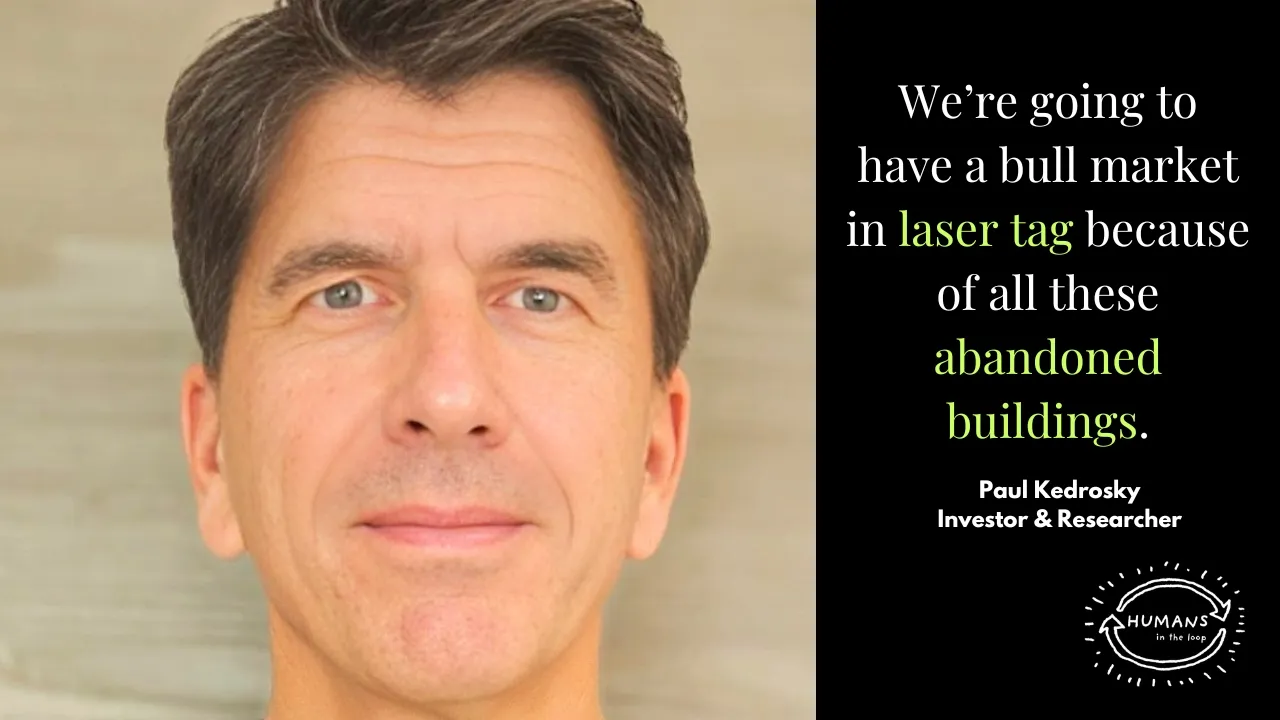
Will we see a bull market in laser tag in all the abandoned data centres?
What needs to be true for AI to NOT be a bubble?
More info about Paul
Paul Kedrosky is an investor, writer, and researcher. He has been a regular on-air contributor at CNBC and Bloomberg, and has written for the New York Times, the Wall Street Journal, and publications around the world.
Paul started as an engineer, became a quota-carrying salesperson, then a technology equity analyst on Wall Street, and eventually a venture capitalist. He has started companies, held academic positions in the U.S. and Canada, has a popular newsletter, and is a research fellow at MIT’s Institute for the Digital Economy. His Ph. D. research focused on risk, adoption, and path dependence in finance and technology.
Full transcript
Humans in the Loop
Paul Kedrosky (00:00)
right. I joke we’re gonna like a bull market in laser tag ‘cause we’ll have all these abandoned buildings,
Seb (00:04)
by all measures we’re talking a shit ton of money here, basically.
Paul Kedrosky (00:06)
We are to All we know about the history of finance is when you have what’s called a duration mismatch like that, it breaks and it breaks catastrophically.
Seb (00:14)
what would you need to believe to be true in order for AI to not be a bubble?
Paul Kedrosky (00:21)
That for the first time in history, people are making rational decisions in anticipation of cash flows that they can’t possibly forecast.
Welcome & is AI a bubble?
Seb (00:39)
Welcome back to Humans in the Loop. Today we’re going to be talking about the economics of AI, and I’m joined by Paul Kodroski. Paul is an investor, writer, and research fellow at MIT’s Institute for the Digital Economy. Paul, welcome to Shack.
Paul Kedrosky (00:56)
Hey, thanks for having me.
Seb (00:57)
Let’s start with a question that at this stage you might be bored of being asked which is we we’re gonna use the B word bubble. is
Paul Kedrosky (01:09)
Uh-huh.
Seb (01:10)
is is is AI a bubble?
Paul Kedrosky (01:12)
Yeah, well, of course. But I mean, that’s not the saying that is saying something really obvious and kind of boring. because if it wasn’t, it would be the first CapEx build out in terms of infrastructure of its kind in 200 years that wasn’t. but that doesn’t tell you very much in terms of the implications, and it doesn’t tell you very much in terms of whether or not AI is useful. But AI itself is unquestionably. a bubble only because it’s almost impossible for it not to be given it’s at the intersection of all the things that have made the biggest bubbles, certainly in US history. And at the same time, you know, the level of spending is is now dwarfing any sort of prior comparable. So but yeah, it’s a bubble, but there’s other there’s other more interesting questions, I suppose, like, you know, does that mean it’s not useful? And the answer is of course not.
Putting the spending in perspective
Seb (02:01)
Yeah. Yeah. I guess just to put the spending here into a bit of perspective.
Paul Kedrosky (02:05)
Yeah yeah.
Seb (02:06)
you know, in in twenty twenty six, Google’s parent company Alphabet, Meta, Amazon, and Microsoft combined are expected to spend in the region of seven hundred billion dollars basically on building data centers and and equipping them. that exceeds the annual GDP of a country like Sweden or Switzerland. and I
Paul Kedrosky (02:23)
Yeah. Yep.
Seb (02:25)
f I feel like people are myself included, bad at picturing what big numbers really mean. So if we put this in like a
Paul Kedrosky (02:32)
Yeah.
Seb (02:32)
time perspective, you know, if you took a million seconds ago, you’re talking 11 days ago. If you’re talking a billion seconds ago, we would take us back to 1995. And if we’re talking 700 billion seconds ago, that would take us back to the Ice Age, 20,000 BC. So in terms of like
Paul Kedrosky (02:49)
Yeah.
Seb (02:50)
just so we can wrap our heads around like the orders of magnitude here, that’s that’s what we’re
Paul Kedrosky (02:52)
No, the numbers, the numbers are insane. And and and that’s part of what got me initially, you know, interested in what was going on, because I realized back almost 18 months ago that US spending on data centers was roughly starting to solve a puzzle. And the puzzle was why is it that the US is is still growing, the GDP is growing relatively quickly and yet it’s not producing a lot of jobs? And when you got under the hood, you realized I realized fairly quickly that Depending on the quarter over the last 18 months, somewhere between 30% and 70% of US GDP growth on a quarterly basis on in every quarter since then been data center spending. And so once you realize that it is so large, and it’s not that you know it’s GDP growth is like $2 and this is one dollar, it’s these we’re talking in the trillions of dollars in terms of GDP. and then if you break it down from GDP to GDP growth. So when you see that, let’s say, for example, the US growed two and a half grew two and a half percent and half of that was data center spending, that’s a remarkable statistic at this scale. So to put it in another context. And so that’s been the case now for 18 months. It even kept the US out of recession, which is bananas, in the first quarter of 2025. It’s the largest sort of, if you want to think of it in another way, the largest private sector stimulus program in US economic history. Granted, we haven’t had a large private sector stimulus program before, but we just have one, meaning that it’s not government doing the spending, it’s the private sector. We’ve now exceeded the non-residential fixed investment associated almost all prior, no, actually we are now all prior economic build-outs, including telecommunications and the fiber build out. We’ve now exceeded rural electrification. We’ve now exceeded the interstate highway build-out as a as a function of straight up spending as well as a percentage of the economy and as well as railroads. As well as canals. So you pick your episode in the last 200 years in terms of spending, in terms of building out an infrastructure based on capital expenditure. We’ve beat them all. The only one we haven’t beat, and unfortunately, I used this analogy recently when I was talking to some Germans, was rearmament for World War Two. we actually spent considerably more at that time, but and it did actually turn into a kind of private sector stimulus program. A lot of a lot of economists believe that it was probably one of the fundamental factors. That took the US out of the Great Depression was spending to rearm for World War Two, but it’s not a great anecdote to use in mixed German company. So
Seb (05:18)
Yeah, yeah, I I I I bet that one went down in w w went down well. so I mean we’re we’re talking
Paul Kedrosky (05:22)
Yeah. So that’s context.
Seb (05:24)
yeah, so I mean by all measures we’re talking a shit ton of money here, basically.
Paul Kedrosky (05:29)
We are to
Seb (05:30)
And
Paul Kedrosky (05:29)
use the technical term, yes.
Seb (05:31)
exactly. and let’s go
Paul Kedrosky (05:35)
And there’s cra and there’s crazier statistics, just to give two more real quick, just because I think it it
Seb (05:38)
Yeah.
Paul Kedrosky (05:38)
helps to understand this. For example, data center, hyperscaler spending in terms of lending is now increasingly being driven by lending. They’re borrowing the money, they’re not just spending out of cash flows. And so one of the other things that I think is really important to keep in mind is the borrowing is now so large that if you think about the debt markets, debt markets loosely can be characterized as sort of investment grade and non-investment. junk, sometimes we call it high yield, is that the more polite way. the the hyperscaler borrowing now exceeds the borrowing of the six large banks in the US. So they are now the largest segment of the investment grade borrowing market in the United States, which is just well obviously unprecedented, because you know, one of the things that historically made tech unusual wasn’t just growth. It was that growth without debt. This was a relatively low debt business. And And a high cash flow. And so the notion that this episode has driven tech companies to become the largest investment grade borrowers in the US bond market is is really startling and should make people sit up and pay attention.
Seb (06:44)
you said yourself the the question at this point of whether or not it’s a bubble is not the most interesting dynamic here. and we’ll we’ll kind of double click into some of these areas. I I guess to start
Paul Kedrosky (06:53)
Yeah.
Seb (06:54)
with, like you know, if if if we’re talking about bubbles in general, I I guess it’s worth saying at this point, as we’ve just pointed out, pretty much the whole Not just US, but kind of global economy at this point is like a big bet on AI. So people get very, very
Paul Kedrosky (07:09)
Yeah.
Seb (07:10)
very, very angry sometimes when you start using words like bubble. what we’re not necessarily commenting on in using the word bubble is saying, well, this technology is crap, you know, right? It’s it’s sort
Paul Kedrosky (07:22)
Right.
Seb (07:23)
of pointing to the underlying business model and like scale out that is that is going on here. but if if we’re looking
Paul Kedrosky (07:29)
And the and the likelihood of and and just to be clear, the likelihood of stranded assets afterwards, which is the the term of you know, the the econom the economic term of art for overbuilding, right? So the likelihood of overbuilding is very high. Consumers don’t necessarily need to worry their pretty little heads about that, but from a financial standpoint, it has huge implications. And that’s the aspect of the bubble that’s interesting. But that that has no bearing necessarily on whether AI is useful.
What defines a bubble? Real estate, tech, credit, and policy
Seb (07:54)
Yeah. Yeah. So if if we’re talking bubbles in a general sense, you pointed to a few historical examples,
Paul Kedrosky (08:01)
Right.
Seb (08:02)
but like what what are the what are the core characteristics of a bubble? What defines a bubble?
Paul Kedrosky (08:08)
So generally speaking, it’s whenever spending is in in in anticipation of future cash flows exceeds the present value of those anticipated future cash flows. so in other words, you’re spending far more than can be just you’re spending far more than can be justified. And then in turn, investors are loaning or investing in in the asset in anticipation of future cash flows, but where the investment becomes detached from what those likely cash flows look like. So it becomes entirely a Sometimes what was called a greater fool idea that are we’re investing on the basis that someone else is going to want to spend even more. And so you can think about it in those greater fool terms or the asset flipping terms. And you know, you can see that, for example, in the new SpaceX IPO, where it’s it’s a bubbly stock in the sense that it’s going to be coming to market trading at something like a hundred times sales. There’s no economic rationale for that. There’s nothing in their business that suggests it’s it warrants that kind of number, but it doesn’t matter. So bubbles have this characteristic of both valuation and investment. being claimed to be an anticipation of future cash flows, but entirely detached from any reasonable estimate of what future cash flows might look like. And that’s and then that begins to feed on itself because once the asset starts moving and becomes detached from cash flows, there’s no speed limit, right? There’s nothing that
Seb (09:22)
Mm-hmm.
Paul Kedrosky (09:22)
stops it from spiraling further. And that’s what we see in all these episodes. And eventually, of course, it all comes back down to earth. But this detaching process, both on the investment in terms of the envelope and cash as well as on individual investors or institutional investors on the other side. And that’s what we’ve had happen here. That there’s no economic rationale for the level of spending we’re currently seeing. It’s largely this idea that if I don’t build if I don’t become an oligopolist and dominate the market as a frontier model vendor, someone else will. So I need to spend to make sure that I protect my position. But that is not because I think that the future cash flows will will justify it. And so and so what’s unique about bubbles, generally speaking, is they usually have one of four characteristics. That is they’re usually tied to real estate. So real estate is a great source of of bubbles. Think about the global financial crisis. They tend they often are tied to technology because it’s a great story and yet it’s very difficult to figure out what the future cash flows will look like. So you know, the dot com period or, you know, maybe possibly telecom. They’re often tied to loose credit. It’s really easy to get money. Nobody really cares. They’re just like, yeah, take it. It’s fine. It’ll all work out. so loose credit is often associated with bubbles. And the last piece of the four is government policy. So if governments are really pushing, we saw this in the global financial crisis with the idea was to make housing more affordable and pushing Fannie and Freddie out to do more lending. We’re seeing this now because the US government, in particular, keeps characterizing what’s going on as an existential battle with China. We must win this because it’s about the future of the United States. And to a lesser extent, you see that in other countries. So when you each of those four forces can really drive the existence of bubbles because they have no relationship to cash flows. What’s unique about this moment is that all we’re at the intersection of all four. So if you want to think about what makes this particular moment so unusual, is we have government policy, loot loose credit, technology, and real estate. And real estate’s really important here, all conspiring and co-mingling to drive what’s going on. Because from the standpoint of most investors, Data centers are just apartment buildings. They just don’t have they don’t have human tenants. They have GPUs. And so they just look at them as an instrument for yield and they literally treat them the exact same way they would treat an apartment building. So that’s the key issue here. It’s not just what characterizes a bubble, but the four the forces that drive them and why this one is at the intersection of four of the most powerful bubble forces you you will ever see.
Seb (11:44)
to paraphrase, I guess, people are kind of writing checks now that future cash flows won’t, you know, won’t justify. and
Paul Kedrosky (11:50)
Yeah, yeah, yeah. Right, right, right.
Seb (11:52)
and there is this like this rational break between yeah, you know, we’re putting this money in now, we have no real reasonable way of justifying how we would make that money back in future. those are some of the things that sort of drive the the bubble factor. But I mean, I wasn’t around, of course, at the the dawn of you know, the the railroad build out in the US. but
Paul Kedrosky (12:14)
Yeah.
The railroad bubble parallel
Seb (12:14)
but I don’t imagine that from a kind of hype perspective, right? When you’re talking about railroads, it’s a bit of a different consideration in terms of what you’re telling people this thing is capable of versus you’re dealing with a technology like AI. Okay.
Paul Kedrosky (12:30)
Not really is the honest answer. The level of hype hype around railroads was in many ways more than almost any episode up to the dot com period. This was truly, especially in the United States, where you had this giant country with with that lacked, you know, predictable stable commu communications and transport links east to west. So the emergence of railroads was seen as a transformative thing on par with the internet. It was astonishing. And at a point in the early 20s, Railroads were analogous to the currently the Mag seven stocks, so are the the largest AI and tech stocks, Google, Meta, Microsoft, NVIDIA, and so on, are about thirty-eight percent of the S P five hundred in terms of market cap. That is exactly the same percentage that the railroad stocks were of indices of NICE, the New York Stock Exchange, in the twenties pre the Great Depression. So and that wasn’t because The cash flows justified it. That was largely because the level of speculation and froth and excitement was simply up was right off the charts. And then most of those companies failed. And in part, the collapse of the railroads, the railroad bubble was one of the factors that eventually led to the Great Depression. So so no, I this this level of hyperbole, we’ve seen it before. And and and probably the best example was the railroads.
Seb (13:46)
Hmm, interesting. Interesting. What what do you think the companies involved actually believe here, right? If like if if there is just this break from reality going on, like
Paul Kedrosky (13:58)
Yeah.
The call option on humanity’s labor
Seb (13:58)
deep deep down somebody has to believe, like we’re you know, we’re sat here sort of saying, well, there’s no reasonable justification for
Paul Kedrosky (14:05)
Yeah, yeah.
Seb (14:06)
the level of spending now. Like, I guess somebody has to believe that there is reasonable justification of that spending in order for the spending to take place. So like how how does that like What what are you what is it?
Paul Kedrosky (14:15)
But it’s not in the form of dis Yeah, yeah, yeah, yeah, for sure. And but it’s not in the form of like a DCV or something, like a dis like a DCF, I mean like a discounted cash flow. So it’s not like someone sitting there and saying, okay, we’ve spent 200 and whatever it is, 20 billion in the first quarter of 2026 in terms of AI data centers, and that’s justified on the basis of my fancy schmancy Excel spreadsheet. It doesn’t work that way. So what’s really happening is if you want to think about it in financial market terms, if you’re familiar with the idea of a call option, which is obviously the option The right to purchase a stock in future, but not the obligation. So you’ve got an you’ve you could create a kind of optionality on the basis of something that you could potentially buy in future. So the way that the frontier model companies think about this, and if I’ve spoken to lots of them about this topic on this topic, is essentially they look at it as a call option on two things. It’s a call option on, let’s say the global TAM, and this is I hate this argument, but nevertheless, let’s say the global TAM for human labor is like $14 trillion. So what would you pay?
Seb (15:14)
And sorry, Ta Tam Tam we’re saying here, to tot total addressable market.
Paul Kedrosky (15:18)
Yeah, yeah, yeah. Like if we replaced all humans with AI and and just swapped the money over, right? It’s a ridiculous
Seb (15:21)
Yeah, yeah, yeah. Okay.
Paul Kedrosky (15:24)
argument, but let’s just take them at face value for the sake of argument. so the global TAM for human labor is like, you know, 12 to 14 trillion dollars. So if what would you pay for a call option that would secure you that cash flow? If I was to tell you it’s possible for you to take to take that that TAM, humans, which is, you know, right up there with reducing us to paperclips. and what would you pay for a a call option on potentially securing that cash flow? And the answer, of course, is you would pay, you know, to use your terms, like a shit ton of money for this, because it’s a call option on, you know, a growing large cash flow. Let’s say, you know, you might put a two or three X multiple on it. So to that way of thinking, which is a ridiculous way of thinking and fundamentally sociopathic. That is one justification that you will implicitly hear that we think we’re this we’re essentially by building what we’re building, and despite the cost, we’re essentially trying to secure a call option on some large slice of the TAM for human labor. Okay. That’s one. And then the more starry-eyed version is well, there’s all these huge problems out there, such as you know, there’s climate change, human longevity, and everything else. What would you pay on a call option to solve those problems? And of course, it’s a chi because the answer is you should you should be if something gives you an infinite series, the answer is there is no maximum price, right? Because that’s the definition of an infinite series. If I can make have you live forever, you should be willing to pay anything for it. And so it’s a tautology, it’s a circular way of justifying very large cash flows. Nevertheless, people smuggle that conversation in under cover of night through the side door and say, Well, yeah, but this is gonna solve cancer and this is going to solve climate change, and this is gonna deal with you know human longevity. And again, you get into this argument that I should be willing to pay anything for that call option because I’m securing an infinite cash flow series, not least with not least of which giving you know allowing you to live forever. So these are the two arguments in various very often very confused forms that people tend to make as justifications. It is not a DCF from a spreadsheet based on, you know, spending whatever on an NVIDIA black well.
Seb (17:32)
So so as I hear that, and and tell me tell me if I’m kind of reading this wrong, but like the call option becomes a kind of bet on a version of the future, and however unlikely that bet is to come to pass, it’s like, well, yeah, if you had even a slim chance of
Paul Kedrosky (17:51)
That’s right.
Seb (17:52)
monetizing the whole of humanity or like replacing, you know, what what should what should you pay to to to be able to
Paul Kedrosky (17:57)
That’s right.
Seb (17:58)
pay place that bet?
Paul Kedrosky (17:59)
Right. And the answer, of course, is you should be willing to pay almost anything, which given that you know the expected value to me, if you think of it in expected value terms, of a low probability on a gigantic cash flow is still a very large number. This is the problem, right? So even though you might think of it as a very low likelihood, it doesn’t matter because the size of the cash flow on the other side makes the expected value of your possible outcome high. And so the problem then is you get into this game theoretic issue where if I don’t do it, someone else will, which is another kind of abdication. I need to do this because there’s other all these other companies spending to get their own call options on this cash flow series, Microsoft, Meta, OpenAI, Anthropic, various Chinese companies. And so, you know, I can’t stand back and let this happen because they’ll often come to this kind of fake moral conclusion that I’m a better person than they are. So if someone’s going to control this giant cash flow, it better it be me than them. Right. Which is a very common justification. It’s it’s integral to anthropic’s argument here. We’re the good
Seb (18:59)
Yep.
Paul Kedrosky (18:59)
guys.
Seb (19:00)
We we we should we should be the ones trusted with this with this responsibility for humanity. Yeah, yeah.
Paul Kedrosky (19:03)
That’s right, right. Yes, yes. Huge responsibility. You might as well put us in charge because we’re the good guys.
Seb (19:09)
Yeah, yeah. So you talked about the different kind of like dynamics of a bubble, you know, the kind of loose credit, the real estate component, the technological component. I I guess if we were gonna try and poke holes in the i in in the argument here for a minute, is like what what would you need to believe to be true in order for AI to not be a bubble?
Paul Kedrosky (19:36)
That for the first time in history, people are making rational decisions in anticipation of cash flows that they can’t possibly forecast. It’s possible, but there’s it would be just so wildly unlikely. I don’t even know why people want to play that game because it has no bearing.
Seb (19:51)
Mm-hmm.
Paul Kedrosky (19:52)
They can still play their game of AI is the most important technology in history, and AGI will generate an infinite cash flow series that will make me and everyone I know have Ferraris. You can still play that game. And so you don’t need to say, well, not only that. But data centers themselves are a tremendous investment because, because, because. And so this is this is it’s not necessary for you to to to make that argument. So it’s it’s it’s baffling to me why people even bother because almost definite this is exactly what happens with canals, what happened with railroads, what happened with rail electrification, what happened with telecom, what happens, you know, cyclically with semiconductors. This overbuild cycle is integral. The you know, Carlotta Perez has written about this extensively in Technology Revolutions and Financial Capital. The only difference this time, which makes it potentially even more problematic, is in most prior episodes, people didn’t go into it saying, you know what, we’re gonna overspend, but it always works out because it always has. Okay, that’s true, but in prior episodes, people didn’t justify the overspend by telling themselves that overspend was okay. This is a really
Seb (20:57)
Hm.
Paul Kedrosky (20:58)
big difference. We have now we have this new notion of sort of an infinite get out of jail f free card by telling ourselves it’s always worked out in the past. Well, yeah, but the reason why it always works out in the past because we didn’t know it always worked out in the past. Once you introduce
Seb (21:11)
Yeah.
Paul Kedrosky (21:11)
this notion of reflexivity, that I can justify any spending because it always works out. It like, and people literally trot out this explanation
Seb (21:18)
Yeah.
Paul Kedrosky (21:18)
all the time. It’s like, hey, hey, hey, hey, wait a minute. Now you’re playing a new game. The new game is It always worked out in the past, therefore it’ll always work out in the future because it always worked out in the past, but no that worked out in the past because people didn’t know.
Seb (21:30)
Okay, okay. Yeah, it’s kind of screwed screwed logic going on there.
Paul Kedrosky (21:35)
Yeah yeah yeah yeah yeah but it’s really common. You hear it constantly from all the usual suspects.
Are bubbles necessary? GPUs, shale, and laser tag
Seb (21:39)
Yeah, yeah, okay. that kind of segues maybe a little bit into this you know, part of the debate, which is like, okay, there are people out there saying, fine, like AI is a bubble, but bubbles on some level are necessary, quote unquote. You know, the bubble bubbles are a thing that needs to happen in order for society to sort of progress somehow. so I I’m curious what you make of that well, whether or not you come across that that sort of argument and what you make of it.
Paul Kedrosky (22:13)
Listen, every seven minutes pretty much I hear that argument.
Seb (22:16)
Ha
Paul Kedrosky (22:16)
give or take. So that’s that is just a variant of the of the other argument, the idea that it always works out. You’re essentially still saying w it always works out. and that’s fine. You can make that argument. It’s just recognize that A, it’s a it’s a tautology and reflexive, meaning that. didn’t always make we didn’t always justify overspend by saying it always works out. As a matter of fact, it’s relatively novel to do that. And so what it does is makes the likelihood of overspend even larger and the stranded assets likely to be even more material. So that’s that’s point one. Point two is that yes, you have to get there. or or yes, in the long run, the assets could can often turn out to be useful and probably will in this case. What’s unusual about the assets in this particular moment. Is that they do have a relatively shorter, meaningful lifespan. So and at the same time, they’re being both securitized, used directly as instruments in syndicating debt. So GPUs increasingly are being unbundled from data centers and using used to create cash flows and in turn are being used for syndicated securities, much like in the old world of, you know, asset back securities and what have you. And so, but the problem is is the the Productive economic lifetime lifespan of a GPU is very short. This is not like you know securitizing a railroad or securitizing an apartment building, securitizing a very perishable asset. So the ideas around this thing create a thing that is much more fragile than it might look superficially. The building looks very permanent, but everything inside of it is much more, you know, perishable and fragile. And yet it’s being used to securitize and backstop cash flows. The other problem, of course, is that when you get into this overbuild phenomenon, a good way analogy to think about it is to think about it in terms of the US shale boom of the 1990s. so there was this explosion in horizontal fracking that led to the the US now becoming, I guess now the dominant petroleum producer in the world. And because of this technology we call euphemistically called shale, but you know, horizontal drilling. But one of the things that happened, of course, early on was that there was this explosion of supply because all of these companies had the same technology at the same time and we produce vastly more supply than the market could could withstand. And this caused a a decline in price. And it also declines some other weird artifacts like you know, the construction of natural gas pipelines that were left largely unused after the bust, and then in turn are now being weirdly enough repurposed sometimes to create natural gas flows for the behind the meter power generation for some of these new data centers. So in a perverse sort of way, you are kind of picking up the pieces from a prior bubble and building this bubble, which is sort of bizarre. So for example, you know, you’ll often see some of the natural gas turbines being sited to power new data centers because increasingly they’re using behind the meter power, are being situated near some of the semi-abandoned natural gas pipelines associated with the last bubble that went bust. So it’s You can either say
Seb (25:07)
Okay.
Paul Kedrosky (25:07)
that’s a great example of repurposing old assets or my God, we’re just stacking bubbles on bubbles. It’s your choice.
Seb (25:13)
Yeah, yeah. So the next bubble is gonna kind of make use of all of the empty empty data centers.
Paul Kedrosky (25:17)
Yeah, yeah, yeah, yeah. I joke that we’re gonna have a bull right, right, right. I joke we’re gonna like a bull market in laser tag ‘cause we’ll have all these abandoned buildings, you know. So you’re gonna have like a huge
Seb (25:25)
Hey, I’d be I’d be I’d be here for it. I’d be here for it, you know.
Paul Kedrosky (25:29)
Yeah, yeah, there’s nothing wrong with laser tech. I actually like it. So yeah, so I
Seb (25:31)
Yeah, yeah, yeah.
Paul Kedrosky (25:32)
mean that’s that’s where we’re going. And of course, you know, to be somewhat more serious, the insidious aspect of all of this, it’s really glib just to say that it all you know, even if 50%, let’s just pick a number, of the of these str assets become stranded, which wouldn’t be implausible at all. it has other second order consequences. For example, one of the reasons why regional economic defici development officials across the US are often acting against the the very loud Protests of their constituents, like’s happened in Utah recently, is happening in North Texas, happening in New Mexico, is because from their standpoint, they bid on, I don’t know, the the Ford construction facility for you know truck XYZ. They bid on the Hyundai battery factory, they got none of those things, right? And yet,
Seb (26:15)
Mm-hmm. Mm-hmm.
Paul Kedrosky (26:16)
you know, their employment unemployment’s sitting at like 18 to 20 percent. They don’t have great cash flows to support schools, healthcare, utilities, and so on. And along comes a data center developer who says, Hey, I got a solution for you. I got this thing where I got like a 12-year lease from a bunch of prime credits, these hyperscaler guys who are never going to default. And I’m going to generate, you know, I don’t know, a few hundred million to a billion dollars in tax revenues for you over the next 10 years. That’s like this is a very hard for these things for regional economic development officials to turn down. And so they end up often voting against the what their own constituents say, because the constituents are like, I don’t want a gigantic thing the size of Manhattan squatting in the fields north of town and making a large humming noise and you know soaking up
Seb (26:57)
Yeah, yeah.
Paul Kedrosky (26:58)
water and raising utility prices. But they look at it as this generates tax flow, tax cash flow. So we create these weird, even though you might say long it’ll all work out in the interim, A, you you know, you piss off the voters in a really remarkable way. And then if it turns out this thing ends up being a a stranded asset. Well now you’re you’re wrong twice, right? Because now the problem is the thing that was supposed to generate the cash flows isn’t and is is an abandoned facility on the edge of town. So you’re in a worse situation than when you started. So it’s so the secondary stuff is really gonna be painful.
Seb (27:30)
Yeah, and it I I guess, you know, the reality is the data center doesn’t actually employ many people, right? Once it’s built, it’s and and also y
Paul Kedrosky (27:35)
No, it does not. If you got a few hundred, it’s be up the that’d be up there.
Seb (27:41)
Yeah, yeah, and I and I guess the the demands on energy are generally gonna kinda jack people’s prices up in terms of what they might have to pay.
Paul Kedrosky (27:49)
That’s the data. And the data is even more insidious because you also have a heat bubble effect. So these things are obviously huge heat dissipation problems, and that’s why you have you know this liquid cooling issue. So the latest research shows a kind of a climate halo effect around data centers, roughly two C of warming within five kilometers. And yeah, this is so you might say, Well, you know, that’s just one data center. That’s the problem. We have over 200 under construction in the United States, most of which are in Northern Virginia or North Texas. And so you create this kind of combined forcing function with respect to the thermodynamics and this kind of heat bubble phenomenon. So there’s all these secondary consequences that really aren’t well thought through, not least of which is okay, fine, even if it all does work out and then we the asset being stranded, you know, all of the cash flow I was counting on goes away if the asset becomes stranded. That’s cold come for me that, you know, that that I was just part of the great, the great drama that is capitalism.
Seb (28:46)
Okay, so so I guess like what what I’m what I’m hearing in all this is you know all all of these core characteristics that have been common to bubbles throughout history are like alive and well in the heart of
Paul Kedrosky (28:59)
Yeah.
Seb (29:01)
of of the AI you know the question of of AI right now. And there are also these added dynamics. So you touched there on GPUs and things being more perishable. I guess what we’re s saying there, right, is that as far as I understand it, somewhere in the region of fifty to sixty percent of the cost of a data center is just buying the actual like microchips that this stuff runs on. And those are not something that lasts all that long, right? You have to keep replacing them depending on who you speak to every few years, give or take. and s
Paul Kedrosky (29:34)
Yeah, more or less, yeah. I mean again, a lot a lot depends, and I you know, we can go as deep into this as you want, but a lot depends on how the GPUs were used historically. And the analogy I often make is if I could buy a used car and two used cars both have a thousand miles on them, But I I know that one used car was only used to drive to, you know, church on Sundays by some little old lady, and the other used car was raced at Le Mans, but they both have a thousand miles. Which car do I want? Well, that’s kind of like GPUs and data centers. So if a GPU was used historically for training, it’s kind of like the car the car that was raced at Le Mans. It was put under immense thermal stress twenty four seven. So the MTBF, the mean time between failure for those things, is much, much shorter. If it was used mostly for inference, different story. it’s more like the the car that was driven to church on Sundays.
Seb (30:19)
Sure, sure. So you’ve got, you know, you’ve got these bubble characteristics, you’ve got these assets that are basically gonna have a relatively short lifespan depending on,
Paul Kedrosky (30:28)
Right.
Seb (30:28)
their usage. And then as you mentioned, there is this kind of circular logic going on where people sort of justify the spending because it’s always worked out in history and therefore it must always work out in future. I I I guess does
Paul Kedrosky (30:38)
Right. Yeah. It’s cool. It’s it’s hermetically sealed logic. It’s the best.
Why should you care? The 2008 parallel, Eric Schmidt, and ‘learned helplessness’
Seb (30:46)
Yeah. I I I guess for like the average person listening, I’m I’m here in in France, in Europe, and people listening maybe wherever they are in the world. but like why should the average person care, right? ‘Cause is some people might be sat there and thinking, well, yeah, most of these firms funneling the money into this, you know, they’re the richest firms in the history of man mankind, right? If they take
Paul Kedrosky (31:04)
Yeah. I get that argument all the time. Right. Yeah. Yeah. Yeah.
Seb (31:08)
a hit, then like boo fucking who, you know. but
Paul Kedrosky (31:11)
Yeah, yeah, yeah. Yeah.
Seb (31:12)
but like why what like paint paint the picture of like when a bubble bursts, how does the average man on the street feel it?
Paul Kedrosky (31:20)
Yeah, so this the we just went through this with the GFC in two thousand and seven, two thousand and eight. So this idea that and we heard this from central bankers even at the time that this is contained, that this’ll st this is just an issue with respect to institutional real estate investors. This is incredibly naive. Global financial systems are tightly interlocking, debt is collateral for other assets and other loans. Everything, in a sense, is a is is a multi-purpose asset that’s used for more than one thing, especially once It’s it’s syndicated and moved through the financial system like these increasingly collateralized loans that are being used to finance data centers. They end up everywhere. They end up inside of insurance firms. They end up inside of institutional investors. They end up inside of sovereign wealth funds. They are literally everywhere. For example, right now, just in the last quarter, the largest slice of data center investors now is no longer the U US investors. It’s it’s sovereign wealth funds in the Middle East and pension funds and insurance firms in Europe. So the Europe’s right at the center of this, even if you’re not building locally, your money is coming over to the United States and being used to finance these data centers via the debt that’s being used. So the the the issue is that you can’t draw this sharp line and say, well, these are big sophisticated investors, and if they lose money on this, nothing’s gonna happen. We just literally live through the consequences of not paying attention to a tightly interlocking system where debt is syndicated around the world. And what happens? And what happens is the financial system nearly seized up solid. And we had to go through this series of programs, TARP in the United States and others elsewhere, to make the system liquid again because everyone was functionally insolvent. And we nearly went we nearly had a system with no banks. And so the same phenomenon is playing out now. It’s just playing out in a different way because the orthodox banking system is is overreserved because of a consequence of what happened during the financial crisis. And so much of this is now leaking out through other channels. Like you might have seen there was recently a series of episodes in private credit. So these are the sort of the new shadow bank financial institutions that do a lot of the lending and are able to do lending because they’re not tightly regulated by financial regulators and they’re exploding in terms of their activity within data centers. And then also as I said, insurance firms, God help us it’s everywhere inside of insurance firms. It’s inside of Sovereign wealth funds and other places. So all that’s happened is it’s become harder to track. the size of the liability is is everywhere and pervasive. It’s just in different places. So and so the consequences in many ways, you know, could be much more dramatic in terms of seizing up the system if we get a series of cascading failures, which strikes me as inevitable. I mean, given that we’re, you know, heading towards s some of the biggest overbuild in history. So that’s why you should care. And I will say, by the way. And I’m I actually have a piece coming out about this. one of the perversities, well, I had someone say to me the other day, they were in Spain. They said, you know what? The Spanish are ballsy, man. They they think that AI, this AI stuff, who cares? It doesn’t really matter and everything else. And whereas Americans are like worry wards. Used to be Americans were real risk takers. And it’s now like you know, polling data centers and AI in the US polls worse than ICE and immigration enforcement officials, which is pretty hard to do. And so polling worse than ice tells you that you’ve got a serious PR problem on your hands. And so, of course, people think, well, I just have to tell better stories. The issue isn’t that. The issue is that people realize that AI is one of the first forces that’s directed straight at white-collar workers, that this idea that it deflates the potential well, the number of jobs, but also just the w sort of wage deflation aimed at white-collar work. And we’re seeing this already in so in some software engineering positions. And so the that has a different consequence. And so if you live in the US where healthcare is tied to employment, you have a very different reaction to someone telling you, we’re gonna see, I don’t know, 18% layoffs across the board. Because it’s not just that how do I replace that income? It’s I may within six months have a healthcare bill of a hundred thousand dollars for some therapy that bankrupts me. So the the issue That isn’t so much that in other other countries, I think some of the resilience with respect to how they think about AI is a function of a more capable safety net where they don’t feel like this is as consequential. Whereas in the US, it could hardly be a more stark test of the deficiencies in the US system, given that unemployment insurance is is a short and and relatively l low value in terms of replacement wages. And the healthcare is tied explicitly to employment. So you lose employment, you know, people find people might have here, you know, three, four weeks of savings. They’re insolvent, they’re bankrupt within a month. And so the I this is a this is a shot right across the bow of people. And that’s why I have people responding much more emotionally here than they are in other places, because they see it as a a crises in terms of their bargain with the state.
Seb (36:17)
Yeah, yeah. amongst those where sentiment is is is lowest is is often amongst young people. You know, over over the last
Paul Kedrosky (36:25)
Yes.
Seb (36:25)
few few weeks there’s been this kind of wave of college commencement speeches, Eric Eric Schmidt, former Google CEO,
Paul Kedrosky (36:31)
Yes, right. That was a tremendous one, yes.
Seb (36:36)
you know, a amongst others, basically just getting booed because talking about AI in front of grads. who are, you know, resoundingly booing mentions of AI and
Paul Kedrosky (36:46)
Bes it was startling he tone deaf. Just this complete inability to read the room and then to continue on in Eric’s case in particular in this very bullying way where he said, It really doesn’t matter if tech if you don’t like it, it’s coming for you anyway. And it’s like, My dude, this is like Michael Crichton stuff you’re coming on here. Like, are you sending like Velociraptors after me? What’s going on here? So, anyways, yeah.
Seb (37:07)
Yeah, I saw I saw I saw a funny clip from that show hacks. I don’t know if you’ve ever seen it. And she’s she’s a comedy writer in the show and she describes it as the way tech guys talk about the inevitability of things like AI as technological rape. And it was yeah, there’s
Paul Kedrosky (37:21)
Yeah. Yeah. No, no, no, no. It’s true. But you what? It’s that’s it’s a really good point though, and not to completely digress, but I make this point all the time that technology people will tell you this. And that’s one of the one of the arguments they make in terms of this call option thing was they say there’s this kind of inevitability with respect to you can’t fight progress. You can’t fight this. And I always call bullshit on that almost right away because it’s there’s two problem, huge problems with that argument is we stop quote progress all the time. And that my my line of pattern on this is is, you know, if we’re not stopping progress, I said I have some tremendous technology for aerosolized Ebola and I’d like venture financing for it. And you can’t get that. And well, why not? It would be much more efficient and a tremendous weapon. Why can’t I do this? And of course, the answer is that in life sciences, we long ago realized that there are systemic consequences to what goes on. And we rather than hoping we’re in the timeline where everything in the multiverse, where everything works out. We realize we’re in a timeline where it might not work out. And we, if we just let people go full Scooby-Doo and just screw around and create their own stuff in the base in basement labs, it might not work out so well for the rest of us. And so in life sciences, the presumption is you need to prove that this not just the efficacy, but the safety of what you’re doing. Technology for various reasons has been grandfathered out of that orthodoxy, which exists in energy, exists in life sciences. That you can’t just blithely say, don’t fight the future, it’s gonna happen. No, it’s the opposite. we actually do say you can’t do that. And so technologists have have gotten out of that in part because so far they haven’t killed that many people. And you know, it’s a good test now of whether or not, you know, where it’s going to go in terms of the likelihood of that continuing. But I just my point is is we fight, we fight progress, not fight. We constrain progress all the time. And it’s a form of the expression in the sociology literature of learned helplessness.
Seb (39:15)
Yes, yeah.
Paul Kedrosky (39:16)
it’s it’s a form of learned helplessness to say, like, I would like this to have this not happen, but you know, iPhones, man. That we c we can’t do anything about any
Seb (39:22)
Yeah. Yeah.
Paul Kedrosky (39:24)
of this stuff. Right.
Regulation, Europe, and the race to the bottom
Seb (39:26)
I like there’s a whole nother topic here, but you know, there are firms now with much larger annual turnover than GDPs of entire countries, who you know, and and a much more globalized footprint of the economy, who who then yeah, essentially you know, I I’m based in Europe. Europe I think has a very different view of this, Depending who you speak to, of course. But in general, Europe is more regulated, for better and worse, and has
Paul Kedrosky (39:51)
Yes. Yeah.
Seb (39:53)
a different, different view of this. But then, a part of the inevitability story there is like, well, if you just regulate us in those countries, we will go elsewhere. Right. And so in Europe,
Paul Kedrosky (40:02)
Right, right.
Seb (40:03)
there are these huge debates going on about, well, do you kind of you know deviate from some of Europe’s own beliefs in favour of sort of attracting the companies and the capital,
Paul Kedrosky (40:13)
Yeah. Yep.
Seb (40:16)
or or do you hold strong to it, you know? And jury jury is very much still out on that one.
Paul Kedrosky (40:20)
But this is the problem. And this has been the problem that companies have played with respect to tax regimes for decades now, right? It’s playing countries off against one another. I mean, the analogy I use all the time is that, you know, it’s kind of like having a swimming pool and you have a sign at one end that says this is the peeing section, and this is the other end, you have to say no peeing over here. It doesn’t really matter with you having those signs because if you once you have a peeing section, it’s all over, right? This is everything permeates into everything. And so this is the problem, is that it’s the same thing is true in global finance and and in in trade and in tax regimes. That fine, you can say, I’m going to do this and try to wall myself off. But the problem is if everyone else is defecting and saying, okay, well, you can come here, it’s Ireland and it’s tax policy or wherever else, you kind of become a constrained by the lowest common denominator. And this isn’t this is a really difficult problem to solve. And and you know, we’ve seen the consequences of it. on both sides in recent, well, in recent months, because if you go the other route and you’re fully integrated, well then you have a problem of certain executives in large countries like this one, who then weaponize trade against you, right? So we have tight trade linkages with all these places because we let down all the barriers. And now all of a sudden those trade linkages are being weaponized against us. So we’re seeing the consequences of making all the border the borders, trade borders, you know porous impermeable. So I there’s a a revenge effect going on now where it’s going to go the other direction because people are rightly angry about having these trade linkages and among other things being weaponized against them. So, you know, I think w we’re in a moment where it’s not particular would be be surprising to me if we did see more balkanization in terms of, you know, AI rules and what have you, because we’ve seen the consequences of the r of the reverse, which is the weaponization of trade.
What pops the bubble? Duration mismatch and the coming AI IPOs
Seb (42:06)
Mm-hmm. Mm-hmm. Paul, we’ve we’ve talked obviously about the dynamics of what might make this a bubble. We’ve talked about what the global implications of if the bubble bursts. I mean, people have been yelling bubble for a while now, you know, it’s not that out there an opinion. it seems to me like you were one of the the earlier you know, to to your to your to your credit in I I guess in in saying so. right, and at the moment. You know, the show goes on. Like the money is free flowing, valuations keep going, data centers keep being built. so what what is it that precipitates the bursting of the bubble in your view?
Paul Kedrosky (42:50)
So the answer, of course, is that if you know if you if you actually knew you wouldn’t I wouldn’t be talking to you, I’d be running a hedge fund.
Seb (42:57)
Yeah, sure.
Paul Kedrosky (42:58)
I’d be I’d have the trade on right now. And so I do spend a lot of time talking to hedge funds about this, though. And my general view on it is that because it’s at the intersection of all four of these forces I’ve been talking about, that in statistical terms, the crash is overdetermined, meaning that Unlike in prior episodes, there are many ways that it can fail from here. And the more ways there are it can fail because it has to do with politics, loose credit, real estate. and what who’d I miss politics
Seb (43:26)
Technology.
Paul Kedrosky (43:26)
of technology. Yeah, that’s kind of important here. because it makes the failure modes, you know, multiplicative and overdetermined. So you it’s the only thing you can say for sure is that all of these interacting forces mean that the The eventual implosion will come, you know, faster and more precipitous than in other episodes because there’s more ways to fail, right? So there’s no single mode that you could point to and say, when that when that’s the thing that’s gonna happen first, and it’s gonna fail because of it. I don’t, I just don’t see how you can say that. So my my hunch is that token prices are falling like anywhere from 70 to 90 percent year over year, recent frontier model price increases aside. You’ve got this perverse phenomenon where we’re where we’re stacking a long duration fixed obligation, 12 year notes in terms of financing data centers, on top of a short duration deflationary commodity, tokens. Tokens prices are collapsing and they’re built on top of GPUs who only last like 18 to 36 months. All we know about the history of finance is when you have what’s called a duration mismatch like that, it breaks and it breaks catastrophically. And when it breaks catastrophically, all of a sudden all of the debt gets repriced and most of it fails. My hunch is that’s what the way it goes. And that this this fundamental deep structural tension between paying a fixed obligation with a with a a deflationary commodity with a short duration is is probably the most fragile part of this entire system. But you know, there’s lots of other ways it could break.
Seb (44:59)
Yeah, yeah. And and what’s what’s the you know, we’re we’re not giving out trading or investment advice here, but like what’s
Paul Kedrosky (45:06)
Ha right.
Seb (45:08)
what’s the kind of the market saying here, right? As a kind of indicative read of the sentiment, you know, where the money is flowing and not flowing. You know, we’ve been through a period of time where the companies connected to this that are public, like your Nvidia’s for example, seeing huge, huge stocks. price increases. the anthropics and open AIs, which may soon be going public. But yeah, what’s your read of what is going on in the market right now and what what does that what does
Paul Kedrosky (45:37)
So
Seb (45:38)
that money flow tell us?
Paul Kedrosky (45:40)
So the market got, I’ll tell it real, I’ll give it a quick version. So the market got somewhat negative about this stuff last year and then got burned by being negative. They were negative because they could see the overbuild coming and they saw the transition happening from training to inference, where more and more of the data center load was becoming inference, not training, and the marginal return on training was flatlining a bit. then they got burned. They got burned because the skeptics and and people who were the financial types and Got burned because of the accidental emergence of this new class of products called harnesses, right? So harnesses are these things like Claude Code, co-work, codex, blah, blah, blah. And what those things did, I analogized them to being, you know, really effective nannies who have to manage really bratty kids. So the models are really bratty kids who just want to break shit. And then the harnesses come along and kind of say, like, you know, don’t break that, but do this and so on. And we’ll manage them. But they also have a more fundamental thing, which is they produce a geometric increase in token usage. So People have them looping madly doing quasi-agentic things, like refactoring code or whatever the case may be. And so that produced this inflection point in terms of token consumption, which pushed out the likely sort of changes in the market in terms of the overbuild, because all of a sudden we went from, you know, open router was doing like, I don’t know, a trillion tokens per week. Earlier this year and now is doing twenty five trillion tokens per week, I think is the number on that order of things. And and that’s entirely a function of the emergence of these harnesses. But th you only you only get these the emergence of these. I I I equate it to like the Saudis gave everybody a Humvee and said, Look, gas demand’s gone way up. And it’s kinda like that, right? Harnesses are really great at using prodigious numbers of tokens and it’s not that they lack utility, they do have some utility. They just have a lot of utility in this one weird domain called coding. Which is a profligate user of code of tokens in the first place. And so what that did was it pushed things out a little bit, I think. And you know, I think the next the current view is that the OpenAI, Anthropic, SpaceX, maybe Databricks, that these I IPOs kind of mark at least a near-term top in all of this, that probably later this year, because There’s going to be so much retail interest. It’s going to soak up in excess of five trillion dollars. This is a banana’s number. Five trillion dollars in public market valuation will flow into these and they’re gonna immediately be added to the indices. So that probably is you know it’s the large single largest liquidity event in the modern history of capitalism. And that will have huge consequences in terms of, you know, future cash flows and then appetite for taking on more risk. So I think that’s late this year is kind of that moment, but it got pushed out because of You know, every giving everybody a Humvee also had consequences.
Compressive vs. expansive: why coding is the exception
Seb (48:28)
Yeah, yeah. So so I guess just to kind of put it in simple terms, right, is like in the in the age of just everyone’s using Chat GPT, it’s a fairly simple interaction, right? You’re most people are kind of chucking in some text, getting some text back, tokens as
Paul Kedrosky (48:41)
Yeah, yeah, yeah. Yep.
Seb (48:43)
the kind of currency in the background here are being you know being generated, but the the amount of data in that exchange is relatively small. And then once you scale it up or or once you broaden it to what you call harnesses, I guess we could call agents, you particularly in the context of software, right, the amount of data sort of being passed back and forth just goes up like astronomically, right? You’re suddenly asking
Paul Kedrosky (49:06)
Yeah. Yes.
Seb (49:08)
like the complexity of the task at hand, the amount of of data being passed back and forth just goes up by orders of magnitude. And therefore, from a kind of anthropic or an open AI perspective, Right, like that’s good for your bottom line. I mean that’s that’s good like that generates you money. Well, yes, actually, sorry, bad for your good good to good.
Paul Kedrosky (49:23)
What’s actually bad for your bottom? It’s actually bad for your bottom line. It’s good, yeah. Yeah, it’s because you have to build you have to build way more capacity to manage this. It’s actually uneconomic growth for them, but it’s good for your top line.
Seb (49:35)
Yes.
Paul Kedrosky (49:35)
so yeah, no, that’s exactly right. And but it’s that’s that’s the important distinction to understand. And just to the way I frame what you just said usually is that historically the way people use this stuff was fairly compressive. We would say, here’s a memo I don’t want to read, tell me what’s in it, or here’s an email I want to write, I want to write an email. These are like one to one or sometimes even one to point five. Like it would generate fewer tokens based on more tokens. Right. When I comp when I say summarize a document, that’s a compressive application. It’s taking the tokens in and reducing them and saying, here’s what it says, don’t buddy, don’t bother reading it. Software is the reverse, where I take a modest number of tokens and produce prodigious numbers of tokens by repeatedly ingesting the code base, adding functionality, doing what are called smoke tests, all this kind of stuff. And that is, as you were saying, is you Produces an explosion in terms of token use. But, but taking it back to orthodox work, most of work is not expansive. Most of work is compressive. It’s people saying, you know, at most, help me with a PowerPoint presentation, but more likely, help me write some emails, summarize some documents, these kinds of things. So the notion of extrapolating what happened because of the emergence of harnesses last year in coding to what will happen in all of white collar work is I think a little bit misdirected and naive because coding is so unusual in.
Seb (50:53)
Mm, mm. Yeah, I guess the example I mean th there are examples I can imagine, you know, in creative work, right, where like I don’t know, people are generating ultimately like feature films using generator generative AI, right? But but to your point, yeah, right. So so
Paul Kedrosky (51:06)
Sure, sure. Right. But that’s not most of white collar work. Right.
Seb (51:13)
it’s it’s these are the exceptions rather than the rule, I suppose is what you’re saying.
Paul Kedrosky (51:17)
Right. Yeah. Yeah. Yeah. Exactly. So so yeah. So but that that framing is really important to keep in mind in terms of people got in their head that something happened last year or early this year and they couldn’t really, you know, quite articulate what well, that’s what happened was these very effective nannies emerged and the Braddy kids behaved a little bit better, but it produced an explosion in token use in this one narrow domain called coding. And then everyone said, Well, that’s what’s gonna happen in the rest of the economy, and that’s wrong.
Escaping containment: what would change Paul’s mind, and closing thoughts
Seb (51:39)
Is there anything at this point? I suspect the answer to this question is no. but I’m I’m ri I’m really curious. Is there anything at this point that could emerge that would change your mind on what’s going on here? Is there anything that could come along and and suddenly like Paul Kodrovski gets out of bed the next day and thinks, you know what, actually I was wrong. This is not a bubble.
Paul Kedrosky (51:59)
We’re not building enough data centers. No. Well, I mean, yes, I suppose so. Like, okay. So the the here’s the answer I give people, because I actually really like being wrong. My biggest fear in in much of life is a tremendous book by a woman named Katherine Schultz called Being Wrong, where she talks about how the problem with being wrong is it feels like just like being right until you find out you’re wrong. So I’m always going through life assuming I’m wrong about a host of things that I hope someone tells me. because otherwise I just feel the same. I’m kind of in this amniotic fluid of thinking I’m right. So so What would falsify the view would be is if to you go back to Michael Crichton in Jurassic Park, is that harnesses escaped containment, meaning that what we see happening inside of software is actually representative of what will happen across the board in the entirety of the economy, not just in you know, white-collar work, but in robotics and everything else. And so that that is explicitly and formally representative will happen because that we will have this incredible explosion in token usage that would suggest that and and economic token usage and that’s important, not just token usage. Subsidized token usage isn’t that important. So that would dramatically change the sort of the the arc, the trajectory of what’s going on. And I think is it possible? Absolutely it’s possible. Is it likely? No, it’s not particularly likely, but it’s not impossible. It could happen. and I think you have to be on the watch out for that. And I I have a when I’m talking to some of the the hedge funds I advise, one of the conversations we have all the time is, you know, what are the signs of this stuff of stuff escaping containment? Is it dis is it is it, you know, has it stopped just rattling at the fences of the compound in Jurassic Park and is it actually out, you know, killing random tourists yet? Is it is it escaped containment? And and I think that’s the sort of thing you have to to watch for. Having said that, the more data center capacity you build, the more deflationary eventually token prices become. And the more markets they penetrate, it still becomes an even more dominant pressure in terms of deflating cognitive labor. So it still has these incredible secondary consequences that aren’t adequately priced into anything you know we’re describing or how the models think about things. Like for example, the idea that you can just say blithely, I’ll take 30%, please, of the $14 trillion TAM for global human labor, it doesn’t work that way. Because once you take it, it isn’t a $14 trillion market anymore, because it’s going to get repriced radically if it’s all automated. If you don’t continue, because AIs don’t have unions, they don’t need healthcare, right? So they’re not going to be priced the same way. So that what you actually do is cause a collapse in the value of labor and then take a slice of the collapsed value, right? And so
Seb (54:41)
Mm-hmm.
Paul Kedrosky (54:42)
the notion that this is somehow a stable system from which I can sort of p take pieces, the more it penetrates more markets and escapes containment, the more fundamentally deflationary the force is and the more those markets get radically repriced lower.
Seb (54:57)
Paul, I I usually like to finish an o optimistic note. I guess in this case, it’s it’s a little hard to to see. it almost feels like there’s there’s a you could argue a lose lose scenario here of like either either it’s a bubble, either either it’s
Paul Kedrosky (55:12)
Yeah, well you could.
Seb (55:13)
a bubble and the economy collapses or it’s not a bubble and we all lose our jobs. so maybe it feels feels a little bit like betting betting on your favorite sports team to get relegated. I’m not sure. But like what yeah, what’s your I mean give
Paul Kedrosky (55:25)
Yeah. That’s what someone someone said to me the other day. It’s kind of like saying, like, who do you cheer for in sports? They said, I they I cheer for anyone who’s I I cheer for anyone who’s playing against Manchester United. Right? That’s the it’s the same sort of thing, right? It’s like a kind of negative pleasure, I guess. But no, it’s this
Seb (55:40)
Yeah.
Paul Kedrosky (55:41)
it’s a difficult moment for that reason. And I I I resist the temptation to just say, Well, you know, it’ll all work out in the long run or something like this, because you know, as Kane said, in the long run we’re all dead. So it’s way more important to me to be realistic about what’s happening. And I actually and to applaud people who are standing up and saying, you know, even if for bad reasons, I don’t want data centers constructed in my county, and here’s why. Because even if just subliminally and subconsciously they understand that this is a, you know, this is a a stealth missile aimed at their livelihood. And in the US, where there’s a high level of precarity already, That’s important. It just these glib answers about you can’t fight it and everything else. Seeing people take action and feel like they have some agency for me is like one of the most uplifting things ever.
Seb (56:30)
Yeah. Yeah. Well, that seems like a a good point to bring us to a close poll, so I I really appreciate you taking the time.
Paul Kedrosky (56:39)
Yeah, great. Glad I could do it.


