/
/
1 hour 2 min
A rational take on tech
Benedict Evans
Tech analyst · Fmr a16z partner
About this episode
Benedict Evans is a tech analyst and former partner at A16z.
His newsletter with rational takes on tech goes out to over 175k people.
In amongst the noise around AI and the tech industry more broadly, Benedict has built a reputation for high quality, level headed analysis.
I sat down with Benedict to discuss topics such as:
The current state of technology and ongoing platform shifts
Whether this time is truly different or not
Historical comparisons of technological revolutions
Challenges in predicting AI’s future trajectory
Silicon Valley’s naivety about the world
The cultural and philosophical aspects of AI and art
The importance of understanding complex systems and markets
Full transcript
Humans in the Loop
Benedict Evans (00:00)
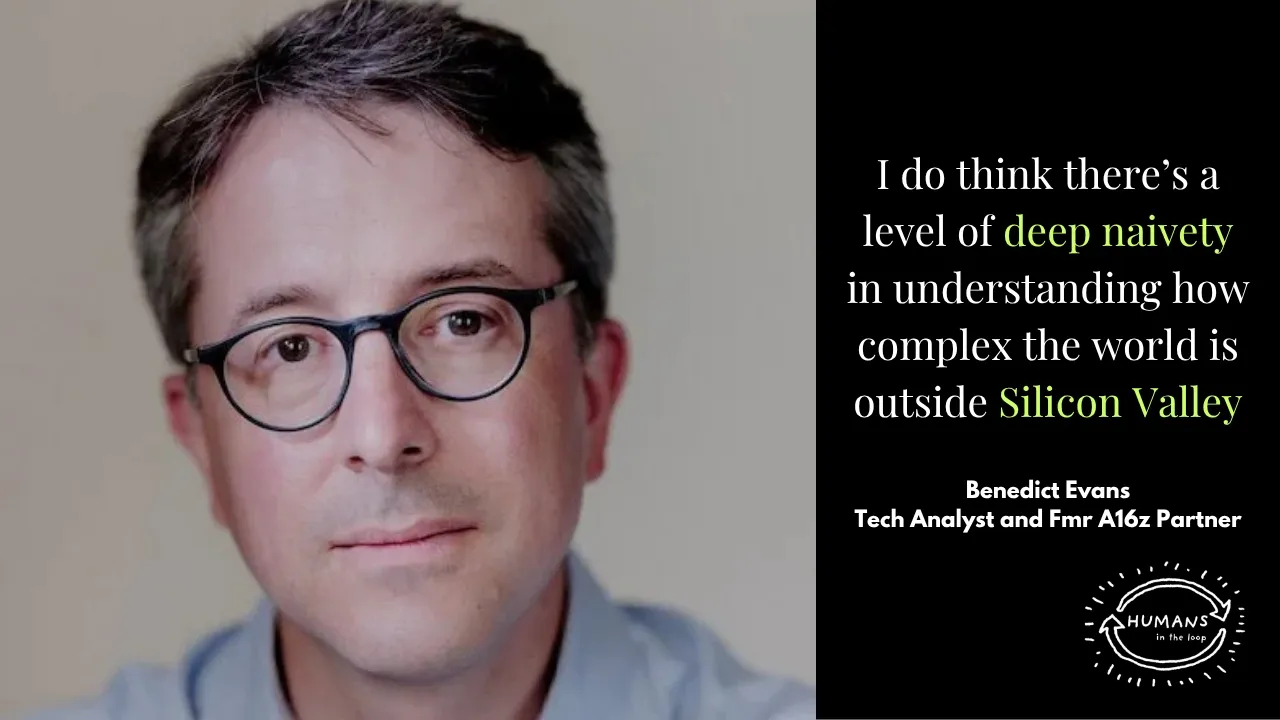
Autonomy has been promised and you know the big white supremacist in chief over at Tesla has spent 10 years promising this and not delivering I do think there’s a level of deep naivety in the understanding of how complex the world is outside of Silicon Valley
Seb (00:14)
if all you have is a hammer, everything looks like a nail. you treat everything like this big machine and where are the inefficiencies. at a human level there is something enduring, which I for one believe believe last.
Benedict Evans (00:24)
We have gone through very big transformations before that changed lots of stuff and those
Seb (00:29)
Mm-hmm.
Benedict Evans (00:30)
were also very big and very new and very scary and changed everything.
Seb (00:44)
Welcome back to Humans in the Loop. The world is in chaos, and I continue to try to make sense of it. So I’m excited to be joined today by Rational Sense Maker, Te Analyst, and former A16Z partner Benedict Evans. Benedict, welcome to the show.
Benedict Evans (00:58)
Hello, thank you.
What’s really happening in tech right now
Seb (01:01)
Benedict, you say on your website that you try to step back from the noise to work out what’s really happening. So what is really happening in the world of tech right now?
Benedict Evans (01:10)
Well, that’s a nice big broad question.
Seb (01:13)
She sh.
Benedict Evans (01:14)
Well, so I think at a very high level, there’s two things happening. One of them is all the stuff that we were excited about before LLM started working is still there. So e-commerce is sort of 20 % of retail. In the UK, it’s sort of 40 % of non-food. Roughly half of all video viewing is now streamed. YouTube is a Netflix of bigger go-tos than the BBC in the UK. So all that stuff is still going on. And then people are thinking about drones and quantum and VR and AR and 3D printing and robots and all that kind of stuff. So all that good stuff is still there. Meanwhile, there is a platform shift. And every 10 or 15 years, there’s sort of a new paradigm. And the whole tech industry gets reshaped around that. And the new paradigm is generally sort of 10x bigger than the one before. So we had. mobile and before that the web and before that smartphones and PCs and mainframes. And so now AI is the thing. Now there’s a not very productive argument about, is this only as big as the internet or mobile or is it some kind of different category of change, which doesn’t seem to be particularly productive. But the core of it is that this is everything that anyone in tech is interested in and excited about right now. And so everyone’s building around this as presumably most people who will be listening to a podcast will kind of know.
Beyond the AI headlines: e-commerce, retail media, and autonomy
Seb (02:38)
what is it that you think people are not talking about enough right now? Because, you know, I I I know your latest presentation was entitled, you know, AI Eats the World, as I guess as a follow-on from Software Eats the World, and AI also kinda eats all conversation around tech at this point as well. so I’m interested, we we will definitely get into talking about AI AI, but what are the non AI topics, shall we say, that you’re thinking about or you think we should be thinking about more right now?
Benedict Evans (03:07)
Well, so non-AI topics, you e-commerce continues. It’s funny, was a, you know, during the pandemic, everyone did, suddenly did the chart showing e-commerce spiking up and a bunch of people didn’t understand the numbers and did the chart badly. And it’s now gone more or less back onto the trend line. But the funny thing about that chart was it was like the most boring chart in tech because it just went up by one percentage point every year. And so, you know, e-commerce is 25 years old and it’s 25%. And it kind of grows at that rate. I mean, it’s accelerated a little bit, but it kind of grows at that rate. But of course, once, you know, there’s one thing when it goes from 2 % to 3 % to 4%, it’s another thing when it’s 25 or 20 or 25 or 30%, because that’s kind of reshapes the entire retail industry, commercial real estate, high streets, property taxes. Another thing that I think sort of popped up and then disappeared is the rise of what variously called retail media or merchant media. So Amazon did $70 or $80 billion of advertising revenue in the last 12 months. Walmart is building a giant ad business. Walmart is buying a smart, bought a smart TV company. Most of Instacart’s, almost all of Instacart’s profits come from advertising. Uber is building an advertising business. So that sense are like the four biggest media owners on earth are Google, Meta, ByteDance, and Amazon. And so that’s kind of an interesting threat. Autonomy has been promised for 10 years and you know the big white supremacist in chief over at Tesla has spent 10 years promising this and not delivering but Waymo is out there deploying and building. So as I said all that stuff is kind of still there and still happening. I think if one kind of brings that back to AI, there’s a slide I have that says something like all AI questions have one of two answers. The answer is either no one knows or how did it work last time. And so how did you deploy? you know, obviously there’s a broad class of AI questions where anyone honestly doesn’t actually know what’s going to happen. Like most obviously how far the models keep scaling. We don’t know. We don’t have a good scientific sort of understanding of why these models work so well and why they’ve scaled so far. But the other side of the question is, you know, how should we buy this? How should we build this? Should we hire Accenture? Should we build it ourselves? Should we buy it off the shelf? How do we find the first use cases? How do we train our people? What does change management look like? And the answers to those questions are sort of, well, maybe not so much how did cloud work, but certainly how did mobile work? How did PCs work? How did the web work? And there’s a sort of a very direct parallel between someone saying, you know, we gave everybody copilot and our productivity didn’t seem to improve. And someone in like 1998 or 99 saying we gave everybody in the company a web browser on their desktop and internet access and productivity didn’t seem to change. We’re having those old fashioned conversations around how does technology deployment work, how do consumers adopt new technologies.
Is this time different?
Seb (06:02)
you’ve you’ve framed the the AI shift here as as kind of a platform shift, and you kind of pointed to to those historical examples. I guess there are a lot of people keen to paint a picture that this is not just, you know, another platform shift that I guess as they have said every time in history, like this time is different, you know, and and and here’s all the reasons why. And Yeah, I I I’m I’m curious what you make of that argument. Like do you see this time as as being different?
Benedict Evans (06:35)
So the problem is it’s different every time. part of the point of the line, this time is different, is every bubble is different. The dot com bubble was different from every previous bubble. If this is a bubble now, is clearly, whatever it is, it’s clearly different to the dot com bubble. We built out fiber in advance of demand. This is being built out behind demand. The funding for the dot com bubble came from retail buying IPOs of non-profitable companies. And that’s clearly not what’s happening now. So every bubble is different, every technology shift is different, and also every technology shift is sort of 10x bigger than the one before. So when PCs arrived in the kind of late 70s when they’re still called micro computers, and sales were in the sort of hundreds and thousands of units in the low single digit units. And when Marc Andreessen kind of kicked off the consumer internet, like, well, Netscape kicked off the consumer internet in 1994, Netscape and Mosaic, there were like, forget the numbers exactly, sort of 50 to 100 million PCs on earth. And half of them were shared in that you had one at your desk at work and one of them at home. So there were like less than 50 million households that have a PC in the entire world. And today, something between five and six billion people have a smartphone. So. You kind of we kind of forget that like stuff like this has been there have been other big changes. You know, here we are recording this by video in a web browser for free. Remember when video conferencing was like, you say video conferencing and you just spent $50,000. So
Seb (08:15)
Hm. Although I’d I’d argue I’d I’d argue that’s still the case in some places. Yeah.
Benedict Evans (08:20)
Well, yeah, that’s a separate conversation. we kind of forget that smartphones are kind of a big deal. There’s five or six billion people in the world who have a device that’s several hundred times faster than the PCs that we had growing up with, connected to a broadband network with access to all the world’s knowledge. And everyone is like, yeah, whatever. But this is a big deal. That wasn’t a big deal. I don’t think it’s particularly productive to try and quantify this.
Seb (08:46)
Mm.
Benedict Evans (08:47)
It is just kind of worth pointing out. We have gone through very big transformations before that changed lots of stuff and those
Seb (08:54)
Mm-hmm.
Benedict Evans (08:55)
were also very big and very new and very scary and changed everything. Now, maybe there’s another answer to this question, which is, okay, fine, the scales all the way to AGI and you define almost sort of, but if you define the outcome of this as something that will change everything, then it will change everything. And if you say, look, this is going to go to something that can replace humanity, is that a bigger deal than anything else that’s happened before? Well, yes, by definition, you’ve just defined this as something that was a bigger deal than anything else that’s happened before. Fine. But the problem is we don’t actually know that. And I think the most interesting difference between this and previous platform shifts is that we understood the science and the kind of physical limits and the kind of what could reasonably happen in the next two years for mobile or broadband or the internet or PCs or whatever. Like we knew how most of it worked. And we don’t have a good theoretical understanding of how this works, so we don’t know what it will look like in five years time. You could kind of draw a line on a chart, and you didn’t know that Yahoo would collapse and be replaced by Google. But you kind of knew that PCs are expensive and telcos aren’t going to give everybody in the world fiber broadband tomorrow. Whereas with this stuff, it could be that we have a paper tomorrow that says, hey, guess what? We managed to get double the results for 5 % of the compute.
Seb (10:05)
Mm.
Benedict Evans (10:06)
So we don’t know where this will go. I think there’s a sort of an observation one can make here, which is that that’s kind of binary in that there’s like an urban legend from the Cuban missile crisis that there’s a rumor that the missiles have launched and everyone starts selling on stock exchange and somebody goes out and starts buying. And he says, look, it’s binary. Like either the rumor is true, in which case we’re all dead anyway, or it’s not true, in which case the stocks are cheap.
Seb (10:31)
Mm, mm.
Benedict Evans (10:32)
And so the situation here is either this stuff is going to scale all the way until it becomes actually massively or more intelligent than people in every possible way, in which case we’ve got bigger problems to worry about than middle class employment and enterprise software. Or
Seb (10:47)
Yeah, yeah.
Benedict Evans (10:48)
it doesn’t, in which case let’s get on with thinking about software deployment and how e-commerce and advertising works.
The Dyson sphere pitch: naivety in the frontier labs
Seb (10:56)
Yeah, yeah. I mean, I I I come back from I was in Switzerland last week for a a sort of event of sorts at which a couple of researchers from one of the Frontier Labs, I’ll leave you to decide which one, presented a presentation entitled Hypercapitalism: The Default Path for the Next Ten Years, and you know, the vision of the future that they laid out involved you know. Recursive self-improvement applies to software, i.e., you know, software writes more software. then sophisticated AI applied to robotics, and then self-recursive improvement to robotics, i.e., robots start building better robots, factories start building more factories, and then at some point in this chain of events, there was a robots deploy themselves into space and start building a Dyson sphere around the sun to mine the sun for energy. And yeah, there there was no sense of I I guess questioning questioning irony or even doubt in these researchers’ minds about that being, as they called it, the default path of of humanity. but I I suppose to your point there, it’s it’s
Benedict Evans (12:10)
problem? Yeah, you’re making predictions where we don’t have any theoretical basis to say whether this will or won’t happen. We don’t actually know how these models work. We can’t draw a line on a chart that says, and we also don’t know how human intelligence works at any kind of really useful level. You can say, you
Seb (12:27)
Yeah.
Benedict Evans (12:29)
know, it’s neurons and synapses, and here are the chemicals, but we don’t know why our brains work producing things that dogs’ brains don’t produce. And so you can’t draw chart and say, well, people are here, and dogs are here, and octopuses are there, and ravens are there, and chat GPT 5.6 is here. And in 17 and 1 months current rate of progress, it will get to people. We can’t do that. We don’t know And so then you get into all these very not very productive discussions where people say, well, imagine if it was nuclear weapons. Well, thank It’s not nuclear weapons. People hunt for analogies. And it becomes a query. And then people say, well, maybe this stuff, you know, so. People argue about whether or not it might be able to do xyz. None of these are productive conversations, but it’s predictive value. You’re not going to be able to prove what’s going to, what will or won’t happen, except by developing some better theoretical model of how LLMs work. at the moment, we don’t have that. So you can just wait and see what happens. I do think there’s a level of deep naivety in the understanding of how complex the world is outside of Silicon Valley and outside of your research lab. and I think there’s a level of setting aside AGI, AGI. There’s a level of naivety in understanding the difference between I can make something that looks quite like a good legal brief and what it is that a lawyer actually does. And
Seb (13:55)
Yeah, yeah.
Benedict Evans (13:56)
there’s a sort of a narrow criticism of the model that says the legal brief isn’t very good. The more important criticism is to say, but drawing up the legal brief isn’t actually what the lawyer does. That’s just part of what the lawyer does. And so if you go back and look at, again, you know, go back and go and back test this. We spent the whole of the 20th century automating accounting, and yet we have more accountants every year for the whole of the 20th century. And why is that? And it’s not just the Jevons paradox, which is just price elasticity. If you’re an associate or, you know, an AP at PWC today, you’re not doing exactly what you would have been doing in 1970, but more. You’re doing a whole bunch of other different stuff. When this gets to the extreme, this gets to these sort of attempts to define AGI as like anything that can do X percent of like productive human labor. Well, go back to 1800, tractor can do 110,000 percent of productive human labor. know, 90 % of the Earth’s populations were peasants. Okay, we’ve automated that. We automated 90 % of what people did. Great. That turned out there was other stuff. And so there’s an awful lot of sort of very dumb extrapolation and people waving their hands and saying you don’t understand exponentials. Well, great. Okay. What is it that makes you think a line on a chart with a log scale has predictive value?
What does an analyst actually do?
Seb (15:13)
Mm. Mm-hmm. I I I’m curious to sort of square the circle with your job as an analyst, because I guess one way I would interpret the title of analyst is, you know, that you’re being paid to have some sort of predictive value of the future here. And as you’ve said yourself, it’s very hard and maybe not that productive in certain areas to try and predict the future. So yeah, I guess how
Benedict Evans (15:38)
I don’t think the job of an analyst is not to predict the future. There’s
Seb (15:42)
Mm.
Benedict Evans (15:43)
a sort dumb YouTuber comment who says, like, you know, I say, well, this might happen or that might happen or that might happen. So you’re an analyst, supposed to tell us what happens. what do think I am, a time traveler? Like I’m going to jump 10 years back
Seb (15:53)
Yeah, yeah, yeah.
Benedict Evans (15:54)
into the future and come back and say, well, this is what happens. There are a bunch of different possible paths. I think, you know, one of the characteristics of Now, going back to the of the platform shift model is, you know, imagine it’s 1997 and you’re trying to predict which tech companies are going to win and where the value is going to be and which industries are going to get affected by this. You’ve got half of it, maybe. You would not have got Facebook. You would not have got smartphones. You know, I was a mobile analyst in the early 2000s. Everybody spent all the time thinking about this stuff. None of us really understood that it was going to be a small PC, that the telcos would have no role. and that it would turn the PC into a smartphone accessory. Everyone thought, it was thinking in terms of what’s a mobile use case. So the idea that somehow you can indeed, that you should say it’s going to be this, as opposed to saying here are four or five possible options and this is what might determine which of them comes out. This is just, this is the argument of a fool. I think there’s a sort of a more fundamental point here, which is that what you try and do as an analyst is you try to work out what the important questions are. and how you might determine the answers to them. And you can say, well, right now foundation models are all sort of using the same data and the same fundamental technology and the same compute, and they don’t appear to have network effects. And we can’t see any apparent winner-takes-all effect other than simply the ability to carry on spending money. And so something would have to change for them to have winner-takes-all effects and for them to have fundamental value capture as opposed to being low margin commodity infrastructure. Now then you can kind of pick that up and turn it around and say, well, maybe yes, maybe no. You can talk about those questions. And sometimes you can kind of form an opinion. You can look at this and say, well, look, I don’t think chat bots are a good user interface. I think this is fundamentally a bad way to give technology to people, and this is why. And I think that this needs to be manifested in use cases and applications and tools. and the skills required to work out what the tools are are different to the skills required to use them. Like the right person to be a really great enterprise salesperson is different to the person to realize that here is this thing that your software isn’t doing and to build a piece of software that would solve that problem and to work out what it should do and what it should look like and how everyone should use it. I think there’s a sort of desperate naivety in the idea that you can swallow everything into a single UX. So there
Seb (18:12)
Mm-hmm.
Benedict Evans (18:13)
are places where you can have an opinion. There are places where you can say, here are five or 10 things that might happen. There are places where you can say, 10 years out, all bets are off. How could you possibly look at mobile in? Again, of backtest this. I actually wrote something about this in 2015 or 2016. Imagine it’s 2000, and you’re trying to work out what’s going to happen with mobile. What would you have had to say to be right with that being a time traveler? So you’d have to say, OK, it’s going to need basically flat rate unlimited data. And then you could have kind of modeled that out and say, well, that will take 2008, 2010, our best, so 10 years out. You
Seb (18:48)
Mm.
Benedict Evans (18:48)
could say it kind of needs to be a small computer, not a managed appliance, which is what Nokia and everyone else were making, given the constraints of bandwidth and battery at the time. Okay, and so you could kind of model out more slowly and say, well, that probably means 2005 to 2010. And the portals, Yahoo and AOL, are gonna disappear off the face of the earth. The telcos will capture no value from this at all. Okay, so who will win? Well, Nockoo and Microsoft, Nope. It’ll be this has-been PC company from Cupertino that’s just kind of a joke. And these two grad students who’ve got this funny little search engine.
Seb (19:25)
Mm, mm.
Benedict Evans (19:27)
And meanwhile, one side of it will be completely open source, and the other side of it will be this closed managed platform made by Apple. Imagine, how would you have known any of that? And
Seb (19:40)
Yeah, yeah.
Benedict Evans (19:41)
if you said it, no one would have believed you. And people would have said, is idiotic, and the networks can’t support that. And remember how long it took for people to understand what the iPhone was. You still get people who think that the iPhone is just Android with better marketing, or the Blackberry should have won, but the marketing was bad or something. And for
Seb (19:58)
Mm-hmm. Mm-hmm.
Benedict Evans (19:59)
years, people said that Android was going to destroy Apple because it was open, and that was what had happened in PCs. So there were so many possible paths as to how this evolved. Then you get to the middle of that curve, and you can say, look, think both Apple and Android are going to survive because of X and Y, and I think app stores are a better model than the web because of X and Y. This
Seb (20:20)
It is it is.
Benedict Evans (20:21)
is why search and social are durable. You can kind of start seeing where the dynamics are starting to kind of get baked in and you can start seeing the paths that are starting to emerge. When you’re right at the beginning, no one knows anything. And I think that’s
Seb (20:37)
Yeah. Yeah.
Benedict Evans (20:39)
going to kind of close to the point. People who walking around the valley right now holding their laptops open to run their agents, this is kind of like people using Telnet. on dial-up in like 1993 saying, look, I’m on the other side of the country from my computer and I can connect to it and use it. Isn’t this amazing? Like, yes, it is, but that’s not what everyone’s going to be doing with this.
Seb (21:05)
Yes, yes. I mean I I I think I I I totally agree with you in terms of the inability of us to sort of predict future pathways from here. and the limited utility in sort of trying to do so or or trying to at least be too opinionated about like yes, it’s this one path. As I mentioned, what you know, this this Frontier Lab presentation. was peppered with all sorts of untold assumptions about the nature of work, the nature of people, as somebody rightly I think pointed out as they raised their hand for a question and said, Don’t you think there’s some kind of mass uprising that happens before all of this plays out? And and then it got into a conversation at what point do these people go and live in a bunker to protect themselves. So yeah, there’s all sorts of dystopian and maybe utopian scenarios.
Benedict Evans (21:51)
Well, but we had all of this in the early days of the internet. So you can kind of go and look up John Perry Barlow he was a lyricist for the Grateful Dead. Lovely guy. Governments of the industrial world you weary giants of flesh and steel I come from cyberspace a new home of mind. Leave us alone you have no sovereignty where we gather. We have no government we will not get one get you one. I address you with no authority that like the new thing always comes with crazy ideas about how this is going to change everything. The great social space is independent of the tyrannies you impose on us. You have no moral right to rule on us. Like, guess what? The laws apply on the internet too. Governments apply on the internet too. So people are people. Laws are laws, governments are governments, sovereignty is sovereignty. It’s like people looking at airplanes and saying, well, this is an end to war because there are no borders in the sky.
Seb (22:42)
you mentioned there that whilst you’re doing this, you know, analysis and you are, you know, theorizing it about these different pathways, you form your own opinions in certain areas. So I I guess I am interested if there are any parts of this debate where you have particularly strong opinions about what is or isn’t happening. and also any Topics where you have, changed your mind significantly over the course of the last twelve months?
Enterprise AI deployment: the long, slow-motion fiasco
Benedict Evans (23:10)
So I think there’s a, it’s interesting. There’s like, two conversations here. There is one conversation which is, you know, my God, Kimmy three and open and closed and, you know, the latest data center and the latest chip and the latest model and those benchmark. you know, it’s nonsense of Antropic trying to ban open models and the other side and like, well, you Kimmy three is at least three months behind the cutting edge. And the other side of it is you do understand that like enterprise software deployment, sales cycles are like 18 months. And everybody gave their staff co-pilot like a year ago, and indeed are carrying on doing that, and we’ll do that next year as well. And that’s like a kind of long slow motion fiasco. And then you do a bunch of pilots of point solutions. Like let’s actually try and automate this one specific problem. And you do a couple of dozen pilots, half of them work, half of them don’t. And then you kind of scratch your head and you think, Yeah, but this isn’t like really fundamentally changing our business. You know, we just kind of automated this flow within accounts verbal using an LLM to automate something we couldn’t automate before. And what would enterprise transformation look like? How do we think about change management and training and deployment and reconfiguring our organization? And as soon as you say that, then you started drawing up an RFP to Bain, BCG, McKinsey on the one side and Accenture and IBM and Cognizant on the other. not IBM anymore. Kindle, they sold their consulting business, spun out the consulting business. And this becomes a professional services conversation, a change management conversation. And out of that, you can kind of go back and look at what the internet did to the world. And you think, well, there were some companies, there were a whole bunch of industries where the internet didn’t actually change anything very much. Like, it’s really great that now I can email, I can go and look at that catalog, rather than like phoning up my client and asking them to mail it to me. This is great. But at the end of the day, if you’re like John Deere or Caterpillar or General Electric’s turbine business, the internet is a great productivity tool and it makes your life easier all the time every day. But your business is selling big spinning pieces of metal. And the internet didn’t actually change that very much at all. On the other hand, if you are like Shin and you shipped a billion orders last year direct to the customer from the Chinese factory, that’s an industry that just didn’t exist, couldn’t have existed before the internet. If you’re the music
Seb (25:25)
Mm, yeah.
Benedict Evans (25:26)
business or the newspaper industry, this changed everything. And so you’ve got this very kind of spiky impact of where does this actually change stuff? Where does this get to the point of leverage and where is this kind of a useful tool? And how would you know the difference? And of course, quite often you can all sort of think of examples where people thought, well, that isn’t going to be a thing. And then the internet, then someone worked, had a way to do it with the internet five years later. And so you’ve got this kind of spread between, to your point, this nice, smooth linear curve of these guys at this conference who just think it’s an exponential curve. Yeah, like the internet was to so smartphones. So PCs, so is Moore’s law. exponential codes are not new. But that’s not the same as what does that mean? If you’re building a company? One of the things I think about a lot at the moment, which I did a podcast about last week, and I’m writing something about now is that most people and most companies are not tool builders. Most people do not sit and look at their job and think how could I make a thing that would change this? Most people don’t see the problem that the software would fix. And if they do,
Seb (26:29)
Mm.
Benedict Evans (26:30)
they don’t see what the software would do. then if you think about, then so then secondly, if you think about any piece of software that you use now, how many of the things that we use every day, a stuff where we looked at it and we first saw it and we thought, well, that’s dumb, I would never do that. And or you look at it and you think, wow, that’s a really clever idea. And it does that thing and that feature, wow, that feature is amazing. It would never have occurred to me that you could do that or that would work or that would be a thing. And then thirdly, Imagine you’re working in, you know, back office, X, Y, Z inside some giant company. And you do have both of those previous insights, which you wouldn’t, but presuming you do, because that’s not you, that’s something that’s not your skill set. You’re good at doing something else. How are you going to get the other 800 people in your company to do that with HIPAA compliance and backups across 18 different sites and data centers and the like, like integration with your payment systems and your systems of record and everything else? Of course you can’t. Changing the system that’s used to manage a workflow that touches 500 people across the company isn’t something that one of those people can do. That’s a central decision. And then you get these people who worked at a university and then worked to start out with 10 people and are now at a company with the enormous number of several thousand employees who think that everyone will just get clawed and automate their work. The best metaphor I can think of here is to imagine the office. like the TV show, The Office. One morning, what’s his name? Ricky Gervais comes in and says to Dwight and Gareth and Fat Keith, like, guess what, guys? No more Salesforce. You’re just going to do everything with TATGBT. What do you think would happen? It would be
Seb (28:16)
Yeah, yeah.
Benedict Evans (28:18)
a very entertaining episode, but I don’t think they would ship a lot more paper.
Seb (28:23)
Yeah, yeah. I I mean yeah, I I wholeheartedly agree, right? There’s there’s this sort of organizational inertia, we could call it, or or just, you know, the real world gets in the way of a of a good good plan in the the eyes of the AI AI frontiers. You’ve also obviously got, you know, regulatory hurdles, you’ve got all sorts of things that I think
Benedict Evans (28:44)
So there’s a lot of, there’s a lot of kind of practical, tangible differences, which are partly seeing the problem and knowing how to build it. And secondly, yes, but how would you actually get that deployed and get everybody to use it? I think there’s a set of a second interesting set of constraints to think about, which is, like, think like saying the model can’t do X or Y is a deeply uninteresting statement, particularly how fast this stuff moves. I think what is interesting is to say, look, what this stuff does is first of all, you have to have enough training data and you have to be able to check the results of scale. because it’s a probabilistic system. so either it doesn’t matter if it’s slightly wrong or if it does, you need to be able to catch that. And basically those can be true depending on the use case. Or there may not be a wrong answer, again, depending on the use case, but sometimes there is. But then, like, where is there implicit knowledge? How much of what you’re doing is implicit? How much of it isn’t easily definable, isn’t in the training data? How much of it would be actually really hard for anybody to sit down and define, what is it exactly that I do all day? How much of it, you get these kind of, frankly, I think these absurd attempts to use this US system called O-net, which kind of looks at jobs and tries to break down what you do all day. And then you say, which percentage of those can be automated? This to me reminds me of the joke about the physicists who try and predict which horse is going to win a horse race. And they say, first, we’re going to presume that the horse is a perfect sphere. I don’t think you can categorize. You can’t break down a job like that. You can try. You can think you’re doing it. But you’re not actually doing it.
Jobs vs. tasks: the PwC audit story
Seb (30:03)
Yeah, on on on that, I guess I I’ve heard you make previously a an
Benedict Evans (30:06)
you
Seb (30:07)
interesting distinction between like jobs and and tasks. So I’m I’m wondering if you can
Benedict Evans (30:10)
Well, there’s jobs and tasks, yes, which is kind of my point about, what does the associate at PWC do today? So I met somebody who just retired from one of the big four accounting firms. And what she said is, her first job in this, as it might be the mid-‘80s, was intercompany audit on some big complex conglomerate. So say it’s Shell. It’s not Shell, but say it was Shell. Shell Copenhagen’s records say that they paid Shell Portugal this much and received this much from Shell Portugal. Is that what Shell Portugal says? And so the way that this works is you have a big empty meeting room with no furniture and a crate of graph paper and you line all the sheets of graph paper along one wall and then you lay them all down that wall and then you fill in the grid. And then you get the audit packs arriving from each of your 40 or 50 individual subsidiaries. then
Seb (30:55)
Mm-hmm.
Benedict Evans (30:56)
you spend like six weeks later, you’ve reconciled in each direction, 60 times 60, whatever number is. And today that’s what 20 minutes in an ERP. And guess what? PWC still exists and has a lot of people.
Seb (31:14)
Mm-hmm, mm-hmm.
Benedict Evans (31:15)
And so why is that? The job changes. The stuff that you can do changes, the things that are necessary expand in all sorts of unpredictable ways. This is my point. The people who think that this will just automate everything away remind me of the people who would kind of look at a tractor and say, well, now there’ll be no jobs because we don’t need to work on the land anymore. So everyone can just kind of go home and relax. Well,
Seb (31:38)
Yeah, yeah.
Benedict Evans (31:39)
that’s no, the job, the work changes, the job changes. The other thing I was going to say is, and I think there’s sort of two parts to this. One of them is, can you actually capture the job, can you actually how much of this is kind of your point, the framing I was thinking about is, is that job just a task or that can be automated? Or is the job a handle, a whole bundle of stuff, some tasks, some not tasks, some things that can be automated, some can’t. So like if you’re an elevator attendant, then you know, or you drive a train, train driver is a task that can be automated. Half of the lines in the London Underground have been automated. Sometimes it’s not like a delivery driver is not is a bit more complicated. There’s like three or four different tasks that are going on there.
Seb (32:19)
Mm-hmm.
Benedict Evans (32:21)
And so if you’re a partner with a law firm, try to, like you’re doing quite a lot of different things, some of which are quite easy to automate, some of which aren’t. So that’s kind of one piece. I think the second piece, which I think is sort of interesting to think about as a constraint, is what these things do in principle is tell you what most people would probably do. That’s what’s happening. Here is
Seb (32:38)
Mm. Mm-hmm.
Benedict Evans (32:40)
the average of what everybody does and how everyone would think about this. Now you have to be slightly careful about that because you know what, you know, this open AI hack of hugging face is not literally exactly what any engineer would have done. It’s done it in different ways. It’s done stuff that an engineer maybe wouldn’t have done or would have taken a week to think of. It’s done
Seb (32:58)
Mm-hmm, mm-hmm.
Benedict Evans (32:59)
a bunch of weird stuff that no person would do. But I think there’s a sort of very almost sort of philosophical point here, which is that sometimes you don’t want the average. Sometimes you want something that’s different, but good. And these models kind of score different as bad. they don’t have, it’s not clear how they would do something that is different from what’s in the training data and to know that that was what we wanted anyway.
Seb (33:29)
Mm. Mm.
Can AI invent hip hop? Taste, judgment, and the limits of pattern-matching
Benedict Evans (33:30)
Now, sometimes that’s innovation that you can test. This is sort of the model that you see with AlphaGo. That AlphaGo could try new models, try new moves, and it had an internal scoring system. So it could know that that move was good, even if no person had ever done it.
Seb (33:47)
Hmm, mm.
Benedict Evans (33:48)
But if you’re making something subjective, where the subjectivity is the judgment of people, have you made an entirely new kind of music? How would you know that people would like that? And this is kind of what you see now with writing. Like if you can’t now, you certainly will be able to make generic fiction. You will be able to make genre fiction. You will be able to make romance novels and detective stories. You’ll be able to make bad jazz. You’ll be able to make bad bark. You’ll be able to make more stuff that sounds like Taylor Swift. Great. But how do you get the genre shift? How do you get the new thing? How do you get the thing that doesn’t look like what we were already doing and know that people would want that? How would you look at disco and prog rock and the Jackson five and then say, we’re going to do hip hop?
Seb (34:42)
Yeah. Yeah. Yeah.
Benedict Evans (34:44)
Now you might be able to see hip hop and say that looks like the kind of thing that tends to be a big thing. But how would you invent hip hop and know that people would like it? Well, what would your training beta be to inform you that that’s the thing people would like? I think that’s a sort of an interesting set of puzzles around where the constraints might be.
Seb (35:04)
Mm-hmm. Mm-hmm. Yeah, and I I I think your point about how do we know people would like it, because you know, there is this argument that LLMs basically sort of package the past and market it as the future. You know, I we take take a bunch of training data and it’s it’s but I I I mean
Benedict Evans (35:20)
Yeah, this is cute. It’s It’s like, you know, the it’s a fuzzy jpg of the internet. There’s a lot of people come up with cute, cute bumper sticker descriptions that aren’t good ways of thinking about
Seb (35:29)
Yeah, of course. Right. There are these there are these there is
Benedict Evans (35:32)
this.
Seb (35:32)
yeah, there are these sort of, you know, snappy sound bites. you know, I guess there are areas even in the last couple of weeks, you know, LLMs have solved or helped solve, you know, some important mathematical conjecture that has, you know,
Benedict Evans (35:50)
Mm.
Seb (35:51)
i evaded like the best math mathematicians for for for like a century. I don’t know how long the conjecture’s been around for.
Benedict Evans (35:57)
Mass, well, but mass, think mass would fit into my AlphaGo framing, wouldn’t it? That has an
Seb (36:02)
Mm, mm, mm.
Benedict Evans (36:03)
internal system of rules.
Seb (36:05)
Yes, right. And I think when you start to see LLMs, I mean I you know, basically my mental model of what is an LLM, well it’s the world’s most powerful pattern matcher. and I think, you know, with enough data and playing a game that has well defined enough rules, there’s probably almost no end to what you could achieve i in there.
Benedict Evans (36:26)
Yes, mean, coding and maths are both logic systems. So it’s a grotesquely
Seb (36:29)
Yes, yes.
Benedict Evans (36:31)
simplistic way of describing what maths is.
Seb (36:33)
Yes.
Benedict Evans (36:33)
But it’s a system that has its own internal rules. And we’ve then spent the last 2,000 years working out what these rules are and working out the implications of those rules. But it’s a system of extended logic. At least that’s one way you can think about it. I’m sorry. philosopher of mathematics thinks this is obviously stupid. But that’s certainly one way you can look at it. But for the point of of the My chain of thought is that it has an internal, there is an inherent system way that it can work out whether X or Y is good or not. And
Seb (37:04)
Yes, yes. Yes.
Benedict Evans (37:06)
whereas if you are making music, the only internal way it would have to work out whether this is good or not is to look at what other things people like. There is an external validation, which is do people like this? And what is your source of truth for whether people like this or not that you could scale and automate? Because the answer isn’t, this objectively correct or does this match what people have previously done? Those are both sources of truth. But in this case, the source of truth is, does our reptile brain smile? Does that please us? Now, you could propose that given enough data, this is just a longer cycle pattern. Short cycle pattern is make more bark or make more prog rock or make more hip hop. Long cycle pattern is invent hip hop. is to sort of see the totality of data in human society and work out that would like that people would like that. This is sort of the the sort of the gold plant problem, like the problem of Soviet central planning, which is that when all you want to do is make more grain and more tractors and dig up more coal, central planning works okay. When you want to produce a complex, sophisticated high technology manufacturing society, it all kind of breaks down because you just can’t manage the complexity.
Seb (38:25)
Yes.
Benedict Evans (38:25)
And
Seb (38:25)
Yeah.
Benedict Evans (38:26)
so the point of a market system is that a market is as high as it kind of points out the market system is an information system. The pricing is an information system. so free market is a decentralized planning system in which all of us collectively contribute to the planning decisions. We’re a vast mechanical truck, if you like. And Soviet planning agency was called Gold’s Plan. And they weren’t able, you simply could not capture that kind of complexity going through one office building in Moscow. Now you could propose that indeed the Russians kind of, there’s this sort of moment in the seventies where we think, aha, well, mainframe solves the problem. And of course they didn’t, they solved a little bit of it, but the problem still remained completely out of reach. You could sort of propose that the machine learning systems could capture that level of complexity. They could capture understanding what people like, because you actually could give them absolutely everything and then they would kind of know. You remember the scene in Dead Poet Society where the guy draws a graph of a poem. He says you can score whether a poem is good or not. And this is obviously kind of horse shit.
Seb (39:23)
Yeah, yeah.
Benedict Evans (39:24)
bird in principle, if you had every poem ever, could you then infer not just make more poems, if you had like every poem, and could see all of human activity or the subset of it that is captured in everything that’s on the internet, social media, messaging, every conversation recorded, could that get you to a system that actually could infer no, it’s time for hip hop? Out of
Seb (39:49)
Yeah, yeah.
Benedict Evans (39:50)
that data. Maybe I
Seb (39:51)
But but it’s the
Benedict Evans (39:52)
mean, it’s not self evident. don’t know. Maybe somebody has a better answer to that. like, thing that one’s
Seb (39:57)
Yeah, yeah. But I just
Benedict Evans (39:59)
coming around is what can you get into the training data? Can you actually get taste and judgment, a system that has taste and judgment?
Seb (40:07)
Yes, yeah.
Benedict Evans (40:07)
Or rather human, what’s people like, or what people would like into the training data?
Authenticity, live sport, and why AI podcasts (mostly) suck
Seb (40:14)
Yeah. And and even then to to kind of pick at this a little bit further, you know, I I’d use a live sport analogy as as a as an example for me, you know, I think I’m sure I’m not the only one here, you know, if if I watch a live sporting event in the moment, it is an incredibly different experience than recording that same, let’s say, football match and watching it twenty four hours later. And the two, if if I if I came into it with no knowledge of whether or not it was live, I could be have equal enjoyment of of both games in in in both moments. But the moment I realise or am told, No, no, this is not a live sporting event, this this happened twenty four hours ago, it it immediately diminishes my level of like interest and and engagement with
Benedict Evans (41:05)
Yes, this is this is this is kind of culturally specific though. Because where you’re going to this is would I know it was AI or not? If I knew it was AI wouldn’t like it. I think I presume that’s where you’re going with this this comparison.
Seb (41:16)
Well well I I I guess y ye y yes and no. Like can you label it as AI also like there are just these
Benedict Evans (41:21)
So.
Seb (41:22)
intangibles that are hard to sort of bake
Benedict Evans (41:24)
Well,
Seb (41:25)
in.
Benedict Evans (41:25)
so I think that the this is really, and again, this is one of those like people who’ve only studied computer scientists and 20 science and 25 just like in guys, there’s more stuff to learn. Yes, they all guys, mostly guys, which is that our sense of the value of what makes something art and not art and our ideas of things like integrity and authenticity and the artistic vision and so on. Those are culturally specific. And so, you know, go back to 1750 and a writer or a musician is a paid craftsman. And their cultural position is no different to a skilled plumber. And today, you know, if a plumber says, you know, you respect them for their professional expertise, but they’re not an artist, they don’t have integrity of their vision. don’t like it’s not like the integrity of the vision. So, you know, the, you know, the whole sort of, you know, our conception of music now is it really matters. Like, it’s like the mini, the mini-vanilli thing. Imagine explaining that to somebody in 1750, they’d be completely baffled. Well, what do mean they weren’t singing? What does that, why, why would you care? Why is that and why is that important? Like, what does authenticity mean? This is, this is a kind of is concept that sort of emerges, you could pin it to a magicism maybe a little bit earlier, that the artist is, there is a difference between an artist and something and a craftsman. And the art, there is a they have an authenticity and integrity, they have to be true to their personal vision, their passion, their spirit, all of this stuff. Nobody in 1500 thought any of that shit.
Seb (43:08)
Yeah, yeah. I don’t I don’t disagree.
Benedict Evans (43:09)
And so those are, and it’s not like they were wrong and we’re right.
Seb (43:13)
Yes.
Benedict Evans (43:13)
So there may be, and you know, I’m gonna think, you know, pull back to the present day, you know, you can sit in an Uber with somebody who’s listening to five hours of, of, of, of generic piano jazz, because it’s just relaxing and soothing. Some people care about this stuff. lot of people really don’t understand, they don’t care about this stuff. Some people actually don’t value that kind of authenticity, you know, you know, high culture, like, you know, it’s important. particularly with emergence of abstract art, the artist’s vision is everything. But there’s plenty of other societies and plenty of other people in our own society who don’t value that.
Seb (43:48)
Yes, yeah. I I mean I I I agree with what you’re saying there, and and I think particularly, you know, the this difference between sort of high culture and and not, but I suppose my point cuts a little more broad in that yes, there are things that are very specific to a cultural moment. I do think, you know, i it’s the kind of old saying, if you know, all you have is a hammer, everything looks like a nail. I think if you view the world in this very engineering-oriented kind of util utilitarian lens you sort of think about automation and you sort of treat everything like this sort of big machine and where are the inefficiencies. But I think that at a human level there is something more enduring, which maybe you know takes different shapes in different periods of culture that that that that I I guess I for one believe believe last. You know, we we can already automate the creation of podcasts, but nobody is listening to AI created podcasts ‘cause ‘cause they suck, because there’s because there’s a human element that feels missing or at least that that is my my belief. So yes, I think I think it it does there is there is a definition
Benedict Evans (44:52)
I’m not sure. not sure about that. I mean, I think if you ever sat, I’m not interested in sport, but like I’ve sort of sat in taxis for 45 minutes listening to people talking about the ladies football match and thinking this could be entirely automatically generated. like, I mean, it’s sort of a joke, but you know, it’s like, what we really need to do is we really need to score more. And we need to stop them from scoring. Like,
Seb (45:14)
Sure. Yeah. Yeah.
Benedict Evans (45:16)
great. And like, repeat for 45 minutes. But this is, know, that of course, that that’s also every technology pod. That’s also half technology podcasts as well. It’s like you listen to this
Seb (45:20)
But but I but I think that’s a g I think that’s a good I I think that’s a good thing. Right, yeah, yeah. But I but I
Benedict Evans (45:27)
and think, my god, how do people do through our podcasts about technology? what? Come on. But there’s
Seb (45:32)
Yeah, but but I th in a way I think that illustrates my point that actually the depth of the analysis being done is not you know, it it it could well be like automated is not necessarily that deep, but I think there is another reason why people tune in, and
Benedict Evans (45:45)
Well, this is, I mean, this is, it’s a slightly sort of unfair comment, but you know, the people who are most in most upset about AI and in large part of people who write genre fiction. And
Seb (45:54)
Mm, mm.
Benedict Evans (45:54)
so people who write romance novels are very upset about this. And you kind of look from outside and you think if your work is that easy to copy and that predictable, maybe you should be looking somewhere else for the problem. you know, if you go to an art gallery in Soho, or, you know, Chelsea or, you know, left bank of Paris, and you say, so, you know, I could use AI to copy that. they will kind of smile politely and might go and talk to somebody else because you clearly don’t understand anything about what you’re looking at or why. It’s a modern version of someone looking at a Jackson Pollock and saying my five year old could have done that. You don’t understand. Now, you might even maybe you do understand and you disagree, but that’s not the point. That’s not what you’re being offered here. And so the, again, it comes back to this question, right? What do you want? Do you just want a novel that’s done in a certain way, in a certain way that has certain patterns with certain kind of characteristics, it has this kind of atmosphere. That’s what genre fiction is. And yes, that will get a lot of an awful lot of that will get auto generated. you you could be it be live. Same thing with porn, incidentally, you know, one cares about authenticity there clearly. And so that says there’s some slightly worrying implications of what people might end up asking for. But clearly, you’re going to get to a point where you know, I want 10 seconds, I want a 20 minute clip. described in these terms, there it is, like that will happen, or five minute clip or three minute clip or whatever the average reading length is. Where you don’t want, that’s not what you want, where you couldn’t describe it, where you want something different and unique that surprises you, where you care about authenticity, then that’s not what automation does. I mean, there’s a core of this is, it does it the same way. It does it the right way that anyone would probably do it. Is that what you want? Sometimes yes, like if you, some of the… If you’re doing my taxes, I would like you to do it the way everyone would do, or don’t do my taxes, please.
Seb (47:58)
Yeah, yeah. But I I I think just to sort of zoom us out for a minute, I I think you know, when viewed as a kind of tool for automation, there are you know these things that clearly have criteria that make themselves easily automatable. So, you know, go back to software engineering, kind of clear rules of the game, a clear logic system, you can tell easily what is sort of good or bad output, etc. And those things almost inevitably increasingly get automated away. And then there are things that lie beyond the boundaries of automation, at least at this point in time. I guess the more interesting implications is when you look at AI not as a tool for automation, but you start to see it as Yeah, I guess a platform for a potentially entirely new economy, you know, and and treat it almost like the equivalent of electricity. And, you know, I guess if you’d said to somebody prior to to the you know, invention of electricity or the the sort of capture thereof what does an electrified economy look like, they would have had no clue. And so I th I I think what I hear you saying is the the kind of new paradigm.
Defining AGI into existence: electricity, Anselm, and argument by definition
Benedict Evans (49:11)
I think you can pull at all of these things and they sort of unravel. So, you know, how much does electricity change the world? Lots. Does it change it more than the internet? Is that a fundamentally different change to the internet? Because I mean, the thing is we sort of, forget that we’ve always had this thing now. You know, again, imagine we were trying to record this in 1980. Like there was like, how would any of this have worked? None of this would have been conceivable. You know, we would be in a recording studio somewhere in Soho that we’d have booked out weeks in advance and it would be 50 grand or whatever it costs. And, you know, this would be for television and it would be edited out in 10 minutes and it would be at, you know, it’s like, you know, the, you know, it’s a sort of bizarre experience I have now with my son. Like I want him to see that movie. Imagine you want to show your son that movie in 1980. What do do? Well, I guess we’ll just have to wait until the TV, one of the three TV channels shows it. Do you remember the thing of like the TV chase stations would have their thing of these are the movies we’ve got for Christmas? Do you remember that? And
Seb (50:26)
Mm, mm. Mm.
Benedict Evans (50:28)
like, great, I’ve always wanted to see that. I’ll set, I’ll remember, I’ll come and watch it at three o’clock on the Thursday afternoon. I mean, obviously we then you have VHS, we have video rentals. But even there, it’s like, so you go to the, it was like the joke about Netflix, you know, you go to the blockbuster at, you know, five o’clock on a Saturday and you walk around seven times and you walk home with predator three, cause that’s all that’s left. So we kind of forget that like the internet was a big deal too. And mobile was a big deal. And electricity was a big deal and cars were a big deal and radio is a big deal. And you know, the industrial revolution is his kind of catchphrase, but the industrial revolution took a hundred years. And you have all sorts of other things there around, you know, agriculture, you have all sorts of big long cycle tangents in human history.
Seb (51:18)
Yeah, yeah.
Benedict Evans (51:18)
And I don’t know how productive or particularly interesting it is to say, well, this is completely different to all of those. Well, yes, if it kills us all, fine. But there’s
Seb (51:26)
Yeah. Yeah.
Benedict Evans (51:27)
a sort of argument by definition that I mean, this is something I sort of sometimes think about, which is this argument by a medieval theologian called Anselm, subsequently, who said, Okay, so God, by definition is the greatest thing that there is. Because if there was something greater, then that would be God. Agreed? Seems like a reasonable statement. A God that exists would be greater than one that didn’t exist. That also seems like self-evidently true. Because like a God that only exists in a book isn’t as great as a God that’s actually right fucking there throwing lightning bolts at you. Yeah? Therefore God exists. And everyone immediately says, but Anselm, mate, that’s just obviously bullshit. And he said, like, can’t any kind of laughs and says, yeah, now prove it. Like, which of the two previous statements is wrong and why?
Seb (52:24)
Mm.
Benedict Evans (52:24)
And I think Bertrand Russell said, like, the logical puzzles in engaging with this are much more interesting than the actual statement. Like, trying to work out why that’s wrong is much more interesting than saying, well, of course it is wrong. And I think Kant, like eight or 900 years later, points out that existence is a value judgment.
Seb (52:45)
Yeah, yeah.
Benedict Evans (52:46)
that maybe a god that doesn’t exist would be better than one that does because of x and y, z. You could imagine a god that didn’t have to do all the weird compromises of allowing evil or what have you. Let’s not get too far down the philosophical rabbit hole. The reason I mention this is there’s an awful lot of these conversations. First, I shall define AGI as something that is completely all powerful, completely inevitable, and that will kill us all. Therefore, AGI is dangerous, and we should stop it. You haven’t actually proved anything, you’ve just defined the argument away. If you define
Seb (53:18)
Mm-hmm.
Benedict Evans (53:19)
God as something that exists, therefore you haven’t proved that God exists.
A16z, techno-optimism, and what Benedict’s optimistic about
Seb (53:23)
Yeah. Yeah. Yeah. I mean, yeah, AGI is a whole nother topic and conversation and and I would argue increasingly just a marketing ploy. I I’m I’m interested, Benedict on a on a sort of tangential note, but I mean I know you spent a number of years at A16z as a Partner. I I have come to think of A16z as sort of the spiritual home of like bullish techno optimism. and it strikes me talking to you that you have a you know a very rational centrist sort of take of of of looking at these technologies And I I guess it gets me intrigued, you know, did you did you stand out or feel like you stood out like a sore thumb in the kind of A16z type of environment?
Benedict Evans (54:07)
I look, I haven’t worked there for, what, six and a half years? And
Seb (54:10)
Mm-hmm.
Benedict Evans (54:11)
when I joined in the beginning of 2014, I think there were 60 or 70 people there. And there’s now, I think, from looking at the team page, like 600 or 700 people there. So there’s a sort of a general point here, which is most people in Silicon Valley have a mortgage and a commute. And their kids go to football practice on Saturdays. And they work on something very boring, doing something useful deep inside enterprise back offices. It’s kind of like the thing of like, you know, the urban myths about like apparently in Japan, and then someone would describe something slightly perverted or slightly weird. And like, no, most people in Japan live in an apartment and they have a commute and the job and they’re like, most people in Silicon Valley have a commute and a job and a mortgage and like they make enterprise software. I think there’s a sort of a second point here, which is just like, you know, part of A16z’s positioning is to think about your profile and your public voice and the message you send as a way of attracting entrepreneurs. Part of it clearly in the US political environment is how is it that you can be what is the best way to communicate to Washington DC, what kind of policies would be good for startups, because ultimately, that’s what you’re doing, you’re investing in startups. And so if you are a VC, you would like there to be lots of open models and lots of AI startups, please. And Biden’s approach was, think AI is incredibly dangerous and we’re going to regulate the whole thing and we’re going to make sure no one does anything without getting approval from us and there won’t be any startups. We’re certainly not going to allow any AI startups. And we’re going to treat the whole thing like kind of nuclear weapons and there’ll be three of them and there’ll be one at DC. And so if you are somebody who builds, A, you can take the view as kind of I do that that’s not actually a particularly sensible way to understand AI. But secondly, If your whole proposition is I invest in startups, then politician who says, we’re just not going to have any startups in this thing is obviously not very appealing. And so, you know, it makes sense that if your strategy is to have a loud voice and to communicate stuff, you’d be have a loud voice and communicate, be communicating about that. I mean, there’s a deeper point here, which is anybody building a startup is trying to take something from a PowerPoint into a billion, five billion, $50 billion company out of thin air in five to seven years through force of will. So that requires a certain kind of attitude and optimism and sense of how the world works. have to start, your default position has to be, it is going to be possible to make amazing things and completely change how this whole big complicated thing works. We are going to be able to build a new giant bank. We can build a car company. We can do X. Your whole attitude has to be, it’s going to be possible to build enormous things that changed everything because one in 10, one in 20 of the things you invest do and all the things you’re investing in are people who are trying to do that. Otherwise, what’s the point? That’s what the business is.
Seb (57:12)
Yeah. Yeah. I’m curious to finish on on a question about what you’re optimistic about for the future.
Benedict Evans (57:20)
So look, I was a child in the 1970s when aircraft fell out of the sky all the time and terrorists were setting off bombs on the streets of London. And solar power was this kind of weird exotic thing that was super expensive and didn’t work. And, you know, my parents were born just before during the Second World War. My grandparents were involved in the Second World War. My great grandparents were involved in the First World War. I went to a private school in the UK that has a chapel as a war memorial. And so every morning, five days a week, we queued to go into chapel. And there are seven or 800 names on that war memorial. And you do the maths, and that’s something like a third of all the people who were the right age to go. So people who were 18 to 25 between 1914 and 1918. There’s this kind of weird trope that like upper class, upper middle class people didn’t go to war. They were the guys who had to get out of the trench first and shout, follow me. They were all the second lieutenants in the infantry, the life expectancy of like three months. I would kind of rather be dicking about on the internet arguing about AI than climbing out of trench shouting, follow me guys. And, you know, I hope I’d have done it. I’m, you know, given the culture of the time, I’m sure I would do it. Everyone joined up. That was what happened. But I would rather live now than in 19, be a teenager in 1940 or a teenager in 1914 or indeed 1814 or 1850 and, you know, be wondering about these vaccine things and they’re looking at the infant mortality statistics and presuming that like Since Dickens’ family, had like 15 or 18 children and half of them died. Charles Dickens. And know,
Seb (59:20)
Yeah. Yeah.
Benedict Evans (59:23)
mean, you know Dickens’ child story that his father went bankrupt or something and he had to go and work age like eight or 10, go and work in a factory making shoe polish for 18 hours a day. Like, tell me again, you know, this is why I think phrases like hypercapitalism are just profoundly idiotic. Like, poverty is always attractive to the rich. Like, if you’re poor, poverty doesn’t sound great. And, you know, we live in, yeah, there’s always problems, like stuff sucks, there’s bad things, but like, I would rather live now than any other time. There’s this kind of funny thing like this game of like, you know, Wouldn’t it be great if you could go and live in Roman times and see what that was like? Wouldn’t it be great if you could live in Elizabeth, Elizabethan England and see what that was like? First of all, know, if you have children, half of them are dead before the time they’re five. And there’s like no sanitation and the 90 % everyone always wants to be like, I want to be a samurai. I want to go to samurai Japan. I guess what like an odds 95 % probability if you turned up in Edo era Japan, you’d have been a peasant.
Seb (1:00:27)
Yeah.
Benedict Evans (1:00:29)
You wouldn’t have got to have like all the nice lacquer boxes in the tea ceremony and live in the pretty house. You’d have, you know,
Seb (1:00:34)
Yeah, yeah.
Benedict Evans (1:00:35)
you’d have spent, you know, you’d be the guy in the Hiroshige print with the hat made out of straw in the rain carrying half a ton of stuff on your back.
Seb (1:00:43)
Mm, mm.
Benedict Evans (1:00:45)
So I feel like this is, you know, yes, like stuff gets better on the long arc of time.
Seb (1:00:51)
Yeah, yeah. Yeah, no, I definitely hear you as on my dad’s side, my my grandparents are Danish and my grandmother was a Jew, you know, Denmark was an occupied country, so she fled to Sweden. My grandfather was in the Danish resistance, and yeah, when you put it in those kind of long arc sort of well, not even that long an arc because it’s yeah, within a within a generation or two, it’s it’s very easy to forget the the privileges we already have.
Benedict Evans (1:01:20)
Yeah, my great uncle was a conscientious objector and he became a medic in the paratroopers and he dropped into Normandy very shortly after D-Day. He was a poet. He published an old book of his own poems and Morticell came in and he was the only one who didn’t get up afterwards. He’s buried in Normandy, aged early 20s.
Seb (1:01:44)
Yeah, yeah.
Benedict Evans (1:01:44)
So tell me more about how your life sucks.
Seb (1:01:47)
Well, that feels like a good place to to draw us to close. I really appreciate you taking the time to have this conversation. if people want to find you, follow your work, where should they go?
Benedict Evans (1:01:58)
Yeah, my Google Benedict Evans, my parents had good SEO.
Seb (1:02:02)
Okay, good, good, awesome. Well, appreciate th you taking the time again,
Benedict Evans (1:02:06)
good to chat, thanks.


