/
/
1 hour
Epstein, conspiracy and how ideas spread
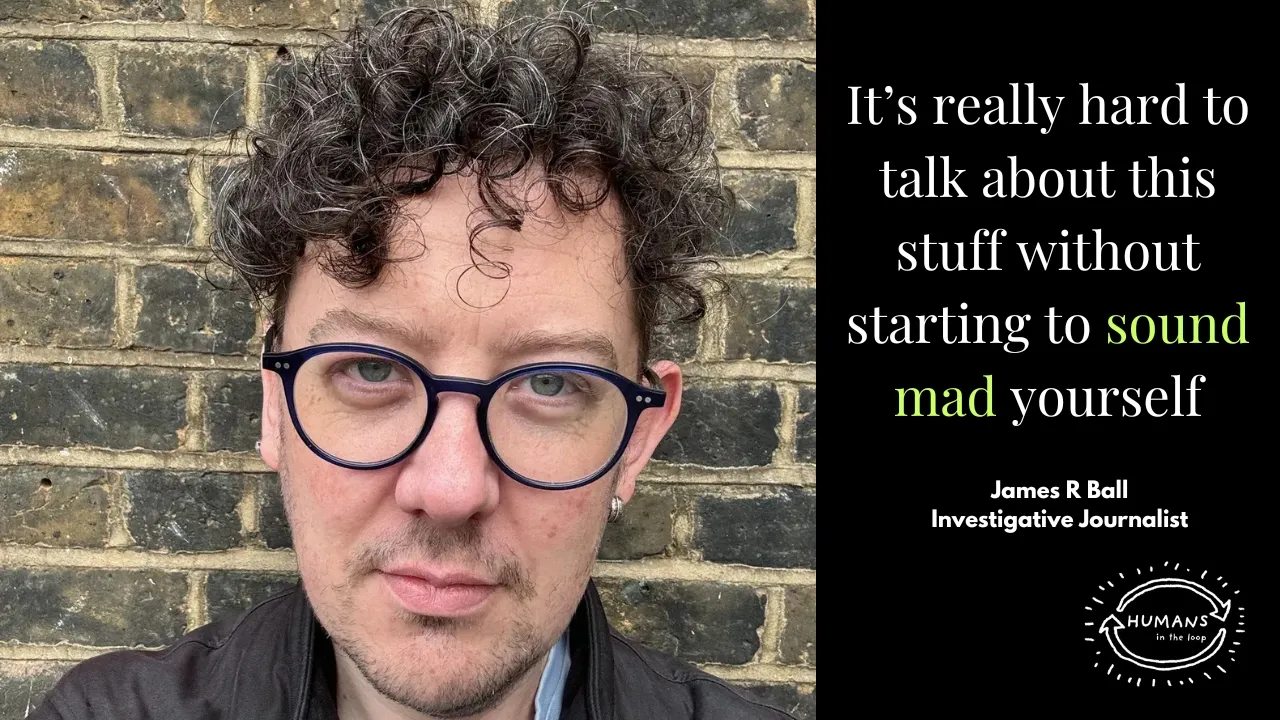
James R Ball
Investigative journalist
About this episode
How do ideas, however crazy they might seem, spread?
Who’s a true believer vs. a grifter following the money?
Can you talk about Epstein and QAnon without losing your rational mind?
How can investigative journalism move with the times?
These are just some of the questions I sat down to discuss with award-winning journalist and author James R Ball.
He has worked as the global editor of TBIJ, a special correspondent at BuzzFeed UK and special projects editor at The Guardian , where he played a key role in the Pulitzer Prize-winning coverage of the NSA leaks by Edward Snowden, as well as the offshore leaks, HSBC Files, Reading the Riots and Keep it in the Ground projects. At WikiLeaks he was closely involved in Cablegate – the publication of 250,000 classified US embassy cables in 2010 – as well as working on two documentaries based on the Iraq War Logs.
James is the author of multiple books, including Post-Truth: How Bullshit Conquered The World and The Tangled Web We Weave: Inside The Shadow System That Shapes the Internet . His most recent book, The Other Pandemic: How Qanon Contaminated The World , was published by Bloomsbury in July 2023.
Full transcript
Humans in the Loop
James R Ball (00:00)
this idea that Hillary Clinton was running a global satanic pedophile ring. if influencers are telling a story better than a train newsroom with a hundred journalists, that should probably reflect pretty badly on the hundred journalists. If you hear Joe Rogan talk about it, he only ever talks about it as a blackmail ring. And this was the first court document that named Prince Andrew. as allegedly having been involved in abuse.
Seb (00:25)
how many people are true believers in all of this and how many people are basically grifters
James R Ball (00:32)
It’s really hard to talk about this stuff without starting to sound mad yourself,
Welcome to Humans in the Loop
Seb (00:47)
Welcome back to Humans in the Loop. Today I’m joined by James Ball. James is an award-winning journalist, broadcaster, and author. He’s worked at organizations such as WikiLeaks, The Guardian, and now as political editor of The New World. He’s been a part of breaking some huge stories such as Edward Snowden’s NSA leaks, and has written several books on topics related to the internet and online phenomena. James, welcome to the show.
James R Ball (01:14)
delighted to be here.
Chasing what goes viral
Seb (01:16)
So I guess as I look at your body of work, James, it seems to me that a kind of central theme relates to how information, credible or otherwise, spreads online. So where’s your, the origin story of this topic for you?
James R Ball (01:34)
I, you kind of come into it through self-interest, you know, as, as a journalist and especially as an investigative journalist, you, you’re trying to get people interested in whatever you’ve managed to dig up. Um, and WikiLeaks especially kind of came into this with this really idealistic and utopian, and I would now say naive view that actually, if you put the data in front of people, if you put the raw files in front of people, They would want to look through them and they would want to find their own stories and their own narratives. You know, that’s why WikiLeaks is called Wiki. You know, the idea would be that it would almost work like Wikipedia. You’d have documents and then people would write stories. And people didn’t really want to do that. People, turned out, wanted to see a document for verification, wanted to have the confirmation something was true, but they… sort of actually want the narrative to be there. They want a story. They want something to pull them in. And so you saw that it would increasingly produce something to sort of give the narrative, to give the shape. Quite famously with the collateral murder video, which is sort of helicam footage from Iraq, which shows the US sort of killing a group of people that included two writers, journalists, and then Gunning down a guy that tries to rescue them. It’s really harrowing. And that footage is real. The commentary is real. They put the full extended camera footage that they were leaked online, but they edited it down. They made a cut and they put narration on it and they explained it. And it went much more viral because they did. So as an investigative journalist, you work on these things for months and then people kind of don’t care and they’re reading a celeb story or a really dumb bit of the scandal or people do these huge investigations on things like MPs’ expenses back in the day. And the story we all remember years later is that someone claimed on a duck pond. And so I got interested in it because you start thinking, well, what catches on, what spreads, what goes viral, what doesn’t. And it starts because you want to get your stories out. And then increasingly I just started going, well, hang on, actually there’s, there’s loads of stories in this as well.
Inside WikiLeaks
Seb (04:01)
what are you able to share about how you became a part of WikiLeaks and what it was like being a part of an organization like that?
James R Ball (04:08)
Yeah. So I should say if we’re talking about stories and information, WikiLeaks would tell you, I am a very unreliable source. They would say I was an intern there for a short time, that I stole material from them and that I kind of sold them out to the mainstream for careerist ends. I would have a fairly different version of events. Truth may lie somewhere between the two. We all see things from our own perspectives. WikiLeaks sort of presented itself as a whistleblowing platform, somewhere you could securely sort of submit documents and it would get them published to the world. And it had a pretty amazing early track record of this. It kind of posed as this very big, very mysterious organization. It claimed to have been started by academics and lawyers, mostly in China. This wasn’t true. It was almost all one guy, Julian Assange and a couple of his mates. But they published amazing information on the global financial crash. They got the internal records of three of the failed Icelandic banks and got them online when other people couldn’t. When a ship carrying toxic waste dumped it off the Ivory Coast, a company called Trafegura was involved in that. They got a super injunction out in the UK, so no one could report it. The Guardian and the BBC had both found out about this and were trying to tell the story and they couldn’t. And WikiLeaks managed to publish the document that got the super injunction lifted because a judge said, well, it’s on the internet. Everyone’s talking about it. It doesn’t make sense for me to stop the BBC and the Guardian saying it now. And then most famously, it got a lot of material from Chelsea Manning. on how the Afghan war unfolded, how the Iraq war unfolded and a whole cache of state diplomatic cables. And those are what I worked on. I was working for a not-for-profit journalism newsroom at the time. I was like 23, 24, and I knew how to use computers. And our editor had had sort of a hookup with Julie Nassandra was trying to sort of pitch for, hey, bring us in on this collaboration. You know, we, we can make TV out of it. We’ll work with channel four with Al Jazeera and they wanted someone who spoke nerd. and so I was, I was sort of brought in and Assange quite liked me and you know, he sort of stayed in touch. do this like 12 hour day trying to turn around all of these Iraq war logs to make a TV program in six weeks with a crew in Iraq, with all of this. I do this 12 hour day and get home. And then online message with Assange for like another five or six hours. And so I was
Seb (07:01)
Wow.
James R Ball (07:02)
incredibly sleep deprived. And
Seb (07:04)
Mm.
James R Ball (07:05)
eventually he sort of said, if you want to work on the state cables, you’re going to have to come work for WikiLeaks. And then that period was when Assange got arrested, you know, when he spent his first week in jail, when all sorts of chaos happened. I think WikiLeaks was genuinely quite innovative in terms of being a publisher that was basically impossible to censor. Because it didn’t have a proper corporate structure, because people were very mobile, because it was sort of agile and small, court orders didn’t really work on it. You couldn’t meaningfully threaten to sue it. And so I call it a publisher of last resort, you know. If people try to censor bigger establishment media, WikiLeaks was like the bogeyman that could keep sort of the courts honest, keep other forms of censorship honest, and keep the media honest. It posed as something a bit more dramatic as this amazing whistleblowing tech. Sadly, a lot of its sources actually got caught and ended up in jail because whistleblowing is way more human than it is technical.
Seb (08:13)
Hmm.
James R Ball (08:13)
You know, even if you’re not caught because you leave an audit trail, you tell people or you feel isolated or your behavior makes you stand out or other
Seb (08:23)
show.
James R Ball (08:23)
things you’ve done mean you get found. It’s often not the very act of how you send something to the journalist. And so that side of it was trying to solve a human problem with technology, which maybe has become a recurrent theme of the last, you know, 15 years since.
How QAnon began
Seb (08:41)
Yeah, yeah, fascinating. And let’s talk a bit about QAnon. you know, when we think about the, this sort of theme of information spreading online and I guess specifically misinformation, unless you are, you know, the conspiracy believer and you think Q is, is some, you know, do say government guy who holds all the secrets or like whoever the latest person is meant to be. So in 2023, you published a book, The Other Pandemic, talking about the rise of QAnon. Can you explain for those who totally had their head buried in the sand and are not familiar with what QAnon is? Can you explain a little bit of the origin story of QAnon specifically and sort of how that came to be?
James R Ball (09:29)
Yeah. So, I mean, I really envy anyone who’s never heard of it. I mean, God, that would be wonderful. It kind of looks very superficially like it starts a bit like WikiLeaks, like it starts with a whistleblower. At the centre of it is this sort of mysterious figure called Q, who seemed to drop in 2017 cryptic hints that Hillary Clinton and a sort of bunch of her co-conspirators were about to be arrested. lots of sort of quite nomic little hints were there. It sort of always told you to think for yourself to sort of follow the trail, follow the breadcrumbs was a big phrase. And so it would say, you know, why don’t you find a friend who’s in the National Guard and ask them why they’re mobilized next weekend? Why don’t you? And so it seemed like it was giving lots of ways to corroborate what they were telling you. And none of them actually corroborated anything they were telling it. quite quickly, idea queued themselves never actually said this, but it merged with things like the Pizzagate conspiracy theory and a few others into this idea that Hillary Clinton was running a global satanic pedophile ring. with lots of cooperation from wealthy backers and other world leaders. And Donald Trump was at the center of fighting this, but was having to do it in a very secret way to throw the deep state off the, off the trail. And this arose initially on 4chan, which is sort of basically a fairly trolley, fairly right-wing messaging board where everyone’s anonymous. quite important context to it is that people there mess with each other and almost play games. And at that time, there was a bit of a game about pretending to be government insiders. And that’s because on Twitter, as it was then, people were pretending to work in things like the federal park service or in other bits of the government and being resistances to Trump. And so, you know, you had Park Service Anon and they post vague anti-Trump messages or pretend that they’d put up a sign in their work and get thousands and thousands of retweets from left-wingers and liberals who they were basically grifting for attention. And 4chan started playing and so they had CIA Anon and NSA Anon pretending to be pro-Trump patriots inside the intelligence agencies. whoever Q was came along to the party a bit late. And so the CIA had been taken, the NSA, you know, national security agency had been taken. And so they needed a name. And there is something called Q clearance, which exists in the department of energy, which handles things like nuclear waste and other stuff in America. And so QAnon to say Q level clearance. And they were just the best writer and it kind of escaped sort of 4chan where everyone sort of knew that it was someone playing a game and skipped into YouTube, skipped onto Facebook, and eventually millions of people started believing, even though Q had sort of said, hey, you know, Clinton will be arrested any day now. And it is now nine years on since the first post and Hillary Clinton remains unarrested.
Seb (13:04)
Mm.
James R Ball (13:04)
But people started to believe there was something behind this. And increasingly over time, Donald Trump and the people around him started to embrace the conspiracy theory, probably not because they believed it, but because they knew lots of their fans did.
From satanic panic to mainstream conspiracy
Seb (13:20)
And what’s your view? Cause as you say, there are a bunch of these kind of playful games, I suppose, going on online at the time. And maybe some people realize that it’s a game. Maybe some people do buy into whatever is being shared. But, know, prior to that point where Trump and others in the kind of so-called mainstream start to really amplify this stuff. What’s your assessment of why Q specifically gains momentum? Because, you know, we’ll come on in a minute and we can talk about Epstein and, you know, the kind of, pedophile ring of elites and what’s really going on there. But on face value, the claims are just like totally outlandish and sort of ridiculous and There are things like Pizza Gay whereby this is my understanding of it is yet supposedly this pizza restaurant that is kind of the epicenter of where some of these elites meet and where some of these child exploitative practices are going on. How does all of this stuff get from
James R Ball (14:33)
Yeah.
Seb (14:33)
like weird conspiracy to mainstream ultimately?
James R Ball (14:38)
It’s really hard to talk about this stuff without starting to sound mad yourself, isn’t it?
Seb (14:43)
Yeah, yeah.
James R Ball (14:44)
Let’s try and park Epstein if you’re going to talk about it later. People knew a bit about Epstein at this point. I’d reported in The Guardian in 2015 that Prince Andrew had been named in illegal filing relating to Epstein. Epstein had had his first conviction all the way back in 2009. People sort of knew that he’d been friends with the Clintons, sort of knew he’d been friends with Gates. So there was a little backdrop of people knowing there was kind of something real. But then there have been satanic panics through the 80s where people, there was a whole scandal around what was called sort of not recovered memories, where people who sort of thought they’d had perfectly happy childhoods. because they had, went to therapy and therapy and hypnosis recovered memories of truly horrifying abuse. And what happened was the nature of the therapy was implanting these ideas. People were coming to believe false events. But at the time, lots of therapists said, no, this is real. We are recovering stuff that actually happened, even though it was completely ridiculous. You know, it would involve tunnels where they didn’t exist, child sacrifice, all sorts of stuff. So it tapped into these old recurrent ideas. There are a lot of old antisemitic ideas that go back centuries around Jews doing ritual sacrifice of Christian children. That dates back to the 11th century. And so people won’t have known that. They probably didn’t know, but there’s these old ideas that surface and resurface and resurface. And know, it’s like, why do we still tell Shakespeare’s stories? They capture us again and again, each generation, the good stories survive. And so it picked up lots of different bits of different conspiracy theories. Pizza Gate was an interesting one because it was quite confused. People found WikiLeaks comes into it. As I say, you start sounding mad when you do this. WikiLeaks published a bunch of hacked emails from a guy called John Podesta, who is a senior aide to Hillary Clinton. And when it published these emails, people quickly realized they were really boring. And so again, some trolls kind of just having some fun said, why don’t we try and convince people that they’re in code? I will say that spaghetti means a girl and pizza means a young boy. And I think it’s the other way around actually, but. And let’s see what happens. And it really caught on. But then some people got confused and thought it actually was pizza parlors, et cetera. And so this guy went into Comet Ping Pong in Washington, DC with an automatic rifle and demanded that they free the kids in the basement. And these terrified staff had to show him that it didn’t have a basement. There literally wasn’t one. There aren’t many in DC. It’s the soil. And so, you know, you had all of this and QAnon was really clever. It’s not like an old school cult. It like said, Hey, you know, do your own research. It encouraged you to self radicalize. And so if you were really into the deep state and the idea that the FBI or the CIA covered stuff up, you’d follow that bit down. If you were aware of Epstein and bothered about sort of child abuse, you’d follow that down. And so you could kind of radicalize yourself on the bits you believed before you really had to look at the other bits too much. And so it kept expanding what was included in it. You know, people start bringing chemtrails and anti-vax in it. It was there when COVID started and everyone went a bit insane during COVID. know, lockdowns weren’t good for anyone’s mental health. And then… You would see a bunch of YouTube influencers who previously had been talking about alien abductions or whatever, switch to QAnon because that’s where the traffic was. And that’s where the money was. It took years for QAnon to be demonetized. And so some of it was just influencers following financial incentives. And then if you’re a politician and you’re in MAGA and you suddenly see that lots of people are talking about this stuff or you’re, you know, a pro MAGA influencer. Hey, you know, why not lean into it a bit? You don’t have to say the most insane things, but QAnon had loads of slogans. Why not just say one of the slogans? Why not say something you know they’ll like and get this rabid fan base who’ll attack all your enemies and think that you’re part of this amazing underground resistance. So it’s not like it’s a plot. It’s just lots of different people had good reasons to go along with it.
True believers vs. grifters
Seb (19:42)
Yeah, I guess one thing I wrestle with around this, and I’m sure a lot of other people do too in some form is how many people are quote unquote, sort of true believers in all of this and actually, you know, they buy into what is being said and how many people are basically grifters profiting off, you know, the core message being sold. you I guess you have someone like Trump come along and embrace it. And yeah, I don’t for a minute believe that Donald Trump believes in the QAnon conspiracy, you know, opportunistically, as you say, saw an opportunity of hear a bunch of people who buy into this thing. Here’s a great opportunity for me to sort of amplify it and profit from it. So having been kind of inside the thing, having studied it, what’s your take on? dichotomy of like the, you I don’t know what really the heart of the question is here is like, how many people are like true believers versus like how many people are just sort of grifters profiting from the story?
James R Ball (20:54)
It’s a weird one, this, because it’s a fascinating question. It’s a question that lots of people ask. It’s kind of the question that I used to ask all the time. And it’s really taken covering this stuff for about 10 years for me to increasingly think it sort of doesn’t quite work like that because you sort of go, well, this person believes the conspiracy theory and this person’s just cashing in. And they know what they’re doing or, you know, Trump knows what he’s doing, but our brains kind of don’t work like that. You know, it’s very hard to start going and saying lots of things and getting lots of support and getting lots of cheering. And they go, but of course I don’t believe any of it. You know, these people are all stupid. Ha ha ha. And so I think some people went in very cynically and went in kind of saying, well, I’ll just cover it. I don’t have to believe it. I’m just summarizing these queue posts. It’s fine. And then suddenly they, you know, their following’s gone up by 10 times, by a hundred times. People are calling them a champion of it. People are sort of saying that they are one of the leaders of this. And they kind of self radicalize because it gets a lot easier if you believe it. You don’t want to go, Hey, am I about to make a load of people do a really dangerous thing? Or am I about to make them ruin their life? We all kind of want to be the hero of our own story. We all want to be the good guy. And so I think people go into it insincerely and start to kind of half believe or a little bit believe or kind of go, well, you know, I’m only testing the ideas, but it could be true. I don’t know. It’s not true. And now all of these people are emailing me with all of these, you know, things they think they’ve found. Yeah. Maybe I hit on something here and they kind of get themselves into it. But on the flip side, imagine if you actually thought that everyone running the world was killing ritually thousands of children a year for some kind of sacrifice. Would you really just post on the internet for a half an hour a day and then get on with your normal life? I think if I fully believed that, I think… people who fully believe it would be mobilized to violence a lot more, or would be mobilized to major action or to try to throw. I don’t think you could go around living most of your life thinking that everyone in a position of responsibility in your country is kidnapping and murdering children. And so I think there’s this odd thing with conspiracies where there’s a slight playfulness or a slight, well, it might be true. I like
Seb (23:46)
Mm.
James R Ball (23:46)
to feel knowing I think it’s possible. But I don’t know for sure. I’m just testing. I like being in the know. There’s an element of play to it, however serious it is. you know, maybe to other people that occurred straight away, it’s kind of taken me years to realize that. And
Seb (24:05)
Yeah.
James R Ball (24:05)
it means that this question that’s so fascinating, you know, does Tucker Carlson believe it? Does Donald Trump believe it? I still wonder it all the time, but I don’t think it’s actually as important a question as it feels to be. you know what I mean? I’m really not trying to tell you that was a bad question because it’s not. It’s a brilliant question.
Seb (24:19)
Sure, yeah. No, no, no, no, no.
James R Ball (24:24)
I just think the answer is kind of weirder than you think it’s going to be.
Seb (24:28)
Yeah, yeah, it almost seems a bit more like as I hear you saying that it’s almost a bit more kind of what a there’s obviously shades of gray. And B, I wonder if there’s just a community element to sort of feeling a part of something. And, you know, almost the more I guess there’s something in a lot of us that likes to be a part of something that feels a little bit exclusive, you know, that you feel on the inside of something that other people don’t know, can’t be a part of. And so, yeah, I wonder to your point as like, you know, even just hearing you say that, I was kind of thinking of it as like, well, either you believe it or you don’t, but yeah, perhaps it’s just the thing of like, well, I’m now a part of this community and there are a bunch of ideas. flying around in this community just by partaking doesn’t necessarily mean I swallow them all whole, but maybe I just keep my mind open to the fact that some of them might be true.
James R Ball (25:29)
I think that’s exactly right. Think about how we bond as people, especially in groups. People signal, even just very normal, healthy friendships, you signal that you’re relaxed in your friends by telling a slightly dodgy joke that you wouldn’t tell at work or in company with people you didn’t know very well. Or you might be bit indiscreet. You might reveal a bit of gossip and you’re partly revealing gossip because that’s fun and that’s funny, but it’s partly, hey, I trust you guys, you know, we’re there. And that sense of in-group and out-group comes, as you say, that exclusivity. And so when it’s driven around a conspiracy and that sense of, we know something, the rest of you don’t, we believe something, the rest of you don’t. Once that’s in your life, it becomes really important. It becomes a huge source of meaning. and a huge source of your social interaction with your friends. Especially if you’re quite serious about it, your real life relationships will probably be getting worse. People get quite obsessive about this. They start trying to convert their partner or their kids or their friends who will usually react quite badly. And that means the people who will actually listen to you and take it seriously and take you seriously become more important. And that means when they say weird shit, don’t, or weird stuff. Sorry. won’t swear. you don’t want to push them. You
Seb (27:02)
Swear away.
James R Ball (27:03)
don’t want to push them away. You know, you don’t want to do that. And so, yeah, you might be fully signed up to the idea of the deep state. And then someone starts talking about how they put chemicals in the water and they do brain control with chem trials. And you might think, I don’t really believe that, but I don’t want to get in a big fight with everyone. And then. After a little while, you start going, well, if the other stuff’s happening and I agree, you know, I think they’re right about the deep side that maybe they are right about the chem trails and maybe they are right about the, just slowly without anyone trying to radicalize you, you sort of become more and more open to more of it. And I think that social side of it is really important. And it’s what we miss when we talk about information as if it’s just about fact checking. You know, we don’t all just sit there going, Hmm. And what’s the source of this fact and how well, you know, has, how consistent has this reporters track record been and which outlets have they worked out and how you think, who have I, you know, who have I heard this from? Who else that I know believes this, you know, who, how does it fit with what I already think? And if we don’t think about that social element and that almost tribal element, we’re going to miss it. You know, you’re, and you’re not going to change. someone’s social group with a fact check, you’re not going to have them transform who they hang out with, or their sense of identity with it. And I think, you know, identity, community are really important in all of this.
Radicalizing young men: the Manosphere
Seb (28:37)
Yeah, yeah, that like social. It’s almost like an experience of information, you know, where you can think of information as this sort of standalone like entity fact or sort of fiction. But I guess what we’re touching on here is almost, well, it’s it’s sort of shared sense making or storytelling that is going on amongst a group here. And those are some the outside might find the stories or the information being told. more or less credible, but sort of being a part of it is, yeah, I guess an interesting lens I hadn’t really considered. know, QAnon, again, we will come back to the Epstein element here, but talking about radicalization, you know, another community or phenomena or however we want to label it is the Manosphere, something that, know, Louis Theroux recently had a… documentary out on Netflix. adolescence was kind of Netflix’s huge hit of last year, which touched on this theme, I guess, for a lot of parents, it’s a theme that, they’re confronted with thinking deeply about, how do I raise my, my children, particularly young boys in the modern world? And with this kind of information flying around. So I guess, you think when you think of other examples of so-called radicalization online, do you think it’s like those same dynamics at play or does it work differently in kind of each context?
James R Ball (30:12)
It’s almost always the same dynamics. It’s people who are dissatisfied in life for some reason or other, usually. Sometimes very content people go in, but, you know, young men are often pretty angry. Hormones of puberty are awful. Being a teenager is pretty awful. You know, being a young guy and, you know, you’re not, you know, you’re not getting the attention from girls that you think you should, or maybe you’re into guys and you don’t know that yet, or you’re not, you haven’t worked all that out yet. So you’ve got all of those kinds of things going through. You’ve got hormones at huge levels. You are furious at your parents. You’ve got huge pressure from school. Just everything’s around. You’re looking for releases. And if you know, if you’re not social, if you don’t have sports or you don’t have a great group of friends, you look for it online. And you might come across this stuff that seems to have the answers. It also seems to explain why life seems so unfair to you, you know, why girls don’t look at you the way you think they should or whatever. And you’re going to be a bit prone to falling into that. But in the same way with QAnon, you found a lot of women in their sort of forties would go into that often through health stuff. You know, there are a lot of chronic health conditions that affect women much, more than men. Things like ME, fibromyalgia, endometriosis, obviously pretty much exclusively women. the health systems are terrible at diagnosing them. There are rubbish treatments. People have this awful pain, this awful isolation. They feel cut off from their partners, their friend, the world. They feel almost mocked by the medical system. They’ve got all of these angry, you know, anger and resentments and look online and they sort of go in through, maybe acupuncture or alternative medicine will help my symptoms and end up radicalized in through sort of woo into anti-vax, into chemtrails, often into full QAnon because a lot of these women are mothers that are worried about their kids. And so, you know, QAnon was interesting because it could radicalize the teenage boy and his mom. And most movements don’t work like that. With the Manosphere, though, there’s kind of something interesting extra going on. There have always been angry young men, and there have always been ways in which they radicalize, you know, to the far right, to skinhead, to sort of drug gangs, to, you know, people always used to talk about the drill scene for sort of young black men in London. the Manosphere is a new one of them. It’s pretty repellent. I I find it awful when I look at it. There’s not much evidence it’s bigger or pulling in more young men than before. Like when you look at the macro level, the kids are all right. Like the young men are pretty much all right. British young men are really left wing by and large. You know, they vote for the greens, they vote for the liberals, they vote for labor. They are generally pro-LGBT. are generally pretty feminist. They think women should have access to abortion. They think women should be paid equally. You have a small sort of group of young men who are Tory. There are more right-wing young men than right-wing young women, but that’s partly because young women have really gone left-wing in the last five or 10 years. But young men in Britain haven’t shifted to the right. haven’t markedly, you know, on average, they are going to be more feminist, more progressive than the two of us. Sorry, unless you look way younger than you are. think you’re a bit younger
Seb (33:58)
Thanks
James R Ball (33:59)
than me, but not tons. 20 year old men, 16 year old boys are overall kind of fine. And I think because we like a moral panic, worrying about these things is also an in-group activity. If you’re a liberal, if you’re an adult, if you’re in a bunch of other things. think sometimes we exaggerate this. so the Manosphere exists, it radicalizes people in the same way as any other conspiracy theory. It ruins the lives of people pulled into it, as well as people around them who they might harm physically or emotionally abusively. It needs looking at, but also we can exaggerate it. I
Seb (34:41)
Mm-hmm.
James R Ball (34:42)
think sometimes we give young men a worse name than they deserve.
Seb (34:47)
Yeah, yeah, I’m certain that’s true. No, no,
James R Ball (34:49)
I wasn’t accusing you there, sorry.
Seb (34:51)
no, no, no. I mean, I’m certain that’s true. I’m certain that’s true. all of us are sort of somewhat through our own pocket of the world, which somewhat trying to sort of put our finger in the air and guess which way the wind is blowing, what the temperature is, you know, we’re, we’re trying to kind of often read into these like macro things about the world based on our own micro experience. And given the way that, algorithms have optimized for, engagement. which has become increasingly synonymous with kind of rage, basically. Yeah, it’s almost like all of these things that are extreme just get way, way, way more airtime perhaps than they once would have done. And therefore, there’s probably a part of our brain that just the kind of the availability bias of that makes us all of a sudden think, well, young men, you know, I’m 35 years old. I don’t know any boys of that age, you know, like I’ve got a newborn daughter, like one day she’ll get to that age. And then maybe I’ll have a kind of some sort of anecdotal thing to look at there. But at the moment, you know, my sense of like what 12 year old boys talk about or do in the playground today, it’s shaped by this kind of thing. Like, I don’t know, maybe they’re all still playing football like I was, know,
James R Ball (36:15)
Yeah.
Seb (36:16)
like trading Pokemon cards or whatever it might be. And so, yeah, I guess we also just live in a time that lends itself maybe more towards these amplified moral panics, even if there is a kind seed of truth behind.
James R Ball (36:31)
Yeah, and I think some of this is we’re all navigating loads of information. We’re all navigating loads of anxieties. The world is kind of terrifying at the moment. And so we tend to latch onto alarming information, but we particularly latch onto information that kind of confirms the world is as we think it is. You know, that tends to very easily be absorbed and stay with us. And so if you’re worried about young men or you’re worried about extremism or polarization, anything that tells you that’s happening kind of will stay and will know, if you’re an anxious person will become a, a sort of preoccupation, but also lots more people will encounter their kids running into Manasphere content, for example, or conspiracy content or whatever it is, you know, for mostly for teenage girls, but not only for them, say pro-anorexia content or other eating disorder content, things like that, orthorexia that, that did a lot of, of rounds. A lot more people will have their kids encounter that than will have kids for whom it becomes a problem. And so, you know, a common example is quite a lot of teenagers try pot. You know, trying weed is not that uncommon. And for most teenagers who try it, most will find they don’t really like it and won’t ever really do it. A few will start picking it up as a fairly regular habit and a really small fraction will start developing. drug problems with more serious drugs, or will be the unlucky ones for whom it activates a predisposition towards schizophrenia or some other psychotic mental illnesses. And so this huge group of people who try weed, their parents might be anxious. You know, they don’t know if their kids are in this huge, big safe group, or if they’re going to be in one of the tiny ones where it’s going to be awful for them. And the manosphere is fairly similar. My brother is a good way older than me. He’s a very old man now, late 50s, ancient. But that means his two sons are in their 20s now. And I can remember when they were in their teenage years, they just suddenly both started talking a little bit weirdly about women. And they were not brought up like that. And there was just a bit of, hang on, what? What the hell do you think you’re saying? know, both, both their mom and their stepmom they’re from Yorkshire and they had no time for that nonsense. And pretty much, verbally smacked them down and they’re nice lads. They sort of took, took the punch and then it’s like, well, where did you hear that? this Andrew Tate guy. And they’d seen some of the videos online. They found bits of it funny because they were like and 14 or whatever it was. And then they kind of went, yeah, this guy’s an idiot. and moved on, especially when they got girlfriends who had
Seb (39:22)
Yeah.
James R Ball (39:23)
no tolerance for any of that nonsense. It was dropped. Were they ever really into it? No, but if you’re worried about it and you suddenly hear your kids watched one of these videos or seen it, your brain’s got to go down the worst case scenario and imagine them as a mass shooter or something. Trying to find that right level of vigilance where you can help people, you can guide it without it turning into panic or despair at the state of the world. It’s actually really hard at the moment because it does feel like everything is blaring red alert all the time at the moment, doesn’t it?
The real Jeffrey Epstein story
Seb (40:03)
Yeah, yeah, absolutely. Absolutely. I’ve held off on it up until this point, but let’s touch on Epstein and I will.
James R Ball (40:13)
Good old Epstein.
Seb (40:14)
Good old, good old Jeffrey. Um, had we been having a conversation about QAnon, I don’t know, two, three years ago, uh, there’d be a certain tone in the conversation that might be that, you know, yeah, this whole thing is mad. Isn’t it? Ha ha look at what is going on here. I guess the more that has come out about Epstein and, his links to global elites, the more people look back at QAnon and go, okay, you know, maybe it’s not the exact story that was told there, but like, it’s not a million miles away. So Yeah, I’m just interested to get your take on it as someone who has been close to QAnon and I know there are now various sort of conspiracies laid on top of the conspiracy. What do you make of it, know, in light of what has come to light about Epstein? Does that sort of change your views at all about QAnon or what do you make of the whole thing?
James R Ball (41:18)
Yeah. So I wrote about Jeffrey Epstein long before I wrote about QAnon. And as I say, what I wrote was I got this anonymous tip off that someone had managed to file a complaint into a US court, genuinely a couple of hours before midnight on New Year’s 2014-15. What can happen in US courts is that things end up filed under seal so that you can’t see the documents and report on them. And this Epstein victim had filed on a kind of public holiday, you know, on this divide, so that someone had a few hours to see it before it got sealed so the story could come out. And this was the first court document that named Prince Andrew. as allegedly having been involved in abuse. The victim was anonymous at the time. We now know it was Virginia Giuffre who has sadly killed herself in recent years, shortly before her book was published. And so, the thing with Epstein is for years, the victims have been trying to get their stories out. And for years, actually, the mainstream media has been trying and We got threatened with lawsuits. The victims got threatened with lawsuits. Giuffre herself had to settle some of those suits. And the facts are incredibly messy and the effects are incredibly depressing. And a lot of it isn’t four-year-old girls who are kidnapped from their nice parents and murdered. Troubled teenagers are sort of lured into paid jobs. of being a masseur or something like a masseuse. And they are then sort of used for sexual services, but they’re paid very well. They’re otherwise treated very well. They’re kept around and then, Hey, why don’t you bring your friend along to do this? And they, are then used to recruit other people. And so they feel guilty. They feel complicit, you know, if they later learn what’s happened was criminal, it was abuse. Well, they recruited other people. So might they go to jail? So there’s no clear, you know, in a conspiracy theory, you have innocent victim and evil, terrible person. And what was so clever about how Epstein operated his abuse ring was that he made the girls feel complicit. You know, as they left, they often had money to go towards university or to do a training course or to travel. And again, this is how real world conspiracies work because a lot of the men who are involved could tell themselves, well, these girls must have known, you know, they know what masseuse means. You know, they do this for a couple of months and then they go on with their life. No one’s really harmed. that’s not what happens. You know, it is abuse. is incredibly cynical, industrial scale, awful abuse, but they can rationalize it. I’m sure Epstein could tell himself he wasn’t that bad a guy, well, everyone knows who I am. Everyone knows what they’re doing. And so it doesn’t fit the conspiracy theory framework. It fits conspiracy. everything’s a bit gray. Everything’s a bit muddy. There are lots of attempts from mainstream outlets, mainstream reporters to try and tell the story, but it doesn’t have this great overarching narrative. There’s not this great purpose. And so the odd thing that you find with Epstein is everyone wants to talk about anything except the abuse and anything except the girls. If you hear Joe Rogan talk about it, he only ever talks about it as a blackmail ring. Or, you know, who was blackmailing who, who was behind it. And like these Epstein files, you’ve got huge crimes admitted in there. You’ve got huge sort of wrongdoing. There is nothing in there with any suggestion of blackmail because the whole thing’s more subtle than Epstein used these girls to preserve friendships in the same way that conspiracy theorists use secrets to preserve friendships. And then
Seb (45:27)
Mm-hmm.
James R Ball (45:28)
he would ring up as their good buddy and ask for trading information or ask for some leaked minutes or ask them to keep his bank accounts open. You know, it was favors, it was friendship, it was patronage. people will go, was it Mossad or was it the CIA or was it because they want it to be big and nefarious and conspiracy theory-ish and not just this rich dude who sort of had this serial compulsive habit to abuse hundreds and hundreds of women and, procure them for his friends who would not ask too many inconvenient questions. And so it’s kind of the opposite of a conspiracy theory. It doesn’t fit the characteristics of it. And so what I see when I look at it is the real suffering of very real victims and the real crimes of very real perpetrators being distorted and almost being hidden to try and fit a conspiracy theory narrative. QAnon did nothing to bring Epstein to light. You know, they weren’t right about shit. Conspiracy
Seb (46:35)
Yeah.
James R Ball (46:36)
theories never are. And the real, there are, I’m not crediting myself here, I did one or two stories on this, but there are US journalists who stayed on this for 10 years or more and kind of devoted their lives to it. And much more than that, the victims who have fought to try and get this story out and get some modicum of justice for years. And they’ve got these conspiracy cranks hijacking their cause, you know, it’s just a way to re-victimize them or to make them
Seb (47:04)
Yeah.
James R Ball (47:04)
disappear again, because They are less sexy and interesting than a blackmail plot involving Mossad.
Did Epstein plant QAnon?
Seb (47:11)
Yeah, yeah. guess the, mean, firstly, I think you’re a spot on to really highlight the core crimes that I think we could say with high degree of confidence have happened and the victims have, you know, and not take the focus off there. I guess one of the conspiracies on the conspiracy I have heard at the very least is that because we know that likes of Steve Bannon had a relationship both with Epstein and with the 4chan founder, And so I guess one of the theories I have heard is that the whole elite pedophile ring cabal narrative within QAnon was actually deliberately planted by Epstein and his posse as a sort of preemptive way to discredit the real story, that like if we, if we, to use a Steve Bannon term, I didn’t think those words would come out of my mouth,
James R Ball (48:19)
You
Seb (48:19)
but to flood the zone with shit, as Steve Bannon famously once said of like, well, if we put something out there through these like channels, and we make it sound like this crazy crank story, then the real thing can kind hide more easily in plain sight. so I’m interested. Yeah, yeah, yeah.
James R Ball (48:40)
It’s a compelling story, isn’t it? The thing is, I like it as a story because that’s how it would work in a film. Like you have
Seb (48:46)
Yeah.
James R Ball (48:47)
really competent villains, you have plot twists, you have people pulling the strings, you don’t have mess. And yes, Epstein met Moot who founded 4chan, but they met like once. And it happened to be when a board came back, when Paul came back, but that board had been up and down and up and down a whole bunch of times. I’ve met a lot of people once who turned out to be terrible people. I’ve met several people I used to work with, were January the 6th insurgents. Some journalism career long enough, some of them are far right influences now. Just because we met once does not mean that we’re teaming up, but people want it to be this sort of sweeping narrative. If you jump back, did any of it work? Pizzagate started in one place, QAnon started in another, they bounced around. But over that time, Epstein had been convicted for the first time in 2009. Most of his sort of bigger famous associations, et cetera, were over long before QAnon began. He was back in jail by 2018 or so. QAnon peaked in 2019. He was dead. Gislaine Maxwell was prosecuted over the same period. a lot of the Epstein story came out and peaked as QAnon peaked. So it doesn’t make any sense. Firstly, none of the evidence shows that happening. People are going, well, this person met this person and this person wanted to do this thing. And, and it’s like, well, yes, but you’re taking, you know, a dot here, a dot here and a dot here and going, therefore the picture is this big.
Seb (50:30)
Mmm.
James R Ball (50:30)
And it’s like, no, sometimes it’s just three little lines. the one I always like is this is from Snowden. general Hayden used to like bringing up these maps. He was the head of the NSA and when they had congressmen or senators in to like, look at the amazing operations, he’d kind of bring up these big networks of who was, who had been phoning or messaging who. And he’d go, Hey, do you see these big connections where hundreds of people have dialed into the same number? that’s how we know the middle of a terror nexus. That’s how we know where the controllers are. And, quite famously agents would go, we’d then look at who that was on the map afterwards, when the congressmen had gone and it would always be a pizza place or a curry house because who gets phoned by hundreds of people? you think you found something. No, you have.
Seb (51:25)
Yeah, yeah, yeah. Yeah.
James R Ball (51:27)
Most of investigative journalism isn’t going, hey, what’s this connection or what’s this story? It’s actually kicking the story you think you’ve found to bits. You stamp the hell out of it to go, is this definitely true? How
Seb (51:43)
Yeah.
James R Ball (51:43)
might I be wrong? What’s it there? The kind of dot joining the conspiracy theorists do or that happens with these kind of narratives of going, well, he met him and he did this. It’s actually the opposite of investigative journalism. It’s the opposite of getting to the truth. You
Seb (51:57)
Yeah. Yeah.
James R Ball (51:59)
get to a theory that seems appealing, and then you ignore anything that doesn’t fit it. the thing is, you know, this stuff, often go, hey, this is really interesting. I kind of like this to be true. Cause
Seb (52:13)
Mm-hmm.
James R Ball (52:13)
then also, if it was true that they, created QAnon, et cetera, then the world’s only got a few terrible people in it. And we don’t have to worry about millions of people self radicalizing just through
Seb (52:25)
Hmm.
James R Ball (52:26)
a weird accident of how the internet works. It’s easier. And so it doesn’t spark joy that they’re not behind it, you know?
Seb (52:37)
Yeah, yeah. Why let the truth get in the way of a good story? Somebody somewhere once said, suppose. Yeah,
James R Ball (52:43)
Who did say that? It’s a good saying, it?
AI, deepfakes, and the future of trust
Seb (52:46)
I don’t know where that one originated. James, I’m interested, we’ve been kind of circling this topic of information online and different kind of extreme examples. We are living through some pretty big technological changes in the world, a kind of ever accelerating pace. And there are very different narratives about where this all leads, you know, from people who say, well, actually, AI is great news when it comes to information, because mostly it means people get their information from something that’s kind of inherently quite sort of centrist and and kind of built around consensus. And then you have other people kind of say, well, yeah, but I can create a compelling, gen AI video of anyone saying anything. And so how are we meant to know what the hell to believe anymore when it comes to any sort of information? Where are you in this whole kind of topic? What’s your, what are your, what are your prevailing beliefs about information online and the kind of trajectory of it?
James R Ball (53:59)
Well, I think the one thing we have to acknowledge is it’s not like as AI comes in, we’ve got this amazing information ecosystem that is working wonderfully that we must preserve. We did not figure out social media as a technology. We didn’t make that work in a good way. We don’t reward good behavior. We don’t reward the best content either. You know, a lot of the YouTube stuff that really works is the bad version of the story. And actually there are better produced, better told stories. the algorithm doesn’t really reward. I think we can come into all of this going, there is the potential to make all of this better. We need to work out what good looks like and then make the technologies fall into line with that. I think it’s about incentives rather than about censorship, cetera. When you think about it that way, well, At least AI means that we’re shifting from social platforms. Information ecosystem is changing naturally. So if we can get AI right early, if we can sort of, whether that’s through regulation, whether that’s through voting with our feet as consumers, however we do it, it’s an opportunity in that sense. Deep fakes, I think, are always less of a threat in the information sphere than people think. I think there’s lots of potential for abuse, know, nudifying non-concentral porn, all of that, I think is a really serious and grave issue and is specific to deep fakes. But the number of times you will see a fake quote go viral or a fake stat go viral and it’s just text on a picture. I mean, the one I remember, and this is a little bit old, but when Theresa May was PM, About once a week, it would go viral that her husband was the main shareholder of G4S, the private security thing. And
Seb (55:53)
Okay, yeah.
James R Ball (55:54)
it was just made up. And every week I’d get emails going, why aren’t you reporting this? Why isn’t the mainstream media reporting this type of stuff? And he had nothing to do with it. It wasn’t even that he used to be the chairman, but he wasn’t anymore. He’d never worked for it. He didn’t work in the bit of a… He worked in banking, but he didn’t work in a bit of banking that invested in… You know, like it just wasn’t true. But that one picture or variants of that picture would do the rounds again and again. It’s like, well, people don’t need a deep fake to believe something false. If
Seb (56:28)
So, yeah.
James R Ball (56:29)
it suits their politics, if it suits their belief and it comes through their social networks, they’ll believe it. So the bigger threat with deep fakes is people using it to say true information is false. And so again, we’ve got to remember trust is a network. You don’t just have trust abstractly in the world. You you trust your partner, you trust, you know, if you pay for, if you subscribe to a particular media outlet, hopefully you trust that, you know, it is a relationship. It is two way. And so it’s more about deciding who we trust and then protecting that trust than going, we should be able to trust everything we see online. No, cause That’s how China tries to work. tries to say, censor everything that the government doesn’t say you should trust. No, thank you. And so how do we preserve it? How do we build it? How do we earn it rather than how do we get rid of everything that we don’t trust?
A hopeful vision for information
Seb (57:28)
If you look ahead with a hopeful lens what is it you would hope to see in the future when it comes to information, particularly as we’re talking about online?
James R Ball (57:38)
I hope as we get through this that we kind of all appreciate that finding out things is hard. People make mistakes. People sort of get there. We’re only human. I think there was a 20th century model of the media which involved a very posh man at the BBC with a very posh accent, sort of speaking with the voice of God and telling you everything you needed to know about the world today. You know, this is the news and I am the BBC and you have been lucky to listen to me, little man. and I think, you know, that was the era of authority and it worked for that technology. It worked for that time we’re past that, I don’t think anyone has ever got to go back to a media that transmits from above them and sort of tells them what to think. where I hope we can get to is where people are rewarded for trying to find things out, trying to tell things honestly from their own perspective. And. sort of appreciating the work that goes into this. I think as the media, we have to learn to tell stories. That’s our job. if people, if influencers are telling a story better than a train newsroom with a hundred journalists, that should probably reflect pretty badly on the hundred journalists. You should maybe be hiring the influencer and training them up a bit. But I hope we learn how to tell stories that match the technology, but I hope. If we start to see the end of this polarization, if we start to see the end of populists like Trump, I think exploit us by playing on our fears and our worst of it, we will look at what holds us together, how can we have a shared vision of reality and set up the incentives so the internet rewards that and so that the money rewards that. Some of that is also as the citizens going, if I want to keep this stuff, need to put my hand in my pocket where I can. If there is an independent journalist I really like, support them. If there is a news outlet I like, support them. But these things won’t survive unless we want them to and unless we make them. And I think we can all be better citizens, right?
Seb (59:53)
I’d like to think so. I’d like to think so. James, thank you so much for coming on. I really enjoyed the conversation. yeah, just want to say, appreciate you coming.
James R Ball (1:00:03)
Thank you so much for having me. It’s been really interesting as I’ve been talking about this stuff and thank you for good questions.


