/
/
55 min
Past mistakes inform policy
Dex Hunter-Torricke
Fmr speechwriter to Musk & Zuckerberg
About this episode
Dex Hunter-Torricke was a speechwriter and senior comms leader for the likes of Mark Zuckerberg at Meta, Elon Musk at SpaceX, Demis Hassabis at Deepmind, Eric Schmidt at Google and Ban-Ki Moon at the UN.
He has spent his career in the room where big decisions were being made that would shape the future of technology.
Eventually, the disregard for human and societal impact he witnessed led him to step away from a big tech career to found @TheCenterforTomorrow - a non-profit focused on how we can make societies flourish in an age of AI.
Subscribe now to never miss an episode!
I sat down with Dex to discuss topics such as:
From working in the UN to a career in big tech
What Dex learnt from working for the likes of Elon Musk and Mark Zuckerberg
The lack of regard for societal consequences
The refugee crisis, his father’s experience as a child refugee, and indifference he saw inside Facebook
How seriously we should be taking the restructuring of society which is going to take place
Why AI governance in its current form is worth a warm bucket of spit
International collaboration and the role of the middle powers
The comms mistakes AI leaders are making
Reform of education, welfare, taxation, climate action
Full transcript
Humans in the Loop
Dex Hunter-Torricke (00:00)
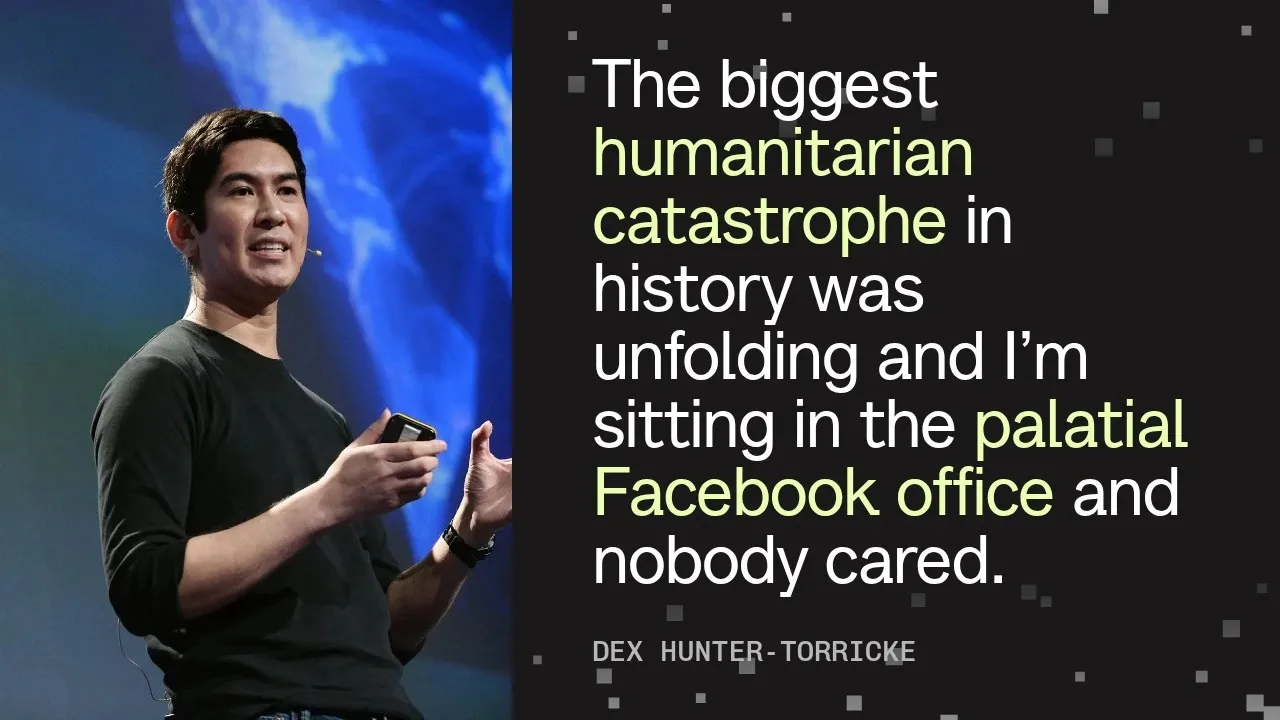
For me, technology is only interesting because it is about improving societies. the biggest humanitarian catastrophe ever in history, was unfolding. And I’m sitting in the palatial Facebook office and nobody cared. We’re at a moment now where there’s 12 billionaires in the United States who have as much wealth as 49% of the world population.
Seb (00:18)
it’s a great shame that like some of the greatest minds of our generation have basically been selling ads to people for their entire career,
Dex Hunter-Torricke (00:24)
most of the AI governance agenda that exists right now is worth a warm bucket of spit.
Becoming a speechwriter
Seb (00:40)
Welcome back to Humans in the Loop. I’m happily not unique in my belief that there are better ways to build technology for the common good. Today, I’m joined by a fellow advocate, Dex Hunter-Torricke. Dex spent many years working as a speechwriter and comms leader for the likes of Ban Ki-moon at the UN, Eric Schmidt, then Google CEO, Mark Zuckerberg at Meta, Elon Musk at SpaceX, and Demis Hassabis at DeepMind. He stepped away from big tech comms in 2025 to found the center for tomorrow. a nonprofit focused on how we build flourishing societies in the age of AI. Dex, welcome to the show.
Dex Hunter-Torricke (01:13)
Great to be here.
Seb (01:14)
Let’s start with you here if we can. Tell me how you end up writing speeches for some of the most powerful people in the world.
Dex Hunter-Torricke (01:24)
I think a lot of people end up in speechwriting almost by accident. definitely
Seb (01:27)
Mm-hmm.
Dex Hunter-Torricke (01:28)
I had no clue how to get into that role, and it wasn’t something I was necessarily aiming for. I fully expected I would be a policy wonk. so I was an intern at the UN after my master’s degree, getting ready to start a job back in the UK civil service actually. And then through a whole confluence of things I ended up put onto the communications. detail at the UN and they discovered I was very good at writing speeches and talking about things. So I got hired by the UN and I never never went for that job in the UK civil service. And yeah, I ended up doing a lot of things which were public facing. Most roles at the UN and then actually most roles in my career never ended up as particularly siloed things. You know, as well as being a speechwriter, I also dealt with media, worked on project management, public policy. And you know, I did a lot of public policy and governance work throughout my career as well.
From the UN to Google
Seb (02:23)
UN to Big Tech, I guess, is maybe an unusual pivot. So, yeah, what takes you from one to the other?
Dex Hunter-Torricke (02:31)
I mean, I was at the point very quickly after I went to the UN where I realized this is not an organization that mostly is about changing the world. It is an organization that is mostly about stabilizing the world, which is a fundamentally different thing. And the UN, of course, you know, I went in eyes wide open, an organization that I think is very important. It’s an essential organization, but is one that is highly constrained by the multilateral way in which it operates, the fact it is a highly political entity, it’s one that is extremely resource constrained. And so it was something I found quite frustrating as somebody who really did want to change the world. And at that point in time, you know, Silicon Valley and the tech industry, it was a very different entity entirely. we didn’t even have the term big tech back in those days. all of these companies which are now sort of part of the furniture of the tech industry They were very, very young organizations that were considered quite hopeful by a lot of people in the world. And, you know, thinking about, you know, a company like Google, which is where my first job in tech was, you know, writing for Eric Schmidt, that was a company which I think most people perceived Google in a pretty you know, simple way. It was some wacky organization where a bunch of geniuses sat on colored balls and invented the future. it was just something that was. vaguely, you know, interesting and scientific, running in the background, and that potentially would have interesting and important impacts on our lives. For me, I’ve always been a huge believer in technology. I was a big science fiction nerd growing up. I absolutely believe that technology should be something deeply hopeful and can be, and that science is a motor of progress in our civilization. So I had a whole bunch of reasons that I I was attracted to the idea of going into tech and being part of that. At that moment in time. And Google ultimately approached me. they they came to me at the end of 2010 when Eric Schmidt was about to transition to being executive chair at the company, and he was taking on an even more public-facing role, really trying to engage with some of the big conversations about technology and society and governance. And so he was looking for somebody coming from a more political, a more global background who could help
Seb (04:46)
Hmm.
Dex Hunter-Torricke (04:47)
shape that story.
Seb (04:48)
Hmm. Interesting. And as someone, you know, I’ve never been a speech writer, I’m assuming it looks a little bit different, the process, depending on who you’re writing speeches for and kind of how active in the process they are. but yeah, tell me a little bit more about that. You know, how, how many other words that end up coming out of Eric Schmidt’s mouth, Mark Zuckerberg’s mouth are words that, know, you have penned ideas that you have constructed. How does the back and forth go in creating a speech for one of these folks?
Dex Hunter-Torricke (05:23)
Yeah, I mean, these are all people who are very engaged in obviously the things that they would be saying. You know, they all are very senior leaders, you know, very protective of the things that are going to come out of their mouths, all very different processes. Eric was somebody who’d like to be quite extemporaneous, so it would be very much, you know, equipping him perhaps with facts and ideas and a framework for things that he could then customize, but also a lot of it. things you would write would be exactly the things you would say just because of the volume of speeches. Generally the more senior you are, the more likely you are going to have somebody supporting you because you’ve just got so much going on. You know, any of these people could, I’m sure, come up with things to talk about as well. but it will be a huge amount of extra work for them to actually take the time to craft something refined. And then also obviously managing these very sensitive you know things they’re talking about, getting the right messaging and so on. That’s a lot of extra work. But yeah, these are all people who absolutely would take ideas and cues and data points and things from work that I did and others did, And that is ultimately what the work of a speechwriter is. Sometimes you get speechwriters who are very coy and they say, it’s not really about putting words in people’s mouths. No, it it literally is about putting words in people’s mouths. That’s why they hire you.
Lessons from Musk and Zuckerberg
Seb (06:35)
Yeah, yeah. And you’ve worked for some of the big characters of big tech, you know, worked for Mark Zuckerberg, you’ve worked for Elon Musk. What did you learn, good and bad, working for the likes of those people?
Dex Hunter-Torricke (06:54)
I you know, so many things. I mean, I think in general, you know, the leaders at the top of the tech industry, the people who are really successful, they have had a capacity to take seriously things that are going to happen many years before they happen in the realms of technology. There’s a lot of things that are five, ten, fifteen years away in tech and in science. And lots of people don’t take those things seriously. They say, it’s science fiction, it’s just, you know, fantasy. And these are people who have a very clear understanding of what that technology could do and the role they personally want to play in shaping it, or in many cases, in in controlling it. And so, I would be in rooms and they would be examining things and forming their views on them. and you know, obviously going through all the interrogation of these technologies and these efforts. And 10, 15, 20 years later, now I’m seeing those things unfolding, you know, which started in those conversations, in those processes of discovery. And that is something which I think was really interesting and valuable to see up close, just like the ways in which people take that future seriously, how they come to understand. what is possible, but then also obviously the leverage and the assembly of the resources, the systems, the teams, the technical systems to achieve all of those things, which didn’t previously exist.
Seb (08:24)
Okay, so there’s this view of vision into the future. There’s this leverage, I guess all sounds pretty positive. To look at the other side of the coin for a minute, anyone who has seen the likes of Elon Musk in public, read anything about him, books, et cetera, has a certain rep for being a very difficult person to work for, a very intense person to work for. you know, creating these very, very unique sort of pressure cooker type of environments like Tesla, like SpaceX, that on the one hand seem to be capable of quite extraordinary feats of engineering in the world. On the other hand, yeah, have a rep for being tumultuous, chaotic, intense kinds of environments. And I know a few people who’ve been through those companies. So Yeah, I guess how about how about the other side of the coin? What were the more more challenging things or the learnings you took that were I suppose less unilaterally positive?
Dex Hunter-Torricke (09:30)
Well actually I’m not unilaterally positive at all because they
Seb (09:32)
Yeah, yeah, sure.
Dex Hunter-Torricke (09:33)
the the point of view, you know, the understanding that these are people who could see what this technology could become
Seb (09:40)
Mm.
Dex Hunter-Torricke (09:40)
is a thing that worked out very well for them, you know, financially. But in fact, even that process, is something that was very broken because they took the time to understand very narrowly how these inventions could be assembled, but did almost nothing. To understand what this would truly mean for societies in the depth with the sophistication, we would really need to have an accurate thesis about what the value of this tech is. And so it’s something where you can be extremely confident and capable and have huge apparatuses, you know, to go and build these very complex sets of infrastructure and technologies. But fundamentally, you’re building a fantasy, you’re building something that is going to have really distorted effects. as it rolls out. And I fault those leaders for not investing just as much effort into truly understanding these things with a clear picture. And, you know, this is something where, obviously, to your point, personally, some of these people are very difficult to work with or have, you know, different sort of particular foibles as leaders. Elon Musk, you know, uniquely you know, a very difficult person to work with. and I’m not, Anything special, pointing that out. There’s been plenty of reporting about that sort of thing. But, I personally found the fact that there was an intellectual disengagement from many of the real effects of technology and the societal problems that already exist and which the tech was being released into and which would interact with. I found that absolutely astonishing as somebody who, you know, from my very earliest days was always particularly interested in. How do we make the world better? How do we make societies better? For me, technology is only interesting because it is about improving societies. I have no particular interest in hardware or software for the sake of it. They are tools designed to have a social mission and impact. And so it was wild to me that people could be spending their entire lives and assembling huge companies and unlimited fortunes who didn’t find that interesting.
What drives big tech leaders
Seb (11:44)
Let’s talk about motives for a minute, because a lot of sense making goes on today. back at, you said when you joined Silicon Valley, I mean, big tech wasn’t even a term. Most of these companies were these sort of ideological experiments going off and doing these wacky things. We were in a different version of the world to the one that we live in today. And, you know, there’s been a lot of questions around, okay, well, where did we go wrong? how did we find ourselves in this version of the world where you have concentration of wealth and power and political influence, and you have, fallout of these technologies and, know, pick your poison, you can talk about social media, you can talk about smartphones, you can talk about AI, all of these consequences, societally speaking, which are very well cataloged and discussed at this point. And in that journey, obviously, a lot of people are asking, well, what was deliberate here? And what was sort of accidental? What was negligence? What was strategy, et cetera? having been in the belly of the beast for some years, side by side with some of these folks. What do you make of that? know, how do you make sense of it? What do you think the likes of, you know, Zuckerberg, Musk, what their motives are for all of this?
Dex Hunter-Torricke (13:20)
I mean they’re all very different characters again. So I think, you know, Elon is somebody who obviously has a very clear, visible ideological agenda that he’s aiming to direct. people like Zuckerberg, I think, are essentially apolitical, but they are complete shapeshifters. They will, because they don’t
Seb (13:36)
Mm. Mm.
Dex Hunter-Torricke (13:37)
fundamentally care about the politics, go with whichever way the wind is blowing. their interest is in advancing their own specific interests and agendas for the company. And this is something which you know, I think has been very, very dangerous because of course, if you are willing to build this technology and essentially divorce it from a set of values or, you know, understanding or you know even any care about what these things might actually do from a political, from a societal sense, then your tools can end up having very negative consequences for a lot of people and a lot of communities. And so, I think how did we end up in this position? I think it is a combination of the fact you had tech leaders who didn’t really understand or even care that much to understand exactly what the technology was likely to do in a very complex world, which, you know, folks who are pretty, I would say, culturally and intellectually sheltered from the world. Very good at technology, but not that much good about a bunch of other things, just like you know, most people. you know, they they absolutely ended up building this stuff for a very distorted vision of of what the world is. But on the other hand, you also had a bunch of you know political leaders and people with influence who didn’t take what Silicon Valley was doing seriously. These things, it took decades, you know, to get to the point where we’ve got these, companies with, planetary scale. user communities and massive infrastructure and trillions of dollars in wealth. And it’s not like it’s suddenly some tidal wave that appeared out of nowhere. It has been a very, very slowly building wave. And these are things that leaders in governments and regulators and industry leaders people should have been paying attention to this stuff a lot earlier and figuring out how do you want to engage, how do you want to ensure that you shape that massive influence and the technologies they’re building. Into things that are going to have the right effects in societies. And you know, the thinking was not at all sophisticated. Most of the leaders on that side, who I’m very experienced at working with, and I’ve been in the room with plenty of those people for decades, they simply did not understand or take seriously these things until it was too late. And in many cases, they still don’t exactly understand or take them seriously, which is why the dysfunction of our institutions and our systems is continuing.
Why Dex left big tech
Seb (15:59)
Hmm. Hmm. We’ll come on and talk more about policy in just a moment, but to kind of, I suppose, chart your path here, you you spent, as I understand it, 15 years or so in big tech, in these kinds of comms, speech writing types of roles. And then in 2025, you exit big tech to found the center for tomorrow. What’s the... straw that broke the camel’s back, you what’s the moment where you kind of say, right, enough is enough in this world, I’m off to do something very different that, that in many ways stands, not necessarily in contrast with, but, takes a pretty different position. So I suppose the one you’d previously taken as a, an insider. So yeah, tell me, tell me how you come to making that transition.
Dex Hunter-Torricke (16:53)
Still absolutely believe that technology can be a force for good, and that tech and AI will do all sorts of extraordinary things if we find the right ways to manage that technology. But what is very clear over the last decade, I mean, literally over the last 10 years, is that our societies and our global order are disintegrating and changing in lots of ways, which we are not managing well at all. If AI didn’t exist at all, how many people think things are generally going well in the world right now? We have very serious crises unfolding domestically and globally. And any one of those could be, the straw that breaks the back of our entire way of life. But for me personally, what, unfolded is, 10 years ago, it was just after my father had passed away, he was a refugee as a child. he was four years old. When he became a child refugee during the Second World War and he grew up in a refugee camp in India after escaping from Burma with his family. And after he passed away, I started spending a lot more time on the refugee crisis, you know, as an issue. At the time, there were about 65 million refugees and displaced people in the world. And it was astonishing to me that this massive humanitarian catastrophe, the biggest humanitarian catastrophe ever in history, was unfolding. And I’m sitting in the palatial Facebook office on the edge of the Pacific, you know, down in the San Francisco Bay Area, and nobody cared. Very few people talked about it. as a company, it was, you know, maybe slightly interesting from a PR perspective in certain markets to signal that you were gonna try and do some stuff for refugees, but it wasn’t something fundamentally that shaped in any way the strategy for the company. Now you might be thinking, what business is it of a social network? to be working on the refugee crisis. Well, apart from the fact you are one of the richest companies in the world, your mission is to connect to the world. It is literally to go and advance connectivity for the entire human race, to build technologies that ultimately were there to have a social mission, literally Zuckerberg’s words. And the fact that the company didn’t really care about this massive disaster unfolding for a whole chunk of humanity suggested for the first time to me. Maybe we’re not actually building this stuff for a real version of the world. It’s a fantasy version that mostly conforms to a simplistic version of humanity that only exists in the minds of a narrow sliver of tech optimists, mostly in the San Francisco Bay Area. Over the last 10 years, we’ve then seen many, many more crises. Obviously, we’re now at a moment where there’s over 140 million refugees and displaced people, which is more than both world wars combined. There’s no evidence that we’re getting our arms around any of the major problems our societies are facing. And now we have the most powerful technology in history that is arriving very, very quickly and it is landing on top of societies and institutions and leaders who are already failing. And so it became emphatically clear to me that if we just continued racing to build that tech, minus a plan, minus a vision of what we actually want to do with that tech for the kind of world. that currently exists and the world that we might want to create, then this is going to be more fantasies with even greater destructive implications for people than we’ve seen over the last twenty years.
Seb (20:24)
There’s these big humanitarian things going on in the world. You’re watching that go by. And in the meantime, you’re working in an environment that says it’s about connecting the world and empowering and connecting people. And you’re seeing it just turn a blind eye to these events.
Dex Hunter-Torricke (20:47)
That’s right. And of course it’s much more than just even those very visceral and heartbreaking humanitarian disasters. It’s things that are much closer to home for all of us. You know, the fact is, we live in a time when there is soaring economic inequality, which has been unfolding for decades. you know, San Francisco and the San Francisco Bay Area were the perfect examples of that. You know, the staggering scenes of the homeless population, on one side of the street and the other side you know, Twitter headquarters. the fact that you had this massive concentration of wealth that arrived in a very small geographical area and it couldn’t even extend to transforming, the scenes that were just down the road, you know, suggests that that this would be a very lopsided version of progress and that will be unfolding. We’re at a moment now where there’s 12 billionaires in the United States who have as much wealth as 49% of the world population. That’s before we’ve arrived at advanced AI. You’ve had a whole generation now in many advanced economies, which have basically experienced no economic growth. They’ve experienced a cost of living crisis, declining investment in public services, and then all the political effects that have arisen from populations that no longer feel a sense of confidence in the future. Soaring political populism, declining democracy, declining rule of law, all of those things are unfolding as well. And then all those things have then bled out into the international consequences. The collapse of global cooperation on any number of agendas, the fact that the international order is at the most unstable moment ever since 1945. you know, casualties in warfare are at their highest since 1945. all of these things are compounding and accelerating. And again, this is the world that we’ve been told technology is just going to magically fix. And that seems quite unlikely, because in fact we have many, many examples now of how those inventions, which started with the best of intentions and which do lots of good for some of us, actually are being used for things that divide us, which concentrate wealth and political power in others, that enable the instability that is now growing across our societies.
The path we’re on
Seb (23:02)
Yeah. Yeah. You talk there about the vision. So maybe let’s come on to the Center for Tomorrow and what is the vision as best you can articulate it now for a better functioning future where it sounds like you believe technology plays a role, but you know, as you pointed to, there are all these broader societal means through which we can point to stagnating growth, institutional collapse, inequality, etc. So yeah, what is your better vision of the future look like?
Dex Hunter-Torricke (23:40)
Well, to get to that, we should talk about what exactly is the current path we’re on with the
Seb (23:45)
Mm-hmm.
Dex Hunter-Torricke (23:45)
technology. If we continue in the path we are on, simply building this technology, trying to let it rip in our societies, but we have not had a real plan or understanding of what we’re trying to do with it, then all those things we talked about, all those negative consequences, they will accelerate massively and they will multiply, and we will see a real collapse. for many people of their living standards, for the stability of societies, for our entire global order. And that’s why the alternative is we now have a real mainstream public and political conversation about what are the choices we want to make as societies about the future involving this technology. It’s a fundamentally different agenda for governance and regulation. But also for you know, in many ways, who we want to be as societies, as people. It’s something that can be almost philosophical, but it’s not philosophical in the sense that it’s a nice intellectual, you know, chit-chat. This is something that’s just you know entertaining to have. This is something that’s real and urgent that we now begin to have you know, as individuals and as societies, because the choices are imminent. They are upon us now. This technology. Is going to produce huge amounts of wealth. On the path we’re on, it’s going to go to a handful of people, mostly in the United States and China, a very narrow sliver of people in the most advanced economies. Most of the world’s population will be cut out of that wealth in the same way it has always been. Of course, 80% of the world population today lives on less than $30 a day, more than half on less than $10 a day. If we want to get to a future, Which truly works for most people in our societies and for most people in the world, then we need a totally different economic model and set of thinking that has figured out how to share that wealth and to resource people and communities all over the world, not just that tiny sliver in the US and China. That’s one single thing. If you’re going to solve that problem domestically, which might involve many different bits of economic and financial engineering, Then you’re also going to need probably a radically different international architecture for this. The UN system has basically failed. It has collapsed, it’s out of money, it hasn’t worked for a long time. We’re going to need something that reboots our global order and allows us to finally diffuse the extreme state of tensions, the brewing conflicts, the dysfunction in the way that we collaborate that now threatens to overshadow all of our other progress. This century. Ultimately, if we want to get to a good future, it is not going to work if multiple superpowers are at each other’s throats while the most powerful technology in history arrives in their hands. It is going to be a highly unstable global order, which is more likely to lead to destabilizing consequences, not to a nice linear path of progress. And we’re going to have to figure out how to now very radically, very quickly. Reboot global climate change cooperation because there is no getting to that good future again unless we seriously manage that. Billions of people, particularly in the global south, are going to face real devastating societal and economic consequences as a result of runaway climate change. We are heading for some of the worst case scenarios from that already. AI will play a huge accelerating role, not even just because of the resource consumption of the industries and the data centers. That’s actually A relatively smaller thing to worry about, even though it’s important, than the fact that AI turbocharged economies will have much larger environmental footprints. And this is something that’s already happening, of course, in the United States and China and other places. we’re not gonna see a good future which works out if we continue to break our natural systems and have these kind of destabilizing consequences for the natural world. So all of those things. Demand a radically different agenda, which is far beyond the very narrow AI governance agenda that currently exists. And that’s what the center’s all about.
Questioning the collapse narrative
Seb (28:05)
Yeah, think I, you know, I largely agree in the sense of there’s no denying that there is institutional collapse in the world and, you know, the societal problems that you’re pointing to. There is, I think at this stage, no denying that AI has a role to play in the future as an important technology. There are a couple of things I guess I want to unpack here. And they’re not necessarily things that can be resolved in this conversation, but just to kind of my own thinking here. There are a lot of narratives, mostly out of Silicon Valley, which are basically like, what if line keeps going up is sort of the basis. And to a certain extent, line has been going up. But just because line has been going up does not necessarily mean line continues to go up or not in the same way that it has. We’ve been scaling a very particular kind of architecture and technology for a while now in a particular way. That’s got a long way and built some incredible technology that can be used for a whole host of different things. I think that technology is already very impactful before you even get into debates about Is it AGI? Is AGI coming, et cetera,
Dex Hunter-Torricke (29:30)
Mm-hmm.
Seb (29:31)
et I guess where I feel personally less certain is in the kind of societal collapse element of this, you know, because to me, there are a couple of things that that is premised upon where I can at least see the counter. So, you know, one is like this idea that wealth concentrates in the hands of like a very few companies. you know, namely your anthropics, your open AI is et cetera. I guess at the moment, what we’re seeing is a lot of open source technology coming out of China in particular, that is at least somewhat demonstrating that you can build on par technology at a much lower cost and do so in a different way
Dex Hunter-Torricke (30:18)
Mm-hmm.
Seb (30:18)
that actually challenges the business model of these open labs. know, at the end of the day, they’re all building largely the same thing using largely the same data as it stands. And therefore the question is like, well, do they really have this moat? They’d certainly like you to believe that they do. And clearly they have a lot of smart people there, but is that truly something that is unique? And are they truly going to get this sort of advantage that allows it to concentrate? I don’t know, right? But I hold some skepticism around this idea. I still think the inequality thing is real, by the way. But it’s just a question of like, concentrated, know, is it really that extreme kind of view of it? I guess the collapse, the societal collapse piece of this, again, feels very premised on basically job loss, and this whole kind of re-architecting of the economic system. You know, I see in the world now, know, had Nick Allardice, CEO of GiveDirectly came on the podcast not so long ago. He’s pointing to economies like the Philippines, for example, where there is a large sector of the economy based around sort of customer service, call centers,
Dex Hunter-Torricke (31:31)
Mm-hmm.
Seb (31:31)
these kinds of things. Now, clearly AI already in its current form is having drastic, drastic effects on
Dex Hunter-Torricke (31:37)
Mm-hmm.
Seb (31:38)
those kinds of industries. Yeah, I guess I still hold some question marks in my head looking at how kind of jagged AI is as a technology in its current form. and looking at how adaptable humans have been in finding new forms of endeavor and work. I guess as I look at it, I don’t see a shortage of work in the world. In fact, talking about things like humanitarian crisis and stuff, I see many important things in the world that we have not really been doing because... our resources have been sort of sucked into these particular industries like tech. And I kind of think it’s a great shame that like some of the greatest minds of our generation have basically been selling ads to people for their entire career, you know. So, yeah, I guess all of that is to say that I think I agree with you in the sense of the need for institutional reform and the need for a different vision and for having the right mechanisms in place. I also just come into this with some skepticism, some, you know, quite lightly on the narratives, the quite extreme narratives that feel at the moment like they are being pushed, strangely enough, by the very people building the technology. And so, well, maybe let’s go there. I mean, you know, we’re
Decoding the AI labs’ comms
Dex Hunter-Torricke (33:07)
Mm-hmm.
Decoding the AI labs’ comms
Seb (33:07)
in this we’re in this strange strange world where you’ve got people building technology and then simultaneously saying this technology has a X percent chance of ending humanity as we know it. You’re a comms guy from a comms perspective. It feels like quite a strange strategy, not one that we’ve necessarily seen a lot before. So what do you make of the comms around AI? Do you think this stuff is deliberate strategy? Do you think it’s a reflection of what they truly believe? what are they trying to do when they’re when they’re talking in these times thought?
Dex Hunter-Torricke (33:43)
I think largely leaders, you know, people like Dario Amodei who are out there, you know, talking about, the existential risks of AI, I think they believe it. I think they are suffering from the same you know, dysfunctional thinking, which is how we got into this mess over the last 20 years, which is these are people who have a particular view of the technology as technical specialists and people who pay a lot of attention to that. But who have relatively less interest or understanding of societies. But also I think there’s a very clever bit of marketing involved. There is a deliberate political strategy here. if you read Dario Amodei’s note, you know, from a week ago calling for this slowdown in AI, there’s absolutely nothing in there which actually would be any serious break on anything that Anthropic or anyone else is doing. Literally, they start by saying that developing new models is off the table as a thing you know, to consider. what the slowdown calls are driven for is primarily, from my point of view, an interest in locking China out of Western markets. Because the Chinese models have basically reached parity with the Western models, there is now an element of panic, I would say, in some parts of the industry, particularly from people who you know are investors, looking to continue getting the big rewards they’ve got from the last few years of the generative AI boom. these are companies, OpenAI and Anthropic, which obviously are aiming for very big trillion dollar plus IPOs. they have an interest in deepening their moat using regulatory and geopolitical levers. One of the few remaining bipartisan issues in the United States is the fact that Democrats and Republicans in Congress remain extremely opposed to China. And so continuing to find new ways to develop. regimes that make it inconvenient or impossible for Chinese models to be acceptable choices by businesses, by people to adopt in the Western markets, or just simply trying to lock out the usage of these things entirely by institutions. That is the primary objective with these calls for the slowdown. Now, in terms of, you know, the other things, you are you were saying, you don’t need to have any sort of mass dystopian, sudden, you know, catastrophic level event to end up in something that really would be dystopian. In many ways, we already live in the dystopia. The fact that, you’ve got billions of people around the world, who are completely denied the kind of quality of life that a very small fraction of humanity has, that is a dystopia for those people. And so
Seb (36:19)
Mm-hmm.
Dex Hunter-Torricke (36:20)
the fact that that future might be something now much, you know, with a much greater disparity of living between the very small number of winners, the winners who have already won in the last generation of tech and the one before that. That is something which should be deeply concerning to people who now understand just how powerful this technology is. You don’t need to have an environment where you get mass displacement of workers where it’s literally, my God, everyone is unemployed suddenly. Even, you know, an incremental uptick, in young people not being able to get good quality jobs, you know, previously stable, prosperous middle class workers. Now finding that they are locked out of the things they were doing, that could have very serious ripple effects in terms of political consequences, domestically and then globally. Donald Trump is the president of the United States. He has been a wildly destructive force for America and for the world. That in many ways, there’s plenty of researchers who argue that what happened in the United States and the deepening political populism and extremism over many decades. was a reaction to the earlier wave of automation that decimated the manufacturing base in many parts of America, obviously led to the rise of the Rust Belt, etc., and how that led to a huge impact on political discourse in many different communities. And so the fact you have an American nationalist president today who’s having the kind of impacts on America and its role in the world, and obviously now at the center of some of the really big geopolitical events which are hammering people’s lives around the world, that already should be cause for alarm.
Where the Center for Tomorrow starts
Seb (37:58)
Yeah, yeah, I think that I certainly agree with that you can, you can end up, even if you don’t end up in this extreme dystopian kind of overnight slight, what I’ll call a slight sci fi narrative that in its extremes that gets played. That doesn’t negate the need for, yeah, of course, what you’re saying, which is these problems can be incremental and still dramatic and potentially catastrophic. Let’s talk about the Center for Tomorrow, because there’s a question in this, like, the scale of the things that we’re talking about here, the scale of the problems is global, it’s monumental, the pace of it. And, you know, on the one hand, I kind of have a deep admiration for someone like yourself who’s sort of jumping in there and having a voice on this. And then on the other hand, I sort of think, Well, it’s so monumental. where do you start? know, how do you, whose job is it really? Because we’re sort of saying, well, governments should be clearly doing this job in lots of places and failed in a lot of, a lot of examples. You know, the organizations themselves, you’d like to think would have a kind of clearer conscience and that has not. not been the case for the most part. So yeah, how do you think about what you’re trying to do with the Center for Tomorrow and where your points of leverage are in this huge space?
Dex Hunter-Torricke (39:32)
I’ve started with just the absolute simplest thing, which is just talking about it. And people often seem to leave out the talking about it. They think that’s a nice to have, or maybe
Seb (39:43)
Mm-hmm. Mm-hmm.
Dex Hunter-Torricke (39:44)
it’s lightweight in some way. I disagree as somebody who’s spent obviously a career shaping reputation and communications. I think it is the most critical thing of all. If you cannot convince people through the talking about it, then ultimately all your best laid plans might not work. Or they might be things that only succeed in convincing a narrow sliver of decision makers about, and you end up then making highly distorted choices shaped just by that narrow range of interests, which is exactly what we’re in. There’s lots of think tanks and advocacy organizations which have this as a political strategy. This is roughly what looks like. We will say we want to solve a particular issue, let’s say AI governance. We will get funding from a set of rich philanthropists or donors. Well, then create an organization which then caters for interests aligned with that to have very narrow effects and applications that fit with a theory of change that has to be very, very crisp and narrow. We’re going to try and pass regulation on AI, perhaps in the UK or the US or in Europe. And that regulation is going to be about better evals for AI models. It might be about demanding some sort of semi independent oversight body for AI. Bunch of these other things. That all looks perfectly neat. You could probably pull that off. But the problem is, that does not correspond to the reality that our societies are facing massive challenges today, they’re angry, they are very volatile in the things that they want, and that ultimately decision makers will take their cues from mostly those populations. If you want to get to an agenda that truly is ambitious and solves these. monumental challenges, as you put them, then you’re going to need to have a lot of normal people, not elites, not regulators, not tech companies, who understand what is unfolding and have made their voices heard. And that is then going to lead to a real regulatory, a real governance agenda. This is why I think most of the AI governance agenda that exists right now is worth a warm bucket of spit. It is stuff that is talking to a small cast of people who all violently agree with themselves on a narrow set of problems, which are not the real problems, and very quickly they’ll discover that populations don’t feel they’ve been catered for at all by those things. And you can spend years and hundreds of millions of dollars lobbying and trying to do all these things. And all your efforts will be deleted in one day by different shifts in political administration. And that is exactly what is happening. That is something that has been unfolding. We’ve really saw it since Trump came back to office and a whole bunch for the AI governance agenda in the United States. evaporated overnight. this
Seb (42:29)
Mm-hmm.
Dex Hunter-Torricke (42:29)
is why it’s now made it very, very difficult to put together the kind of ambitious global thinking we need to truly manage AI. So the barest minimum thing we can do is try to reset the conversation in public with normal people, also with decision makers and stakeholders who might have more influence in these things. But we need to radically expand and mainstream that conversation as a precondition. Before we can get to really developing those wonky solutions. If down the road somebody wants to, you know, argue we should have universal basic income or massive investment in our education system and transforming that, or retraining workers, or having an evolution of the UN or a global AI body to manage some of these challenges, every single one of those issues is going to need permission from populations, which they’re not going to get on the current path we’re on.
Data centres and public backlash
Seb (43:21)
Hmm. Yeah, it’s interesting because, you know, in the US, for example, anti AI sentiment and anti data center sentiment, it seems to be emerging as one of the few bipartisan issues, you know, whether you’re, you know, MAGA, whether you’re
Dex Hunter-Torricke (43:44)
Mm-hmm.
Seb (43:44)
Republican, whether you’re Democrat, you know, there does seem to be across the board, a wide range, know, wide tent of agreements. the challenge is, as far as I’m concerned, is that it doesn’t really, for the most part seem to be laying out an alternative. What it seems
Dex Hunter-Torricke (44:00)
Mm-hmm.
Seb (44:01)
to be saying is, you know, data centers are bad, let’s not build data centers. I think whatever the future holds, I think we will need data centers. I think we should build data centers in, ways that are considerate to the environment. I think we should do so in ways that are inclusive of people. think we should think about clever policies that mean that local communities perhaps benefit in the economic upside of what these technologies can bring. But I think you need data centers. So I think, I think policies or political stances that sort of say, well, just no to that. To me, they don’t feel like they’re sort of kicking down the road, they’re
Dex Hunter-Torricke (44:43)
Totally.
Seb (44:43)
putting up resistance. I think they have an important place to play in the conversation, but I don’t necessarily see them being in and of themselves a kind of thing that’s going to resolve the situation. so,
Dex Hunter-Torricke (44:56)
That’s right.
Seb (44:57)
I think what you’re saying is true. conversation does need to be reset. But yeah, of course, there is already this large kind of negative political toxicity around this topic. A lot of it born out of what the AI leaders themselves have been telling the public, you know, we’re building this technology, whether you like it or not, it’s going to take your jobs, it might kill you in future. By the way, can I build a whacking great data center in your backyard? Turns out people don’t like that, understandably.
Dex Hunter-Torricke (45:29)
That’s right. And this is also why the going back to the communications and you know your question about that, the communications and political strategies from these labs is terrible. You know, and I am the person who advised a bunch of, these folks for years. And if I was advising them again now, I would say you are doing it totally wrong. This is absolutely the surefire way to ensure a whole bunch of people hate you, which is exactly what’s happening. These are very unpopular leaders. And companies now, extraordinarily distrusted. And this is going to ultimately overshadow any positives you might have been trying to pull off with your inventions. And I do believe AI could do extraordinary things, and I do believe we are going to need data centers to get those extraordinary things. And obviously the way that they’ve been foisting these things upon communities with no respect for communities and for their interests and for the cost of energy bills and water, that is very, very bad, and that has to change completely. But ultimately, there is no competing vision either on the anti-data center side, nor is there a compelling vision on the tech industry side about how to truly get us to a better world. I tell people we’re not trying to just hang on to this existing world and our societies as they are now because they’re already not working well. What we should be trying to do is figure out is there a way To manage this technology and to use it in ways that are more humane and just and sustainable to do things that might move all of our societies forward. I don’t consider it a triumph of our, you know, our existing societies that we have to have most people working to survive. I think that’s a very bad thing. I think lots of people, most people in history, have had to surrender their dreams just to put food on the table and just to live. And we know that, you know, 60% of the population in the UK. about the same in the US, live paycheck to paycheck. And so is there a way with the arrival of this technology, which will be very capable of doing lots of things, to give people back their lives and allow them to do other things with much more purpose, things that might add meaning to their lives and to the world? I think that would be something where you need a very different plan for how to get there, but that’s what we should be exploring.
Plans, middle powers and the next five years
Seb (47:44)
Yeah. Yeah. So I mean, yeah, step one is vision and conversation. of course, we don’t know all of the answers, you know, I think anybody who, you know, when people talk about a plan, I think some people use the idea of a plan as a form of sort of internal cope, you know, this idea that this thing that is rapid and changing things all the time can be sort of control, then it can all happen at a nice steady pace. I’m not sure I’m convinced that we’re going to be in that version of the world. think things are going to feel fast and ever-changing. so I think as I think about a a plan needs to be, the right level of specificity of what the real problems are, but a lot of flexibility. around what the right solutions will look like tomorrow, two years from now, five years from now, as well as what’s the plan for building, the institutional and state capacity that allows us not just to solve this one problem now, but to continue to solve the problems that may themselves mount up and accelerate. And I think there we get into discussions about, how do you build a more... I suppose, technologically enabled participatory democracy. There’s some interesting examples like Taiwan, for example, and some work by Audrey Tang and Glen Weyl, book called Plurality that kind of lays out some of the interesting things that have happened over there. So yeah, think just when people have this idea of a plan, some people maybe have a sense of, there’s going to be this one page and here are the
Dex Hunter-Torricke (49:32)
Mm-hmm.
Seb (49:33)
five steps you do on it. And then, you know, next other side of it, we’re, we’re in some utopia. And I suppose for me, that plan looks very different and needs to incorporate
Dex Hunter-Torricke (49:44)
Mm-hmm.
Seb (49:44)
the fact that we are going to continue to be in this, in this rapidly ever-changing environment.
Dex Hunter-Torricke (49:50)
That’s right, exactly. And so in a way, it’s more understanding there are particular categories of things, which we know we’re going to need a lot of thinking on, putting real resource and mainstream institutional support behind much more ambitious research agendas quickly to understand what some of those things might look like. But to your point, being flexible and recognizing it’s a massive world, we’re going to need such a multiplicity of solutions which may differ. and vary enormously in their prioritization depending on different societies, right? you know, the global south, where you’ve got societies which in many cases are quite frail, they don’t have the kind of economic, reserves and you know institutional strength to necessarily navigate well even slight disruption of their existing economic models. These are things, right, where we’re gonna need probably a very different set of prioritization than the global north countries. which still have serious challenges, but are, you know, obviously dealing with much greater in terms of institutional capacity and state functioning and so on.
Seb (50:55)
So we’ve talked around this idea of needing this alternative vision and we’ve touched on some of the hot topics and issues that are central to this. Fast forward, I don’t know, three years, five years from now. What would a good outcome in your mind look like? know, how would the world look different from today?
Dex Hunter-Torricke (51:19)
Three to five years, so very near term, what we would be looking for is serious evidence that a set of countries, probably mostly coming from the middle powers, are collaborating on trying to really understand now how to evolve their systems in order to deal with the potential negative consequences of AI, but also how to harness them to do things well. And This is something that has to be international. I don’t believe any single country gets out of most of these problems on their own. and the thinking is unlikely because of the nature of the incentives here and of of their own particular challenges and relationships with each other. I don’t think that thinking is mostly going to appear in the United States or China first. Certainly it might be developed by researchers and civil society and by particular thinkers in those countries. But in terms of like an actual serious level of policy or institutional collaboration, it’s probably going to appear in other places. And we’re going to need a lot of those middle powers now to really work together to build leverage and shared solutions so that they have a seat at the table when these massive choices are you know going to be shaped as some of the technologies from the US and China arrive at scale, which will really radically transform our societies in the next 10 to 20 years. So In three to five years, I would really be thinking, now are we seriously exploring in a mainstream way with, you know, a credible amount of resources, how to evolve education systems, what to do about our economies, our taxation, our social security and welfare systems. What are we doing, you know, to seriously try and figure out how to build a more stable global order, you know, and to advance the foreign policy and the national security agendas that contribute towards that. what would this truly look like for an agenda that is figuring out how do we respond to what is happening with our climate in a much more real and urgent way than our current progress towards these things? So those are some of the things I think could be quite near to.
Seb (53:28)
Yeah, yeah. Well, I feel well aligned with what you’re hoping to see on that timeframe. And I hope that you and others doing great work in this space continue to fight the good fight and push the world in that direction. thanks so much for coming on Dex. Is there anything that we’ve not covered that feels important to say before we wrap up?
Dex Hunter-Torricke (53:50)
No, I think this is great. thanks for having me on, Seb. I would just say keep having more of these conversations because these are massive topics. They are monumental. we are going to need a lot lot of folks to engage on these things if we’re gonna get to really understanding what’s happening and how to solve these problems. And you know, it may feel to a lot of people who are in the AI space and have spent years on this, thinking, we’re all talking about AI. And actually that’s not true. It’s a relatively narrow sliver of people. We need to be talking much more about what this truly means for us. So it’s great that you’re having these conversations.


