/
/
1 hour
The hacker ethic and pro-social tech
Alex Komoroske
Founder & CEO, Common Tools
About this episode
Alex Komoroske is one of the smartest voices out there talking about better forms of technology right now.
He spent a long chapter of his career at the likes of Google and Stripe and is now the Founder and CEO of Common Tools, working on enabling decentralised technology.
Full transcript
Humans in the Loop
Seb (00:01)
Okay, here we are. Alex, thanks so much for coming on the show.
Alex Komoroske (00:06)
Thanks for having me.
The hacker ethic and Google’s golden years
Seb (00:08)
Just to set the scene here a little bit, what do you think people need to know about you and your story, your experience to understand your perspective on tech?
Alex Komoroske (00:21)
I think I am, I’m a, so Stephen Levy wrote this book in the eighties about the hacker ethic. I read it in college. Actually my undergraduate thesis was in the emergent power dynamics of Wikipedia’s user community. I wrote a bunch of term papers on discourse on the internet and what modalities lead to high quality convergent prosocial results and stuff. And I think I am very much in that hacker ethic vibe. I’m an idealist who also is very pragmatic, but like I, I need to do what I can to make the world a better place in a way that many people would agree is better. And, I, I’m very much of the tech industry. Like I’ve been in tech industry my whole life and I’ve become pretty disillusioned with it. because we lost that idealism. It’s all like in the last 10 years, it’s become kind of the cynical extraction phase. And if you. steep in cynicism, you become like a nihilist. And at that point you say, well, whatever, nothing matters. I might as well make do the thing that, you know, makes is good for me. And I feel like tech has so much potential to create so much amazing pro-social outcomes for society. And we kind of just lost it in the tech industry at late stage of this last era. And now with large language models being so transformative, this is the reboot moment. This is the time where we have to decide, are we going to continue the slide into cynicism and nihilism, or are we going to rediscover and come home to the hacker ethic in this idealism?
Seb (01:53)
Mm-hmm. And that hacker ethic, like there’s part of me’s interest in the idea that, you know, you have this hacker ethic, this idealism, and then you had a career, know, pretty long career at Google, at Stripe, in these kind of bigger tech settings. So did you experience… in those organizations like that hacker ethic at all realized even in the early days and you you mentioned the disillusionment or was it kind of disillusionment from day one?
Alex Komoroske (02:28)
I know, I think it was when I joined, I was an intern in 2007 at Google and it was like the most wondrous place in the world. And even then was past its glory days, kind of like that was already on the down swing. I have to talk to people who have been from the beginning, but it was so earnest. It was really just this positive sum framing of like, what is the most value we can create for society? What is the like the thing that’s audacious, but in a way that is good, like everyone can agree is good for society. was really truly deeply embedded and It didn’t over time, it just started fading away in the whole industry. This is not as specific to Google or whatever. It’s just, I think we got to the late stage dynamics of like, whatever there’s like four or five big aggregators that have carved up basically every minute of consumer attention. And now I guess we’re just in the extraction phase. like it absolutely fundamentally had it in a way that I found. It was like flying because you had the benefits of the scrappiness of a startup and the ability to make decisions quickly and emergently. You had the benefit of like an academic kind of environment. Let’s do it the right way. What is the right way of doing this problem or solving this interesting thing that we’re going to grow into? And you also had the benefits of a big company of like knowing that you were getting a paycheck as long as you didn’t do something egregious or something. And that created just the most amazing environment for doing stuff for living your ideals, having a great job that paid well at the same time. It was just the dream, absolute dream. And Google, it’s not like Google ever lost it on a single moment. It was just a long, slow slide. And it was, again, timed with the rest of the industry was also in this cynical slide.
Seb (04:12)
Yeah, I guess that slide and that drift, which I definitely agree with you on, like, what’s your assessment of why that has happened? Like, is that just related to this stage of these technologies? Is it something to do with the people? Like, yeah, what are the dynamics that allows that kind of ethical stance to just slide?
Alex Komoroske (04:34)
So I don’t think this is specific to tech, actually. I think everywhere you look in the last 15 years or something in society, we have a problem, an emergent problem, and this is hollowness. So there’s a, the difference between hollowness and resonance. Something that’s hollow leaves you feeling regret. Something that’s resonant leaves you feeling nourished. They look superficially very similar, but they are fundamentally different. And modern society and all of these kind of technocratic approaches that we have to optimization are really good at creating hollow things. And they’re very bad at creating resonant things. And tech is an amplifier. It multiplies whatever you apply it to. And now with LLMs that turbo charges it by a hundred X. And so it’s more important than ever before the things we apply it to are resonant. like the reason no one picks hollowness, that’s not a thing that everyone’s like, let’s make this thing hollow. It’s an optimization ratchet. What happens when you’re optimizing something? Optimization is optimizing for what? There’s an implied question there. And the answer is number go up. I don’t know, weekly active users or like engagement or whatever. the, but the… So when you optimize for that, you lose this resonance in a way that isn’t obvious. so because optimization has been presented, I think throughout society as an unalloyed good, there’s no downside. It’s simply do it as much as you can by not having it in balance with this resonance that we lose, this wholeness, this nourishing quality of what we want to want, not just what we want. We’re left with this thing that’s quite hollow. And I think that’s true across all of business. I think it’s true across politics. I think it’s… true across society. like that to me is the defining characteristic of the modern society. The thing that we are missing is resonance. And we are living in a hollowed out world and it’s optimized to hell. You know, it’s optimized and also not worth it. You know, to what end?
Seb (06:20)
Yeah, yeah, yeah. We’ll come back to this word resonance in a minute because I know that plays an important role in some of your work. But I want to just like understand. So you mentioned 2007, you interned at Google. It sounds like this dream job for you, the mix of idealism, steady paycheck, know, the resources behind you to have big impact. Steady, very, yeah, yeah, Yeah, healthy paycheck, healthy paycheck.
Alex Komoroske (06:43)
Set a very nice paycheck. It was not just a steady paycheck. It was also like, you’re paying me how much? Just wild, you know?
The YouTube ranking story
Seb (06:50)
So, and you spent, as I understand it, you know, a decade or so at Google and then went on to Stripe. And so, like, as you say, there’s no one moment where the whole thing just crashes off course, but it’s this steady slide. So like, what did you notice over the arc of your career, you know, at Google, at Stripe? What are the things that you were seeing that was indicative to you that this slide is happening?
Alex Komoroske (07:18)
And to be clear, think very highly of Google and I think very highly of Stripe. I, almost uniformly, almost entirely, there’s a couple of like little bad apples kind of thing where people would say a thing where it’s like, my God, is that really what you think? But the vast, vast, vast majority of people I worked with in all these organizations were truly some of the most impressive, collaborative, warm, compassionate people I’ve ever, it’s just, it was amazing. And so, These are like emergent factors that are not about, well, everyone became a bad apple. was like, it was just a, processes and incentive structures inherently led you to it. And the thing that nobody chose. And again, this is not a specific thing to either of these companies or even the tech industry in general. It’s just endemic to the whole system that we live in currently. And, And so you would like I’ve told this story in a few other places, but this is slightly stylized, but I’m kind of mashing together a few real stories. But I used to mentor hundreds of product managers at Google over the years. I just loved doing it. I grew a ton. I learned a ton. I helped people. It was just like, just a thing I love doing. And A few years before I left Google, someone came to me who was a junior product manager who was working in YouTube ranking, the ranking algorithm of how you make recommendations. And she said, hey, Alex, hi, nice to meet you. I have a proposal to tweak ranking, know, we’d probably do 100 of those a year or something. And I don’t want your thoughts on the proposal. I want your thoughts on how to get it shipped. And so said, okay. So I kind of skim the proposal and then say, okay, what’s your engineering manager thing? What’s your VP thing? they go, wait a second. Isn’t the second order impact of this ranking change bad for this set of creators that we care about? Not like world-endingly bad, but like, you know, distinctly worse than the status quo. Isn’t that bad for our users? Isn’t that bad for Google?
Alex Komoroske (09:05)
Isn’t that bad for society? And she goes, who’s to say? I said, well, you’re the person saying we should do it. You should be the person to say, I think that this is a good thing. And she said, Alex, everybody knows that our goal is to increase watch time. If we don’t increase watch time, it will go to the bad guys, TikTok, who don’t even care about making it enriching or good for society or whatever. And my manager told me recently that I’m in danger of missing expectations of my next performance review because I’m not moving metrics that matter. This will increase watch time. What do you want me to do? And that to me, I think, is a nice little distillation of the forces behind all of this. If you went to the CEO of Google and said, hey, this person is going to this trade-off that will increase watch time at the cost of this other thing, they would say, oh, don’t do that. Don’t do that. But the entire system does a thing that nobody wants. Nobody wants it. And that emerges.
Seb (09:52)
Mm.
Slime molds, emergence, and whether incumbents can change
Seb (10:01)
Mm. Yeah, it’s like everyone’s optimizing, but for these sort of distorted goals over time that lead to like ultimately bad, you know, bad outcomes for the user and perhaps over time for the company. You’ve I’ve heard you describe on a sort of on a similar note, you know, we’re talking about emergence here and how organizations evolve. And I know you’ve got a bunch of interesting and pretty vivid like metaphors and ideas about the ways in which organizations and teams work and this idea of emergence. And one of these is like this idea about slime molds. So tell me tell me more about slime molds like and emergence.
Alex Komoroske (10:42)
Yeah, mean, the slime mould deck is without doubt the most lightning in a bottle piece of writing I’ve ever done in my career. like, someone asked me actually last night, I was talking at a dinner with a bunch of very smart tools for thought, creative people. And someone said, how do you make an idea go viral? And I said, no, no, no, that’s backwards. What you do is you figure out your goals or the thing you’re trying to say, and then you find a viral message that aligns with those goals. And so the slime mold thing totally emerged out of discussions that lots of people were resonating with. And I just kept on putting more gas on the fire, and ended up building it into this whole deck or whatever. But I think the slime mold deck is about emergence in that. We feel this, the same hollowness in organizations where everyone’s working harder than ever before and yet less and less is getting done. Like, why is that? Everyone’s like, someone secretly got, you know, lazy or it’s a bunch of people that are only working on make work. You know, they aren’t really doing real productive work or in the fact of the matter is just fundamentally, the, as you, the number of people that have to coordinate goes up. The amount of effort goes up at a, compounding rate. That’s a fundamental characteristic. That’s not even like a downstream of the physics of our universe. It’s downstream of the physics of any universe. It must be so. And that leads to by having that force be hidden that we don’t even think about, it makes us all go crazy because it is a fundamental unstoppable force. It’d be like, what if we all pretended gravity didn’t exist? We’d go crazy. We’d be like, what the fuck is happening? Why can I not jump to the moon? I don’t understand.
Seb (12:15)
Mm, mm. I mean, I hear you on that. I guess it’s obviously not unique to tech, this idea that like coordination complexity increases with scale. So, but I’m curious if there’s a part of it that you think is specific to kind of the technology industry as a whole, or is it a universal theory for how organizations evolve as they grow?
Alex Komoroske (12:23)
Mm-mm.
Alex Komoroske (12:42)
I think it is a relatively universal theory. That’s what’s surprising to me when I published a public version of it and re-derived it from kind of memory to settle a bet with someone. And that was debating with about why were they just got slow. And people feel that all over the place. I think tech feels it more acutely than others because tech. is able to be very fast paced in a way that is like, you know, one of the reasons that tech is so able to be fast paced and have this very levered impact is because it turns out that manipulating bits is many orders of magnitude easier than manipulating atoms. And tech , outside the hardware space, doesn’t have any atoms, it’s just bits. So that means that like a good idea could scale very quickly. where it’s very difficult to do that in a world where you have to physically arrange the atoms and then physically move them to the place and store them and make sure the user can see them before they buy them. This is way harder. so tech can run way faster. It’s the same dynamics that everybody else has. It’s just the most pure hyper speed, fully in the virtual realm kind of version of it. And so it’s the vanguard for what other people, other environments experience.
Seb (13:55)
Sure, And so the slime moulds, you know, for those who’ve not come across your deck and writing, I’ll include it in the show notes. But for people who are like, hold on, why are we talking about slime mould here? And like, what’s the link? And they haven’t quite joined the dots. Join the dots for them. what is a slime mould? why is a slime mould an appropriate analogy here for this kind of organisational emergence?
Alex Komoroske (14:25)
A slime mold is a type of organism that is a lots of different single cell organisms that work together as a colony. And it can, despite having no central location, no central point of control, can exhibit shockingly nuanced behaviors. And it does this entirely emergently through just like very straightforward kinds of mechanics. And one of the reasons I called organizations a slime mold is, first of all, that frame of organizations are a slime mold. I knew for years before I even did the very first version of the deck, whenever I said, yeah, organizations are kind of like a slime mold. Everyone I said that to goes, because slime sounds like gross. But it’s also like people are like, yeah, everyone knows about slime mold. like, oh, yeah, yes, absolutely. Organizations are this emergent phenomena that no one really controls. We pretend like we can, but it’s kind of hard to. And so I think it’s an apt combination just because it has that kind of like. almost subversive air of like, look, I’m going to like point out that like organizations kind of suck. And they have fundamentally this like bottoms up difficult to control emergence. And like, by pointing out the thing that everyone can see, but no one’s pointed out before they go, Oh, you said it, you know, but I’m doing it in a way that like nobody is. If you point out the emperor’s wearing no clothes, the emperor is going to have your head cut off. If you point out that the gravity exists, like there’s no one to cut off your head, right? Like it doesn’t hurt anybody. Does that make sense?
Seb (15:46)
It does. does. I mean, you’ve obviously spent a good chunk of your career working in those, you know, these bigger organisations, the slime molds, you’ve been an inhabitant. You mentioned the the disillusionment you feel today. So from your perspective, I’d be interested to know like, do you think the organisations, those big organisations today, do you think that they can be course corrected and changed from the inside to operate differently, to reconnect with the kind of the ethical stance, the hackers mindset that you talked about? Or is it a question of like, no, we just need new organizations built in new ways that will like lead the the charge of something new? Like how do you how do you conceive of like the role of the the incumbents now?
Alex Komoroske (16:39)
think incumbents basically never go backwards. This process of cultural ossification, I think, is almost entirely a one-way ratchet. I think it’s fundamentally true. Jeff West, who wrote the book Scales at SFI, and I’ve talked about this a bit, and I think that it’s a fundamental force of what you just ossify. The question is, how quickly do you ossify? So I imagine the new things will be new AI-native companies that can use this new electricity, this new input that is so insanely valuable in novel ways that change the behaviors and the laws of physics. So I imagine these companies will intrinsically kind of, will intrinsically be difficult to change them over time. And so new things will come up. think companies like Google and all these other ones, they’ll exist for decades. The question is, will they ever be at the vanguard? Will they ever be able to like regain it? You could argue that Microsoft has had a significant cultural change in the last 10 years in a positive direction. You could argue how deep that is, but it shows that it is possible under certain characteristics when the stars align to like… to change some pretty fundamental cultural beliefs. like Microsoft going from a company that was like saw open source and called it literally a cancer. I think they, you know, back in the nineties, I think they called it a cancer and to like actually be one of the best open source contributors across all these crazy projects and stuff. Like, wow, that’s cool. So it’s possible, but it’s, don’t, I’m not holding my breath, I guess.
Seb (18:11)
Yeah, yeah, I guess there’s a reason now you’re on the outside,
The same-origin policy’s fateful decision
Alex Komoroske (18:15)
Yeah, and to be clear, I’m still very positive on these companies. I just think that there’s more to be unlocked, more pro-social outcomes to be unlocked with tech. I am fundamentally an optimist. I think that technology is awesome. I think it’s amazing. And I think it’s a bummer that we’ve become so cynical and so ossified and so centralized in the tech industry. And I think that it doesn’t have to be that way. And I think the most fateful decision that was made in the tech industry ever Unless this is a very strong statement. yeah, let’s go with it. Let’s go with it. And I think it was 1994 when the same origin policy was first described and distilled. And it was, I had to check my notes again to verify I this right. But it was basically a hot fix. Netscape adds JavaScript. goes, shit, people can take someone else’s cookies and send them elsewhere. What should we do? And so they’re like, OK, we need to partition, clearly. But the question is, where do you partition it? Where do you draw the line?
Seb (18:46)
Let’s go with it. Let’s go. Come on.
Alex Komoroske (19:13)
The domain is not exactly right because there’s certain subsets, certain examples where the sub domains are actually kind of notionally separate partitions. And so this notion of the origin was created that’s slightly different than just the domain. And then now you have that little wall, kind of. And now when you add additional things that need be partitioned, where do you add it? I don’t know, just use the wall that’s already there. And so you build it up a little bit more. And then you keep on adding more more stuff, and the will get very large. And then the App Store comes along, iOS and Android app models. And they go, yeah, let’s do that. Let’s make all software like this. And it leads to a really weird environment where the app controls the data. And you have to trust the app. with that data in some open-ended way, which is a pretty big thing to do. And so that fundamentally leads to centralization. Data flows into silos easier than it flows out, and you end up getting these extremely over-aggregated silos that, you know, take all this data and make it so nobody else can do anything with it. And all of this is downstream of the same origin paradigm. The same origin paradigm goes, it would be dangerous if your data could flow across different bits of code, so we will simply not allow that. And that’s reasonable, the totally reasonable thing to say. it’s been in some ways, it’s a very clever decision because it is one simple model that can then be extended for decades and it’s produced all the great things we have around us. The problem is what did we lose in that? Like, what are the things that are not possible? Like here’s a scenario that is literally impossible to imagine in the same origin paradigm. Imagine I go to potterybarn.com and as soon as I get there and it says, Hey, I want to get access to your, I want to know if you’re doing a remodel or if you’re like, you know, sort of renovating your house. I guess it’s like one thing, you doing a big project? So I want look at your notes on that. I want to look at your private pins on Pinterest to see like what your mood board is, like what your style. I want to know, have a picture of your living room.
Alex Komoroske (21:07)
so I get a sense of what you’re trying to redo. And I also want to know how much you spend on furniture. How much did you spend in last five years? And what’s your income? As a user, if it asked me for all these things, I would say, are you insane? Of course not. No, no, my god. But imagine a world where it could have those things. It could have a thing that says, by the way, if you get this information, here’s how you should assemble it into a recommendation with our catalog to render a picture of your living room.
Seb (21:21)
You
Alex Komoroske (21:35)
with the style we think best matches your style, fits in your price range, and does what you want. And you can see above it and say, here are the inputs that you use. You use your income, you use this, you use this. And I can say, oh, you know what? Get rid of the income thing. And then maybe it generates another suggestion. go, actually, no, I don’t want the IKEA stuff. I want the nicer stuff. So I put back in the income. That’s fine. And Pottery Barn meanwhile, knows nothing about any of these data. But now I have produced value for me of like, I now have really good recommendations. can visualize them very directly and say, Ooh, that looks great. That’s exactly, it’s my style. That’s impossible to imagine in the same origin paradigm. It’s just too creepy because data is fundamentally has to be shared with someone who you should not share it with like all that sensitive data. And so we started to consider it. So it never even comes up as a thing that might, that should exist, you know?
Seb (22:22)
So to trace it back, the same origin is like, as you put it, this kind of hotfix that goes out that sounds like it had a, you know, it was a security kind of decision about like where, you know, to kind of protect data and the inadvertent outcomes of that is it becomes this kind of architectural norm for the internet whereby data kind of like lives in these separate silos with individual companies and is kind of like locked away by. Apple or Google or whoever else you’re using for whatever service you’re using.
Alex Komoroske (22:56)
Yeah, and I actually I want to make a stronger claim, which is a lot of the like crazy stuff that’s happened in society in the last, you know, 15 years and like bizarre things happening in politics are pretty clearly bad for society and like is super hollowed out. I think are downstream of this. I think that decision gave us our current president, for example. I like that’s a very strong claim. And I but like it’s sort of in an indirect claim. But I do think our modern political environment is downstream of the same origin paradigm. And I think had we somehow come up with a different model back then, which I don’t think actually was possible. I think it’s possible now. I don’t think it was possible then because they were missing a whole bunch of things and cryptography was too expensive and whatever. But like now it is possible. We might be in a very different world where we don’t assume that you have these like engagement maximizing hyper aggregators that are very easy to sway and to sort of have these political messages that, some foreign adversary can invest a shockingly small amount of money and like sway a national decision. I think that would be, plausibly would not have happened. I mean, that’s a strong claim. I don’t know if I had to think through it, but like, It’s occurred to me that that might be the case. We just see these kinds of hollowness all over the place that comes from this massive centralization and that centralization in tech. Ben Thompson talks about aggregators as a frame of like, aggregator by the way is just a polite word for a specific peculiar kind of monopoly in that it creates the thing where the aggregators basically nowhere else to go. There’s a network effect. As more users use it, it gets better. And so why would you leave? Also you can’t leave. And so Ben Thompson kind of has this like, like that’s good. And businesses can make a lot of money from it. It’s like, okay, but like, that normatively good for society? Is that the model that we want? Is that the thing that unlocks the most value for society, for people and for businesses and for society in general? And the answer to me, I don’t think it is. It also is to some degree, aggregation is downstream of the same origin paradigm. Like it wouldn’t aggregate nearly as quickly if you didn’t have the same origin paradigm, if it weren’t built into silos.
Seb (25:02)
So just to kind of like map out my understanding of like Alex’s theory of the world here is you have this same origin paradigm decision that gets made that essentially becomes architecture for the internet around how data is sort of housed. And that enables this like data aggregation. So you have these huge companies that basically, you know, swallow up all of our data. And it’s that data in… cumulative data that’s been collected that then enables the kind of more distorting effects you alluded to around like political decisions, of weirdness in the world, conspiracy theory, whatever.
Alex Komoroske (25:41)
Just people getting super char, like controversies and like people just yelling at each other all the time is downstream of that kind of centralization. that, yeah, that is roughly my, like what I’m asserting. I think the… Yeah, I think that we get stuck in this. Yeah, I know. I guess it’s rough. I’m sorry. don’t have any other points to take.
Resonance, hollowness, and the five pillars of resonant computing
Seb (26:05)
Okay, let’s talk about resonance and hollowness. hollowness is this word I’ve heard you use and then resonance is kind of the contrast. So tell me a little bit more about the distinction between the two and what is it that’s important about resonance?
Alex Komoroske (26:23)
The distinction between the two, so one of them makes you feel, leaves you feeling regret, one of them leaves you feeling nourished. And the test for whether something is resonant is as you look at it more carefully, as you peel back the layers, as you consider it more deeply, do you, every little incremental bit, do you feel like a little bit like betrayed by it or do you feel more love? Do you feel more nourished by it? And if you keep on actually pulling it back, that’s bad. Like that’s that’s hollow. that’s not resonant. it’s like this, resonance is a fractal alignment across the layers. All the layers are aligned in some meaningful way that gives it some emergent quality that is bigger than some of its parts. And so like that to me is like the definition of resonance. Resonance leads, this is it comes from Christopher Alexander, who’s an architect, actually lived a few blocks away from me, it turns out, when I realized after reading his book, that talks about the quality without a name. Some spaces just feel alive. They feel like somewhere that you wanna be and that you feel proud to be in them. And you feel like you’re, know, a cafe in an old courtyard at night with bistro lighting and someone playing guitar over the thing. It’s just like, go, yes, wow. Like, of course that’s a, that’s what a space that you wanna be in. And he called this, you can use different words. I think resonance is the best word for it, frankly. And so. That was why we chose the word resonance to capture this kind of deep nourishing thing. Something that you would proudly recommend to a friend even after you’re sober. So like, if you’re like playing Candy Crush, you’re like, this is so great. Your friend asks, should I play it? You yeah, I love it. But then like a week later after you stop playing it, would you recommend it to a friend, someone you care about or no? And if not, it’s not resonant.
Seb (28:09)
Yeah, yeah. Well, where I live in the, I live in the Basque country on the border of France and Spain. And so yeah, there’s lots of those court, resonant courtyards you, you describe. I know the feeling. Are there, are there examples you have outside of, you know, the courtyard space? Are there examples you have of tools, products that you feel that resonance for today?
Alex Komoroske (28:35)
I think today there aren’t that many. I think there are, they’re typically in cozy spaces. They’re typically, you know, like human scale. When we scale to massive things, we have to distill, we have to compress, we have to lose nuance and make it average. And resonance is wrinkled. It’s fractally situated in a particular context. So like, Resonant experiences today are typically in this kind cozy environment. I don’t think it’s, by the way, fundamentally, in tension with scale. I think it now with LLMs in particular, it is possible to create scaled resonant experiences in a way that was difficult to before. like, so like, me, it’s like, you know, when you’re having a resonant experience in your bones, like you just feel warmed by it and you feel like… you’ll remember this forever or it’s the kind of place that you want to wish the whole world could be like this. And it’s hard to describe that. And the challenge is resonance is very, hard to distill into numbers, which is one of the reasons we don’t optimize it for it. The closest thing would be something like, know, net promoter score is kind of the simplest, like the like most operationalized thing, version of it. But know, a week later, would you proudly recommend this to someone you care about is the closest test to for resonance
Seb (29:56)
Okay, so there’s this kind of abstract, like know it when you see it, feel it in your bones, quality to resonance. But I know you are the co-creator of what you call the resonant computing manifesto. So what are the other attributes, should we say, of resonance that you guys have outlined?
Alex Komoroske (30:02)
Yep.
Alex Komoroske (30:16)
So I’d say Resonance in general has that overall characteristic of it’s not hollowing out, it’s not just being optimized, it is something that feels whole and nourishing. In the computing environment in particular, we enumerate five different characteristics. One, it’s private. You have stewardship over your own data and it’s used in ways that align with your interests and expectations. Two, it is dedicated. The system works, doesn’t have a conflict of interest. It’s up, you know. suddenly optimizing to get you to click more ads or whatever. It’s helping you do the things that you want to do as an extension of your agency. Three, it is plural, which is to say there’s no centralized bits of power or entities that have too much, an undue amount of power in the system. There’s alternatives, there’s competition, there’s this kind of fluidity. Four is adaptive, it’s open-ended, that you can use it in ways none of the creators anticipated. And so it doesn’t box you in, it kind of lifts you up. And five, is pro-social. The outcomes help you embed in harmony with the world around you and the society around you. Some other visions that are like crypto, think, for example, has some of these characteristics, loses something because it’s like, okay, everyone’s an island and you don’t have to trust anybody else. You can just do your own thing. like, well, society is a tapestry. We’re all woven into this tapestry. It’s impossible to separate it from us. So we should do a good job at being a tapestry together.
Seb (31:40)
So that’s the pro-social element versus the kind of every man’s an island perspective.
Alex Komoroske (31:45)
Yeah. Yeah.
Why now: LLMs, naming the moment, and Common Tools
Seb (31:48)
I guess one question I have around this, I mean, I love the manifesto and I would, again, I’ll include a link in the show notes. I would recommend people go and read what you guys have created there. I guess this idea of centralization versus decentralization. What do you think kind of determines which direction we head in? a kind of capitalist economy as it stands today, can a more decentralized approach kind of win as a strategy in your point?
Alex Komoroske (32:28)
Sorry if I’m taking it in.
Alex Komoroske (32:33)
I think it can, but I think the thing that’s missing, which is implied, I’m gonna connect the dot, I think what’s missing is we need to transcend the same origin paradigm. The same origin paradigm traps us in the thing that we’re in. And I’m not saying get rid of the same origin paradigm, I’m saying we need to extend an add onto and have other models in addition to the same origin paradigm. And I believe that if you do this properly, that you can create it by default resonance experience. In the same way, I would say like the early web was kind of a default resonant experience. You could create a new web kind of moment. The web, what it did at the beginning was the revolution was the internet is the way that, know, the interconnect of data and fiber lines, very capital intensive, you know, and the web was an optional little shitty open source thing on top. that you could choose to use that had radically different laws of physics inside of itself for how content could be distributed. And that catalyzed a whole new resonant open ecosystem. And I think we’re missing that same kind of moment to catalyze this potential energy of LLMs.
Seb (33:40)
What is it about LLMs and this moment that makes that such a critical need? What’s your connection between the two?
Alex Komoroske (33:51)
I think LLMs are as important as the printing press, electricity, and the internet. I think that they are radically, they are just extraordinarily powerful. They are truly a new kind of thing that enables all kinds of things that we previously were just impossible to do are now possible. And the… So like they’re just, think we’re seeing like 10 % of what they can do. Be like, oh, it’s a chatbot. No, no, no. Chatbot actually is, think, one of the worst applications of it because it very quickly lulls you into this feeling of, oh, it’s my friend. It’s not your friend. It’s created by a corporation. doesn’t have an internal mental model and like whatever their incentives are or what it’s going to do for you. I think. Of course, chat is a feature, not a paradigm to me. I expect it like, yeah, chat will show up in lots of different interfaces. It will not be the only interface. And it won’t be like there’s a single chat bot that you use to do everything. So I think large language models can write code on demand. That’s crazy. That’s insane. So it can write little bits of software. You can have infinite software. When you have infinite software, software sort of fades away. You don’t think about, I’m going to go, kachunk, and use this app. Your data just comes alive. just does the things that you wanted to do organically without you even have to do very much. Like that’s wild. That is so different from how software has worked before in a world where software is expensive. And I think there’s so much that we can do with LLMs that we are just at the very beginning and unlocking this power and this potential.
Seb (35:18)
And I mean, I can see the, well, I obviously agree with you in terms of there is huge potential here. And I guess with that potential, know, LLMs have a capability to work with data in a way that is just new and different and fundamentally more powerful. I guess what I’m curious about, you know, the resonant computing manifesto, I read it, there’s a lot there that I’m like, yes, I totally agree with this. And… I still don’t know the path forward, you know, I still don’t know.
Alex Komoroske (35:49)
and that’s part of, I think the path forward is A, like, know, Steven Levy posted, made a post a few months ago that said, where did the Silicon Valley that I know, where did it go? It was idealistic, was a hacker ethic, and it’s gone. Cynical, it’s, know, engagement maxing. And I don’t think it is gone. I think it just scattered. Like, if you talk to any individual person, they want to do this kind of thing. Like, when you talk to them about residence, what they needed was a way to describe it. They need a word that other people also understand. can say, yeah, that. That’s what we’re going for. That’s what we’re missing. So I do think that if you have lots of people that now have, boom, a thing that everyone can talk to and knows what that word means, and it means something that they all, everyone agrees is good. Everyone agrees we should optimize, you know, that we should create more of. I think that that can lead to an emergent force. of like, even if, imagine if every PM across Silicon Valley, when people were launching stuff or coming up with anything, just asking, is this resonant? You know, like just that single question, go, oh, you’re right. This is kind of like doing a thing that’s like good for the user and like what the user wants, but like not that they want to want. Like that one check, just putting in a little bit of balance with that. I don’t know, make number go up. I think it would be really powerful. And two, I do believe that it is, I mean, I’m talking to my book here, but I believe I’m the company that I co-founded with this radically different privacy model. Fundamentally, I believe is a thing that will usher in resonant computing by default. And I think the reason I got here is it thought that we came up with the idea and then said, okay, let’s back out. What is the characteristics it has? For the last 10 years, the idea of resonance has been bouncing around in my head. as a fundamental thing for humanity to talk about and create more of. And then it’s like, okay, so how do you use tech to create the most resonance you can in society? And the answer is a different privacy model. So like we got to it because of starting from what’s the process or way to unlock the potential of tech, you know?
Seb (37:55)
Yeah, so you’ve got the idealism and yeah, like you say, sometimes like something just needs to kind of name the moment and it needs to be that thing that people can like point to, know, and we can, I guess, name examples. was like, I don’t know, when Paul Graham wrote the like founder mode essay, a bunch of founders like, yeah, I’m just doing founder mode now. And it was like this thing they could put. Exactly, right? And when like,
Alex Komoroske (38:15)
Yeah, that’s, I’m not an asshole, I’m just doing founder votes. I got it. Okay, cool. Yeah.
Seb (38:20)
a bunch of like 25 year old girls or like having a kind of summer at Coachella or other festivals. They’re like, I’m doing my brat summer like Charlie XCX said, you know. And so, yeah, I guess to your point, this resonance as a term, I think can catch on. But yeah, I guess one element seems to be this kind of privacy model. And I’d love to spend a little bit more time talking about that in just a moment.
Alex Komoroske (38:28)
Yeah, yeah.
Tourists don’t get to vote: the corporate-structure book
Seb (38:48)
I guess the other thing beyond the privacy model, I’m in the process, can’t, maybe you’re pre-reading this book as well, I’m not sure, but there is a well-known figure in the world of tech who right now has a sort draft book that is not public and therefore I can’t kind of.
Alex Komoroske (39:06)
I think I, yeah, this is about long-termism in structure in like organizations. Yeah, okay, yes, love this book. I love it, I love it, I love it. I think it’s so good. I think it’s incredibly important. I’ve actually shared, a facility at a book club for him to get a bunch of interesting readers on it. I think I’ve shared it with like 40 readers for him of people who I thought would be really impacted by it. I think it’s phenomenally important book.
Seb (39:11)
Yes, yeah, think in corporate structure and yeah.
Seb (39:33)
So whilst we can’t name like what the book is, who it’s written by, I guess the other component here, and I think to me this book captures that really nicely, is we need to have organisational structures that support the ability to build in a different way. Because I guess what this book is pointing to is a whole bunch of examples of, yeah, it’s one thing to sort of set out with this idealism, but there’s kind of this like gravitational force. within the way we sort of structure organizations today that mean at some point probably, post IPO for example, the founder gets kicked out because the market cares about profit and profit only. And suddenly they’re kind of this thing that grew big because it had this heart and this idealism sort of gets deconstructed from what it once was. So.
Alex Komoroske (40:23)
Mm-hmm.
Seb (40:27)
In my head, at least as I’m enjoying these dots, I’m kind of thinking about like, yeah, the name, the moment there’s the privacy model. And then there’s kind of this, these, these structures that would need to be in place, to be able to realize this.
Alex Komoroske (40:39)
So this unnamed person actually advised on how we set up the corporate structure of our company. So like that, because we explicitly wanted, and in fact, it’s funny reading the book, I was like, you gave me this like 40 minute version of this when you were advising on the company. And like, I see it now in book form that other people can also get that advice. It was very powerful. I think it’s one of the lines, one of the key insights in this kind of, first of all, what I like about this overall thing that we’re talking about is,
Seb (40:44)
Amazing.
Alex Komoroske (41:09)
A lot of are like, you have to have, you can’t have tech, tech is bad. so, or you can’t have growth, growth is bad. No, no, I, growth and tech are good. It’s like, how do you put them to good ends? And what I love about this book and this approach is this notion of like, it’s a resonant model. It’s good for the users. It’s good for the shareholders. It’s good for the company. It’s good for society. Like all of these things can be true, you know? And like, this is not like, you shouldn’t make profit. No profit properly considered also nets out the externalities. The externalities are intrinsically difficult to. incorporate like almost by definitions, almost tautological. But when you do, is this creating more value in the world than it is extracting? And if it is, go for it, man. And it gets, it’s hard because you can’t trade off like different externalities have different trade-off costs. have to figure out, it’s basically impossible to operationalize this in some fully bean counter spreadsheet kind of way because it’s almost intrinsically, know, definitionally challenging. But Another thing in this that I love is this notion of no country allows tourists to vote. Duh! Like, that doesn’t make any sense. Like, the tourists are only there for like a week. And if the tourists could vote and say, hey, you know what would be great is during this week only, if all of the budget for the country were put into having a big fun party with my favorite artist and whatever, like that would be insane. Like, of course, that’s dumb. And so if you had a thing, for example, imagine a thought experiment.
Seb (42:29)
You
Alex Komoroske (42:37)
Imagine that all the owners of the equity of a given company, current owners, are all going to sell it in three months, every single one of them. They’re going to sell it to new people. No, actually, wait. Maybe this doesn’t really work. And just imagine they’re going to leave in three months, and they think it’ll coordinate this wouldn’t work. Just imagine they’re going leave in three months, and everyone is going to leave in three months. None of them realize this, maybe. That’s the key. OK, that’s the key. What they would do is they’d say, hey, take this thing and just go. maximize the profits, you know, just burn out everything, sell off all the, you know, all the real estate, whatever, just maximize this ring the sucker dry in these three months before I get out. If everyone secretly did that at the same time, you would destroy the company and it will be gone because the long-term interest of the company, the future profit potential, you don’t care if you’re going to hold this equity after three months. And the reason that doesn’t happen today is that kind of happenstance of people have different time horizons that overlap. But structurally, there is a pull towards short time horizons. So like the average, the only thing you’re allowed to optimize for is fiduciary duty to your shareholders and public equities, the default amount of time they’re held now is like three months or something. That’s a tourist, I was talking about something last night about public benefit corporations and they’re curious about it. And my understanding is, You know, the default charter for a C Corp is you got to maximize fiduciary duty to your shareholders, which means if there’s a trade off that you think won’t be good for the shareholders, but will be good for this other thing, there’s basically no you aren’t allowed to trade off. Someone could theoretically sue you. Whereas in a public benefit corporation, there’s an explicit other goal that is maximizing the prosocial impacts of this technology on society or blah, blah, blah, whatever. And this allows you now to say there is a thing that you have to balance. And so now you can say, listen, in the charter of this thing that is formally recognized, I have to balance these two forces. And in this case, an infinitesimal gain here is not worth a considerable loss over here. And so we aren’t going to do it. And that just gives you the cover to be able to actually do these kinds of decisions without someone going, I wanted that infinitesimal gain in profits.
What Common Tools is actually building
Seb (44:49)
Yeah. Yeah. And I mean, I guess what we’re touching on here is just when something is hard to measure, kind of inevitably becomes hard to optimize for and, know, resonance, prosocial impacts, whatever we want to talk about here is inevitably harder to measure than the kind of bean counter number goes up, number goes down. And that feels like part of the issue here. And also people just distort these metrics and take them take them to mean something they never were. One example of this is GDP, which we take as this kind of universal measure now of economic growth. Everyone’s tuned in to what are our growth numbers. Simon Kuznets, who invents GDP as a measure of basically managing post-war recovery. How is the economy doing right now, given that we’ve just been through this horrific war? And kind of the one thing he says is, you should never ever use this as a sole measure of economic welfare. Like that would be a catastrophic thing to do. And what do we do today? You know, we use GDP pretty much as a sole measure of like economic welfare. And I guess the same is true of this, of profit, you know, as a thing to maximize. I guess just to then jump into the privacy bit of this, because that’s clearly where you guys at Common Tools are spending so much time. Like, what is it you can share in a publicly?
Alex Komoroske (46:23)
I could show you about a lot of that. mean, what we’re doing is everything is, we want to get new open decentralized ecosystem where common tools is just one of the players. Like that’s a very fundamental characteristic of the design of the thing. So it’s funny, people say, Alex, nobody cares about privacy. First of all, I think people actually do care about privacy. It’s just in this world where you basically don’t have any choices in it. Like cynically, you just go, whatever, screw it. guess I’ll take the, I’m not gonna get privacy anyway, so I might as just take this other thing. But second of all, what I’m describing is that people won’t use this thing that we’re describing because it’s private. they will use it because it allows them to do open-ended useful things to them that’s impossible in other systems. And the reason that’s possible is because of the privacy model. So the privacy model is the enabler, not the reason that people will use it. And that’s key distinction because I can see this leverage point so clearly from decades of working on privacy and security models and open ecosystems. can say, aha, down here. That’s the leverage point that we zigged and we could have zagged. But like most other people, even as this thing becomes as broadly used as the web in five years, people won’t talk about the privacy model. They don’t care. That’s not the reason they will use it. It’s just the reason that it work is the privacy model.
Seb (47:39)
Yeah, yeah. So the privacy model is what opens up these kind of better experiences. Although I do ask myself these days, I guess maybe like two, three years ago, I would have had exactly the same conclusion that like nobody cares about privacy in, or there’s a small number of people in the world who care about privacy in a very direct way. And that’s probably always going to stay the same, I guess in the current state of like, what feels like geopolitical instability in the world. It does feel like it’s becoming more and more of a crowd who care just about like privacy for privacy’s sake. But yeah, I do take your point that actually probably the majority of people it’s just is the experience is what I can do here just fundamentally different and better as a result of this model versus.
Alex Komoroske (48:25)
And why not both? As in, I’ll take it. The people who are like, hey, here’s the thing that like, this is what’s, what is a resonant privacy model? A resonant privacy model is one where you don’t have to think about it. And the closer you do think about it, the more you’re like, oh, I didn’t even think to care about that thing, but that’s good. I like that. And that’s why I want a resonant privacy model where you don’t have to think about it, but the more you think about it, the more you’re going to like it. And that I think is the goal. Systems should have that kind of care. If you, my husband, for example, is very privacy conscious. And for a while, he didn’t even let me use Google Photos because he didn’t want his picture to be in Google Photos training data. And I had to prove to him that that was not explicitly forbidden from the public statements the creators of Google Photos had made. And I remember a few years ago, I was still on Chrome. And he’s very technical, but not like an engineer. He was an IT guy. And he was just over the course of a dinner. just said, OK, tell me how third-party cookies work. Like, tell me how cookies work, tell me how. And as I unpacked each layer, as we unpacked each layer and described how it worked and how we got there, why it does that thing, both of us were like, oh, God, ew, how did we get here? And I was like, of course, here’s incrementally how we got here. He’s like, yeah, but doesn’t it suck? And it’s like, oh, mm, yeah, it does. It does. It’s not good. And so that’s the opposite of a resonant privacy model.
Emergence and resonance: the two-word theory of everything
Seb (49:48)
Yeah. Yeah. I guess Alex, as I look at your public writing and kind of get to understand a little bit of how you think about the world, there are pieces out there, podcast appearances you’ve done, things you’ve talked about that seem very much about the organizational structure and team structure and slime molds as we’ve touched on is one example of that. And then… in kind of the resonant computing realm, guess we’re also talking about the nature of the technology that we build. So it’s kind of like organizational structure, there’s like what we’re building. What is your… theory about the overlap between those two things. I guess we’ve kind of touched on it a little bit with talk of this book and sort of corporate structures, but what are the team organisational theories that are going to lead to the resonant computing outcome that we’re talking about here?
Alex Komoroske (51:02)
yeah, it’s funny if I had look back and like make sense of these themes that have been like, if I could go back and just whisper two words in my ear, kind of all the way back when I started thinking about this kind of stuff. And I remember actually, I was, I read the book, Stephen, Stephen Johnson’s book, emergence, I think it’s called in when I was in, right before I started college. And it was about Stimmergy and emergence in these systems of like how you get these like bottoms up outcomes. And it blew my brain. that summer at the beach, like stayed in and didn’t really got to the beach very often. And I was making a little ant colony simulator to like really play with the emergent characteristics and whatever. I remember very distinctly that summer walking on the beach with my sister and saying, Susan, I think I’m on the cusp of something extremely important and I don’t know what it is. now 15 years later, I can look back on it and be like, okay, two words, the things that define everything that I care about, emergence and resonance. the emergence is the fundamental process of these things that show up and under what conditions do the good things emerge and how can you tweak the kind of fundamental local laws that lead to these emerging outcomes. And resonance is kind of the why or the what or the thing that I’ve always been searching for. in everything I do. One of the things I try to do as a moral thing is every decision I make, I try to imagine, even small ones. Like, you know, I’m like, this morning, washed my hands briefly coming to this, that’s why they’re a minute late, and the hand towel dropped to the floor. And I was late. And so I was like, oh, I just gotta go, I’m just gonna leave it. And then I thought, wait, is this the world I wanna live in, that people, when they drop the hand towel on the floor, don’t put it back for the thing? No, it’s not. I can be an additional three seconds later and also like do the kind of thing I want other people in the world to also do like that’s a micro example, but like to me the test is if for any decision every micro decision Imagine if this were a decision of video this would be shown to a lot of a lot of people I care about in ten years, know husband parents my role models my ancestors
Alex Komoroske (53:10)
Would I be at the very least not embarrassed and ideally actively proud of that decision? And if not, then don’t do it. Like that’s like, you know, and that’s that kind of principle I try to live by as much as possible. am a human being. I’m imperfect. I make a number of things where I realize that was really not aligned with like, I’m not proud of that thing that I just did. But like, I think as a North Star, it’s really powerful. And that gets at that kind of fractal alignment. of different layers gives you that resonance and gives you something that feels important for society and you know, everything else. So does that make sense? that?
Seb (53:46)
It does. I think that kind of moral substance, if we want to call it that, you know, is what we, I mean, to go back to your discussion about like what we’ve lost in Silicon Valley, like it is exactly that. It feels like it is the people sitting around and saying not just can we build it, but like, how do we build it with those ideals in mind? How do we tap into, know, whether it’s the hackers mindset or it’s Picking towels up off the floor so that your husband doesn’t doesn’t doesn’t doesn’t shout at you later on No, great example. It’s a great example. No, because it yeah, it needs to permeate at all levels So I think it’s a great example. I think it’s a great example I get I guess just the thing maybe there’s something here. Maybe there’s not the thing where where my mind is going is like Okay If the two words for Alex are about emergence and resonance now
Alex Komoroske (54:15)
What a silly example, but you know.
Seb (54:42)
Part of the characteristic of emergence is it’s not a controllable thing. You can’t just top down, kind of say, not directly, exactly. So…
Alex Komoroske (54:49)
Not directly, not directly.
Seb (54:55)
But I’m trying to figure out like, okay, what is the link between the two? Like does emergence lead to resonance? And of course, and that’s kind of a dumb question because emergence can head off in all of these different directions. So maybe the better question is like, how if organizations are emergent, what are the things we need to do to try and influence that emergent system that makes resonance the default? And maybe that comes back to some of the ground we’ve already covered, but I guess I’m just asking myself, there anything, is there any stone left unturned there that we haven’t touched on?
Alex Komoroske (55:34)
I don’t know, I think the… I think there’s certain things that make it easier to live in a resonant way. the, I was talking to, this is also slightly stylized and combining a few people, someone from Meta a few years ago and someone was debating me and they said, know, Alex, despite what people say, our metrics are very clear. People love doom scrolling. It’s like, that’s not love, That’s like, right? Like, and that’s addiction. And so I think when you’re in a system,
Seb (56:00)
That’s addiction. That’s addiction. Yeah, yeah, yeah.
Alex Komoroske (56:07)
that is optimized to get you to hyper engage, that’s not a, that’s hard to do things that with your principles. know, when you’re at like a, when you go to a conference and they’ve got a bunch of donuts and pastries and whatever, you’re trying to not eat desserts. It’s hard to not eat the dessert, right? Like I can, it’s easier for me to not purchase desserts in the home than to like be invited to it and have people like, Ooh, you should have some. No, really, they’re really good. Like just stop it. away. You know, it’s So you can create situations and characteristics that I think have this, can make it easier or context can make it easier or harder to live in a resonant way. Right?
Seb (56:52)
Mm-hmm. And to use your dessert eating analogy, right? A lot of people who eat dessert feel immediately more guilty if someone else at the table says no. Is it like a lot of people don’t like to drink alone, you know? And so I’m curious, given that you are very much, in terms of a chapter of your career, you’re very much of Silicon Valley, certain companies, et cetera, as you have got
Alex Komoroske (57:05)
Yeah, yeah, yeah, yeah.
Seb (57:20)
noisier about quote unquote, you know, not eating dessert or pointing to some things that are alternatives. How have you found the response of your network and the people around you?
Alex Komoroske (57:35)
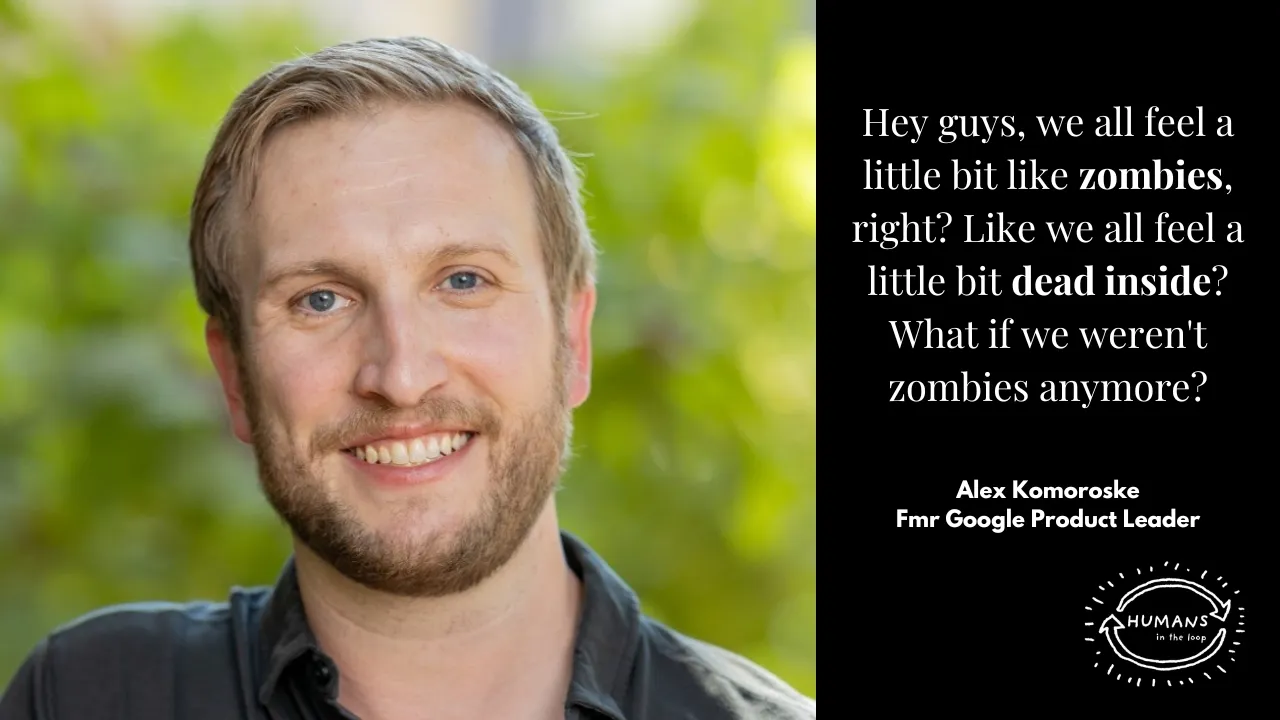
Very positive actually in that, because I’m not saying anybody is bad or evil or whatever. I’m just pointing out this thing that I everybody feels. I’m not saying you made bad decisions. saying in the emergent incentive structures of this industry based on the same origin paradigm and the optimization ratchet, like this is where we ended up. And it’s more just like, hey guys, we all feel a little bit like zombies, right? Like we all feel a little bit dead inside. Like maybe if we didn’t, what if we weren’t zombies anymore? And so it’s not saying, it’s very important me to not say, think in fact actually some people, by the way, I really deeply respect, refuse to sign on to the manifesto because they said you don’t go hard enough against people who have made these bad and greedy decisions. And you make it sound like, oopsies, I just fell into the thing that made me a whole bunch of money and was bad for society. Like, whoops, like, can get a ball again? And I think it’s very important that we allow people to recognize when they’ve taken actions that when they take a look up and realize that they were zombie shuffling forward to like, know, come join us and the people who are looking around, know, who are these thoughtful, what was your frame? thoughtful technologists. I love that. And let’s make it so that people feel welcomed to being thoughtful technologists as opposed to shame for not being.
Seb (58:57)
Yeah, and I think if there’s anything we can learn from the moment of like the last, however many years politically, et cetera, is like, if you shame people on the kind of outside, whatever tent you’re in, then it doesn’t make the tent a more welcoming place to come in. So I like that ethos. Alex, we’ve covered a lot of ground here and I’m super fascinated by the many dots we’ve joined. I guess maybe a good place to…
Alex Komoroske (59:11)
Yeah, yeah.
A hopeful vision of the future
Seb (59:26)
to focus the end of the conversation here is really about your optimistic view of the future. Obviously you’re working on some pretty specific topics with common tools, but yeah, fast forward me, however far into the future you feel is appropriate, five, 10 years, 20 years, I don’t know, a lifetime, like what is it that you would hope to see in the world? What is it that you would hope that your work had contributed to that?
Alex Komoroske (59:53)
I hope that I am just one person who has these strong ideals and cares about a lot of that stuff. My hope is that at the right leverage points, like very small actions can lead to other people really joining in and participating and doing something that’s way, way, way bigger than I could ever hope to do as an individual. I think it just looks like, I think technology is the kind of thing that should help us be, should be embedded in our lives in a way that feels cozy, aligned with our interests, that helps us be the person that we want to be, that makes it easier to do the things that we want to do, like that we want to want to do. And so just think. Little things like, here’s a stupid little example. My husband is allergic to nightshades, which is a very weird allergy. I think it’s way more common than people realize it is, but it’s a weird allergy where you can’t have eggplants. Okay. You can’t have peppers. You can’t have potatoes or tomatoes. so people, friends of ours who care very deeply about us will have us over to their house and they’ll say, I remembered that Daniel can’t eat tomatoes. So I made gnocchi. So close, you know, and like very thoughtful of them. But like, I’m sure they would love to be like when they learn that Daniel has a nightshade allergy, a system that’s their sort of operating system for their life says, Oh, your shopping list, you know, you’re you’re at this recipe to the shopping list for this week on Thursday is you’re having the Komoroskes over. Just remember that thing that you can’t Daniel can’t eat that, you know, just like is that like, oh, crap, right. I forgot the potatoes part. OK.
Seb (01:01:04)
Yeah
Alex Komoroske (01:01:33)
You know, those kinds of things that help you align with the kinds of, like, be intentional and be thoughtful in ways that, are very easy to forget in the modern world. I would love to have a little help to be a thoughtful friend and supportive of other people and their goals and whatever. just, I know, I feel like that today is, takes so much effort to do that we’re just lost, left feeling bad about how little we do. to be, to do thoughtful things that help other people in our lives thrive, you know?
Seb (01:02:06)
Yeah, yeah. Well, it feels like a good place to kind of bring us towards an end here. But before we go, is there any… Is there anything we’ve not touched upon? Anything you’ve not been asked or…
Seb (01:02:23)
golden nuggets that are coming to mind that feel worth mentioning before we wrap up.
Alex Komoroske (01:02:29)
I think we covered a lot. I mean, we’ve covered a lot in abstract on these themes. And I think I could talk for hours about specific examples of specific versions of this. But as we’re wrapping up, I don’t think there’s anything, any big point that I’m, I guess just, again, I think optimism and idealism, those are good and we can have those again, like a society, like the, and let’s be optimistic and let’s work to make the world a better place. I think it’s way more achievable than we think. And luckily, LLMs as a reset moment of like, have this widely destabilizing for technology kind of force of things that are so different, the change to the cost structures in such a way. Cool. If we’re to have to rebuild a whole bunch of stuff, it’s all going to be reborn. Let’s make it reborn in the image that we want. Let’s bring back that hacker ethic. This is not about a revolution of something new. It’s about coming home to the thing we’ve already done. This is already in the DNA of the industry. When I talk to people across the industry, people all still care about this, almost to almost every single one. So let’s just do it, man. Now is the time. So.
Seb (01:03:35)
Yeah, yeah. It’s an important rallying cry. And as you say, I feel like the same is true in my network, right? You’re naming a thing that a lot of people feel here rather than trying to convince people of something that they’ve not already felt, sensed, and seen around them. So yeah, I hope a world of resonant computing becomes the new norm that we all live in.
Alex Komoroske (01:04:04)
Yeah, and I think, you know, LLMs as an opportunity for a new system to be born because it has to be a new technology system. Let’s make it have the ideals that we want it to.
Where to find Alex
Seb (01:04:15)
Let’s make it better. Let’s make it better. Okay, Alex, and if people want to get in touch with you, learn more about your work, understand where you are online, anything to say about where people should find you.
Alex Komoroske (01:04:29)
I have, my, komoroske.com is where I publish essays and stuff. We have the, I need to add a link to the resident competing manifesto and that’s a good place of following. And then I have a little mailing list. that’s linked to from that where I send whenever there’s a new podcast or a new post or something. And I do weekly reflections. I send there too. So it’s gets like 20 pages of whatever’s on my mind. And you’ve been seeing me take notes in this conversation of things that will be in next week’s bits and bobs, that is following along on that is the best way to like stay in tune with like where this particularly weird brain is going.
Seb (01:05:07)
I’ve read a little bit of your Bits and Bobs docs and yeah, I wouldn’t describe it as weird, but I can definitely see that you’re someone who has a lot of thinking about the world, it’s supercharged. I’m not sure I could churn out as much on such a regular basis.
Alex Komoroske (01:05:22)
Yeah, it’s one of those things of like, I just for whatever reason, I can’t help myself. I just love talking and thinking and distilling. And, so I might as well do it in public, I guess. don’t know. Like the, someone at one point was like, Alex, if you do it this way, you would get a lot more readers. said, you misunderstand. I’m doing this for me. And the, know, it’s like, I do it publicly. So other people, if they want can like benefit from it, if there’s anything in there and also, so I can sort of keep myself honest of like, I feel like I would let down people if I didn’t do it every Monday. And, cause otherwise if I lost this streak, my God, I would never get it back. takes so much effort to do it. Yeah. So.
Seb (01:05:56)
How long is the streak out of interest?
Alex Komoroske (01:05:59)
so I’ve actually done it. It is a, it’s an outgrowth of the thing I did at my last, the last company was at, oddly it’s cabal been grown into me very different than what it started as. But so I’ve been doing that for now, I think five years or so it’s been public. I’ve been working on them in my own time and doing them publicly for, maybe two and a half years or so I’ve now on my third Google doc, because I’ve run out. Like when you get to pass a few thousand pages, it stops working and so you have to make a new one.
Seb (01:06:26)
I didn’t even know that was possible.
Alex Komoroske (01:06:29)
it is. Believe me, I’ve run into it multiple times. And when you do it, you paste in the big chunk of text and it just goes brr, brr, brr, brr, error, refresh the page. what? And like you try to do it, error, refresh the page. Like that, actually that means you’re hitting the limit and it can no longer add to the document and you need to create new ones. Just FYI.
Seb (01:06:43)
You’ve completed it. You completed it Google Doc. Awesome. Well, Alex, I really enjoyed this conversation. Thanks so much for taking the time and for sharing. Yeah, it feels like a lot of unique insights that a lot of dots to connect that others might not. So yeah, really appreciate you and thanks for coming on the show.
Alex Komoroske (01:07:01)
Thanks for having me.
Seb (01:07:04)
Alrighty, I’m gonna…


