/
/
1 hour 2 min
Creative courage in big tech
Ben Lehnert
Fmr design leader, Microsoft & SAP
About this episode
Benedikt Lehnert is former design leader at Microsoft and Chief Design Officer at SAP. He’s had a seat at the top table in big tech and brings his own clear-eyed perspective based on that experience. I really enjoyed the conversation with Ben as we discussed the role of the designer in this current moment, the moral responsibilities of building business and technology, the hype cycles and weird incentives at play with the AI hyperscalers, and Ben’s view that we should simply focus on adding more than we take.
Ben hosts the Poets and Thinkers podcast and you can find out more about him here: benediktlehnert.github.io
Full transcript
Humans in the Loop
Seb (00:00)
Welcome back to Humans in the Loop. Today’s episode features Benedikt Lehnert Ben has had a pretty illustrious career in design, working his way up and eventually becoming senior leader at the likes of Microsoft and chief design officer at SAP. Today, he does a mixture of advising. He teaches a course at Princeton University, and he also hosts his own podcast, Poets and Thinkers. What I appreciated in this conversation with Ben is that his thoughts and perspectives are those of someone who’s been at the top table and has been in the room as an executive, not just an ill-informed outsider. But at the same time, he remains pretty clear-eyed about the things that could and should be done better, the wider view of impacts on people and society as we build tech, and what he calls creative courage. So without further ado. This is Ben Lehnert
From graphic design to chief design officer
Seb (01:13)
thanks for coming on the show.
Ben Lehnert (01:15)
Thanks for having me.
Seb (01:17)
So to start with, how would you describe what it is that you do?
Ben Lehnert (01:24)
Great question. So I consider myself first and foremost still a designer. I was trained as a designer and that’s pretty much what I’ve done most of my professional career. The things that I do design have changed over time. I started traditionally in graphic design and have made my way into product design, digital, physical products. And then over time, design more of the organizations behind that. And now I’m actually helping executives, leaders, CEOs design the organizations in a way that they’re ready for the future and hopefully thrive and prosper. But first and foremost, I’m still a designer and now also more and more a teacher, which is an incredibly rewarding part of my work.
Seb (02:14)
Nice, okay. So let’s sort of trace it back. Design is clearly the common theme and the kind of core skill sets. Talk me through the chapters if we go back through your career, like what are those things that you’ve spent time designing?
Ben Lehnert (02:31)
I started off traditionally learning the craft of design, graphic design to start with. So really started off with discovering a love for typography. So that got me into graphic design. I got trained in traditional, like everything from logo designs to big books, brochures, anything and everything you can think about, lots of visual identities at first. And then when I started my first company, which was a design agency at the height of the first really big internet boom, made my way into digital products. And I think the work became just more holistic at the time, especially because the digital transformation forced companies to think differently, not only about, you know, their advertising material and marketing material, but actually how they would actually strategically position themselves in this new online world. And so a lot of the work that we got to do was really the new digital products driving also some of the strategy. So that was really fascinating. And I did that for a few years until I eventually joined a biotech startup. And there I got a chance to really dive deep into designing physical and digital products that would work together in the space of biobanking specifically. And as a designer, it was fascinating, obviously, because I learned a lot about medical devices and how to produce them and how to produce them at scale and got a chance to really think through an entire product portfolio from start to finish. From there, after the company was acquired, I moved on and helped build a digital productivity startup. And that was, in its own right, an incredible journey because there, we were very design driven and our design ethos really kind of pushed the entire company to grow the way it did. And eventually I think that became a really big part of why we attracted both the legendary investors that we had from Sequoia to some of the big European funds. And then eventually also our acquisition by Microsoft in 2015. And at the time, Microsoft had just gotten a new CEO, Satya Nadella, just a few months before that. And again, design was a big driver in then helping transform the culture at Microsoft. I think from there, for me, the things that I eventually started designing were a lot more the organizations around it, the culture around it. We were able to really help transform how Microsoft’s building products, especially from the mobile age all the way into what you still see reflected in the AI products that are coming out of the company now. Then I moved to SAP, enterprise software company. And there my entire job as the chief design officer was to really build a user experience focused culture, all the way with bringing the board along, making sure that we’re measuring different things that would determine our success in this cloud and AI first world. And in parallel, I started teaching at Princeton as design and entrepreneurship fellow and really trying teach the next generation of entrepreneurs and founders and business leaders how important it is to put the human, which all of my career, at the end of the day, you’re designing for the people in the center of the work that you’re doing, that that experience for the human is the best quality it can be. And how do you lead accordingly? So that gives you a little bit of a sense for what I’ve been doing so far in my career and maybe the through line across all of that.
Seb (06:06)
Yeah, yeah, thanks for sharing. mean, lots of rich chapters there and I’m sure some will delve in a bit deeper.
Ben Lehnert (06:13)
Yeah.
Building Wunderlist
Seb (06:13)
Tell me about that journey. So you’re part of a startup that grows a lot and ultimately gets acquired by Microsoft. What was the, remind me what the name of that company was?
Ben Lehnert (06:24)
The company’s name was Wunderlist.
Seb (06:26)
Yeah. And so, you know, you’ve kind of done that full mythical journey from sort of startup to,
Ben Lehnert (06:34)
Yes.
Seb (06:34)
I don’t know, big exit of some description. Yeah. Talk to me a little bit more about that journey. You know, what do you learn along the way? And, you know, how do things change when you go from being a startup to being acquired by a big organization like Microsoft?
Ben Lehnert (06:51)
Yeah, yeah, yeah. It’s a great story to tell and I’ve had the chance to, you know, tell my students about it and then speak about it. And it is as far from, you know, the wonderful headlines that you typically just read because
Seb (07:05)
You
Ben Lehnert (07:06)
that’s all we see from the outside, right? But
Seb (07:08)
course.
Ben Lehnert (07:08)
the start of the journey obviously is a lot messier than that. Building a company is exciting, exhilarating, super scary at many times. And so I think You know, I had the luck and fortune to join that company very early as employee number nine. And the founders, I think, the foresight to bring in a few more folks like myself that were a little bit more experienced in building companies and building products because they were very young and early in their careers, but had a big vision of how to change productivity. And so when I joined, you know, we essentially jumped right into the first really big crucible moment on that journey, which was we were building a second product and it just didn’t turn out the way we wanted it to turn out. We had built a lot of really big fan base already with the first product, which was actually Wunderlist, which was the to-do list app. And then the second product was called WunderKit, which was supposed to be a really big platform that was built on the success of this first product, Wunderlist. And so that didn’t work out. It wasn’t as… user friendly, intuitive and well thought out as Wunderlist and it flopped. And, you know, that put the team in a really tricky situation from not just a financial perspective, because, you know, funds are limited in the startup when you venture backed but also from a moral perspective, because the team had given it really, they’re all over a long period of time, almost a year of developing this platform called Wunderkit. And so when it didn’t work out, it hit the market in a beta form and it didn’t work out, it was incredibly challenging. So for us as a leadership team, that really meant kind of, A, making a strategic decision of what are we doing with the rest of the funds, given that this is not working out and this is what we were betting on, but also making sure that the team would stay intact and would be able to take us to whatever that next jump would be. We eventually made the really difficult decision to essentially scrap that entire second product. So a year’s worth of work, essentially
Seb (09:13)
Mm-hmm.
Ben Lehnert (09:14)
putting it on the shelf and saying, no, we’re going to go all in on this small, tiny test product that we had built called Wunderlist. But it had over a million users already right out of the gate and people loved it. And we said, we’re going to go all in. And the problem was we had not built it on a technology that would actually scale beyond. the first million users. So we had to rebuild it from scratch and redesign it from scratch. So if you entire company, the success of the company and the morale of the team and the energy of the team runs on rides on such a bet, that’s really challenging. And so there were a few more of these near death experiences, as I would call them, along
Seb (09:54)
You
Ben Lehnert (09:55)
the way. And that’s typically what people don’t really hear about much and how you make it through that as leaders, as a team. We did eventually so, you know fast forward a little bit wonder list 2 so the second version worked out not without its you know, bumps in the road but it worked out and more people loved it and you know from 1 million to 5 million and eventually when we were sold to over 15 million users for Something that you know started as really just a test balloon for for this bigger platform And so, you know, we eventually made the right bet, but it was not easy And I think the leadership lessons that I’ve learned, that we all collectively learned, are deeply embedded in what I do today and how I try to teach, especially startup founders, and advise them on the not so glamorous moments of the journey.
The Microsoft years
Seb (10:42)
Yeah, yeah, important hard lessons learned. Take me into the Microsoft phase, because as you said, you were joining right at the time Satya Nadella was joining there thereabouts. I’ve never met spoken to him, but he’s one of those. Big tech leaders, one of the few that I feel particularly impressed by in terms of just the way he conducts himself and the way he seems to think about the world. And clearly, from a results perspective, Microsoft has been on an amazing journey in recent years as well. yeah, tell me about your chapter there and what it was like to be a part of.
Ben Lehnert (11:23)
Yeah, one of the moments in my career that I’m probably the most grateful for was to be able to be at Microsoft at that time. And I ended up being there for much longer than I thought initially. I would be there almost six years through a very transformative time. And as I mentioned earlier, Satya had just taken over as CEO maybe nine months before our acquisition. We were part of a series of mobile first acquisitions that the company did in that period of time. because for those who do not remember anymore, now that as you said, Microsoft has been incredibly successful over the last decade, Microsoft had just missed the mobile revolution essentially. So they were big obviously during the PC era, had made some really incredible product decisions on the mobile side, but never were able to really… get into the hearts and minds of the mobile users and entirely essentially missed the train. And so, you we were part of a series of acquisitions to not only buy mobile productivity software, but also bring in teams that embody the mobile culture. And, you know, I think it’s so normal now that we forget how much the mobile revolution actually changed our relationship to technology. You know the reason why mobile has become such a big thing I think is largely to the fact that the experience that humans have with software became so much more natural so much more intuitive so for for Me and for us we had a chance to bring that culture into this big large old traditional software company and really I got a chance to help shape some of the oldest organizations within Microsoft. So after the acquisition, the first year where we spend a lot of time just transitioning into the company, becoming part of Microsoft, I moved to the United States from Berlin and took over the Outlook design and research team with the very clearly stated goal of helping shape the culture of this organization that was at the time already almost 25 years old. And Outlook being one of the most used products at the time of Microsoft. And so redesigning the entire suite of Outlook products, but also helping shape the future of product organizations, not just design, but product organizations, how we were building products, how we were thinking of products from the user experience first was a really big moment, certainly for me and my career. then, you know, as you look through the rest of the six years that I was there, got a chance to really embed a lot of that thinking, a lot of that philosophy in big parts of the company. So, you my last role there, I was leading very much like horizontal initiatives across all of Microsoft and really bringing together this collaborative idea of, we’re designing these experience in a connected way across all of our hardware and software portfolio. And we can only do that if we work together, if we’re thinking from and designing from the human first, and that became a big part of, think, what now drove a lot of the change in perception first of the company, and then obviously reflected in the product, and people, I think, understood where we were going. And I think that the company obviously is better for it, but I think first and foremost, people changed the relationship that they had with Microsoft products, which is also something that… is often forgotten by, you know, people didn’t necessarily love to use Microsoft products very much. so, you know, hopefully we were able to make a little bit of a contribution there to change that.
Seb (14:55)
Yeah, Microsoft definitely didn’t have the sexiest of images, it’s fair to say. Although I still maintain that Excel is probably the single greatest piece of software ever created.
Ben Lehnert (15:07)
It absolutely is. there’s many, many stories that you can also Google, but also, you know, the more time I spend within the office organizations talking to people, Excel is in fact a miraculous piece of software to the point where, you know, I remember a few of those kind of stories that people tell, it becomes lore within the company, but where, know, certain improvements on bugs in the software, you could actually not go and fix anymore because entire budget decisions in large scale corporations or even countries were riding on that bug still being present rather than being gone. And it would break entire calculations that have existed for decades. And so it’s the kind of scale that you didn’t realize how you actually affecting the world and people’s lives in ways that you typically don’t even think of.
Chief design officer at SAP
Seb (16:02)
so you go from Microsoft onto SAP and you were chief design officer there. I’m curious, because there’s plenty of big organizations that don’t have a chief design officer. So was that a pre-existing role or were they creating chief design officer as a new role in the company that you were stepping into?
Ben Lehnert (16:23)
Yeah, great question. And yes, unfortunately, although I think we will see a change in the next decade on that, the fact that the chief design officer, I think, I believe is becoming a lot more relevant than it ever was. But in terms of SAP, interestingly enough, SAP was very early on understanding the role of human centered design. In fact, Hasso Plattner, the founder and at the time still chairman, of the Supervisory Board of SAP funded the D school in Stanford and then an equivalent of it in Germany as well. Because I think he and folks at the company understood the relevance. But there’s a difference between understanding the relevance and the relevance for the business, relevance for people in the market, and then embedding a culture that is in fact user experience and design. forward. And the reason for that is that our traditional business school thinking is very much so at the other end of the spectrum of what is required to have a human first design culture. And so what happened was that SAP actually was one of the first companies to really have a chief design officer years and years ago. Then the role disappeared for a few years. And I think then the company again was a very pivotal moment, had just gotten a new CEO. And with that, set a new strategy because SAP as a very traditional software company had to become not just a cloud company, but AI was on the rise. It was very clear that that would be the next frontier. But having not even fully made the cloud transition, it was very important that the new strategy reflected both. here’s how we’re to get into the cloud. And that meant also being not only on everyone’s browser, but also being on everyone’s phone. And then also being ready for this AI first future that was on the horizon. And so I think it became very clear that if you wanted to win in the cloud, if you wanted to win on the edge, you needed to have great user experience. Because at the time, it was already the standard. SAP was behind. And so bringing recreating the role of the chief design officer, I think was a very strategic move by the board. And then anchoring it as a reporting to the executive board role was really crucial. And I had very deep conversations with the board in the hiring process to make sure that the transformation of the culture actually was going to work.
Seb (18:55)
Mm-hmm.
Ben Lehnert (18:56)
Because as you probably know as well, and many people that listen, You can have really good intentions for cultural transformation, but if the incentives are not set properly and the goals are not stated clearly and those are not aligned, then those intentions will fall flat on their face. so thankfully, we were able to create this role in a way that it was meaningfully anchored. And I was reporting directly to the executive board and also on a quarterly basis to the supervisory board to really make sure we have a user experience strategy that is long-term successful. Also making sure that people across the board and across the levels are incentivized to put the quality of the end user experience front and center. And that meant making better and new trade-offs, right? And so, you know, That kicked off a whole lot of work organizationally, working with everyone from sales to HR to making sure that the quality of the experience was the thing that we were after and making sure that we did the best we could to deliver a world-class experience across all the different products, because SAP has a vast product portfolio, to make sure that that all is done properly.
Stepping away from big tech
Seb (20:13)
So you’ve had this glittering career in tech, you you’ve gone from like startup that has great success gets acquired by, you know, big tech company, you have a great chapter there in a transformative time, you go on to another big tech company and it kind of, you know, sounds like a role that’s well set up to succeed and well designed from your perspective as well. So why leave the world of big tech behind? That’s not a world you’re operating in right now. So what caused you to step away from that?
Ben Lehnert (20:51)
Great question. And there’s a few things. One, after 10 years as an executive at scale, I really got the itch, and maybe that’s the entrepreneur itch that happens to just be there and never go away, to go and do things again with my hand. So actually, after SAP, I went back into a startup called Stark. that is very transformative in the digital accessibility space. And they could use someone with my experience on the corporate side because accessibility compliance is really big in the B2B world. It’s very important. And so that’s what I did for about three years. And then after that, as you pointed to, I decided to take a break. And there’s a few things. here. One, I started teaching about three years ago at Princeton University, Entrepreneurship and Design, and it’s not the school that you would expect necessarily someone to teach entrepreneurship and design, which to me was actually the appealing part because Princeton is a very special university that really sits at the intersection of the humanities and science. And it fit with my understanding of of design very much, where we’re here to design things that improve people’s lives. I think with a good amount of reflection, and the more I was diving into my own research on where markets were going, where technology was going, I felt it was the right moment in time for me to actually take more than one step back and examine where the world is headed and how I and we more broadly speaking could make the right contributions. And I think especially with what we’re seeing in AI, that seems like the most relevant thing for me to do right now, at least. So what I mean by that is that I think with every transformative technology, general purpose technology specifically like AI, there is a very clear understanding that this technology can be used for good or for harm. And I’ve always seen the role as the designer, specifically also the design leader, to examine both parts and try our very best to design products and experiences with the new technology in a way that it ultimately ends up being a net positive.
Seb (23:27)
Mm-hmm.
Ben Lehnert (23:27)
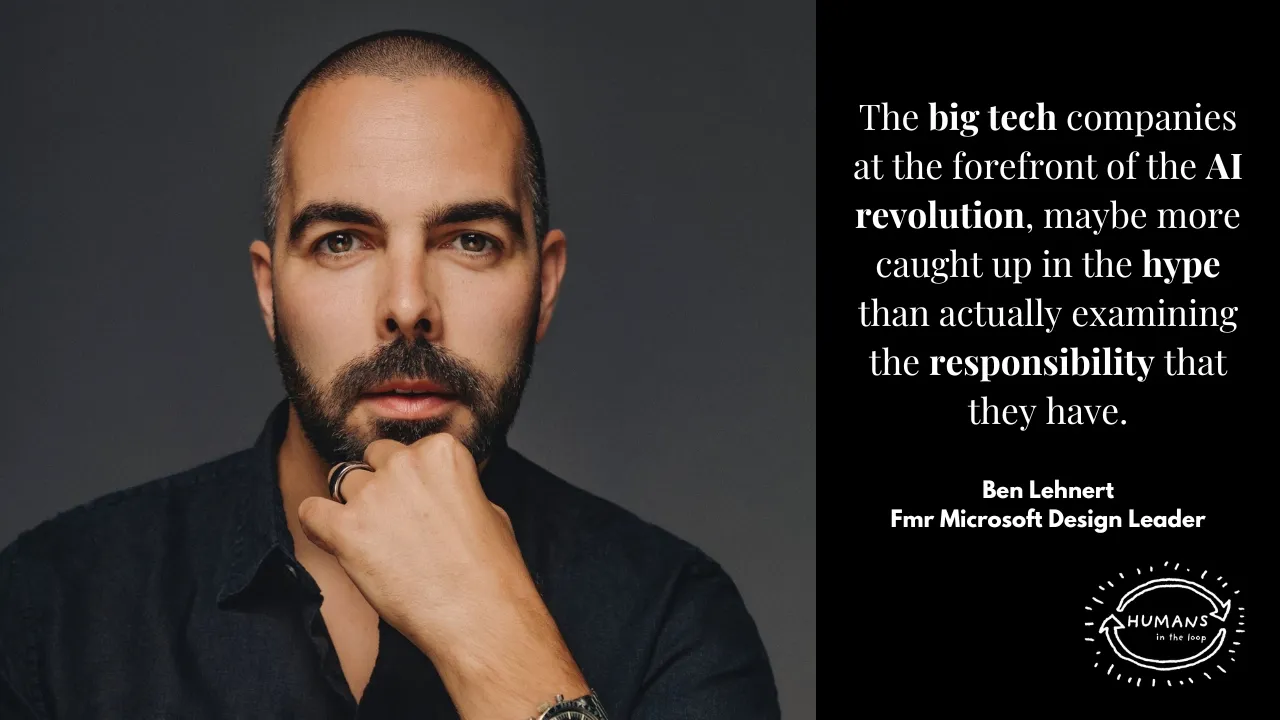
for the world. I think that the big tech industry currently, especially the big tech companies that are at the forefront of the AI transformation or revolution, if you want to call it that, maybe more caught up in the hype and the speed that comes with the hype than actually examining the responsibility that they have. And there’s many reasons for that that are very understandable. But I believe that there are moments in time like this one that we’re in right now, where it’s the job of the designer to call attention to that and say, we can and we need to do better in the way we’re putting this technology to use and in the hands of people and ensuring that what we can control is first and foremost to the betterment of society and humanity. And we try to avoid the foreseeable unintended consequences because there are some consequences that we might not be able to foresee, but the ones that we can foresee we’re doing our best to put guardrails in place to not have that hit, you know, human lives, essentially. So that gives you a little bit of a sense for why I am taking, a little bit of a break and also gives you a sense for the work that I’m doing now and hoping to shape, you know, the next generation of business leaders, the next generation of design leaders and giving them the tools, the education and maybe somewhat the philosophical and ethical foundation to stand on.
An ethical foundation: do no harm
Seb (25:09)
And what is that sort of ethical foundation from your perspective? Because, you know, I’m conscious, as we have this conversation, the world feels very politicised, there seems to be very meaningfully different sets of values driving different behaviours in the world. And so, you know, this idea of creating with the net positive of humanity in mind is an ideal that I can very much align with and buy into, but I’m curious, what’s Ben’s version of what it means for something to be net positive for humanity?
Ben Lehnert (25:45)
Yeah, that’s a big question. And I certainly don’t have all the answers. I mean, I’m
Seb (25:49)
Of course.
Ben Lehnert (25:50)
also one of the reasons I started my podcast called Poets and Thinkers is because I don’t have all the answers and I want to talk to people that are much smarter than me to help me figure out what that looks like. But I can give you my best answer
Seb (26:01)
Likewise, likewise.
Ben Lehnert (26:06)
so far. think there’s a very obvious answer and that is to do no harm. And we’ve, for the longest time as humans, embraced that that’s something that is really good principle for doctors and health workers to apply. But what’s interesting is that, especially with this latest technology, meaning AI, we’re actually operating very close to the human body, right? And we’ve seen this. There’s already, unfortunately, been a loss of life several times. that was caused directly by interaction with AI systems because these, especially LLMs, are so good at selling the illusion of human language and human interaction that we are in fact altering people’s biochemistry. Which to me brings with it the responsibility that we need to be very cautious in the rollout, in the way we put in guardrails in place, in the way we also say this is not okay to be deployed in the world. And that last part is not happening enough. And there’s many reasons for that, which we can happily dive into. I think that’s where it starts. Do no harm. Is this something where we know enough about that we are OK with rolling it out at scale and accepting now repeated loss of life where it could have been prevented? So I think that is a very clear line for me. And I think it’s my it mirrors my understanding of what we’re here to do, because I design, technology, business is ultimately here to improve our collective living together. And it’s something that is often forgotten in this hyper capitalistic narrative that, you know, capitalistic gain in itself is the end. instead of the means to an end, is building thriving, prosperous, more just societies. What that looks like per society is a whole different conversation, but I think it’s important to keep humanistic values at the core of what we do. And that is in this very technocratic time period that we’re currently living in, often forgotten, which is why, you know, for me personally, my explorations and my research into the future is around the humanistic future of business leadership. And I think that the answers to all the questions that I have, and I think many of us have, lies actually not in the traditional business thinking that has dominated the last 100 years since the Industrial Revolution, but actually much more in the humanities, much more in the arts, much more in the parts of human nature. that’s almost gonna push to the side too much. And what I’m trying to get to is how do we find balance? Right? Because I think net positive really is more about balance than it is about complete revolution. But the pendulum has swung too much to one side.
Big tech’s mad bastards and the capitalism question
Seb (29:13)
Yeah, yeah. so I wrote in my newsletter, a sort of article, you like, entitled The Wild West Full of Mad Bastards this last week, which was
Ben Lehnert (29:25)
Well done.
Seb (29:26)
talking about some of the wildest stories in tech. And it’s kind of reflective of my belief. And this is obviously not true of every person who’s associated with the label of, say, Big Tech, for example. But for a bunch of them, I sort of hold the theory that they are, you know, they seem to have exactly the skills in the modern world to accumulate wealth and power and exactly the lack of knowing of what it means to deploy that in a way, even for themselves to just like live a good life, what most of us would consider a good life. You know, there’s this…
Ben Lehnert (30:03)
Yes. Yeah.
Seb (30:06)
And you can see it, you know, it’s kind of bizarre. It’s like a bunch of people doing their best impression of being a real person in the real world.
Ben Lehnert (30:17)
Yes.
Seb (30:18)
sometimes it feels like lack of awareness. At other times, it frankly feels like just disdain for humanity. mean, there’s in that article I linked to. the recent interview with Peter Thiel where he’s sort of asked, he’s talking about transhumanism and he’s basically asked if he really wants the human race to survive and he takes about 30 seconds before he
Ben Lehnert (30:40)
Yeah.
Seb (30:41)
even says yes, you know? So there’s some troubling sides to it. But I think, yeah, I think this like do no harm as a principle that’s already in place in other professions is, sounds like a good starting point here.
Ben Lehnert (30:58)
Yeah,
Seb (30:59)
What?
Ben Lehnert (31:01)
I’ve seen that interview with Peter Thiel and I think what you’re pointing at is something that is troubling because I think a big problem and I think actually a big reason for a lot of the negative implications and actions we’re seeing is, you know, the narrative, obviously, we just talked about this, but I think ultimately underlying all of that is men, mostly men, mostly privileged white men that are disconnected from their own humanity, and in turn, from the rest of humanity. And so, you know, we need to acknowledge that. We need to acknowledge that the accumulation of power and wealth, which equals power in the world that at least in the Western world, more broadly probably in the world that we live in is probably a really big coping mechanism for filling a massive void. And I think that part of the next generation of leadership will be to acknowledge that and figure out how do we raise leaders that are more aware, that are more self-aware, that are more connected to themselves and in turn to others. that, you know, I don’t think that capitalism is a bad thing. But, you know, if it’s completely unmitigated, unregulated and only serving, you know, select few that all exhibit the same kind of characteristics and not ultimately focus on adding more to the world than they take from it, then I think that’s highly problematic and I think it needs to change.
Seb (32:43)
Mm.
Ben Lehnert (32:43)
And it is unfortunate that we’re not yet at the cusp of, or maybe we’re at the cusp, but it’s not clear if we’re gonna make the jump or not.
Seb (32:54)
Yeah. Yeah. And I think that capitalism point you raise is a really important one. There’s a guy called Adam Delahanty who runs a sort of ghost writing agency, works with a lot of companies, likes of Duolingo and stuff. And I stumbled across something he wrote on Substack the other day and I just thought it was such a good framing because he basically described it as the question underlying it all. And basically that question is like, what is your orientation towards capitalism? And in this he outlines four categories as he sees it. He says there are the kind of the naysayers who basically think that capitalism is inherently evil and kind of every day they partake in the system is something that is in misalignment with their values. There are kind of the true believers at the other end who think that like, you know, business and capitalism and the mechanisms there are kind of almost like the meaning of life and the way the world goes around. then he talks about, I think, Transformers, who are those who sort of see some of the merits of capitalism, but believe that there’s like lots of room for that to change and be channeled. I kind of would largely place myself in that camp. And then there’s the escapists who basically just want to get away from the system. And I also see a bit of myself in that camp as well. But it does sort of feel like whenever you kind of come to this conversation. It just feels like such an appropriate question to kind of get to the heart of is ultimately like, do you believe that the creation of things within a capitalist system can be a good force in the world? And I guess hearing you describe it, I’d be interested to hear where you place yourself if you categorize yourself in any of those, but it sounds like your belief is. is yes, that there is a humanistic way of leading and creating that needn’t come at the cost of humanity, but can actually can serve us.
Ben Lehnert (35:01)
Yes, yeah, I do believe that there is a way to put capitalism to good use. Because to me, at the end of the day, it is not about being radically on one side or the other. And maybe underlying of that is my Maybe my self understanding and the way I’ve been raised, you I grew up in Germany. Obviously, you know, my grandparents were war generation and my parents post war generation. And my education was very much so formed by, you know, understanding the good parts of our history and in terms of, know, ethical, philosophical, really profound work. But I think ultimately my understanding, and it goes back to the very beginning of how I, my self understanding as a designer is that I think we’re all here once, right? In this world. And I believe that it is our job to add more than we take. And I take the same understanding for building businesses and making them thrive and building them up. And I think That’s really what it comes down to, to me, is there’s nothing fundamentally wrong with building a business and making money. I think it’s what you do with that that matters the most. And that to me is, I think if it completely goes unregulated, unmitigated, and we put the worst, characters in place to run these, then that is not the way that we add more to the world than we take. But if we ultimately look at the role of the entrepreneur, the role of the business leader, the role of business to create prosperity and distribute that prosperity more broadly, more evenly, more just, and I’m not talking about perfection. I’m just talking about more balance to the world so that we ultimately add more than we take. Then I think that’s a goal worth striving for. And that might just put me more in the transformer. category, you know, I’m not too familiar
Seb (37:17)
Mm-hmm. Mm-hmm.
Ben Lehnert (37:18)
with the framework. But that is how I look at what I want to contribute and how I want to contribute and and selfishly or selfishly selfless. You know, I’m thinking about my daughter, she’s 10. I, you know, I want her to grow up in a world that is ultimately better than the one, that that I was born into. And I think that if we if we make that one of the guiding principles, then it will help us maybe find more balance. It feels like a lot of the extremes that we’re seeing play out today are not on that line. And it doesn’t mean that the world has not gotten better over the last 100 years, but there’s a lot of really concerning stuff happening worldwide. And it doesn’t have to be like…
Why AI companies skip humanistic design
Seb (38:06)
Yeah, yeah, agreed, agreed. To take us back a minute to the AI thread of this, you said that part of your reason for sort of taking a break and stepping in some different work is this moment that’s so heavily shaped by AI. And you also mentioned that you don’t think that the right kind of humanistic considerations are being thought about, being talked about in the right places there. as someone who’s been, you know, in the room in very big companies at a very senior level. Obviously each company is different. So it’s hard to sort of generalize this into a kind of universal law. But what is your take? Why is that lacking that humanistic consideration from your point of view? Is it lack of awareness? Is it a kind of general negligence? Is it a, well, we know there are gonna be issues here, but we’ll make money along the way. What’s your assessment of why that is just not baked into the recipe already?
Ben Lehnert (39:15)
Yeah, that’s a great question. And certainly one, you know, I can speak to my own experience and what I’m observing in the market and maybe some of the companies that I did work for and some that I would never work for and why. And maybe that helps. So there are are companies where it’s a lot more present to think about the impact of the work we have at scale. It was certainly something that under Satya, you know, it was very present. We were you know, a lot of responsible use of technology when I was at Microsoft was at the forefront of a lot of the work that the company was doing. And I think to a certain degree from what I’m seeing is still happening. It is a bit concerning to see even what comes out of Microsoft, you know, in terms of the AI deployment. But I think out of all the companies that are in the space, it seems somewhat reasonable. And certainly at SAP, the understanding and awareness of responsibility was also present, very much so. There are other companies like Meta, when you Google some of the documents that came out of Meta around, for example, chatbots and AI chatbots and how they’re Internal documents are actually stating what they are okay with in terms of responses, for example, toward children is incredibly concerning. And I made, for example, a very clear statement to a bunch of the executive recruiters at Meta that I would never work for that company for even like really high profile jobs. And I posted about it publicly too, because to me that is highly irresponsible, highly irresponsible. And I think open AI to a certain degree is exhibiting similar traits. And I think to your question, ultimately, I think it comes down to the top most senior leadership roles. And by senior, I mean really the highest up in the food chain. I think both meta and open AI from the outside in seemingly have leaders that I think exhibit a lot of problematic character traits. And where that comes from, I can only speculate and read the same books that everyone else can read. But I would encourage people to read Empire of AI that talks about the rise of open AI and everything behind it. There’s Careless People, talks a lot about inside of Facebook slash Meta. I think ultimately it comes down to what I said earlier. I believe we have here several privileged white men in positions of power. that are disconnected from both their privilege and their humanity in a lot of ways. And I think the organizations that are building, like every other founder, are reflection of themselves. And I think that is just a reality of building companies. And so unless you make a conscious effort to become more aware, to become more conscious, and to become more connected, And that’s an ongoing process for all of us. You will stay in your own cycles and in turn your organization will reflect where you are. And I think that’s what we’re seeing. And I think we’re not seeing that just in the tech industries. I think this is a, I don’t want to call it a law of nature, but it’s certainly a pattern that we see across any organization that has ever been built. And maybe part of those are human cycles and part of it’s just, people growing either into themselves or not.
Poets and Thinkers: learning from outside tech
Seb (42:38)
And so to go back to your podcast called Poets and Thinkers, it sounds like there’s a thesis you hold there that some of the answers or some of the inspiration that is going to inform a more human centered form of leadership is going to come from the outside as opposed to from within, specifically say the tech industry, who are the types of people that you’re speaking to and yeah, what are the lessons you’re learning along the way as you explore that?
Ben Lehnert (43:16)
Yeah, well, the lessons are incredibly vast and I’m so grateful to everyone who I got a chance to speak to so far. so, yes, I do believe in fact that the answer to the future of business leadership, maybe leadership more broadly, lies outside the traditional business school and leadership thinking. And I think part of that is because when you look at… What has shaped largely our understanding of business leadership, our understanding of leadership more broadly, it’s a exploitative philosophy. And a lot of it is driven by the Industrial Revolution, certainly. If you look back the last 100 years, the entire model is very exploitative. And on top of that, you add very paternalistic structures, and then you get what we are. in today. Now, the reason why I believe the answers of what a better future looks like, better form of leadership looks like is a my own personal journey of even recognizing my own privilege, learning a lot about myself, connecting a lot more with with myself. And as I mentioned earlier, becoming a father thinking about the future that I want my child to grow up in plays a large role. I think that set me on this track of looking beyond the traditional playbook. And so I think a lot of the work and the answers are around the balance and finding back to something bigger than ourselves. And so the people that I try to speak to are people that are in some way coming at the world from a more additive mindset. And it can be anything from like literal poets and thinkers and artists who are naturally more connected with themselves in the world and often have an underpinning of a philosophy that they believe in, right? And maybe romanticizing even the work that they’re doing. And it’s always been part of human nature, right? to romanticize things. In fact, there’s a great book that’s written by Tim Leberecht, which is a German-American thinker, founder of the House of Beautiful Business. And the book is called Business Romantic. And his entire work in the House of Beautiful Business has done incredible work bringing together community, doing research around exactly that. There is a underpinning that is not just extracting as much gain as you can at the cost of other people as possible, but finding more balance. so to me, that is the kind of group of people I want to talk to because I think a lot of it comes down to changing the narrative, offering maybe a different narrative because I fundamentally really believe in the good in most people. think humans are inherently good. They’re inherently creative. which to me, creativity and enhancing and building people’s creativity up is incredibly powerful, not only because we actually then end up creating, but also because I think it shapes a sense of agency in all of us. And when you look at the traditional business thinking and teachings, there’s none of that. And so if we want to add more than we would take, then we need to actually teach people, leaders, again, how they can create more, how they add more than they take and build that sense of agency. And that’s, you know, full circle coming back to chief design officer and creative leadership. I fundamentally believe that we’re entering an age which, you know, I’ve been talking about the age of ingenuity. I think we are entering an age where we can and have to leverage these powerful new technologies. in a way that we are creating net positive outcomes. so the people that I’m trying to talk to are even business thinkers that come at the problem from a more humanistic perspective. And it’s refreshing to me personally, I’m learning a lot and I think more and more I’m starting to realize themes of skills and philosophies and, know, ways of looking at problems and leadership as a whole. from different perspectives. again, I don’t have any answers per se yet, but I think even just having the conversation, it seems meaningful.
Seb (47:55)
Yeah, yeah. Well, I would highly recommend people to check out Ben’s podcast.
Ben Lehnert (48:01)
I appreciate that.
Seb (48:04)
Yeah, there’s, I guess there’s something exciting for me around, this group that you’re describing, the poets, the thinkers, the people from these sort of what we think of now as being kind of from the outside. I guess one of the things I’m excited about is the sort of technical barriers to entry into, the technology industry lower and lower. Like if we look around today, basically most tech leaders come from an engineering background. know, the Zuckerbergs, the masks, like different degrees of proficiency, different areas of specialty, but basically, you know, the industry is built by engineers who sort of think a certain way, you know, have built lots of impressive things, but there’s, and I, at least, seem to be agreed on some of the shortcomings over there. And so, yeah, I think there’s this really interesting and… exciting time, which is like the people who get to build stuff now, I see that becoming a much broader cross section of folks. And to me, like, I don’t know what comes with that, you know, none of us really do, but I can kind of only really see good things in kind of diversifying basically who gets to build stuff. you know, the first episode of this podcast that I released was with Will and Sylvan who… founders of what’s called the restless egg. They are basically building something at the intersection of art and technology. These, what they call the artist founder and tapping into this amazing ecosystem of people who are kind of artists and kind of outside of the certainly the Silicon Valley norm of what we might think of as being like a technologist or a company builder. But more and more. this world is becoming accessible to them, I suppose, through like not necessarily always needing that kind of concrete coding skills to build your first application, for example.
Ben Lehnert (50:08)
Yeah, yes, I agree with with all of that. And I think there’s a few things in what you described that I think is important to underline. Right. One is the means of production are more getting more evenly distributed, which I think is incredibly powerful. And as you said, it gives artists, designers. anyone really with an idea, the ability to go and make that somewhat real enough to see if it can make a difference in people’s lives. And I think that’s a good thing, right? Having more democratized access is a good thing. And I also think that this point about the artist founder is both from a creative perspective really interesting, but also I think from a I guess, humanistic perspective, typically, know, artists are artists because they have something to say. And that’s typically not about themselves per se. You know, I see this and this is anecdotal data. So it’s not probably like really scientifically relevant, but I see it whenever I publish an interview with an artist and have a few on the podcast so far, they get the highest engagements, the highest views and the highest, you know, overall listening time. And I think it’s because as humans we are craving a deeper meaning behind the work that we do. And we know instinctively that a lot of the things that have been sold to us as success are not enough, right? It’s like a microwave meal versus a properly home cooked meal, like nutritiously different. And not just from a pure nutrient intake, but also If you end up having a home-cooked meal with people you love, it’s a very different story, like emotionally too. And I think that in itself is also incredibly valuable that we get people to make things and distribute that more broadly that typically were excluded. And I think it goes for artists. I also goes for certain groups in certain geographies that were entirely removed from access to the internet distribution of the ideas. And what we need to make sure though is that the tools are in fact really serving them well and are fairly distributed and are not, you know, ending up skewing things in the wrong direction. But yes, I absolutely agree. I think it’s one of the most encouraging things about where we are that we’re seeing more and more people actually, you know, getting access that didn’t have access before and get to contribute. you know to to the world that way.
The role of friction in creativity
Seb (52:51)
There’s a link topic here, which is something I think about, I’ve been thinking about a lot. And I know will be relevant for you as someone who’s deeply creative, been a designer. And that’s kind of the role of friction in all of this because, I’ve certainly come to believe that there are things that should be hard and they’re hard for a reason. So, you know, I write and I’m not. I don’t think creating any literary masterpieces that are going to stand for generations. But, what I come out with, I find that there is a benefit to me in what I call the like the banging my head against the wall phase, you know, that like sit with this thing because it’s hard and mull on it and go for a dog walk and come back and rewrite the thing and reshape it. And there’s something in kind of crafting that that kind of beats my thinking into shape and gets to something that I think is worth sort of putting out there. And yeah, I guess in this world where creating stuff gets easier, there’s this interesting question about friction and like what role that should play in the whole process. So yeah, I’m curious just to put that to you and how do you think about friction?
Ben Lehnert (54:07)
Yeah, well, that’s a really, really good question. And it’s a really, I think, important one, especially in the time that we’re living in right now for several reasons. One, I know the feeling very well as a creative. I’ve also started started again after not doing any art for many years, started painting again, drawing again. And and it is challenging. I’m also currently sitting on a draft for a bigger piece that I’ve been writing and I know the feeling you’re describing of just wrestling with it and banging your head against the wall. And what I believe is that it is without a doubt one of the most important parts of the process. Maybe if not the most important part, actually maybe more important than the outcome itself. And I’ve had several interviews now for the podcast where that topic came up with artists. In fact, also, the last episode that I published, episode 15, was with João Sevilhano who’s a clinical psychologist. And we talked about friction as well and how these moments of friction, either with just ourselves, through the process of creating and making art, or interaction with others, they force us to deal with ourselves, with our inner workings, in ways that if that friction is not present, we don’t have to. And I think that brings us all the way to privilege too, right? If you have grown up in a world of privilege, you have experienced less friction than other people. And in turn, you have not had to face certain parts of yourself and your humanity, And that’s a gap, that’s a blind spot that ends up being something that you have not yet experienced. so again, I think that in a lot of ways, the systems that we’ve built in the corporate world, in business more broadly, in society, a lot of them have been around and I’ve been part of that, right? For a long time, it was all about reducing friction, reducing friction. And in lot of ways when you’re building product, that is a good thing. Right. That is what create value often, you know, inherently in what you’re offering. But I think from a more human perspective and a creative process perspective, it’s essential. It’s essential so that you can actually face yourself and then hopefully meet the world as a different you than you were before you went into that process. And I think that a lot of the negative consequences we’re seeing is a result directly of humans, especially male leaders, white privileged male leaders, not having to face themselves through enough friction to discover and explore parts of themselves. And, you know, we can only meet others to the extent that we’ve met ourselves. We can only lead others to the way and extent that we can lead ourselves. And I think friction plays the essential role here. And I also think that, you know, without friction in our lives, there’s no stories to tell. I there’s no art to be made. I think there’s no music to be made. And that is one of the things that I’m learning talking to a lot of the artists that I talk to, you know, and through my own process, that that seems like a really essential part of the human experience that we’ve kind of removed from the business world in a lot of ways, because it’s not professional. It’s not something we can measure. And, you know, now we could go all the way into, well, Why is that? And our inability to deal with uncertainty as humans and our want for certainty and lack of scary things and all of that. But just focusing on the friction, think it’s an essential part of becoming more you and hopefully making something that lasts and contributes to the world.
A hopeful vision for the future
Seb (58:10)
Yeah, yeah, beautifully put, beautifully put. Ben, I guess final question here, we’ve spoken about, well, broad range of topics, some of them, the, you know, the things that are troubling and some of the things that are exciting in the world. What’s your hopeful view of the future? You know, what’s a version of the world that you hope to see come into existence?
Ben Lehnert (58:36)
Great question. Probably try and keep it fairly simple. jumping off from friction, it seems like we’re living through worldwide through a massive moment of friction, friction on a lot of levels. So my hopeful take on it is that because it’s so profound, it’s so big, it’s everywhere all at once. Currently there’s friction that in the most hopeful way, it’ll bring us out on the other side. having faced more of who we are and who we want to be as humans. I think that the tension and the human condition is on the one hand, we are animals, it’ll be very animalistic and very simple. On the other hand, we have really big brains and we can think very philosophical thoughts and envision a world that’s better. So my hope is actually it gets us closer to that. If there are some things specifically I’m thinking about is that I hope through the friction we’re experiencing and a lot of parts of the world that we get closer to a better, more nuanced, more vibrant definition of democracy and that we can actually make that happen with the help of all the amazing technology we’ve built and all the things we’ve learned on how to not do it. Because it requires constant efforts to build better democracies and make sure that people thrive within that. think healthcare, these powerful technologies that we’ve built, I think there’s many, people out there that are that we can help and build better medical systems and healthcare solutions that I think are incredibly exciting. And then maybe the last point is education. think a lot about the education system is basically built on our understanding of the Industrial Revolution. It’s recreating predictive outcomes, but that’s not how we’re born. We’re born creative and we’re training it out of our children. So now we have all of this powerful technology. How can we make sure that we actually create an education system that brings creativity back and enhances it so that we don’t trade it out and then we have to relearn it later in life? And so, you my hopeful take on all of that is that we can figure all of that out now because we have to face ourselves. We have to face the darker sides of, of the decisions we’ve made. And hopefully that shows us where we actually want to go and how everyone can thrive. I’m trying to remain in that place and sometimes it’s a little harder than other days, but that would be my hopeful take on where we can go.
Seb (1:01:05)
Amazing. Well, that seems like a good place at which to end. Before we do so, obviously, your podcast Poets and Thinkers, we’ve already mentioned, we’d recommend people check that out. If people want to find you, get in touch, what are the corners of the internet that you’re hanging out in?
Ben Lehnert (1:01:26)
Yeah, thank you. Yes, so I think Poets and Thinkers is probably the place to go. Anywhere you get your podcasts, There’s 15 episodes to listen to. LinkedIn, obviously. And I publish a very irregular newsletter on Substack called To Whom It May Inspire. So if you don’t want to get overloaded in your inbox and sometimes not receive anything for half a year, that’s the place to go. And I think I’ll probably leave it at that.
Seb (1:01:52)
Amazing. Alright Ben, it’s been a pleasure. Thanks for coming on.
Ben Lehnert (1:01:56)
Likewise, thank you for having me.


