/
/
51 min
The soft technologies of democracy
Ed Gillespie
Futurenaut
About this episode
Ed has spent his career thinking systemically about the future and consulting with governments and corporations on topics as varied as the environment, politics, healthcare and education.
He’s also the co-host of hit podcast ‘Jon Richardson and the Futurenauts’ alongside comedian Jon Richardson and fellow Futurenaut Mark Stevenson.
Given Ed’s varied expertise I wasn’t quite sure where this conversation would go, but I needn’t have worried. What unfolded was a great chat about climate, politics, and the soft technologies of technology that we need to make better use of to solve our toughest problems.
Full transcript
Humans in the Loop
Seb (00:00)
Welcome back to Humans in the Loop. Today’s episode features a conversation with Ed Gillespie. Now I first came across Ed’s work via the brilliant podcast he co-hosts with the comedian Jon Richardson and his fellow futurenaut Mark Stevenson in which they spend time talking to experts and of course bringing their own expertise to big and important questions about the future. Climate, energy, healthcare, education, politics, you name it, they cover a bit of it all. So I was excited to get Ed on, but also a little unsure as to where the conversation might go. As you’ll hear, Ed was in a bit of a contemplative moment, it felt, as I guess many people who spent their careers dedicated to climate activism are right now. And where we ended up was really more in a conversation, not about the hard technologies of things like energy and climate change, but… More so the so-called soft technologies of collaboration, democracy, things like citizens assemblies, as well as Ed’s vision of a more bioregional and decentralized solution to many of these problems. So without further ado, this is Ed Gillespie
What does a futurenaut actually do?
Seb (01:30)
Ed, thanks very much for coming on the show.
Ed Gillespie (01:33)
It’s a pleasure to be here.
Seb (01:36)
So first things first, I’m curious to get your take, your explanation of what it is you actually do.
Ed Gillespie (01:45)
That is something that eluded my late mother in understanding for about 25 years. What is it I do? Well, I describe myself these days as like a recovering sustainability consultant. I realized that a lot of the consultancy work I was involved in wasn’t actually changing anything and that actually I was probably part of the problem rather than an integral part of any resolution. I mean, these days I kind of call myself a futurist or a futurenaut Futurists are also incredibly annoying because they tend to be making predictions or trying to analyze existing trends. That’s usually a kind of very stupid thing to do because you usually get it wrong. think in history is full of like terrible predictions that were completely off kilter and inaccurate. So I landed on futurist simply because also as a public speaker, I was getting more gigs. So there was something slightly mischievous about the fact that if a conference organizer was trying to decide between two different speakers and we’re going, do we have the sustainability guy or do we have the futurist? it’s like sustainability guy sounds a bit dry, futurists, it’s exciting. He’s going to talk about tomorrow. so I just Trojan horsed it. essentially I’d give the same like provocative sustainability and, and, and campaigning climate change chat, but I’ve kind of Trojan horse to in as a futurist rather than a sustainability dude. And then futurenaut comes from, I mean, was when Mark Stevenson and I, as the futurenauts were working together. We originally called ourselves the future men. It’s an awful, awful name. And also
Seb (03:23)
You
Ed Gillespie (03:24)
if Google it, you get a lot of gay pornography.
Seb (03:26)
You
Ed Gillespie (03:27)
So it wasn’t a great, great moniker to have. And obviously astronaut is really cool. Everyone wants to be an astronaut and astronaut basically means star sailor. So futurenaut is future sailor. The whole idea of a future knot is that you sail close to the winds of change. So you’re trying to be there at the cutting edge. And there’s all sorts of lovely nautical metaphors you can come up with then about, you know, we’ve got to rebuild the ship, you know, we’ve got to recruit the right crew. We’ve got to be sailing in the right direction. And it’s not in a kind of colonial conquistador voyage of discovery of countries that are occupied by other people and then stealing all their wealth. but perhaps more about that sort of classic South Pacific Islander, know, navigating by the stars to know
Seb (04:18)
Mm-hmm.
Ed Gillespie (04:19)
where the promise of tomorrow might actually be.
Seb (04:22)
Hmm. It’s a beautiful analogy for it. Futurenaut, you say you sort of Trojan horsed your way in there. It’s obviously not a job title that they openly advertise at the like school careers fair.
Ed Gillespie (04:38)
No.
The skills of a futurist
Seb (04:38)
So how does one become a sort of futurenaut, a futurist? And what do you think of the skills that or perspectives that you bring to it or people should bring to it?
Ed Gillespie (04:51)
Yeah. Well, mean, Mark and I always joke in our talks that the key thing about being a futurist is there’s no qualifications required. Any idiot can call themselves a futurist. And believe me, me, as many do. I mean, I also call myself an insultant because that was the kind of the bridge from consultancy, which is like being strategically and playfully rude to clients to try and point out their shortcomings and get them to raise their game and their aspirations and ambitions. I mean, I think the skills for like a really authentically useful futurist are usually about systems thinking. And that’s a real cliche these days, but I am very much a jack of all trades, master of none. And I’ve sort of always prided myself on that. So I think it’s genuinely having a fairly rapacious curiosity and the ability to ask incisive and insightful questions. And I think. If futurists are going to be helpful, they have to help us understand the right questions to be asking themselves. There’s a lot of talk about solutions. Indeed, my old agency, they go on about solutions all the time. That worries me slightly. They even have events at Climate Week where they’re like, answers only, solutions house, you mustn’t ask questions. For me, that’s… really quite dodgy, actually.
Seb (06:22)
Mmm. Mmm.
Ed Gillespie (06:24)
Because if you’re asking the wrong questions, you’d come up with completely the wrong answers. And, you know, there are some solutions out there where they don’t want us to ask questions about them. They just want to roll railroad them through or avoid the awkwardness. So I think for this, you know, in a nutshell, I think the skills really are about curiosity, systems thinking and the ability to ask the right questions.
Seb (06:49)
Mm, mm. Well, as a fellow jack of all trades, master of none then I can definitely relate to those skill sets and, yeah, what it takes to apply them. You mentioned this idea of asking the right questions versus perhaps the wrong one. So I suppose what are the questions in your line of work that you are asking yourself and others and focused on right now?
Ed Gillespie (07:17)
Well, mean, my colleague at the Forward Institute where I work on responsible leadership these days, Dr. Kate Simpson, who’s an amazing systems thinker, she always asks the question, who is the system working for? You know, because the reason that systems continue and perpetuate is because they’re working for someone. You know, we always go, the system’s broken. It’s like, yeah, it is broken, but there are players in it who are benefiting. And so one of the questions I think is really incisive is like, who’s this, who’s this working for right now? Who’s benefiting from this status quo, which is untenable and unsustainable. So I think that’s a really powerful one. I also think, you know, when it comes to, let’s take something like energy, for example, if you, if, if the answer is, is centralized nuclear power, I think you’re asking the wrong question, you know, because I believe in the energy sector right now, we’re at a huge crossroads where there’s a transition point and a tipping point between the transition between a fossil fuel based and a renewable waste energy system. And if you perpetuate then centralized power generation like you get with large scale nuclear, you then perpetuate that same highly distributed, high transmission loss costs. system that we have at the moment, which is super centralised. And we then we miss out on the opportunity for a much more decentralised, arguably more resilient system where we’re all become both producers and consumers of energy, because we’ve all got some degree of renewable energy on our properties or in our communities, and we can trade and share that and store that together. And so that’s the danger of asking the wrong question is that you actually shut off other potential future opportunities.
Seb (09:08)
And so in the in the energy example, you’re giving, I mean, that points to almost a like, yeah, build, more nuclear energy, plug it into the existing system versus just like rethink the entirety of the system from from scratch.
Ed Gillespie (09:25)
Yeah, well, exactly. And also because of the massive cost and the time delays of building that highly centralized power generation, you know, a nuclear facility. I mean, they’re trying to build one, you know, at size well C, which is a ridiculous place to build a new nuclear power station. We’ve got two there already, but, know, we’ve run out of bedrock. They’re going to have to build a massive, great concrete platform to put the plant on. They have to defend it with a sea wall from sea level rise and an inner wall. to it from flooding that comes inland. All of that’s ridiculous, but it’s going to cost, and who knows, but probably somewhere between 20 and 40 billion pounds, and it’ll take a decade to build. Now, if you deployed that 20 to 40 billion pounds now, you would get a much bigger bang for your buck in terms of renewables, which are ready to go. And then you will hopefully obviate the need for that centralized nuclear power station in the future. So there’s massive opportunity cost because if you don’t get to do both, you can’t sort of hedge your bets and go, is it this or is it that? And I think there’s a real emergent property that comes from a grid, is a hundred percent solar wind and battery operated because you lose all of the inefficiencies and all of the transmission and distribution losses because energy is generated and consumed much closer together. And also the systems you’re using, whether it’s solar wind. you know, or, or, or heat pumps, they are generating energy at the point of use. So, you know, you’re doing it hyperlocal.
Why climate got so politicised
Seb (11:00)
Yeah, yeah. I guess the other thing it brings up is you talk about systems. If we think about energy and about climate matters, in some cases, it seems like we already probably have the technological solutions we need to solve the problem. In other cases, maybe there is further innovation required. But if we look at the landscape right now in the system, politicization of the climate is clearly a massive topic. even before we get to the idea of what are the right solutions to implement, it seems that we don’t have universal agreement that there is even a problem to be solved. So I’m curious just to get your take on like, do you make of this particular moment where the climate has been so sort of politicised?
Ed Gillespie (11:46)
Yeah, I mean, it’s interesting. say I’ve been working on climate change for 30 years, you know, and I don’t think it’s ever been as politicised as this, arguably, because there was a political consensus for many years. I think we lived through a period of relative mutual agreement and it’s the rise of, you know, the right and the far right and the reform type parties that have made political capital out of questioning net zero. Now, the trouble is net zero doesn’t mean anything to, you know, man or woman on the street. It just sounds like bit of technical jargon. So of course, why would I be excited or interested in net zero? It sounds banal. Whereas when you talk about the power of renewable energy to bring down our bills, but also empower us literally and for us to be collectively proud of, think there’s a lot more emotional heartstrings to be played there. And I live in East Anglia where we have the highest concentration of offshore wind farms. pretty much anywhere in the world along our coastline. And yet, is there the same pride as there might have been in a Welsh Valley around the coal mines and what the service that they provided to the world? No, there isn’t. And I really think there should be. think, you know, we should be incredibly proud of our offshore wind industry and the huge contribution it makes. So the politicization, I think, is not inevitable. You know, it’s basically some cheap political point scoring that’s going on at the moment. But I think also there’s something underlying this in the fact that, you know, in terms of the electricity grid mix, we’ve passed the tipping point. You know, we are now at, I think, 37 % renewables against 33 % fossil fuels in the grid mix. You know, it’s tipped. And that’s from three years ago. It was the other way around. It was something like 45 % fossil fuels and 25 % renewables. So that’s changed. So I think part of this politicisation is that the transition is gathering momentum. And when that happens, incumbents lose and they start to lose badly. And so I think part of the politicisation is the backlash of the transition’s momentum, you know, because the reality is starting to shift and there are always winners and losers. You know, we have to be honest about the fact that transitions aren’t painless. And I think some of those losers are now making a lot of political noise.
Seb (14:10)
Mm-hmm.
Ed Gillespie (14:10)
because they are worried about the way that the transition is unfolding and it won’t necessarily be beneficial for them. So that’s what I think is happening. And populism provides a dangerous outlet for people’s simplistic concerns in regard to complex issues, you know, which is why migration and night zero and those things can then be held up as sort of talismanic issues, whereas, you know, they’re complicated. But ultimately they are of benefit to us as a culture and a society and as an economy. And yet you can do cheap point scoring to make political capital out of it on the short term. unfortunately, that’s what Farage is doing. I call him Farage, not
Seb (14:51)
Mm.
Ed Gillespie (14:52)
Farage.
Seb (14:53)
Yeah, he doesn’t deserve the appropriate pronunciation. I mean, it-
Ed Gillespie (14:59)
He loves Europe so much. So let’s not give him a European pronunciation. Let’s give him a nice anglophone one. Mr. Farage.
China, Trump, and doing right for the wrong reasons
Seb (15:03)
Yeah, nice, yeah, nice Thanet pronunciation. I guess this touches on an interesting question that maybe you kind of alluded to this when you in your intro. But around climate, there’s always this question of are we going to do the right things for the quote unquote sort of right reasons, you know, as you’re describing the East Anglin. offshore wind and you know that sense of pride and shouldn’t this be you know something that we’re proud of it’s almost touching on the kind of the emotional heartstrings and I guess there’s part of me at least that that hoped when it came to matters of climate that the combination of those emotional heartstrings was just like the rational science would would prevail and would be the thing that convinced people and in some cases maybe that’s true in other cases it seems like very much it’s not or certainly for a for part of the population. And then I guess at the same time, I look across to China and you look at like the electrification of the Chinese economy and it feels very much like they are probably doing the things that are actually in a strange way advancing the climate technologies, but doing them not necessarily for the good of humanity or good of the planet, but for kind of more geopolitical strategic matters. So yeah, I guess I’m just curious to get your sense of, of like, what’s your thinking about, the changes that need to happen and almost what the driving forces are behind those changes.
Ed Gillespie (16:37)
Yeah. I mean, as you say, it’s a complex mix of different incentives and motivations. I mean, the purist in me wants everyone to do the right things for the right reasons. You know, there’s definitely, I would love it to be a kind of high minded, you know, humanitarian, intelligent analysis of the global situation and the power of the collective and solidarity. that would lead us to take serious systemic action on climate change. I would love that to be the case. And that’s always been my personal goal and aspiration and ambition would be to foster and advocate for that. I mean, that said, I would also take in a rather blunt and brutal pragmatic fashion changes which are done for perhaps different reasons. And I think, you know, China is, as you say, an interesting case. And China’s carbon emissions have potentially peaked. know, think the data coming in the last year or two is suggesting that we could be at a plateau, which has got to be a good thing. And the electrification of the Chinese economy has to gather pace in order to eliminate that enormous coal fired power station portfolio that they have. But I think you’re right. mean, China is doing these things for its own self-reliance and resilience. doesn’t have beyond coal. It doesn’t have oil and gas particularly. I don’t think in any kind of substantive quantities. So if China is to grow its energy consumption, it has to diversify from coal and renewables or obviously the solution for that. And I think in any one year, mean, China pretty much installs as much renewable energy capacity as the rest of the world combined. I it’s gargantuan. It puts the rest of us to shame. So yeah, I think I’m a pragmatist. know, I’m an idealist at heart. but I’m a pragmatist in the reality in which we find ourselves. And I think, that is also the risk. If you see what Joe Biden did in the US with the Inflation Reduction Act, which was basically bringing in a whole bunch of, you know, climate friendly legislation under a different heading to get it through the sort of bipartisan nature of US politics. It also failed, unfortunately, to capture public imagination. And as a consequence, you now have the Trump administration, which does the hokey-cokey on the Paris agreement, in, out, in, out, shake it all about, and enables them to double down. And hence you have Trump’s insane speech at the United Nations this week, where he’s describing climate change as a hoax. And
Seb (19:19)
Hmm.
Ed Gillespie (19:19)
I always quote the sci-fi writer Philip K. Dick. said, reality is that which when you stop believing in it, doesn’t go away. You can stop believing in climate change as much as you like, Donald, but it ain’t going away. And that kind of stuff is incredibly dangerous, but arguably that’s what happens when the conditions change and the pragmatic approach has not captured the public imagination and hearts in the way that it could have, and I would argue should have.
Seb (19:48)
So to your view, it sounds like it’s got to of capture hearts and minds or risk getting kind of lost. But I’m wondering, I’m almost wondering, does China represent an important kind of lesson or blueprint that certain things could be taken from? Because even for those people who are… skeptical or just for whatever reason don’t buy into the kind of emotional hearts and minds we should treat the planet better type of story which you and I might might ascribe to. The thing I don’t understand for some of those people is like even if we boil it down to kind of ROI, revenue opportunities, business, capitalism, there’s still very very good arguments for doing these things
Ed Gillespie (20:35)
Yeah. Yeah.
Seb (20:37)
and the arguments in favor of doing them are much much stronger it seems than then sort of clinging to reserves of like fossil fuels or coal or whatever it is. And so, yeah, guess it’s sort of interesting to think about like, well, how do we speak about these things in a way that depoliticizes them and sort of makes the quote unquote sort of right choices, like the easier and obvious choices.
Ed Gillespie (21:04)
Yeah. Well, I I’d agree. I mean, I think you touched on the point there. I it’s also about competitive advantage. You know, if you want to use the mercenary economic language, I believe, you know, a renewable energy based economy will give you massive competitive advantage because it will be cheaper to run. I mean, I like the way the Rocky Mountain Institute often talk about these things. I mean, they talk about an age of carbon coming to an end, which is, you know, an age with finite fuel resources. which are hard to extract and they’re concentrated in certain localities on the planet. They then need to have continuous material flows of those finite resources across borders, which has led to all sorts of problems, particularly in Europe since the Russian invasion of Ukraine. We burn these things at really low efficiency and in big sheds, probably about 30 % efficiency and then we lose loads of stuff in distribution. And we put money into the hands of oligarchical regimes that control these resources. So many of them we don’t like very much, know, whether it’s Russia, whether it’s Saudi Arabia, you know, these are, these are not necessarily model nations to be funding. And then the transition that we’re moving towards is where, renewables are abundant in some way, shape or form in every nation, whether it’s renewables from the sky, the sea, the wind. And you’re dealing with massive increases in efficiency because they get better all the time. We’ve got lower costs and we’re not relying on these flows across borders because they’re all around us, these energy forces. And also you’re not putting money into the hands of dictators and oligarchical regimes. you know, when you start to paint that bigger picture and say, look, you know, this is one world that we have at the moment. And this is what I mean about stretching the imagination of the possible. And these are all the flaws that that world has. An actual fact, there is a new world being born, which will be so much better in almost every aspect, whether it’s ecological, environmental or social. But in order to deliver that world at scale, we have to make tough choices about leaving that old world behind. not least, and this is going to be the biggest, I think, politically contentious point. is the unburnable carbon, the reserves that have to stay in the ground because we can’t burn them because we cook ourselves if we do. And a huge chunk of the known fossil fuel reserves that we have, which are mainly owned actually by state owned businesses, they’re not necessarily owned by commercial operators or companies in the conventional sense, they’re state owned companies. They have to stay in the ground. And I think in order to do that, We then get into the very dodgy, tricky territory of having to pay compensation to people who won’t burn their stuff. In the same way that, you know, the UK paid reparations to the slave owners at the emancipation of slavery, not to the slaves, but we basically bailed out the slave owners in order to end slavery. And do know what year we finished paying off those debts?
Seb (24:22)
I do not, I do not.
Ed Gillespie (24:23)
2015.
Seb (24:25)
2015, wow, wow.
Ed Gillespie (24:26)
2015, at the time it was the single biggest corporate bailout in UK history. So that is what is on the cards, think, geopolitically and internationally, is we probably have to come to some kind of compensation deal, much as it kind of sticks in my throat to say so, in order to stop these companies and these state-owned businesses burning what they’ve got.
Degrowth vs. Abundance
Seb (24:51)
If we take the side of the equation of the people who do believe that there is a problem with regards to the climate and that something needs to be done, there are kind of two narratives that as I see it, that I’ve kind of seen emerge and sort of follow voices in each. on the one hand, as I think about
Ed Gillespie (25:12)
Thanks for watching!
Seb (25:13)
it, there’s kind of more of a degrowth. sort of mindset which seems to advocate for, okay, we need new economic models that are not necessarily capitalism, this kind of move away from grow at all costs, and some sort of reevaluation of like the values that underlie humanity and society. And then on the other hand, with Ezra Klein and Derek Thompson wrote the book Abundance, which seems to very much like capture the imagination of a certain proportion of the population. And as I understand it, kind of the narrative of that book is mostly around, well, trying to speak to people we would probably think of as politically left and point out that there is this tension that in order to build, say, the climate solutions we need, we need to make sure that they are not wrapped up in endless regulation in order to build transport solutions. think they come back time and time again to sort of California, like rail network as an example of that. the abundance mindset seems to sort of be, well, let’s limit some of the regulation and let’s assume that technology is going to kind of and growth is actually going to help us get out of this problem. And so, yeah, I guess I’m just, I’m curious to of like lay those out in front of you and get your take on, you know, degrowth, abundance. Like, how do you think about this all?
Ed Gillespie (26:43)
Yeah, I mean, I’ve read Jason Hickles, Degrowth, and I have Ezra Klein’s Abundance by My Bed, but I started it yet. But I know the basic argument that you’ve relied I have to basically mix my reading up, otherwise I end up reading nonfiction all the time. So I have to escape into fiction occasionally in order to keep my sanity. I mean, I think, again, this is a heart and mind type thing. I mean, I think my heart is degrowth because I’m just not convinced, you know, the cliche of infinite growth on a finite planet, but I’m just not convinced that so much of this growth actually makes us much happier and increases our wellbeing and our benefit. Some of it does. And so I think degrowth itself is a slightly tricky sell in terms of the word. And I’ve had endless debates with people about Some people who just reject the word degrowth out of hand. I’m not one of those, but I understand why it doesn’t necessarily sound good to people because we’ve just had generations of conditioning that growth is good. Keir Starmer is about to stand up at Labour Conference today and say, growth is the antidote to division. Basically, we grow the economy and we all benefit and then everyone loves each other again. I think it’s quite as simple as that here, but you know, but I guess that’s probably what he’s going to try and say.
Seb (28:10)
If only it were that simple.
Ed Gillespie (28:12)
If only were that simple. Exactly. you know, and the counterpoint to that is, you know, if you don’t deliver growth, what happens then? You know, do we all go out each other’s throats? So say my heart says actually a much smarter form of growth, because we do need to grow some things. You know, we talked a lot about renewable energy in here, but you know, We could argue that we need to, there’s some things in the economy really, really do need to grow. We need to grow more grassroots solidarity, more social systems, we need to rebuild a lot of those things which have been decimated by budget cuts at local authority levels. That local community type solidarity and connection I think is really, really critical for what is coming. And so I end up arguing myself, as I transition from heart to head into agreeing with some of the elements of abundance as well. do think the truth is probably somewhere between these two things. And I don’t mean that in a kind of, you know, lazy middle ground, but I think, you know, there are some elements of demand management and smarter growth and retirement of terrible industries in the degrowth model. And then if you like, I’d probably just be a bit more selective about the abundance part about, which bits do we really need to grow and why. And so I think the smart mindset is not about getting yourself into the polarised position of degrowth versus abundance, but saying, actually, I want to pick a few elements from both of those, because that’s what I think delivers the world that will be rewarding and resilient and help to reconcile some of the tensions that we currently face.
Seb (29:59)
I’m mindful here of almost not falling into the trap that the modern world consistently presents us, which is to sort of believe the extremes and the loudest voices,
Ed Gillespie (30:08)
Yeah.
Bystander leadership and the cost of silence on Gaza
Seb (30:09)
who are those that, you know, the ones that are often heard. And so I’m curious, what’s your perspective as somebody who is working with organizations, with leaders, in a day to day capacity? Like, what are you seeing? not in the headline grabbing politicians and the shouty moments, but at a grassroots level, what are you seeing from the organisations you’re working with around how they’re currently thinking about climate and how that is evolving?
Ed Gillespie (30:41)
Yeah, I mean, it’s a good question. mean, I think you have several different flavors going on here. You have the kind of, you know, the well-known advocates, like the Unilevers and the Ikeas and some of the usual suspects, know, which, you know, they’re doing some good things. I wouldn’t necessarily put them up on pedestals, but, they’re making some progress. I mean, I do think it’s not just about climate. I think we have to talk about Gaza as well, and what is happening in Israel, because I think that’s more revealing right now of where our leadership is and where our business leaders are. It’s very hard to get people to speak out. And it reminds me a bit of climate change 20 years ago, where it was seen as risky for your personal career and your professional respect and responsibility. It was seen as a marginal thing. And I think you’re seeing something worse on Gaza, know, with a live genocide unfolding in real time and people unwilling to speak out. And I wrote something about this the other week about bystander leadership, because I think, we’ve got a lot of people keeping their heads below the parapet in the same way that they used to do on climate and they’re doing it now on a live genocide. And that’s because people are reluctant to get involved in something they perceive to be political or politicized. Again, similar with climate. But also, the stakes are even higher this time around. So I think you do see some individuals who have taken very strong, arguably moral positions and been much bigger advocates. there’s been a sort of chilling effect, I think. across the issues in the Middle East because of the complex history. I think that echoes the chilling effect that the Trump administration and what some of the right wing want to do on net zero and on climate. It’s like create a sort of culture of fear of people looking over their shoulder. That might be consequences for them as individuals if they make the wrong decisions. And certainly you see the the gutting of environmental legislation and environmental bodies like the Environmental Protection Agency stateside. And you can see exactly what is happening where people are just basically being removed from post. So it’s not without warrant. And again, I think you can see something similar happening with the chilling effect around Gaza. I mean, I’d like to say there was more good news, but I think, you know, what bystander leadership means I worked with a brilliant guy called Professor Mark Levine from Lancaster University who spent 20 or 30 years researching the bystander effect. And you’re you’re familiar with the bystander effect. You know, it’s like, it sort of says, you know, if something happens to someone in the street, you better hope there’s a whole bunch of people who are willing to act and willing to step in. And Mark’s speciality is around street violence. And what his research shows is that actually interventions are made like nine times out of 10. people almost always intervene. But those interventions are not always equally successful. Some interventions are much more effective than others. And often it requires the first person to take action, which then compels and encourages others to also engage and intervene. And I think, whether it’s on Gaza or climate, we need some more of that courageous moral certainty from our leadership, which breaks the ranks and makes it feel okay for other people to step in alongside them and behind them in support. Because right now, think people are looking sideways and they’re not seeing others taking that risk. And that’s exactly what we need.
Seb (34:43)
Yeah, it seems like as well as the values and the principles, I mean, I forget the origin of the quote, maybe you know, the kind of all it takes for evil to prevail is for good men to stand by and do nothing. It’s the one that springs to mind as you’re talking about bystander leadership. But I think about it.
Ed Gillespie (35:02)
I always paraphrase the one, just say if you wondered what you might have been doing in the 1930s, you’re probably doing it now.
Nuance, podcasts, and the pub
Seb (35:12)
Yeah, yeah. So there’s this sort of strong kind of moral and values component. I guess the other side of it, if we go back to the kind of systems thinking, it feels like part of what makes it very difficult to talk about some of these topics in the modern age is that our kind of information architecture just can’t cope with nuance, you know, we sort of strip So it’s very difficult, it seems, for someone to stand up and say, yes, what Hamas did was an atrocity and awful, and at the same time, what is going on in Gaza right now is not an appropriate response, and his children are dying, and there is something going on here that is fundamentally, both of those things can be wrong at the same time. But it’s almost like people’s… seem to fear maybe from a values perspective, but also just from a, well, if I lay both of these out, you know, maybe I just get kind of edited down to one side of the argument and all of the nuance of what I’m trying to say gets lost. And that then takes on a life of its own. So, from a technology standpoint, I also think about this as a, what in our information architecture allows this kind of nuance to be spoken that then hopefully encourages people to step forward in courageous ways as well.
Ed Gillespie (36:40)
Yeah, I mean, that’s a million dollar question.
Seb (36:44)
You
Ed Gillespie (36:47)
I mean, partly, think, I mean, I know the podcast world can be quite polarizing, but I do think, you know, the context of a podcast, which allows a long form exploration and discussion and debate of issues is really, really powerful and really important. And I know, you you get podcasts of every political persuasion. So you can pick your different flavors. But I think the very best in an era of like sound bites and, you know, headlines where people don’t dig in below anything, anything underneath that, you know, they just take it. that’s my position. Yeah, I agree with that. I think anywhere which allows those audiences or participants to agree, disagree or disagree agreeably as Alastair Campbell would say on the rest is politics. You know, that’s absolutely critical. That’s where our nuances, um, and maybe it’s only a certain, um, section of the population that takes time to engage with those things. I mean, certainly I know on the podcast that I do, that’s very much our hope is that we get to explore stuff with expansiveness, you know, and, uh, and to look at it from different angles and perspectives and not just leap to a simplistic conclusion. Um, I mean, certainly the world of social media does not do that at all. So. Yeah, I mean, I also believe the pub is a very important, you know,
Seb (38:11)
You
Ed Gillespie (38:12)
secular institution, which brings people together. And, you know, we’ve all had great conversations in pubs, but, whether it’s online or offline, I think we have to find ways of exploring that nuance in a way that doesn’t just push us into respectively extreme binary polarised positions. Because the middle ground is the fertile ground. that’s obviously where compromise and consensus and camaraderie lie and conviviality. And so you have to get into that space. Because otherwise, that culture war divisiveness, which seems to manifest so much now, and it comes from wildly different values. mean, you alluded to values, but you’ve got the sort of bastards of the universe, as they are technically described, the dark triad. the narcissists, the Machiavellians and the psychopaths. And they are into money and control, power over others and a very sort of asocial, unempathetic type of approach. And you can see that in a lot of right-wing populism. They don’t care. It’s othering of migrants. It’s othering of minority groups. It’s othering of people that are deemed to be lower value citizens, which is really dangerous and really, really pernicious. And you see those values being manifest in those populist slogans. And on the flip side, then you have, not necessarily the left wing, but it’s the kind of the values which are about universalism and adaptability and inclusivity and solidarity. And that’s the tension right now. And those are very different values camps. And at the minute, they’re set in opposition to each other and somehow we have to draw our shared values into a space between those. So it isn’t about this kind of power over and control and solely financially driven decision making, which feels psychopathic. It is about the universalism, the adaptability, the solidarity and inclusivity.
Time to unfuck ourselves: reasons for hope
Seb (40:20)
So we’ve spoken a lot so far about, you know, some of the some of the challenges and some of the frankly like doom and gloom that exists. If I were following the futurenauts format here, you know, I would say we were moving into the how do we unfuck ourselves stage of the conversation. So I’m
Ed Gillespie (40:41)
My favorite bit.
Seb (40:42)
good. Exactly. Exactly. We need we all need a bit of hope. So like, I’m curious. to get your take, you obviously through that podcast, through your work, you’re exposed to lots of different things around climate, energy, and many, many broad industries alongside. And so what are the things that give you hope? What are the things you’re excited about and the more positive stories that you’re reading
Ed Gillespie (41:07)
Yeah.
Seb (41:07)
about?
Ed Gillespie (41:09)
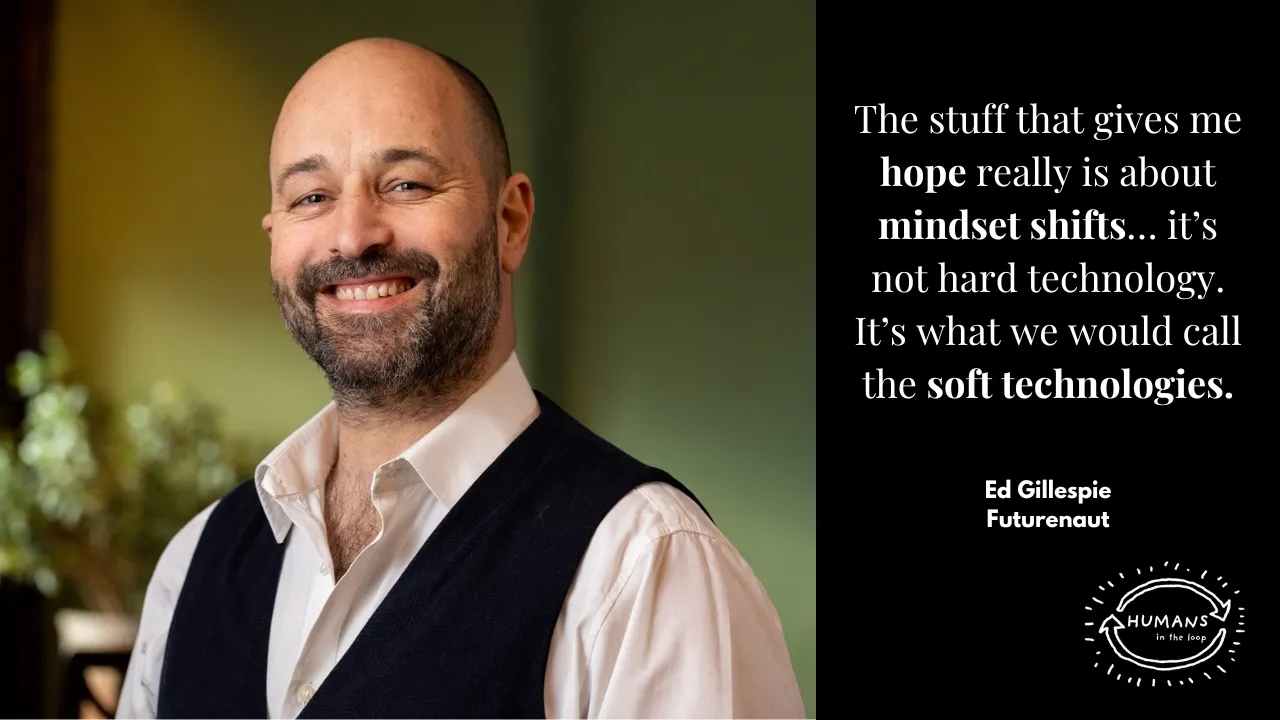
I mean, think, I think Nick Cave said hope is the warrior emotion. You know, I mean, people, people argue sometimes that, you know, it’s glib to be hopeful in a world which is programmed or set up for despair. And I don’t agree with that. I mean, I think, hope is gritty, you know, it’s messy. It’s roll your sleeves up and get your hands dirty hope. It’s not some happy, clappy. And it’s not necessarily optimistic. think, you know, that people often conflate hope and optimism and I think that they’re different. optimism can be a bit glib. It can be disconnected from the factual reality, whereas hope can come from the darkest of places. It really can come from the Stygian gloom. So, the stuff that gives me hope really is about mindset shifts. You know, it’s actually the softer… It’s not hard technology. It’s what we would call the soft technologies. think it’s about the mindset shifts that come from a change in the experiential reality in which people live. So when I first started working on climate change three decades ago, it was something which happened to someone else somewhere else tomorrow. That’s not the case now, for better or for worse. It’s happening here and now and it’s happening to you. And so I think that is starting to have an embodied effect on us because the weather is not what it was. And so the things that give me hope are those slower realizations and epiphanies and stirrings which come from an acknowledgement of where we are in the reality. And I think it will be dependent on us to find out ways of resolving grief and loss and other tensions which emerge, which they undoubtedly will, in a way which is much more mature and to your word nuanced, than we currently see these things debated. We’ve already touched on the hostility and the polarization around things like migration. Well, we’re to have to find better ways of discussing and exploring these things together. And I’m hoping that there is… a consciousness shift and an ability to engage in these things in more sophisticated fashion. And that’s the thing that potentially gives me hope.
We already have the technology we need
Seb (43:41)
in a hypothetical world where we could get everybody on the same page, you know, this is a problem, this is direction we’re going in right now. Do we already have all of the technology, all of the hard technologies we need to solve the problem? are there fundamental sort of gaps in our arsenal and areas where like the hard technology really does need to catch up in certain areas? Or are we there already? And it’s just a coordination and almost political problem more than anything.
Ed Gillespie (44:09)
Yeah, I I think we’ve got all the goals. I mean, I say this repeatedly in talks. said, we’ve got the kit. You know, we know we’ve got the kit. We know what works. There are winners and losers in the transition, though. So that’s part of the problem. Part of it is about the mindset and the ability and capability to roll out those solutions and resolutions at scale. And this is where the kind of the soft technology meets the hard technology. You know, it’s. You won’t get a kind of renewable energy based system, which is individually and community based, unless you put in the right social structures to make that happen. You know, it requires us to cooperate and collaborate together, perhaps in ways that we’re a little bit unfamiliar with and might even be a little bit uncomfortable with. And so. You know, I think the soft technologies that which could replace our politics, like the citizens assemblies, which have been used, you know, in a widespread way now to come to difficult decisions collectively based on facts and based on, nuanced discussion and exploration together. Those are the real real superpowers we already have. And what we need to do is have the courage and confidence to be able to use them for the biggest questions. like what would what would our energy system look like? You know, what should our defense industry look like? What should our education system look like? How would our health care system work better for us? All of those big questions, I think, could be better resolved and better explored through participatory democracy, through citizens assemblies and the like, because I believe that the conclusions that those bodies would come to being made up of representative cross-sectional groups of the peers that represent the nation would be far bolder and braver and more imaginative than what we currently get through our political system. And so that’s the bit that gets me excited because if you get that soft social technology right, then the hard technology solutions that we already have will happen because it’s the soft technology, it’s the mindsets, the beliefs. the values and the moral systems which are the things which are not being manifested in practical reality right now. And they really could be.
Seb (46:41)
Yeah, it’s interesting because almost you started this conversation talking about systems thinking and the more time we spend talking about it, the more deeper deeper levels I appreciate that the complexity of the systems, even though we’re talking about climate as an entry point here, actually to try and say, these are the technologies we need to solve the problem is just far too simplistic a model. actually my takeaway so far is just in, the societal structures and ways of collaborating are really the things that we need to fix. And that’s where the innovation needs to take place in order to basically deploy technologies that, not only have we mostly already invented, but you know, if you look at the cost of things like solar panels and similar types of things, they dropped in cost by 90 plus percent, most of them in the last 10 years or so. So
Ed Gillespie (47:36)
Yeah. Thanks to Joanna.
A bioregional vision of the future
Seb (47:39)
yeah, yeah, I guess mostly thanks to China. So yeah, it’s interesting to reflect on that. Ed, we’ve sort of touched on some of the components there, but if you cast your mind forward, I guess what’s a vision of the future that you’d you’d hope to see in your lifetime.
Ed Gillespie (48:00)
I don’t know whether I see it my lifetime, but I mean… Mark Twain always said, history doesn’t repeat itself, but it sometimes rhymes. I would like to see us return to a kind of degree of bio-regionalism, where we we relocalize a lot of our support systems, whether that’s food, health, energy. I think that is a much more effective way. And by bringing those local support networks together. So there is a degree of community connection, cohesion and solidarity that brings and celebrates that mutual dependence and interdependence. I think that’s really beautiful. And I think it would make us happier because it would reconnect us with our neighbors and our communities in ways which are meaningful and purposeful. I think part of the curse of free market capitalism’s individualism has been to atomize us, has been to separate us and to take so many of those services out of the local and turn them into faceless, disconnected national or international networks and supply chains. I think that works for a very narrow economic perspective on the world, but it doesn’t work for when we look at things in the round and try to bring the social and environmental elements back into that. You know, the extreme dystopia is, know, we all just end up hiding away in our homes with Amazon delivery drivers. It’s like being in lockdown. It’s like everything local has vanished and everything is delivered to your door by faceless corporate behemoths. And I don’t think any of us want that, you know, deep down. And the alternative to that, I think the future is not necessarily a return to the past, but it’s understanding that those renewable energy networks, those healthy, secure food networks, those systems of healthcare and even education all work much, better when they’re really deeply integrated and connected in real local communities involving real local people. And I believe that is a world that is not only possible, but I think preferable. And one I think could capture the public imagination again.
Seb (50:37)
Yeah, very well said, very well said. Well, Ed, I think that brings us to a good point to finish up. So thanks so much for coming on the show. I really appreciate all the insights you’ve shared.
Ed Gillespie (50:52)
My pleasure, thoroughly enjoyed it.


