/
/
48 min
Tech & what it means to be human
Henry Shukman
Zen master · Co-founder, The Way
About this episode
Henry Shukman is a Zen Master, a meditation teacher, and co-founder of The Way meditation app. As AI poses some hard questions about what it means to be human, I thought Henry might help make some sense of things.
Full transcript
Humans in the Loop
Seb (00:01)
Henry, thanks so much for coming on the show.
Henry Shukman (00:03)
Great to be with you, Seb. Thanks for having me.
What Zen actually is
Seb (00:07)
So if I may, I’d love to start with Zen and perhaps to get your take initially on what is Zen and how does one become a master?
Henry Shukman (00:18)
Well, the master part, you know, is just a technical designation that I’m very much still working on, so I can’t really answer that question very well. the main thing about Zen, as far as I know it, and I have to just say there are different expressions of Zen, and I only know deeply the one that I know. But speaking about that kind of Zen, it’s very, very simple. It’s very stripped down, it’s very bare. You don’t have to wear any fancy robes. I have short hair because I’m mostly bald, so I keep my hair short. But it’s not part of the Zen that I know to have a shaved head. There’s no real ritual. What attracted me to Zen when I was a young man was that I really was in dire need of some kind of spiritual life, but I just wasn’t going to go near religion. And meditation seemed to be like this premier activity that could help you have a spiritual life that didn’t need to be religious. And of the various paths of meditation, I still think this is pretty much true to say none is simpler than Zen, because in Zen you just sit there. If you can sit on a cushion, great, if you can’t you sit on a chair or a bench, it doesn’t matter. You just sit there and you kind of get to know your own experience more and more intimately, essentially. So you’re simply sort of being with what’s going on. And as you get to be able to be with it more and more, you naturally find discoveries about the nature of experience that would be probably very hard to find. without doing a practice like being quiet and still on a daily basis. that was another thing that I loved about Zen. I’m going on rather long, but I’ll wrap it up in a moment. Is that it recognizes that we can experience our own consciousness in radically different ways from the ways we ordinarily do. Okay, I’ll just pause there.
The vision at nineteen
Seb (02:40)
No need to pause, no need to pause. It’s good stuff. So you mentioned there you described a dire need for a spiritual life. What was that dire need born out of for you?
Henry Shukman (02:55)
Yeah, kind of desperation, I’d say. In my early twenties, I was very unhappy, depressed, anxious. I’d also suffered from a chronic skin condition all my early life, which sometimes put me in hospital. It was a very severe form of eczema and it was a very, very stressful thing to live with. So I was suffering a lot. But at the same time, also something else, I’d had a kind of blessed time when I was 19, I’d been away on a gap year, 18 to 19 for six months. And during that year, or six months rather, away, I’d had a strange, compelling moment when I was stone cold sober and my… I suddenly found that my experience was just not what I thought it was. The me I thought I was, it was as if there was a completely different me that was all-inclusive of everything that had been here all along. And that wasn’t really me as I knew me, it was something much larger, but I was intimately part of it. It wasn’t… So the main ingredient of this experience was that I and the world were just one thing, and there wasn’t really a separation between me and the world. And the thing about that experience is that it just came out of the blue, and I had no knowledge or even interest in spirituality at that time, but it came with a real force of… convincingness, I was totally sure that I’d seen something real about the nature of being alive, of being conscious that I had never seen before. But it was so radically different and it was so sort of, it had such a sense of sort of, I want to say truth or reality to it, that actually it changed my life really.
Henry Shukman (05:20)
because it was unforgettable. It faded, but it was unforgettable. there was this constant thing hanging over me in the years after that. like, what the hell was that? And what was I going to do about it? And so that was the other thing that was driving me to have some kind of practice that, you know, I didn’t really know whether meditation was going to help with that when I first started it. But I knew that at least it wasn’t just running around my little hamster wheel of
Seb (05:33)
Mm.
Henry Shukman (05:58)
worry and stress and activity, know, it was sort of slightly outside that. So meditation itself. So I thought there’s a chance it might help me with somehow addressing that experience.
Why meditation stuck this time
Seb (06:13)
Yeah. Yeah. I guess lots of people can perhaps relate to giving meditation a go more and more through apps like your own and others out there and people have increasing exposure to it. Many willing, well-intentioned participants set off to say, right, I’m going to start a meditation practice and probably many, more for by the way, side along the way and don’t stick with it. So what is it you think that helped it stick for you?
Henry Shukman (06:50)
Yeah, two things I’d say. One is desperation. It was like my primary sort of lifeline. And actually I quickly found it was helpful. I was really lucky in that regard. By the way, I didn’t start with Zen I started with Transcendental Meditation. I was a graduate student in London at the time. And TM was, for a student it was pricey back then. But they offered, they had an offer on, 90 % off if you were a graduate student. And so I joined, you went every week in the evening. There was a small group, I don’t know, maybe 10 of us or something, learning. And at the end of the week, this is what they did in TM, they gave you, in a sort of ceremonial kind of fashion, which I didn’t particularly like actually, but they gave you your mantra and you had this mantra like a sound or a word you were going to repeat in your mind every time you did your meditation. And you had to do it twice a day for 20 minutes or it wouldn’t work. That was the sort ground rules of TM. And I was desperate enough that I just did it. I just did it. And I’m very grateful for TM. I did it maybe five years because it absolutely locked in, basically what’s turned out to be a long meditation. I was going to say a long life, but life’s not over yet, but it’s already been long enough. I don’t know if I’ve it twice a day. I’ve done different permutations of how do it, but I’ve had a couple of phases, like around when our first child was born and then when our second child was born. I lost it a bit, but I’ve been pretty regular. all these years, know, and whatever it is now, over 35 years and
Henry Shukman (08:55)
It was like they just said, unless you’re going to do it this way twice a day for 20 minutes, why bother? You know, kind of thing. And I just, I bought it and I’m so glad I did. And so I would say that’s one element in why it stuck with me was I was desperate and I just found benefits very quickly. So I stuck with it. But another was I had a couple of friends who did it.
Seb (09:03)
Yeah, yeah, yeah, yeah.
Henry Shukman (09:23)
And that was so helpful because sometimes we did it together. I knew they were doing it. It was just some kind of buddy, you know, on the path as well, who had already locked in their commitment. They were doing it before I… They encouraged me to do it actually. I think that made a big difference as well.
Teaching in the world, not the monastery
Seb (09:47)
Yeah, yeah. And here we are all these years later. yeah, credit to you for sticking with it. I’m You know, some people when they are drawn to the spiritual path, should we say in some capacity, there are those who go off into the hills to live their life as the recluse in the retreat or the monastery and they kind of disconnect from modern society and that is one path. You know, that is not the path you seemingly have chosen to take, you know, being out there in the world teaching. bringing out, et cetera. I guess I’m curious how you’ve landed on this path and this version of a spiritual teaching journey.
Henry Shukman (10:44)
Yeah, yeah, no, it’s a great question. I would say, just from my own experience and what I see, it’s really helpful to at least have phases when you are a bit withdrawn from the world. And I’ve done that many, many times, but always short term. Like the longest have been maybe three weeks. But I’ve done, there’ve been years when… You know, was 75 to 90 days of the year I was on retreat, but not in one continuous block. So this was probably another thing that attracted me to Zen is that a lot of it is about life in the world. It’s like you have your practice, your time, you know, on the cushion or whatever, however you do it, your meditation time. And sometimes
Seb (11:32)
Mm-hmm.
Henry Shukman (11:43)
you know, under normal circumstances that’s twice a day for an hour or whatever it is for you. And then under retreat circumstances it amps right up, you know, it be eight or ten hours a day or something when you’re on retreat in a sequestered environment. But the idea is that actually the practice is simply not only when you’re meditating. Yeah, the meditation time is crucial for regenerating, rejuvenating, powering. your whole system and your practice, but you’re trying to live it every moment. And that’s the aspiration, of course, it’s not that easy to do that, but it’s a worthy aspiration and you can get sort of thresholds you cross when it suddenly gets a lot easier for a while, you know, to really stay kind of aware as you move through your day. And that’s really beautiful, I because you… What I found anyway, speaking of myself, at times when I’ve been more in that space, my relationships are different, my work is different, my values, I’m able to live out my values more fully. And there’s often just a kind of sense of gratitude that’s accompanying me through the day. I know from experience it’s possible to… get that on a fairly consistent basis, you know, for large stretches of time. it doesn’t, so in other words, I’m saying, guess that from my experience is not actually contingent on being off in the hills in a sequestered monastic environment. And I have a lot of respect for people who take that path. And I think that’s marvelous actually. But it’s not the only way. I mean, can go really deep without the monastic path. You can actually. Some monastics don’t agree with that, but that’s okay. We can differ.
Seb (13:43)
Yum.
Three poisons in a digital age
Seb (13:57)
I guess that leads me on nicely to thinking about the kind of the modern existence in the let’s say the Western world kind of modern existence and question I sit with is almost how compatible is the modern life that most of us lead Very, very digital, very plugged in, technology enabled. How compatible is that life with the spiritual path and the essence of the core teachings of schools like Zen?
Henry Shukman (14:41)
Yeah, we’re all kind of figuring that out, I think. The first thing that I would say about…
Seb (14:43)
Yeah, yeah. If you could just give everyone a simple answer here, Henry, then we’ll be on our way here.
Henry Shukman (14:50)
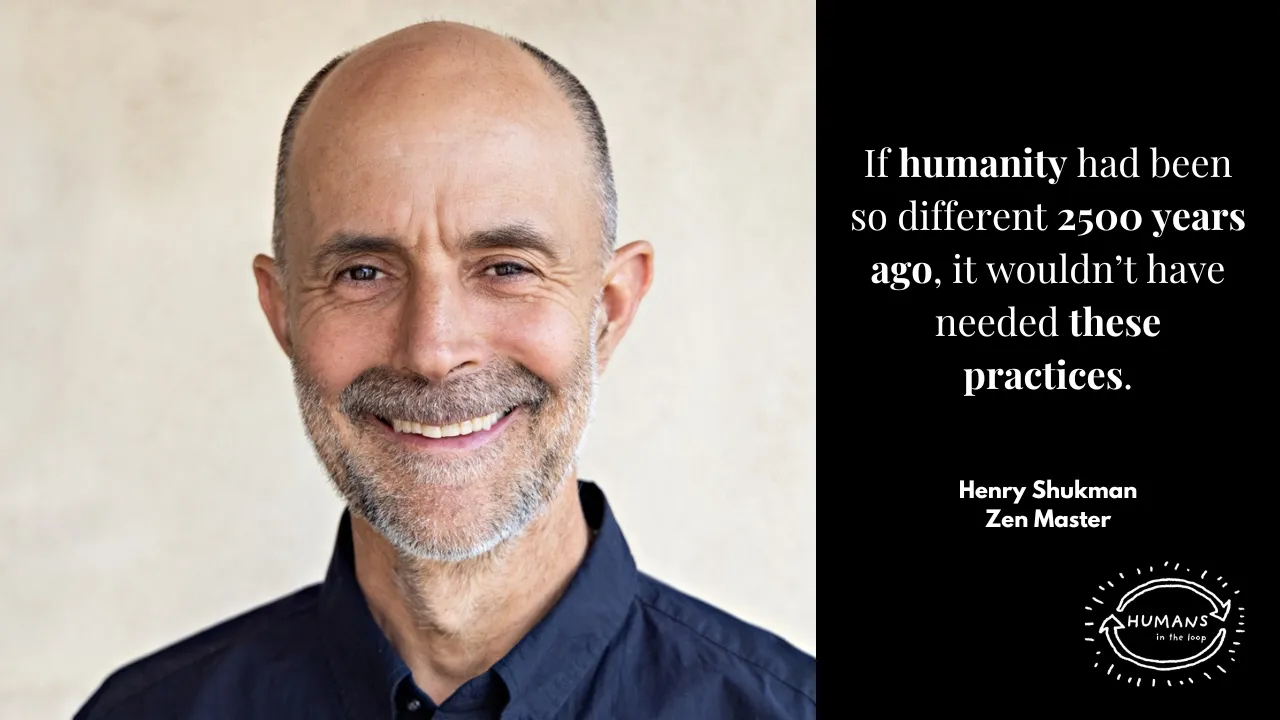
I mean, look, I always think like, if humanity had been so different 2,500 years ago, it wouldn’t have needed these practices. It’s like the issues in Buddhism, you know, they say there are three poisons that afflict us and they’re basically, you know, they’re approximately greed and aggression or anger, know, intolerance, whatever. And the third one is misunderstanding or ignorance or delusion, know, they sometimes call it. And those three things were active in humanity, clearly, 3000 years ago or whenever these, I mean, these practices, we don’t really know when they began, but could be 10,000 years ago. But we know when they started to get formulated and written down, roughly 2500 years ago, 3000 years ago, 2000 years ago, somewhere in the first millennium, most BCE. mostly it happened. yeah, why were they bothering if they were also calm and clear and enlightened? It’s obviously not new that we need something to get trained. I mean, they actually use that term in early Buddhism. They talk about worldlings who are untrained, who haven’t trained their minds at all. who in other words, who are still at the mercy of these three poisons. And they haven’t detoxified from them, they haven’t recognized them even. I mean, you know, we wouldn’t exactly probably want to, I don’t know whether we can buy into that terminology precisely today, but it seems that it’s recognizing something very common that we still all have, which is that we crave things, we hate other things and we, know, that applies to things and people and. places, of course, all. And we get really confused about what makes us happy and well, and what actually doesn’t. so I’d say the sort of core process of these practices, ancient though they are, are still totally applicable to us today. does, yeah, does digitality and the whole
Henry Shukman (17:16)
screen thing make a difference? Well, yeah, it’s probably one more thing that we need to watch out for that we can very easily get very attached to and get addicted to. can crave and get so automatically sort of, I don’t know, how do I put it? Like just automatically turning to what we crave, just pick up the screen and look at it without really thinking what we’re doing. All of that, I don’t think is a totally new challenge, but it’s maybe a new way that the challenge of craving can show up. it’s not, craving itself is not new, you know? And people might say, well, what’s wrong with craving? And that’s, I think that’s a fair question. know, we value love very highly in some forms in the West. I mean, we have great…
Seb (18:08)
Mm-hmm. Mm-hmm.
Henry Shukman (18:15)
epics written about the whole Homeric cycle, know, the Iliad and the Odyssey, they’re all about a mad love affair at the heart of it, know, intense craving between a man and a woman. Helen and, and what were they, Prince, whatever he was called. What was he called? my gosh, Helen of Troy, Menelaus, was it? Who went off, yeah, I think it was. Anyway, you know, that,
Seb (18:37)
Yeah, I think so.
Henry Shukman (18:44)
you know, the first great work of Western literature that’s come down and foundation Western literature, it’s all about craving as a generative impulse of the whole cycle of stories. But actually, from the Buddhist perspective, we’re never gonna find peace as long as we are completely at the mercy of our cravings. There may be wholesome ways of
Seb (18:51)
Mm.
Henry Shukman (19:12)
being with certain kinds of craving or dialing down the craving to a motivating healthy desire for something good and definitely beneficial for self and other, not just self. But if we’re unable to even see it and are just driven by it, we’re kind of on the hamster wheel. We’re just. cycling around around with a constant round of activity, never getting a moment of space to actually recognize being alive, being conscious, the gift of having experience, and how to sort of use that gift more wisely while we can. So that’s a long, rambling answer, but.
Suffering, curiosity, and an app with no choices
Seb (20:08)
It was a beautiful one. was a beautiful one. You as a teacher, you teach in person, hold retreats, et cetera, and then also have many people you reach through your app and I guess other digital mediums. What do you know or understand about your students as a whole and what are the kinds of things that you see amongst your students in terms of why they’re coming to you and why they’re coming to meditation and Zen Buddhism.
Henry Shukman (20:47)
Yeah, thanks, that’s an interesting matter. I mean, could say probably, broadly speaking, it’s either suffering or curiosity. There’s various degrees of that suffering. Some people are having a really hard time. They’ve lost a loved one or they’ve lost some life that they had, it’s been radically changed and they’re just… finding the transition really hard to navigate. Or they’re dealing with mental health, kind of say mild end of mental health issues, sort of anxiety and depression. I think when it gets more clinical, the jury’s a little bit out on how and when meditation may help. But I think not really with the more common end of mental health issues.
Henry Shukman (21:46)
So yeah, either suffering of one kind or another or curiosity. And the curiosity is usually around, well, I’ve heard that there’s something called awakening where I experienced the world in itself in a radically different way. I want to taste it there. I want to know what that is. Or it’s curiosity like, I recognize that I’m alive and my life like this is finite. How might I explore it most beneficially or most interestingly or most helpfully for others? And how might I use it most helpfully? How might I examine my life in a nutshell? And so I think there’s… very, very broadly, it’s those ends of the spectrum. And then there’s actually a lot of people who are already convinced that meditation is a good habit to establish, but they’ve tried and tried and tried and they haven’t managed to lock it in. We get quite a lot of people in that category who are already convinced it’s a good idea, but they just haven’t found a way to lock it in. And I’m really actually quite happy and proud that our app is helping a lot with that category because that’s actually a primary reason we built it. Because we’re radical. There’s no choice in our app. It’s crazy. Every founder would think, what on earth are you doing? It’s all about choice. People want choice. Well, we thought, no, they’re wrong. There’s some…
Seb (23:30)
Mm.
Henry Shukman (23:41)
place for having no choice. just, this is what you’re going to do every day. And it’s so it’s a long-term pathway and you know, each sit unlocks the next one. You can’t do the next one until you’ve done the current one. And so it actually guides people on a long-term pathway, you know, and, every sit is a guided sit and, know, so that’s how we structured it. And it’s really cool for me to see that. Yes. Of all the things that I’ve done in my life as a teacher, nothing has been so effective for getting people to sit daily as this app.
The gap between stimulus and response
Seb (24:18)
Yeah. Yeah. I think it’s actually a very, very smart choice is as someone in who in my first chapter of my career spent my life building, building products for people to use. I think, yeah, the idea of just having a single linear pathway that limits people’s choice is actually in a lot of cases what people seek. know, we, anyone who sat there scrolling through Netflix for half an hour, trying to find the perfect show that every member of the family is, going to be happy with. can maybe attest to, you know, just here’s a channel and pick it and have someone else make the choice. So, yeah, no, I can see that. I can see that. So we’ve touched already a little bit on technology, the good and the bad, if we want to simplify it in those terms. And, you what I hear you saying is, well, in the case of The Way, here is an app that has helped a lot of people. to instill a regular meditation practice. We’ve also already acknowledged the ways in which our technology can draw us in and can feed the mental patterns of sort of craving and aversion and these kinds of things that we fall into. So what is it that you think Zen and or a spiritual path more generally can teach? What can we learn from that about our sort of relationship with technology and what right relationship should look like?
Henry Shukman (25:56)
Yeah, I’m tempted to say that it might be different for a little different for everybody. But I’d say that the principle is really about… know that Victor Frankl, who’s a philosopher who survived the Holocaust, a famous guy, he said, I’m not going to get this exactly right, forgive me, but he said, between stimulus and response, there is a space. something like in that space lies all our freedom and growth. And what he meant, I think, was that commonly we just get a stimulus and we respond to it and there’s no gap. just automatically, phone rings, you pick it up or whatever. Just all the way through the day, there’s a task and you do it, task and you do it. And the moment you’ve done one, you’re onto the next one. If you have a moment of downtime, it’ll be filled with thought. you know, thoughts come up, thoughts come up, just, you know, we sort of, let them tell us what they tell us and we have emotional responses to them. And some are pleasant, some are not pleasant. So we’re just going through the day, this constant sort of ticker tape of stimulus response, stimulus response, not recognizing and not really giving ourselves a chance to taste a gap. you know, so meditation, and so of course, if you’re working with, if you’re doing screens, that’s another way that stimulus response loop just keeps playing, keeps playing. Meditation, it can give us that gap between stimulus and response. It’s like what we’re doing is we’re unplugging, not just from digital media, we’re unplugging from all activity. So when we start to meditate, we’ve made the commitment, it five minutes a day, 10 minutes a day, whatever it is, to just sit still.
Henry Shukman (28:05)
to stop doing activity. And usually our brains may be filled with activity while we’re being still. A lot of thinking, thought loops powered by emotion in some cases as well. So that’s how it is, but gradually we get better at noticing the emotions which we feel in the body. We get better at noticing the thought loops, what the mind is doing. And gradually, gradually, some of that overtime starts to simmer down and we start to get tastes of this actual gap, this space when we’re present, we’re still, we’re quiet and there’s a gap in thinking and there’s just an open space and it’s a beautiful thing to get to know that and everybody when they find it they’re touched by it. You know, it’s like, my gosh, it’s beautiful. It’s just an instant, a short moment of calm. It’s like a peace that has just settled. Okay, it’s gone in a couple of seconds, whatever. It’s okay. You’ve tasted it. And that kind of calm and peace, space, you know, we can just get more of it if we practice. gently, steadily, diligently. And that… Really, that’s the thing that matters. Whether we’re then going back to a screen or then going back to digging in the yard, if that’s what we’re doing that afternoon. It’s the gap that is a kind of homecoming almost. It’s coming back to oneself in a more meaningful or meaning-filled kind of way. You feel, I don’t know,
Henry Shukman (30:11)
reconnected with something deeper about your life. You feel, would venture to say, sort of more connected with some sense of purpose maybe. That there’s something intrinsically good about being alive that you’d forgotten or something like that. You just feel, you and you may feel difficult things, you know, but they’re also authentic and, know, you sort of…
Seb (30:25)
Mm.
Henry Shukman (30:40)
coming back to ourselves. And I don’t think you can, so I’d say like, regardless of…
Seb (30:43)
Mm.
Henry Shukman (30:50)
the place of digital media and digital platforms in our life. Finding gaps, space, light there is just intrinsically valuable.
Seb (31:07)
Yeah. I am.
Seb (31:13)
I remember sitting the Pasana for 10 days of silence and meditation. And on the 10th day, doing a walking lap of the field and just being in awe of the fact that I’d sort of just done a lap of the field and had almost no thoughts whatsoever. Just sort of calm, empty space. and that sense of connectedness and homecoming and just a simple realization. It was like a peek behind the curtain to, this is how my brain could operate. And I think I knew in that moment, as I’ve known in many moments since, that my life is not destined, as most of our lives are not destined, to sort of live that side of the curtain every minute of every day. But there’s something I find reassuring about knowing it’s there, knowing it can be accessed even if for a fleeting moment.
Henry Shukman (32:22)
Yes, I think that’s a really sweet point. Thanks for sharing that. Yeah, just having tasted it, just knowing it’s actually always here, even if we don’t always taste it, it’s really reassuring. And I would say, I mean, for those who have the calling or whatever, had a strong kind of, I mean, my calling to meditation was sometimes up higher and sometimes lower. I was always doing it. But there were times when I just had this kind of calling to do it more and went to retreats more consistently. you know, there was a, could say just speaking, you know, just out of my own experience, of course, I had a phase when I was really, yeah, ramping up my practice, because I just wanted to, and that paid off a lot. I mean, it over several years, but I… things happened in the course of that time. And I also had a great teacher, a pair of teachers at that time. things did sort of change for me in a way where that great space didn’t go away for a long time, for over a decade afterwards. I could live with it present all the time, basically. So that is an actual possibility even in… an ordinary, you know, workaday life. It is an actual possibility. And it’s not that we have to, I’d always say in this practice, it’s great to have aspirations, but you don’t want to be striving too much to make them happen because that’ll push them away. But to have aspirations is great, you know.
Ambition, ego, and losing your edge
Seb (34:15)
Yeah, there’s a certain, I joke with some of my clients because there’s a certain type A approach to spirituality, which turns it into the new sort of stick to beat themselves with. Well, have to, you know, this many, you know, I’ve to optimize it. I’ve got to do this many sets. I’ve got to get to this thing. I’ve got to get this accreditation. Yeah. So, yeah, I think that’s driving. mean, that actually points to an interesting topic and this is something I’ve wrestled with. myself, which is this topic about ambition. In my work, I work with predominantly tech company founders. They’re inherently ambitious people trying to do big things in the world. And I think there is, in my view, a misconception that while you embrace something spiritual and your ego disappears and somehow we just slump into this, I don’t know, existence of a monk who never, never feels the need to do anything and just sits and meditates all day. And for most of the people in my circle, that’s not the life that they envisage for themselves. And so there’s almost a, there’s almost a fear there of, well, if I let go of this thing that’s driving me and that can be a past hurt, that can be a sort of chip on my shoulder, that can be, there are all sorts of things that can motivate us. There’s a fear, a genuine fear of like, will I lose my edge? You know, is this the thing that is actually my sort of superpower that I need to hold onto and the thing that drives me forward? So I’m curious just to get your, know, to put that to you, this topic of sort of ambition and spirituality and how you hold those things and whether or not you encounter those similar fears or hesitations amongst your students.
Henry Shukman (36:10)
Yeah, definitely. I can totally relate to that. And I hear about it quite a bit. I’m just reflecting on a couple of different ways of coming at this because it’s very important topic. One thing I’d say right off the bat actually is that my own master in Japan, Japanese Zen Master, has been the CEO of a large company for the last 20 years. And prior to that, he was managing director at a large bank. And so he had a very successful career all his long life while pursuing Zen or meditating daily for probably 60 plus years at this point. And he’s also a teacher of teachers in Zen. There’s some 70 to 100 Zen teachers worldwide who try to study with him if they can. And so he’s a kind of leading figure in Zen and a very busy, and I guess we’d have to say successful, businessman at the same time. And he doesn’t see any distinction between his work life and his Zen life. He actually just can’t. make a distinction. He says it’s just all one field, know, whether I’m sitting on my own in a zendo, whether I’m in a board meeting, whether I’m going over spreadsheets, it’s a one, it’s a single field of experience. So why would I sort of excerpt large parts of it from my practice? It’s all one field of practice. So just, here’s an example that
Henry Shukman (38:00)
know, ambition, success in a worldly sense, you know, is an opposite path to a spiritual path. It’s just simply not the case in his life. And there are many, I mean, there are many sort of famous figures actually in the history of meditation traditions and Buddhism who were lay people, you know, whether they were hugely successful or not, they vary. I mean, one… There’s one canonical figure from early Buddhism called Vimalakirti who was a merchant, tremendously successful merchant. And he’s always held up as the greatest of the Buddha’s students, actually. So I don’t know, there’s…
Henry Shukman (38:46)
there’s undoubtedly a way of practicing deeply while having a successful, ambitious, worldly life. On the other hand, I don’t know, I’ve got this feeling that there’s certain kinds of flavors of ambition that might not be so helpful, that might be so kind of colored by craving and resistance or aversion. that somehow they’re getting in the way of our practice. Or they’re getting in a way, they might get in the way of a wider opening to our practice. That we might find that there’s some, I mean, we’ll know when we’re practicing. Our practice will tell us. But we might run up against particular forms of craving that are flavoring our ambition. That until we see through them, we won’t, we’ll keep bumping up against them. But our practice will sort of tell us. Because I think there’s, but not everybody’s ambition is the same. I know people who are sort of ambitious, but it’s not really wrapped up in a sort of craving to prove themselves or something. They’re just really enjoying work and seeing something flourish and helping it to flourish. there’s a deep sense of purpose there, especially if they think that what they’re building is a really positive thing in the world and they have no hesitation or qualms about that, then it might just be this really healthy, positive form of ambition. If it’s got sort of flavors of, know, I need to prove myself, this must work out, I’m gritting my teeth and it’s more of a, it’s got some sort of flavors of self, I don’t know, self clinging in it. maybe that’s something that practice will take a will want to take a look at will ask us to take a look at you know
Seb (40:50)
Yeah, there’s certainly plenty of stories of technology company founders who have had great success, had the big multi-millions, billions of the end of the rainbow and the whole experience pretty hollow as a result. And of course there are people who have got there and enjoyed those riches greatly. So it’s not all one or the other, but.
Henry Shukman (41:18)
Yeah, actually, you know, just thought of a story. was one Zen master, I remember hearing this story, where he had a sort of, you know, like an assistant, you know, in the meditation hall, who was a guy who had had one, he’d had a really difficult time in recent years, his wife had left him, his company had failed, and it just built up a new, getting a new company going, and it was looking quite good, and he had a new partner. new relationship, and he was about to do a big retreat, a large retreat where he was helping the master in the course of the retreat as a sort of attendant assistant to the master. He a serious meditator, but in the few days right before, his new girlfriend dumped him and he didn’t get some new investment and his business was going to collapse. And he arrived… ragged at the beginning of the retreat and said, Master, I’ve got to speak to you. And so he had a little moment with the teacher and teacher asked him, what’s up? And he said, this is what’s going on. And my girlfriend’s dumped me and my company, my new company is collapsing. I don’t know what to do. And the teacher just reached across the table with his hand and said, congratulations. So there may be a place for some kind of release, relinquishing of some flavors of our worldly aspirations. It doesn’t mean we have to drop out altogether, but some different approach where we’re less tightly clinging. might be a great relief to our system and very helpful for our spiritual lives.
Seb (43:16)
Yeah, indeed. Henry, sorry, two seconds. I’m going to have to just unplug one thing and plug my laptop in because my battery is just running a bit low. Hopefully this doesn’t disrupt us recording wise. Give me two seconds.
Seb (44:00)
Okay. Still seem to be running here, which is good. Okay. Can you still hear me okay Henry? Great.
Henry Shukman (44:09)
Yeah, all good. Seb, let’s… Let’s see if we can make sure that we get everything you want and just because I’ll have to hop off in kind of 10, 15 minutes. So let’s just make sure we get what you most want.
Seb (44:25)
Yeah, yeah, absolutely.
Seb (44:30)
Yeah, perfect. Well, think, probably a couple of areas just to touch on. But yeah, we’ll keep a close eye on time.
Intelligence, consciousness, and AI
Seb (44:42)
One topic we haven’t touched on yet, and I’m almost hesitant to do so because it feels like the topic of the world right now is about AI. And I guess as a spiritual teacher, I’m interested to get your thoughts here because, you know, as a technology is posing many interesting, difficult questions about the nature of what does it mean to be human and what can we do that uniquely that technology can’t and other people at the real kind of having existential crisis about, are we, know, are we, are we even, do we even have value in the world that we’re going to be, you know, slaves to the machine? So yeah, I am, I’m just curious as to, you know, A, if that’s a conversation that seems to circulate in the world in which you move and Yeah, any of your thoughts on the challenges that AI is posing for people?
Henry Shukman (45:48)
Yeah, look, I would, I mean, certainly our team talk about it quite a bit. mean, I’m older, all the team members are half my age, basically, pretty much. And I am not as plugged in as I probably should be, but I just want to say a couple of things that might be interesting, I don’t know. There’s some confusion, I think, between intelligence, consciousness, and self, sense of self. I noticed, like, I love that. Alex Garland movie, I’ve forgotten what it was called, where there’s this beautiful AI robot, you know, in a hideaway in New Zealand or something like that. Do know what I’m talking about? I’ve forgotten what it’s called.
Seb (46:31)
Is it X Machina? Is it X Machina? No? Yeah.
Henry Shukman (46:33)
Yes, yes, exactly. exactly. So that in that movie, they totally conflated those three things as if they were one thing, intelligence, consciousness and sense of self. They’re not one thing. So that’s the first thing I’d to just really lay out that obviously we’re seeing that, you know, there’s it’s possible the it’s possible to have some kind of intelligence without consciousness. know, the calculation capacity, problem solving capacity. Those can exist without consciousness. I don’t know whether, I mean, the evolutionary philosopher Daniel Dennett, he talks about the bird that pretends to have a broken wing in order to lure a predator away from its nest where its fledglings are. Is that bird thinking consciously, I’ll do this thing to lure it away? Or is it just, well, I’m going to say absolutely not. It’s just, there’s a genetic coding for it to do that under those circumstances that’s been passed on down the generations and the birds that did it survived and reproduced, you know? So there’s, he calls it, there’s competence without comprehension. So that you could say that’s a sort of problem solving technique right there, method right there. It’s a competence, but there’s no comprehension in it. So. Where am I going with this? So there can be problem solving, there can be intelligence without there being consciousness. There can also, and this is critical, there can be consciousness without sense of self. This is one of the big things that you discover in meditation if you stick with it, is that your sense of self is something that arises. It’s basically
Henry Shukman (48:30)
a set of thoughts, a set of stories about me that arises within a larger context of consciousness. And to discover that is immensely liberating because we’re all so identified with our sense of self that it’s hard to believe that there could be any space between awareness and sense of self, but actually there is. And to be less identified to notice that, wow, I don’t have to cling to this sense of me. I can be conscious and not be identified with a sense of self. That’s a really amazingly liberating discovery. And so I’m sorry, you’re asking about AI, I’m going off on different things.
Seb (49:20)
Mm.
Seb (49:24)
No, no, no, this is this I’m enjoying it
Henry Shukman (49:27)
But I think somehow my response to AI would come out of that kind of awareness. And obviously as a content creator, I don’t know, because is somebody going to make a pathway similar to what we’ve created on the way 10 times longer, 10 times better? I don’t know. And it’ll be made in a matter of a moment by some AI voice clone. I don’t know. I don’t know, know, maybe it’ll get good enough. I don’t know. But,
Seb (49:59)
Yeah. Yeah. Yeah, it’s…
Henry Shukman (50:02)
Yeah, I mean, I think there’s always going to be, I can’t imagine a really good AI massage therapist. I think that’s going to be a really hard thing to get to, you know.
Seb (50:10)
Yes. I think I think the math, yeah, massage therapists have got a few years of work ahead of them still, I would say. Yes, I mean, sorry, I mean, I was gonna say, you know, there is, this is a big topic in and of itself that we, we won’t get too deep in. But I suppose a lot of the the existential piece seems to be based on this quite sort of fixed
Henry Shukman (50:18)
So, yeah.
A hopeful close
Seb (50:39)
view of, we are people, these are the jobs we do today. And therefore, if AI takes this, what space is left for us? Perhaps as opposed to a view that maybe acknowledges what we have done as people, the activities that we do day to day, you and I having this conversation right now. Someone in medieval times did not think that the podcasting was a thing that the world needed. or, you know. So yes, I guess there is new space that emerges and is filled from a, or at least that’s the belief that I like to hold on to. And yes, there are these. Yeah, these deep and interesting questions about, I suppose, the nature of consciousness, that it sort of forces us to confront, even if we don’t have good answers for it yet. Henry, to wrap us up here, I usually ask guests a question about the future, about their optimistic view of the future. And often that is born out of people who are building something specific in the world in terms of the technological advancement that they see playing out. So I’m sort of noting that the context in which I ask you this question is a little bit different, but I’m equally interested in asking it of, know, when you look ahead to the future, what is it that you’re optimistic about?
Henry Shukman (52:25)
Yeah, maybe we could think of it as sort of inward technology or something like that, you know, because I do think that…
Seb (52:30)
Mm. Mm.
Henry Shukman (52:35)
the path of meditation can bring a lot more ease to an individual, a lot more peace and a lot more love. And so I’m very hopeful that because meditation has been spreading in an insane way for the last 30 years. And, know, when I began 38 or so years ago, it was very, it was pretty fringe and niche, you know, a little bit weird. It just isn’t now. It’s mainstream. Not only that, but some of the insights that come from meditation that are kind of at a deeper, more existential level about the nature of our interconnectedness, the nature of our shared consciousness, the nature of the sense of self being more contingent than it appears to be, so that we’re actually able to drop into a greater sense of a kind of interbeing as one famous Zen master Thich Nhat Hanh from Vietnam used to call it, interbeing, that we don’t exist so independently. And the more we discover that, you know, the more we feel compassion, the more we feel love, the more we feel connected. And I think that there’s a really solid case to be made that as more people are tapping into that and are curious about that, we’re undercutting one of the great human psycho neuro immunological problems, which is dehumanizing others, othering others, considering that other humans are somehow not human like we are. And to undercut that is a really important thing right now when so many unscrupulous and malicious politicians are trying to fire up hate in the world and divisiveness. I think any use of technology that is working the opposite direction is a really good thing. Even if it’s, you to whatever limited extent it works, but I do think actually, you know, the deeper meditative path can work really well at undercutting that. So I’m hopeful. I’m hopeful.
Seb (54:56)
Beautifully put, beautifully put. Well, Henry, I’ll bring us to a wrap there. I just want to say a deep gratitude for you coming on the show and thanks for sharing your insights and your wisdom.
Henry Shukman (55:08)
Thanks for having me.
Seb (55:10)
Okay, I’m gonna just hit stop.


