/
/
54 min
Talking to animals
Kate Armstrong
Executive Director, Interspecies Internet
About this episode
In this conversation, I speak to Kate Armstrong , the Executive Director of InterSpecies Internet , about the latest advancements in how we communicate with animals through technology.
Kate emphasizes the importance of planetary kinship and the responsibility humans have as advanced toolmakers to create beneficial tools for other species.
The discussion also touches on real-world applications of interspecies communication, the complexities of wild animal communication, and the need for legal frameworks to protect animal rights. Throughout the conversation, Kate shares insights into the future of this field and the resources available for those interested in learning more.
Full transcript
Humans in the Loop
Seb (00:00)
Have ever watched Dr. Dolittle as a kid and wonder what it would be like to talk to animals? Or maybe like me, you’ve got a dog at home and you know what it’s like to speak to an animal on a daily basis. Today’s episode is all about interspecies communication. Kate Armstrong is director of InterSpecies Internet, an organization co-founded by musician Peter Gabriel, by internet pioneer Vint Cerf, one of the architects of the modern internet. MIT professor Neil Gershenfeld and cognitive psychologist and marine mammal scientist Dr Diana Reiss Kate and I covered an array of topics, her work at interspecies internet, the latest advancements in interspecies communication, a vision for planetary kinship with other species, and also some of the ethical debates and questions that lie at the center of this work. So without further ado, this is Kate Armstrong.
From design school to Fab Labs: Kate’s path to Interspecies Internet
Seb (01:16)
Kate, thanks so much for coming on the show.
Kate Armstrong (01:18)
It’s my absolute pleasure. Thanks, Seb
Seb (01:21)
So let’s kick things off with what it is that you actually do.
Kate Armstrong (01:28)
It’s a good question. I think I’m here because I’m the executive director of the InterSpecies Internet. And in that role, I act as a bit of a glue and organiser for a community of around 4,000 folks who are experts, enthusiasts, scientists, technologists, all of those kinds of. with wonderful humans that are interested in the advancements in the field of interspecies communications.
Seb (02:04)
how do you become the spearhead of this community?
Kate Armstrong (02:08)
by accident, I have to be completely honest.
Seb (02:10)
Yeah.
Kate Armstrong (02:12)
But I think what really got me here and my trajectory so far has been around the idea of how we can explore and simplify complexity. So I studied design originally and I went into design when design was having one of its many crises. It was kind of on this precipice of being something that was completely vocational based. So, you know, you were going to be a graphic designer or a textile designer, those are two I studied. And it was in this transition towards something more of a tool, something more of a mechanism for allowing us to explore thinking and processing and developing, you know, and ideating. And so I kind of got the tail end of that in my studies and then went on to explore how design processes at that time, it wasn’t necessarily design. are involved with engaging communities, engaging various actors in developing different kinds of projects, different kinds of interventions, ways of working together. And that was always really interdisciplinary. And I think I’ve just always followed that as a bit of a curiosity of mine and how those processes of bringing different types of people together around let’s call them problems, but probably, you know, they’re more like challenges can really create for want of a better word innovation, but novelties, I guess is a better way to explain it. So along that journey, I found myself at a fab lab. I don’t know if, you we all know what a fab lab is, but this is a small domestic scale digital fabrication laboratory. It’s an outreach project of the MIT Center for Bits and Atoms. And I found myself at one of the almost 3000 labs that there are globally. And this kind of piqued my interest in open source technology, technology deployment. and this interface of technology as a tool to actually be central to this kind of deliberation that happens in design. And from there, yeah, I was hooked and it took me along about a six, eight year path through the lab network, Fab City, where I currently also serve as a CEO and management board member of Fab City Foundation to, yeah, the interspecies internet and the incredible work that they do with. and technology and interdisciplinary thinking.
The TED talk that started Interspecies Internet
Seb (04:52)
Yeah, and so tell me about InterSpecies as an organization, because as I understand it, there’s some connection between Fab Labs and InterSpecies, but yeah, how did InterSpecies come about and like, what’s the kind of the origin story there?
Kate Armstrong (05:07)
Yes, so the origin story is a TED talk from 2013. And I encourage everyone to watch this TED talk because it puts in place how incredible these types of movements can be when they’re shaped by thinkers like the four thinkers that are involved in the interspecies project. So it tells a story of four experts, people really top of their field. getting together and coming up with a vision which was, can we plug animals into the internet? Can we give them the same networking capability that we as humans have been provided by the networks of the internet? So this was Peter Gabriel, musician, and he had had an incredible interaction with playing music with animals and being really inspired. This is Vint Cerf, so founder of the TCP IP protocol, one of the founders of the internet as we know it. Diana Reiss who is one of the first people to recognise that dolphins have selfhood, which is an incredible advance forward in animal studies. And then the connector between the Fab Lab and the InterSpecies project is Neil Gershenfeld. So Professor Neil Gershenfeld is from MIT, Center for Bits and Atoms. He’s the father of Fab Labs. And he and Neil, he and Vint, sorry, they refer to themselves as plumbers of the interspecies internet. So they’re really interested in the technology and the deployments.
Seb (06:50)
Yeah, interesting. I will try and get for the purpose of the recording a little excerpt of that music session that you kind of alluded to
Kate Armstrong (06:59)
Mm.
Seb (07:00)
there with, is it chimpanzee who’s playing? I think it is chimpanzee who’s playing, right?
Kate Armstrong (07:05)
Yeah, yeah, it’s really beautiful.
Seb (07:08)
Playing keyboard. It’s kind of a magical moment. So the four of them, I’ve seen the Ted talk, I guess the four of them,
Kate Armstrong (08:47)
Okay.
Seb (08:47)
did they have a, pre-existing connection to one another. Like I’m trying to picture in my head, like how do they come together as a four?
Kate Armstrong (08:56)
You know, they’re connected the way that people of their calibre are connected. And I don’t mean to say that in, you know, a fangirl kind of way, but, you know, they’re
Seb (09:04)
Sure.
Kate Armstrong (09:06)
really on the same level of understanding and they’ve done, you know, projects and different explorations together in the past. And I think what really is the catalyst or was the catalyst is this vision. that was driving the interest, which was, is this possible? And back in 2013, I think that that was really, in some ways, quite speculative. But today, we’re really seeing that with the right people in the room, it is actually possible, and it’s becoming far more possible. And I will also add that animal communications as a field is really It’s quite an old field of exploration. So what we’re doing in interspecies and what the trustees came together to do really sits on the shoulders of giants or elephants or whoever. And it really is about an augmentation and a development and an evolution of a field that is really rich with really incredible research.
Dr. Doolittle vs. reality: what interspecies communication means
Seb (10:20)
Mm hmm. And that this interspecies field, so there’s a childish part of my brain that when we talk about interspecies communication, pictures kind of like Dr. Doolittle, you know, in like direct dialogue, chatting back and forth with
Kate Armstrong (10:35)
Mm-hmm.
Seb (10:36)
whatever animal might be in front of them. But tell me, like, what do we really mean when we’re talking about interspecies communication? What’s the kind of plethora of different ways in which that field is being explored?
Kate Armstrong (10:51)
Yeah, it’s a good question because I think everybody’s mind goes to either Dr. Doolittle, you know, that kind of side of things or, hey, I talk with my dog all the time. What are we talking about? Why do we need, you know, why do we need technology? So what we’re really looking at is two different modalities. So we have intraspecies communication and interspecies communication. So intraspecies would be, and I love this, this is the… This I’ve heard from one of the first people who actually discovered that underwater animals are making sound. So this person was Marie Poland Fish and this was back in the 1940s. She started working with the US Navy. And in an article that she wrote, I think it was for Science Magazine, she said that this is eavesdropping what we’re doing. And in actual fact, that’s what that is. So the intra-species work is understanding what is being said or communicated inside one group, so one specific species. So that would be where we would maybe use technology that could potentially translate or transduce signals and attempt to find meaning from those signals. That could be one side. The other is interspecies communication, which is more like the do-little situation. So this is about mediated experiences where we can find ways to translate via interfaces between ourselves and non-human animals.
Seb (12:30)
And so obviously the organisation is called InterSpecies Internet. So is it the latter that you are solely focused on or do you sort of
Kate Armstrong (12:40)
We.
Seb (12:41)
look into the former as well?
Kate Armstrong (12:44)
We do all. in actual fact, we have recently had some talks around plant communication. So we’re really interested in the field as a whole. We’re interested in how the different nuances of the field interconnect because often you can’t have one without the other and some of the technologies intersect. So we’re really interested in building out that field, providing support for the technology side. How can we support the field in terms of connectivity in technology, networking potential, deployment of stack for technology? And then we’re interested in one of the most important parts, I think, arguably, is the discourse development. So what we’re doing right now, actually kind of talking to people to let people know that this is a happening field and it requires and does demand some attention. And also we talk about how we can share and convene different workers in the field and different people who are interested in the wider field.
Planetary kinship: why this work matters
Seb (13:49)
I guess on
Kate Armstrong (13:49)
Mm.
Seb (13:49)
that, point there about the discourse and when we’re sharing with people that this is a field that’s going on and sharing the message of it, what is the, I guess, why should people care if we put it really bluntly,
Kate Armstrong (14:04)
Mm.
Seb (14:05)
know, beyond that kind of initial spark of interest, like, could this happen? You know, could we somehow connect different species? Like, what are the… the parts of this that you feel are really important for people to engage with.
Kate Armstrong (14:19)
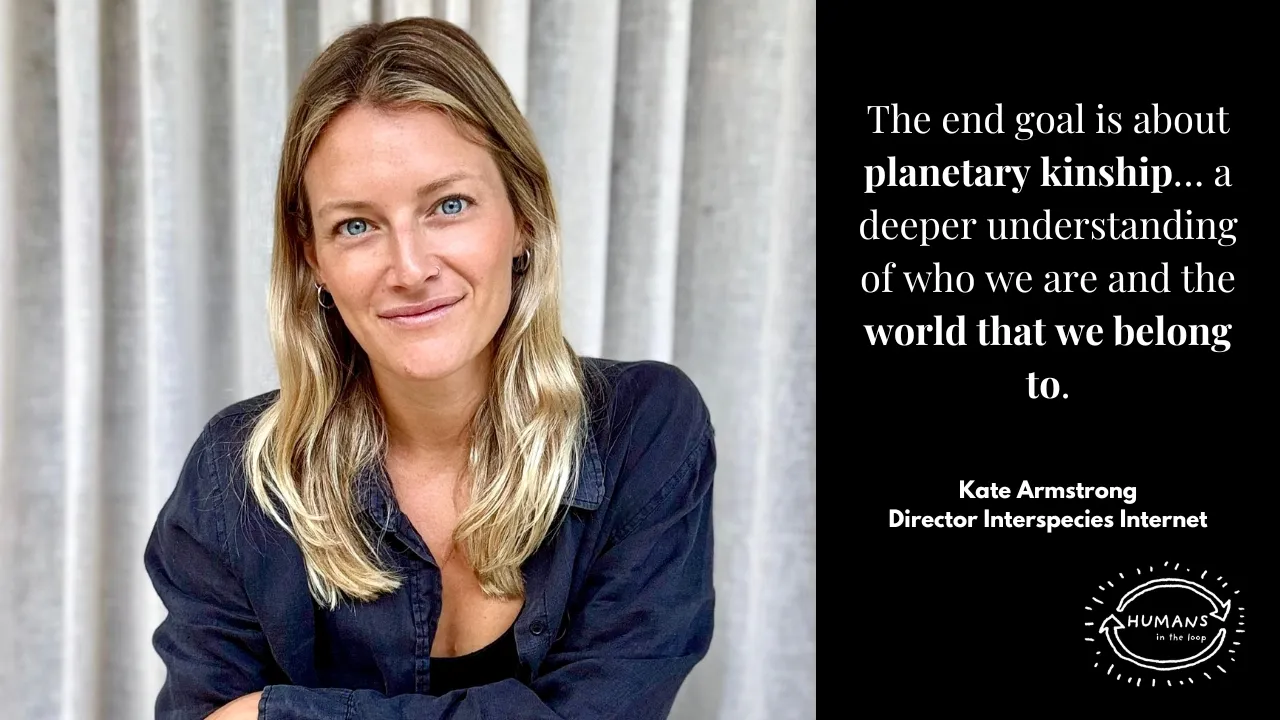
Yeah, think, you know, when you hear it, when you take a second thought, you start thinking, well, you know, we do have quite a lot of, you know, issues in the world. And is this one that we really need to focus on? But the end goal is something about planetary kinship. And it’s about having a deeper understanding of who we are and the world that we belong to. And further to that, it’s about the responsibility that we have. We are the most advanced toolmakers on the planet. We always have been and humans have a responsibility to use tools and create tools that can be beneficial to the other, you know, billions of species that we share the planet with. for us, that’s the end goal. This is about reverence. It’s about, you know, reciprocity. It’s about understanding our place within the universe and really galvanizing that. with the imagination, of course, those captivating ideas of the doodle machine or Google Translate, that is important because that’s where we kind of can galvanize this imagination and the possibilities of the technology. And I think in addition to that, the deployment applications that are being developed for this technology are truly wild. We’re talking about life saving both animals and non-human animals, deployments for human-animal conflict zones. These kinds of technologies that are actually, working towards eventually being able to deter animals from harm in the wild using some signalling systems that will actually feed back to humans so that that would maybe influence our own decision making within, you know, environmental. context. it is really interesting to dream, but I also think that we can really look at some of the examples today and the potential deployments today and recognise that the dream is also having very interesting and very worthwhile applications now and impacts now.
Scent, sound, and saving lives in conflict zones
Seb (16:33)
Yeah, really interesting. if the big kind of sci-fi vision of the future is the do little machine and the conversation with whatever animal it might be, actually it sounds like, yeah, there are ways, like we already have the technology in place to have a real impact in the world. To go to your example
Kate Armstrong (16:56)
Hmm.
Seb (16:56)
you shared there in the conflict zones. So what’s actually being done there? Is it about sort of translating almost a message that we want the local wildlife to be able to receive and understand and respond to? like, how does that intervention actually work?
Kate Armstrong (17:17)
There are examples that do something like that. So one that I am personally quite fond of is one that uses olfactory sensors. So we know that animals, there are many modalities of communication and signal reception. one of the ones in the animal kingdom that is really heightened is smell. So I was recently shared a project by a amphibian, which is a… Innovation Lab for Nature out of the US shared with me a really cool example of the use of AI to develop deterrent olfactory outputs. So this is basically smells that are developed by AI and inputs depending on what type of animal is detected within the environment. And that way that the communication system there is not one that… we would necessarily recognise as communication because we’re so heavily linguistic. But of course, that is a way to communicate with animals. And I think that, yeah, this is a really great example of how you can use those technologies quite simply, but really effectively. And there are similar ones for, for example, for auditory inputs. So there is a fantastic Swedish organisation called FLOX. which is using these in really high risk areas like, for example, airports in train lines, public transport, where you have a high risk for both animal and also human impact if a disaster happen. So they’re using sound to deter animals and using AI to detect the animals, where the animal is in that environment and different behavioural. So yeah, you can have different kinds of applications and the technology these days, I mean, the interfaces are really innumerable.
Seb (19:17)
Yeah, it’s a fascinating space. mean, just thinking of my own uses here, similar, not quite the same, but my wife and I both have the, is it Merlin? The birds, Birdsong app, you know, and it’s like, you can be out in the wilderness
Kate Armstrong (19:28)
Yeah, from Cornell, yeah. Mm-hmm. Mm-hmm.
Seb (19:33)
and just, you know, record clips and. the scenes, AI
Kate Armstrong (19:36)
Mm-hmm.
Seb (19:37)
seems to be analyzing that and picking out, these are the different species that were present and maybe how many of them there were, et cetera, which seems like a really cool application. So yeah, it’s
Kate Armstrong (19:48)
Yeah.
Seb (19:49)
a fascinating space.
Kate Armstrong (19:51)
Yeah, that is a really good example. And what you touch on there is something that’s quite, quite interesting, maybe a little on the nerdy side of this whole situation, but it’s the data, right? So we’re actually out there collecting. And in some cases, as you say, community science platforms, know, researchers in the field are collecting so much data, biocustic data, behavior data, geo location, you know, there is just so much data being collected and actually one of the interests that we have as an organization is to try and find some structure, try and find some way to support this huge amount of data that is being collected in the field that is required to then feed, for example, AI as you mentioned, or other modeling systems to come up with some of these potential translations of AI. hands in quotes, air quotes, of animal signals. So, yeah.
AI and the hunt for animal language: whale codas and primate gestures
Seb (20:56)
We’ve touched on a couple of examples already, but I guess what are the frontiers of interspecies communication that you’re most excited about?
Kate Armstrong (21:07)
We’ve said it a few times, AI, think, you know, it’s everywhere, you can’t escape it, it’s happening. But I think the application of large language models and the application of artificial intelligence within these types of fields is really nuanced, but it’s also something that is going to be so useful to really expand and extend the field in quite a rapid manner. So it’s really interesting. We did a session last year developing with our community a set of guidelines for how might we know as a community that we have translated in animal language and what kinds of criteria need to go into that process of quote unquote, translation. One of the key findings and the key sentiment from the community was, well, AI needs to be used as a tool actually, because the benefits are so high, but we actually really need to also ensure that that’s coupled with a human eye. So we need the ground truth thing by researchers in the field. So how do we use AI or how do researchers use AI? Because I have to also preface. I’m no researcher, I’m no scientist, you know, I’m here as a glue and I’m here to communicate what I know of the field and in a kind of broad manner. But how AI is being used is to, number one, parse these incredible amounts of data. So that takes researchers a very, long time. It’s really something that can be quite arduous and quite a roadblock for a lot of this kind of research to move forward. So that’s one way. Another way is matching. So you can take different types of modalities of data and actually match them together. So an example of that might be when animal says X has X signal or makes X noise in X environment with X behaviour, we can assume, you know, why. So we can have this kind of matching approach with the different forms of data. And then of course you have the examples that I gave, know, detection, behavioral detection. And actually we have coming up a really nice new finding from the team at, I think Google DeepMind and some other researchers. around the use of AI generative tools actually for dolphin languages. So this is using basically a model that is akin to a human language model that generates suggestions based on what it’s learning and this is then being applied to signalling systems where we can detect some kind of pattern recognition such as dolphins or whales.
Seb (23:58)
Dolphins, guess, for most, certainly for me, jump up as the obvious example of an animal that’s just like clearly really smart, And I guess they’re also very vocal in terms of making lots of noise.
Kate Armstrong (24:11)
Mm. Mm.
Seb (24:14)
So I guess to me it raises this question of like, there are obviously lots of different ways in which species communicate as we’ve touched on already, know, smell
Kate Armstrong (24:24)
Mm-hmm.
Seb (24:25)
might be one of them. There’s
Kate Armstrong (24:27)
Mm-hmm.
Seb (24:28)
language, body language, all sorts of different manners. So do we know what’s kind of our scientific best estimates of like what proportion of species out there are actually communicating or using language in a way that we might recognize as communication?
Kate Armstrong (24:50)
Yeah, that kind of splits the room, that question, because I
Seb (24:54)
Okay.
Kate Armstrong (24:55)
think, and I can talk about it from a couple of different lenses. The first lens, I would say, is we can’t actually scientifically really be sure at this point. We don’t have
Seb (25:05)
show.
Kate Armstrong (25:07)
anything that says X animal is participating in linguistics as… humans are, but we do have lot of researchers who are looking at that as a key kind of hypothesis. So we have a project in our community or people who are in our community from Project CETI They’re working with robotics and AI and whales, sperm whales. And some of their findings are actually suggesting that the coders of whales, so that’s the click sequences that whales make are actually combinatorial. So they combine different sounds on a repetitive state and they also are contextual. So that means that they are using specific signals for a specific reason or in a specific case. And they’ve even gone as far as to look at and to find evidence for structures within those coder. that are reminiscent of phonetics and vowels. So whilst we can’t say, yeah, this whale coder is X, Y, and Z, that level of research is quite phenomenal and has been brought about by the help and aid of AI. And it was actually done by Gaspar, who is head of linguistics. at CETI project, which is interesting because linguistics is not always a term that’s used in animal communication. So it’s quite an interesting kind of interface between the human way and our obsession with language and our hyper use of language and sound and the animal behaviour. So that’s quite an interesting interplay. The other one I think is very interesting to talk about some, let’s say, similarities or touch points between the two. would be work by Cat Hobaiter So Cat is from St. Andrews in Scotland and has worked with primates for a very long time. And the findings of the team suggests that primates use gestural combinations in order to create meaning. So for those people who are listening on a podcast, you wouldn’t be able to see it, but I’m wildly, you know. as I talk waving my hands around, am a very visual kind of talker and this all, creates meaning. And in the case of many primates, the meaning is held solely in those gestures. So one example that Cat gave in a talk that we had was the way in which this specific primate rips a leaf actually signals something to another being in the group. So it’s actually a way of flirting, so they say. So this is really interesting because we can make these similarities. We do a similar thing. We would have a very physical way to show somebody that we may be interested in them, and so too do these primates. So we can find touch points. We can find these crossovers in the way that animals communicate. And in the same breath, I will also add that there is definitely a risk when we’re talking about this kind of field of this kind of anthropocentric view dominating the way that we look at it. And I think I am in two minds about this. I do believe that when we anthropomorphize animal behavior, we can sometimes dampen the complexity of the individual animal and we can dampen the… the nuance and the unique nature of these animals and the way that they communicate. But if we look at it from the storytelling angle and this discourse development angle and this idea of the imaginary that we were talking about, it’s actually very, very useful. One of the most famous examples is Songs of the Humpback Whale by Roger Payne and Katie Payne. Roger had heard some recordings that were made. Frank Watlington, I think, had originally made the recordings in the Navy. And the whale sound was interference on the tapes. When the tapes got declassified and released, they ended up with Roger Payne. And he went and actually transcribed the songs into music. And by doing this, I believe that it translated that whale communication into something that we as humans really value and that we put really high on a pedestal, which is culture and song. And so I think by translating that animal signalling system into song, it really captured the imagination and helped us to get that one step further that we in Interspecies internet are really interested in doing. So the way in which Roger Payne mediated that communication, I think is really interesting. I think it became one of the most widely pressed records in history. went out in a Nat Geo mailer to like 10 million houses or something ridiculous. And I think it’s still one of the most widely pressed records in the world. I think that whilst that, as I said, could run the risk of being kind of an anthropocentric way of looking at that. animal communication system, it really has a place in developing the discourse and developing how we interact and understand and value and find connection with the animal kingdom.
FluentPet buttons and the truth about talking dogs
Seb (30:53)
Hmm. So it sounds like, yeah, whilst the realities of interspecies communication are incredibly nuanced and complex, like there’s still something in our simple human brains that needs the reference point that makes it come alive, So yeah, I guess there’s
Kate Armstrong (31:12)
Yeah.
Seb (31:13)
that kind of hearts and minds side of it that sounds like we need to get people to buy into the importance of it.
Kate Armstrong (31:21)
Absolutely. And you know, this is only further evidence by the importance of domestic animals in this conversation. You know, we talk a lot about wild animals and the need to work with animals in their natural habitat. Very important. We also work with organizations and researchers that work with animals in human care. the domestic space provides such an interesting experimental context. because it’s something that we’re all really familiar with, right? A lot of people have dogs, a lot of people have cats, and a lot of people have probably seen dogs and cats pressing the fluent pet buttons on social media, which is this kind of button interface where a human can teach a learner, a dog or a cat. I think they have other animals at this point. to use the buttons in order to request or to alert or to do other interactions with their human. And this absolutely goes wild online. And that’s because it’s something we really all understand. And we all want to be a part of that. We all want to be a part of the narratives that come from that. We actually had a… a talk by one of the scientists from Fluent Pet who works with Fluent Pet, Federico Rossano, he told about a story where, so basically the data that they’ve been able to pull using both video and also button capture shows that dogs and cats, learners, they call them, are usually requesting or alerting those are the kind of two main outputs. So requesting is usually treat, scritches. walkies or the classic dog kind of communication moments.
Seb (33:11)
Simple demands, simple demands, yeah.
Kate Armstrong (33:15)
We’re all aware of them. And then the second is alerts. So one thing he commented about the fact that they’ll often be alerting their humans to the presence of somebody outside, which is often a postman or an Amazon delivery person. But in one case, one of the animals, I think it was a cat, actually actually alerted the human to smoke in the house and saved the family was given a medal from the fire brigade, all this kind of thing, which is just, those are the stories we want to be a part of, right? We want to be part of that imaginary and in this case, you know, the real situation, but those are the things I think that as humans, they really drive our attention and we think, yeah, that’s something that is beneficial and If in one case it saves a life, fantastic. The rest of the time the dog will get a walk, so that’s great.
Seb (34:11)
Yeah, and I guess it’s an interesting thing because I have a dog who is somewhere around my feet right now.
Kate Armstrong (34:19)
Mmm.
Seb (34:19)
And, you know, there’s no doubt in my mind that he is continuously communicating with me in a whole bunch of different ways, whether he chooses to bark at the door when the postman knocks or, you know, whatever it is. And I think there’s a nuance to the ways that a dog can also understand our communication. My wife is pregnant
Kate Armstrong (34:44)
Mm-hmm.
Seb (34:45)
at the moment. There is no doubt that the dog knows that she is pregnant and it’s like responding accordingly and whether that’s smell or I’m not certain of the science there. But I guess the example here with pets, for those who haven’t seen it, you have these mats of like buttons that are on the floor and I guess to your point, you start with the simple ones, like, this button says the word treat and a treat comes your way and pretty quickly, I guess a dog puts two and two together and knows like, hit that button, treats coming my way. But then that, in the case of some dogs, it seems, I think I looked up one that’s called Bunny, it was like an English sheepdog.
Kate Armstrong (35:27)
Mm-hmm. Mm-hmm.
Seb (35:29)
And you know, there’s something, I don’t know the exact number, but there’s something like a hundred buttons on the floor. And this dog is not simply hitting a button for a treat and leaving it at that, but it’s like combining various buttons in ways that at least has the appearance of being quite complex, quite complex kind of structure, conceptually. But I mean, I guess what I’m getting at here is almost like, yeah, it seems like… our pets are already communicating with us and these buttons just provide this interface to
Kate Armstrong (36:06)
Hmm.
Seb (36:06)
make it understandable to us, know, to your point, like the alerting, you know, okay, I don’t bark at the door anymore, but I press the button that says somebody is at the door as an example.
Kate Armstrong (36:18)
Yeah, yeah. And I think that, you know, there’s also quite a split in the community around this, around, how useful or, yeah, what what the actual nuance of that is, I guess. So, you know, for example, dogs themselves, I believe this research came out from an evolutionary biology side that suggested that dogs actually evolved to have eyebrows so that they could communicate with humans because eyebrows or that eyebrow muscle shows empathy to humans. But, you know, these kinds of things, which is like, well, maybe dogs have also evolved the opportunity, the ability to learn. from us. And that is very true. There’s a split within the community of, know, do we introduce synthetic tools, synthetic languages, or do we look to, as I said, kind of, let’s say, eavesdrop and try to understand and analyse what’s happening inside a natural group or a natural context. And this is a very interesting ethical discussion, which does happen quite often. And the other extension to that, of course, is, well, dogs have spent the last X hundred thousand millions of years learning our communication, when are we going to turn around and learn theirs? Right? So that’s also kind of this other look at the, you know, the centering of the human in this and part of the role that we also do in terms of that is decentering the human. How can we actually look at things from the animal’s perspective? And that’s really important also when we look at the design of interfaces, for example, there is some fantastic research that doesn’t teach a dog to use tools, but actually creates tools that are natural to the dog and through use, the dog understands the fact that, you know, a different output is elicited when they use that tool.
The ethics of listening: welfare, rights, and legal personhood for whales
Seb (38:19)
You know, dogs, cats, I domestic pets seem like, to my mind, at least kind of one category because they’re obviously already not living
Kate Armstrong (38:28)
Mm-hmm.
Seb (38:29)
in a kind of natural environment and there are obviously already ways in which they are adapted to our lives and we incorporate them. Tell me a bit more about the ethical questions and considerations that come up for wild animals or, you know…
Kate Armstrong (38:45)
Mm.
Seb (38:46)
even plants you touched on as well.
Kate Armstrong (38:48)
Mm.
Seb (38:49)
What are the tough questions that are being spoken about in relation to that?
Kate Armstrong (38:55)
Yeah, yeah, this is really important and it’s definitely a rising issue. We hear a lot of different perspectives on it and we really encourage that because as a convening body, we want to create this platform where those different perspectives can find air and be discussed. there are quite a lot of different… approaches to this. Some come from a conservation perspective, some from more of a welfare perspective, some from animal rights perspective. There’s lots of different considerations. Everybody that we work with works under international animal guidelines. This is very important that everything that happens happens within those guidelines. But beyond that, we’re starting to get to a point where we have on one side a rise in nature rights. rights of nature movements and personhood movements and these kinds of conversations. And these start to interface with data collection from populations that are wild and unaware of the fact that we’re collecting their bioacoustic behavioral data. the actual output of that can become complex. So when we think of the deployment of technologies that can geolocate an animal, they could be used for good, for deterring the animal from harm, but they could also of course be used for contexts that we would not like to think about, such as poaching. So we have to think about the way in which we deploy these within ethical guidelines and frameworks, and we have to try to adhere as much as possible. to the development of a guideline on an international level because we haven’t quite got to a point where AI regulation, digital regulation interfaces with nature or the natural world. On the other side of this, we also have the movement for personhood and rights of nature. So these conversations are more akin to conversations of actually allowing animals or non-human animals, the ability to be represented in, for example,
Seb (41:14)
be in the
Kate Armstrong (41:16)
a legal context or a regulatory context. So we have a lot of movement in the South Pacific, so also in Micronesia, in this area where you have a lot of whale movement and you have a very strong connection between, for example, Maori people and whales. there is a big move with the Maori populations to try to ameliorate the relationship that humans have with these animals through both cultural and legal frameworks. So this is about creating representation processes for whales and allowing whales through representatives, through legal representatives to be part of. frameworks of regulation or policy. And you know, this is really important because in many cases and in many jurisdictions, animals are still seen as property. So in order to protect them further and to ensure their welfare, this really does need to evolve. And if we are looking, you know, at a whale or for example, a marmoset monkey, these tiny little monkeys, highly social creatures. We just have some new findings coming out this year that suggest that they have vocal labels for each other, which basically means they have names for each other. So how can we look at a social group of primates and go, cute, they have names for each other, and yet see them in many cases as property with no real ability to be leveraged within frameworks that would protect them, but also protect the habitats they live in, for example. So, yeah, this is ongoing and it’s a very complex space, but it is being very well supported. We work, for example, with the Moth Project. They work closely with the CETI Project. and, you know, there are a lot of really wonderful organizations like Animals in the Room who are looking to really understand the complexity of this and bring it forth and ensure that it’s taken care of. because of this need to ensure that we are working towards this, planetary kinship and this reciprocity of respect and interrelation with the natural world.
Seb (43:39)
Yeah, it’s interesting to think about the legal frameworks inside of this.
Kate Armstrong (43:45)
Mm.
Seb (43:45)
I’ve long admired an organization called Client Earth, who you may or may not have come across, who are basically seemingly a team of badass lawyers who… use the legal framework to try and kind of win cases in favor of the planet. And so, yeah, it’s interesting to think about the animals perspective in all of this and how do we bake that into these legal frameworks such that they get the appropriate
Kate Armstrong (44:13)
Mm.
Seb (44:13)
protections. And I guess the other,
Kate Armstrong (44:15)
Yeah.
Seb (44:17)
you know, this in my mind goes back to that thing we were talking about around the hearts and minds. story of this because with the, marmoset, that have names for each other, that’s something I guess that we can relate to in a way that we can’t necessarily relate to the fact that, fungal networks are connecting all of the trees in a forest and they are
Kate Armstrong (44:41)
Mm.
Seb (44:41)
communicating to each other. So
Kate Armstrong (44:44)
Mm-hmm.
Seb (44:45)
it feels like, we need that emotional lens just to kind of get people to
Kate Armstrong (44:49)
Hmm.
Seb (44:49)
engage with the nuance of it.
Kate Armstrong (44:53)
Yeah, and sometimes it seems granular, right? So sometimes it just feels like we’re focusing on this one tiny individual animal in this expansive planet that is hyper-connected and as you said, know, is really connected on an atomic level that we cannot ever, ever imagine. But, you know, I think that our role as humans and as I said, you know, as the best toolmakers on this planet, is to try to ensure that that granularity isn’t lost on us and we can actually, we can create something from this huge brain that we have that actually, you know, does make that one individual marmoset count inside our minds and inside the way that we see, you know, the deployment of something so huge as the internet. And I think, you know, we… we have this kind of idea that technology is something that we hold in our hands and that we’re always kind of connected to. But it is actually a way for us to belong somewhere else outside of ourselves and to find connections outside of ourselves. And that was, the original internet was an opportunity to connect machines. This is what Vint says in the TED talk. And he says, suddenly we realized that we were going to connect people. And now I think what we’re connecting is far beyond that. We’re connecting concepts and we’re connecting our understanding of what is consciousness and what is our role as this huge brain toolmaker in the world. We’re really connecting that granular example towards something that is really planetary.
A hopeful vision: feedback loops and the price of a whale
Seb (46:40)
Yeah, it’s sort of on one level like mind boggling to even think about as you start to kind of zoom
Kate Armstrong (46:46)
Mmm.
Seb (46:47)
out and think of everything that’s being connected. It’s
Kate Armstrong (46:50)
Hmm.
Seb (46:51)
obviously hard slash impossible to predict the future here. And it sounds like there are so many amazing frontiers of research going on. But I’m curious what your sort of hopeful vision of the future is in this space. if we fast forward however many years into the future, like what are the things you hope to see in your lifetime?
Kate Armstrong (47:16)
Yeah, I think for me it’s about this, possibility that we have to further protect the world around us. And I think I gave the example of developing deterrent technologies to ensure that animals are kept from harm’s way. But I think the eventual aim of that will be that the systems actually are changed in response. to those deterrents so that we don’t actually have a need for them in the first place, right? So I think it’s really slow going in terms of how you use the data from how many, for example, how many birds are injured in airports per year. If we really understand the global impact of that economically and also from an environmental perspective, we may start to design airports differently. So we come back to this idea of, for me, as a designer, it’s about the process and it’s about linking the different aspects together. And I think that if we could get to that point, then the role of the interspecies internet starts to make sense. It starts to have that influence that is required at a policy level, at a deployment level, at a technology level, at an urban level. And then we can really see that all these tiny little granular… primates running around doing different things are actually contributing to this overall development of, of, and I think also not only development, but regeneration of the systems that we’ve designed and rethinking the systems that we’ve designed beyond ourselves. Yeah.
Seb (48:58)
So it’s sort of about creating those feedback loops that have an impact in the way we conceive of these things to begin with.
Kate Armstrong (49:06)
Yeah, I mean the IMF actually did a study about the monetary value of a whale. Turns out they’re really valuable. They actually sequester the same amount of CO2 as 1,000 trees or something in their lifetime and puts the population of all whales in the world as something like a trillion. We can look up the stats exactly. So there is. a way for us to kind of interlink our hypercapitalist mindset with the potential of these kinds of technologies. And I think that the more we work on this interdisciplinary, transdisciplinary lines of inquiry through organizations like interspecies internet, the closer we will become to recognizing that that type of intervention is possible.
What are the orcas trying to tell us?
Seb (49:57)
It begs the question in my mind about, you know, what these different species might say to us. was reading, think it was, was it last week
Kate Armstrong (50:02)
Mmm!
Seb (50:06)
or a couple of weeks ago? because there’s been this spate of orcas, sinking boats around different parts of Europe. And there was another, there was another
Kate Armstrong (50:11)
yes.
Seb (50:15)
yacht. There was this kind of crazy footage of these orcas just,
Kate Armstrong (50:18)
Portugal.
Seb (50:20)
nailing this yacht off the coast of Portugal and ultimately sinking it.
Kate Armstrong (50:23)
Mm.
Seb (50:25)
If they’re not already trying to tell us something, I wonder
Kate Armstrong (50:28)
Mm.
Seb (50:29)
as our understanding evolves, what are the messages that we might receive? And probably some tough things to hear that we need to hear.
Kate Armstrong (50:42)
Yeah, I think then humans will say, no, we don’t really use hearing as a sense. We don’t really know what you’re saying. I think we will be in a position to potentially ignore what they have to say. No, I mean, I think this is, you know, this is the ultimate question. I always laugh once I saw a cartoon that had two whales in a vinyl store, like a record store. And one of the whales is holding up the songs of the humpback whale. Disc and the caption of a cartoon says can’t believe they got me breaking up with Sharon on this record So
Seb (51:17)
You
Kate Armstrong (51:17)
it’s like, you know, okay, what are they gonna say to us? But like what are they actually saying and should we be listening, you know, and there’s like this
Seb (51:24)
Mm.
Kate Armstrong (51:24)
whole kind of hilarious Irony to all of these really intense, you know and very important research is we just don’t know and We just don’t know until we get And I think that there’s lots of speculation that we can create, and I think that that curiosity drives us, and we need that curiosity to wonder, what are they actually gonna say about us? Why are they playing football with our super yachts? And that’s kind of, yeah, that’s part of the inquiry, I think.
Where to go next: talks, Slack, and joining the conversation
Seb (52:00)
So, okay, I know we’ve covered a lot of ground here.
Kate Armstrong (52:03)
Mm.
Seb (52:04)
If people want to learn more about interspecies communication as a field,
Kate Armstrong (52:11)
Mmm.
Seb (52:12)
as an organization, obviously they can go to the website, but beyond the website, are there any particular kind of resources or things that you would recommend for people to check out?
Kate Armstrong (52:22)
Yes, yeah we run a quasi monthly talk with experts. we actually, most of the experts that I’ve talked about today, they actually have been in our lecture series. So these are members of our community. They’ve got new research to share. They’ve got fascinating stories about, you know, cats signalling fire alarms and marmosets chatting to each other. So it’s really honestly one of the most inspiring kind of monthly events. You can join it live or can also watch that on our YouTube. The details are on our website. And yeah, we share snippets on our social media. You can always follow us there. We do every now and then do in-person events that we also share via our social media. But I think, the best place to go is to join the conversation in those talks, because we have a Q &A and yeah, you can ask whatever you want. So I think that’s a really great forum to bring people together to discuss it. And then you can also join our Slack, so we have a Slack where you can actually meet with other people. And that’s always a great way to continue those conversations between different experts and enthusiasts.
Seb (53:34)
Amazing. Well, I will make sure to include links for everything that we’ve mentioned in the show notes so people
Kate Armstrong (53:41)
Awesome.
Seb (53:42)
can check that out. That feels like a good place to wrap us up here, Kate. So I really appreciate you taking
Kate Armstrong (53:46)
Great.
Seb (53:47)
the time and yeah, thanks for coming on Humans in the Loop.
Kate Armstrong (53:50)
Yeah, my pleasure. Thanks, Seb


