/
/
55 min
Flounder mode and optimism
Kevin Kelly
Founding editor, Wired
About this episode
How to describe Kevin Kelly?
Founder of Wired Magazine.
Writer of industry defining essays like ‘1000 true fans’ - kk.org/thetechnium/1000-true-fans/
Co-chair of The Long Now Foundation encouraging people to think on civilisational timescales
Passionate traveller and photographer whose travelled remote parts of Asia for the last 50 years - kevin2kelly.myshopify.com/products/colors-of-asia-a-visual-journey
The subject of the brilliant term, coined by Brie Wolfson - Flounder Mode joincolossus.com/article/flounder-mode/
And a dream podcast guest
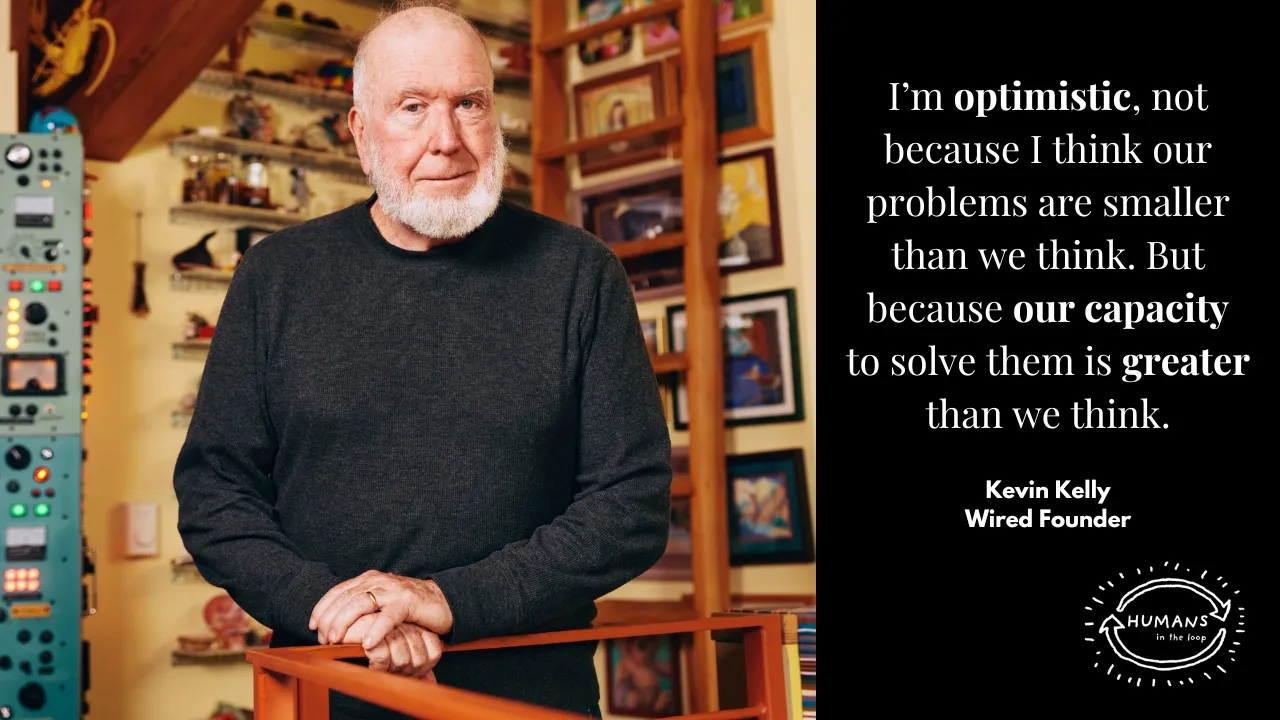
Kevin is known for many things, not least his optimism, but Kevin’s flavour of optimism is what we calls ‘protopian not utopian’ - an acknowledgement that new technology creates major new problems but that over time we find ways to solve them
Kevin’s essay on 1,000 True Fans.
Full transcript
Humans in the Loop
Seb (00:00)
Hello and welcome to Humans in the Loop, a podcast for thoughtful technologists hosted by me, Seb Knox-Agertoft When I first started this podcast, I drew up a list of names, dream guests who I would one day love to have on the show. The types of people who, whilst I wanted to speak to them, might take a bit of persuading to speak to me. Today’s guest, Kevin Kelly, was on that list and thankfully he agreed to take the time. Kevin’s done many things in his career and for those who want an exploration of that career and the different chapters in it, I would highly recommend Brie Wolfson’s profile on him entitled Flounder Mode. I’ll include the link in the show notes. But perhaps most notable amongst Kevin’s many different achievements and chapters was founding Wired magazine. Beyond tech, he has traveled extensively been visiting unexplored remote parts of Asia since the 70s and taking beautiful photographs along the way. In fact, he has a photography book out now, which again, I will include link in the show notes. Now we covered a range of topics here. So we’ll leave you to listen for yourself. But what stuck with me from this conversation in particular is Kevin’s perspective on optimism. Now we have different types of optimism, it feels floating around. There’s a certain brand of techno optimism as it’s been labeled that seems to ignore any potential downside of tech or any attempt to regulate it, any attempt to curb some of the challenges. Now Kevin’s optimism, doesn’t seem to come from that place. It’s more grounded. It comes from a place of acknowledging that new technologies create new problems, sometimes worse problems than we’ve ever encountered. But what Kevin believes is that we underestimate our ability to solve those problems and that whilst we can make a very long list of them, generally speaking, if we look at the course of history, they make up the 49 % and not the 51. And it’s in that 2 % that we see progress over time. So now it feels like a good time to hand over to Kevin himself. Without further ado, this is Kevin Kelly.
The Hollywood model of a career
Seb (02:36)
Kevin, thanks so much for coming on the podcast.
Kevin Kelly (02:38)
It’s a pleasure and an honor to be here. I’m looking forward to this.
Seb (02:42)
Yeah, me too, me too. So one of the things I’m intrigued by is your apparently non-linear career path in a distinguished career. In fact, Bree Wolfson wrote a great profile on you not so long ago called Flounder Mode. And she talked about what she described as your Hollywood approach to a career. So I wonder if we can start there and you can tell me a little bit more about, what does a Hollywood approach to a career look like?
Kevin Kelly (03:12)
That’s her term, and I had never really heard that before. And it was an interesting take. I think, I’m not sure, but I think what she meant was this idea of a career that’s kind of assemblies of different projects
Seb (03:31)
Mm-hmm.
Kevin Kelly (03:33)
in the way that Hollywood, basically each movie made is its own company that’s… formed for the purposes of making the movie and they disband and they recombine in some other fashion to do another movie. And so you have a series of projects rather than a kind of an accumulative career or kind of climbing a ladder. So I think that’s what she meant. And that if that’s what it is, then that is a good description of my own life, which has been a series of projects rather than. a central, rather than a central theme that is just constantly kind of pursued and optimized. So
Seb (04:21)
Mm-hmm.
Kevin Kelly (04:21)
there’s, really not a lot of optimization in my trajectory. It is, a lot of opportunistic shifts and, whimsical endeavors that maybe sum up to something interesting. but on their own, wouldn’t suggest anything fabulous. It’s, you know, I mean, I spent a lot of time traveling as a young adult. and if you’d met me at the time, I just been kind of another nomad. There was no digital part. It was just a nomad.
Seb (04:59)
Mm-hmm. Mm-hmm.
Kevin Kelly (05:00)
And so it’s only in retrospect that that becomes interesting. so again, to summarize the Hollywood model, I think that’s what she meant. was this sort of
Seb (05:12)
Mm.
Kevin Kelly (05:15)
make a life built out of interesting projects one after another.
Seb (05:20)
Yeah, yeah, that’s kind of my understanding as well. I’m curious about those projects that you have opted to pursue and I mean, I guess in hindsight, we can apply a narrative to some of these things, but when lived in real time, what determined what became a kind of interesting project to you and the things that you’ve put your energy and time into.
Kevin Kelly (05:45)
Yeah, it’s a really good question to always ask yourself. It was not trying to optimize money. It was not the choices. It was not necessarily. things that would. make sense of optimizing my skills in a certain sense. That was really trying to pursue interests. And again, I came late to this idea. So it wasn’t in my mind as I was doing it, but later on I realized what it was. What I was trying to do was trying to figure out what it was that I could do that nobody else could do.
Seb (06:32)
Mm-hmm.
Kevin Kelly (06:34)
And you can’t do that in a linear way. There isn’t really a step through process. You can kind of only doing it by trying things where you suspect that you might have a skill or interest or an ability or something and you try it and sometimes it works and sometimes it doesn’t. And then the next time. So you’re trying something different. in a certain sense, it’s, it’s like, it’s a way of sort of probing your skillset, your talent set, your, and, The hopeful result of that is you sort of wind up being aware of what you can do that other people can’t and what you enjoy doing, other people don’t enjoy doing, what you are doing that other people can’t do, what you’re doing that other people don’t want to do. so, and then that’s valuable to other people. And so that process, it looks like it’s not. a very coherent process as you’re doing that. And that’s the flounder part. It looks like you’re floundering because you are trying different stuff and not everything is working great. so, but the result is, I think you come out with a little bit more idea of doing things that maybe you’re the only one who should be doing them.
What only Kevin Kelly can do
Seb (08:11)
And what are those things? I noticed that there’s a lot of influential people and successful people in their own right who would cite you as someone who has had an influence on them, whether that’s
Kevin Kelly (08:26)
Sure, sure.
Seb (08:27)
Jeff Bezos, whether that’s Naval Ravikant whether that’s
Kevin Kelly (08:30)
Thank
Seb (08:31)
musicians like Brian Eno. So they cite you as an important thinker. why is it that those people hold you in such high regard and what is the thing you’re doing that other people maybe can’t or won’t?
Kevin Kelly (08:43)
Yeah. Yeah. I think if you are really good at this… what you were doing might get a name. And usually that name might actually just be you. So like, what is Brian Eno doing? It’s like he’s being Eno. It’s
Seb (09:07)
Mm. Mm.
Kevin Kelly (09:08)
his job. He’s kind of, know, he’s just a lot of hyphenations in there. He is an artist, musician, philosopher or whatever, but he’s being Eno. And, and so what is it I’m doing? Well, I’m, I’m doing Kevin Kelly. It’s, it’s, it’s the answer, but the things that I’ve done, some of the pieces that I’ve written, some of the books that I’ve done are basically things that nobody else is going to write or do. It doesn’t mean that they’re necessarily groundbreaking or, you know, kind of seminal works of Nobel level importance. But it’s just that I know there are not things that other people would write because I tried to get other people to write them. I tried to give away the ideas. you know, like a thousand true fans I talked about for years before I wrote it. And so it’s. and so it’s, it’s, it’s the thing that I’m doing is, you know, having observations, writing things in a way that no one else can. And the way I currently describe this is, is my radical optimism is pretty much mine. The optimism I have is deliberate. It’s not something that is necessarily natural. It’s something I’ve chosen. It’s something that I am. deliberately deciding to pursue. so it’s something I’ve created. It’s a position that I am fulfilling, that I am occupying. And
Seb (11:07)
Mm.
Kevin Kelly (11:07)
so that is, again, part of what I am bringing to the world. It’s not necessarily like a superpower. It’s inhabiting a point of view. It’s inhabiting a set of abilities that again, of themselves are not necessarily special, but in an arrangement that’s going to be unique. And I think that possibilities true and available to every single person on the planet. And it’s also by the way, true for businesses, businesses. I think also have to occupy that position of doing something that is maybe other people don’t want to do or other people find hard to do and people find valuable and yet you’re kind of doing it yourself. So you’re a little weird about it.
Seb (12:09)
Mm-hmm. There’s a great Miles Davis quote that I like where he says, takes a long time to play like yourself. it’s kind of feels pertinent
Kevin Kelly (12:19)
Yeah. Right. Exactly.
Seb (12:23)
right now. You’ve learned how to play Kevin Kelly based on all of these unique experiences that no one else can replicate.
Kevin Kelly (12:26)
Right. Yeah. And I think, I had several mentors, people that I worked closely with who were doing that. Again, this, this sort of framing came late to me, but, Stuart Brand, Danny Hillis and Brian Eno those are people that are themselves that they have. It’s unclear what Danny Hillis Actually does. I mean, he does lots of things, but it’s. He’s inventor. Primarily, I think, but, but, but he’s doing Danny Hillis That’s why he’s so interesting and admirable and charismatic is because he kind of is it had been able to kind of fill himself to, to, occupy himself. And he happens to be very, really smart. that’s a very powerful combination.
Choosing radical optimism
Seb (13:29)
You touched there on radical optimism as something that is certainly, if I said Kevin Kelly, that’s something that’s kind of affiliated with your name and what
Kevin Kelly (13:38)
Right,
Seb (13:39)
it means to play Kevin Kelly. You know, one of the things that I appreciate in my understanding of what you mean by it is there’s a certain brand of techno optimism that has emerged that sort of seems to be a little bit tainted with Well, we just want to go ahead and kind of do what we want unencumbered and sod the rest of them is like one way to read a certain certain brand of it. But at the same time, think many of us can kind of feel a sense of pessimism to the point of almost nihilism in the world, where it’s like, well, everything’s screwed. So what the hell’s the point? You know, and so to have these people out there talking in an optimistic fashion but in a way that feels sort of grounded and not disconnected from core human values I think is is really important in this moment. So yeah tell me a little bit about where you said optimism for you was a choice so like where
Kevin Kelly (14:38)
Yeah.
Seb (14:39)
did that choice come from why make that choice?
Kevin Kelly (14:42)
In general, people, me included, behave better when we’re optimistic. And I think society at large needs optimism to prosper. I, and then thirdly, I think what we get out of optimism and technology is not a neutral thing. It’s a positive. And it’s so positive that I believe that we have a moral obligation to do more of it and therefore to be more optimistic. so, so I think there’s like, again, several dimensions to, to, to where I come from. One is that I think, in general, we behave better for the world in a more altruistic sense if we’re optimistic and Secondly, I think we can’t make really complicated futures, things in the future that are complicated and complex without imagining them first. And that act of imagination and believing that they’re possible is optimism. And therefore I believe that our entire world today was created by the optimists of the past. They’re the ones who made our present, which was their future, and that the future is going to be shaped by the most optimistic people today. So I want to be somebody who’s shaping the future and you shape that by being optimistic. Even though,
Seb (16:13)
Hmm. Hmm.
Kevin Kelly (16:17)
fastest racing car needs brakes to steer. Brakes are important. The critics are the brakes. They’re necessary. but they’re not as necessary or as fun as the engine moving it forward. the brakes aren’t really shaping the future. It’s the engines, the optimists and the vision and the visionaries. They’re the ones who are shaping the future. And I want to be one of them. So that’s. The second reason and the third reason, as I said, was this moral dimension which is… What these new things give us are increasing options and possibilities and. these possibilities allow. some person to find their and express their gifts. So I believe that technology unleashes people’s abilities. So the standard trope that I use is imagine if Beethoven had been born before we invented pianos or the symphony, what a loss to the world and to Beethoven. That would have been if he had been born before we had invented that technology. And that must happen millions of times. Imagine the world if Lucas had been Bill Warren, you know, 2000 years ago, that genius would never have been expressed. And so there are there are people, young people today, a young Shakespeare today, and she’s waiting for us to invent the technology that she needs. become and share her genius with us. And so we have a moral obligation to keep making those possibilities for the born and the unborn to really, really share their geniuses with the whole world. And so for me, there’s a moral element to the optimism as well, which is to imagine
Seb (18:24)
Mm-hmm.
Kevin Kelly (18:26)
what those are and believe that they could happen in order to help them come about.
Time-traveling through Afghanistan and Taiwan
Seb (18:32)
Yeah, yeah. I guess it’s one thing to say, here are all the reasons why I should be optimistic, and then it’s another thing to genuinely feel optimism. So I’m wondering for you, beyond the active choice you’re making and the reasons for that, what is that optimism grounded in for you? I mean, I know you have many, as I understand it, you have a faith, I know you’ve done have a long history of travel. I’m sort
Kevin Kelly (19:02)
Mm-hmm.
Seb (19:02)
of intrigued just like what these different nodes
Kevin Kelly (19:05)
Yeah.
Seb (19:06)
play in the like in the optimism picture.
Kevin Kelly (19:08)
Well, the primary one is the more you’re interested in the future, the more you have to read the past to become… So I really became interested in the past. in part, part of my travels to two things. One of them was that I had an opportunity to get into a time machine and travel back to the 15th century. in being in Northern Afghanistan in the seventies and Himalayas in the seventies and parts of India in the seventies where it was literally exactly the same life as hundreds of years ago. Nothing had changed. was incredible. And so I got to see, what the world was like without those technologies and what those technologies had done. So it was no longer theoretical, it was actually visceral. And then in the passage of time, other places where they’ve had rapid development like Taiwan, which I was there in the seventies, I saw a witness with my own eyes, the bootstrapping and the… progress that came. progress was no longer a theoretical possibility. It was absolutely real. So part of my optimism comes from the reality of progress. So if you take a look at the academic scientific evidence, there is no question that we have, that progress is real. or 400 years. It’s absolutely real. so my optimism begins in acknowledging the progress of the past until this point. Now it could change. It’s possible that all those things could change tomorrow, but it’s highly unlikely. It’s highly unlikely because all the ingredients are still there. Everything is in place. And so it’s very, very likely that progress will continue. at least for another decade or two. So that’s a large degree of my optimism is based on the scientific evidence for progress,
Seb (21:40)
Mm-hmm.
Kevin Kelly (21:41)
history, the course of history over time, in recent history primarily, and the way that it has improved our lives are possible. And, know, the Obama test is very clear, which is if you’re going to be reborn and you had no control over your race, age, status, gender, when do you want to be born? know,
Seb (22:15)
Mm.
Kevin Kelly (22:15)
you want to be born now or tomorrow. You do not want to be born in the past. And so. That’s because progress is real. So that’s part of my visceral feeling about optimism is
Seb (22:37)
Mm-hmm.
Kevin Kelly (22:37)
the fact that we can be optimistic because progress is real and progress can continue and will continue into the foreseeable future.
Protopian, not utopian: the 49/51 split
Seb (22:50)
I mean, I agree with you on this point about progress being real and there being a valid case for optimism. I guess if we look at the argument from the other side and particularly in the context of technology
Kevin Kelly (23:06)
Uh-huh.
Seb (23:07)
and people will point to, okay, yeah, I agree with you. Maybe the overall trend is positive, but like here are all the examples whereby there have been these unintended consequences and hey, social media has had this impact and now democracy feels more fragile than it has in recent history, et cetera, et cetera, et cetera. So I’m wondering how do you remain optimistic in your mind and then how you wrestle with the counter narrative and the counter examples and the things that
Kevin Kelly (23:40)
Yeah.
Seb (23:40)
don’t necessarily represent progress.
Kevin Kelly (23:43)
So I’m not a utopian.
Seb (23:46)
Mm-hmm.
Kevin Kelly (23:47)
I refute utopian and utopianism. I’m a protopian, which is my term for incremental betterment. So that means that I believe that all the problems we have today have been created by the technologies of the past. And that means I think… the technologies today that we’re making are going to be creating incredible problems in the future. In fact, more powerful technology is, the more powerful the problems. So AI will make the most difficult problems we’ve ever encountered. But the reason why I’m optimistic is that not because I think our problems are smaller than we think, but I think our ability to solve them is greater than we think. And so… For me, the problems of technology are solved not by reducing technology, but by making better technology. Okay. And so I don’t deny that there’s problems. It’s just that I say that if we can create one or 2 % more than we destroy, that’s progress. So that means that the world’s 49 % problems. That’s a lot. You can make the long list of them. It’s huge. 49%, but there’s 51 % good stuff. That 2 % is almost not visible unless you look back and you see it accumulated over time. So yeah, 49%, you can make a long list. That’s a lot of stuff. That’s. That it’s harmful. But I’m optimistic because 51%, 2 % more.
Seb (25:36)
Mm. Mm.
Kevin Kelly (25:36)
That’s where my optimism comes
From precautionary to proactionary
Seb (25:40)
Yeah, yeah, it’s a great way to look at it. You mentioned the needs not to stop building technology, but to build better technology. And I’m curious to get your perspectives on what does that mean to you in this moment? What are the things that are important about building better technology? What do we need to do differently?
Kevin Kelly (26:09)
Well, I think one of the things… So… I, through my own travels, through my own life choices, I am much more of a globalist than I am. a nationalist. And so I’d like to look at technology from the global point of view, the technium I call it, the system of all the technologies. And I think what we’re trying to do right now is find better trade offs with the harms that we make with technology that are inevitable. And yet still be able to keep making it. we have learned collectively a lot about technology. We understand now that every single technology must have negative aspects. There is no such thing as a non-problematic technology. And this is why the idea of The precautionary principle is so dangerous and misguided and harmful. The precautionary principle says you shouldn’t allow any new technology until and unless it has been proven harmless. There is no thing. And there’s many reasons why that is a really bad principle because it also gives a pass to existing technologies and the harms that they produce. And so… We have become very aware of the cost, so to speak, of a new technology. And we’re collectively trying to figure out how we navigate that and deal with that. So I think what we’re trying to do is we’re trying to overcome the precautionary principle. I call it the proactionary principle. The proactionary principle is that you… constantly use technologies to figure out their strengths and their weaknesses, their goods and their harms, and that you keep adjusting to things. You don’t just pass a drug once, you test it all the time for how it’s actually used and what actually happens. And you have constant vigilance where you’re evidence-based. You’re not deciding about things, about thinking about them, which is lots of times people are going to regulate technology by imagining what could go wrong rather than what actually goes wrong. And so
Seb (29:00)
Mm.
Kevin Kelly (29:02)
there’s very, very few things that can’t be changed or shifted or modified. We have to date always figured out ways to make things greener. first version of technology is just the first version. And so we can figure out how to do things greener, less harmful. And that’s the agenda rather than looking for something that has no harms whatsoever. And so part of what we’re learning how to do as a collective society is to navigate that better, to… keep innovating better technologies, knowing that they are in fact going to be creating new problems. That is part of the deal. And those new problems will be more difficult than the previous problems. But that’s still worth doing. Still, you have problems, but you’re going to have to figure out how to solve those problems as you go along.
Seb (30:09)
Mm-hmm. Mm.
Kevin Kelly (30:11)
Okay, not before hand. You can’t solve them before hand because they’re not, that’s not how we do it. They’re too complicated, too complex. So we can only solve them through use.
Who’s really building the technology
Seb (30:24)
Yeah, I think there’s an interesting thing here that I try to separate in my own mind between talking about technology as a standalone entity and then thinking about the people who build technology. And I think share your optimism about technology as a whole. I guess one of the things that people point to and I think understandably is who are the dominant forces building technology in the world? And do I trust, the value systems of those people? Do I trust the ways in which the technology is coming about? And, as part of this podcast, I’m trying to speak to people like Tim Berners-Lee, He did not sort of commoditize the internet and turn it into something that he made lots of profit out of in a kind of direct sense. And I guess if we contrast that with the current model of technology. at least the headline grabbing versions. There’s lots of amazing technology being built in the world that does not grab the headlines and the people who build it do not grab the headlines. But there’s lots of sort of villains in inverted commas in the world that people think about these days when they think about who is building technology and do I trust that they have mine or society’s best interests at heart. So yeah, I guess I’m curious just to get your take on that, like that distinction between the technology itself and then. who is building technology, who has power in the technology ecosystem.
Kevin Kelly (31:55)
Right. Yeah. I think there is a little bit of a conflation because right now, and even the way you’re using technology means kind of the new fancy digital stuff. But most of the technology in our lives is not that it’s concrete. It’s steel. It’s old stuff run by people who aren’t on the front pages. But It’s very much the same kind of a thing of a lot of that technology is made, created, invented by people who have money and power, but they’re not on the front page because we’re mesmerized by the new shiny things. And so people like to focus on that part of the, of the, the technium. the kind of new shiny AI digital stuff that we spend a lot of time with, that we touch with, that we’re mindful of. I’d say technology succeed by becoming invisible. And once they’re invisible, we don’t pay any attention to them unless they break. But that, most of the technology is out of that nature where it works. We don’t even ever think about it. And my hanging around with the people who are making the shiny stuff. Is that they are, they are absolutely generally really committed to trying to make the best for humanity. turns out that for a lot of things, you do need corporations. You do need markets to make them, It would be nice to have a, and I’ve written about this, I’ve wanted to have a public intelligence, a public AI. It would be really fantastic. And I think we will. that’s one like the internet that is, not really owned by anybody that’s owned by many, many kinds of stakeholders. Like who owns the internet? It’s really unclear. and so we’d like to have an AI that was like that, that, was kind of publicly accessible, publicly funded, publicly, publicly, that there are many, doesn’t, and many many funders, many kinds of funders. But it seems really hard to imagine how something like that could have arisen from the very beginning as a public thing, just because of the cost of making it, the billions of dollars that needed to be invested into something that nobody was sure was going to work. And that turns out to be an ideal thing. There was a nonprofit kind of involved. So the kind of structure was interesting, but… The people behind it, I really feel are genuinely interested in trying to bring this. It’s free. Come on. It’s like they are trying their hardest to make something that’s good for humanity. They’re still struggling with the best form to kind of keep it going and get the resources that you need to make it better. And I do believe that over time we’ll have open source versions of this. But the fact that you require the market to fund it in some ways, I think is one of the great innovations of our species right now. So the fact that, the fact that you have a leader leading it, it’s just kind of weird that people think that. That should not be allowed. I don’t know. It makes no
Seb (35:52)
Mm. Mm.
Kevin Kelly (35:53)
sense to me that they want and use this technology for free. but don’t want someone leading it. It’s weird.
Billionaires, pharma money, and building something better
Seb (36:10)
Yeah, yeah, I hear you and I can definitely apply that to certain examples. In the same way, let’s take pharmaceutical companies. I used to work for a company focused on substance use. So I’ve spent many years being embroiled in the debates around pharmaceutical companies and what’s going on with things like the opioid crisis. But in general, pharmaceutical companies, are the best mechanism we have created so far to basically turn money into medicine. And so like, I guess, you know, we can use that same analogy here. Like we’re turning, you know, money into innovation. And so from my side, at least I’m not a, advocate of like this sort of anti-capitalist, everything must be centralized or decentralized At the same time, you know, people question, I suppose, the values systems of certain individuals. I feel like there’s this collective nostalgia for an earlier stage of the internet. And as you’ve already said, it’s important we don’t limit our talk about technology just to the internet. But if we focus there for a minute. there is kind of this nostalgia and I saw Noah Smith, the economics writer, he had this tweet where he said, 15 years ago, the internet was an escape from the real world. Now the real world is an escape from the internet. And to me that like, that I feel like touches on something about the internet has sort of almost morphed and changed in the atmosphere. And I think our relationship with some of the products that we are using is sort of like morphing and changing and people are sort of questioning the incentives at play So yeah, I was kind of just curious to get your sense of that side of it as much as anything.
Kevin Kelly (37:51)
Right. Yeah. So you’re, you’re, saying there’s problems and I’m acknowledging that there are problems. There’s 49 % problems.
Seb (38:00)
Yeah, yeah.
Kevin Kelly (38:02)
Okay. So you deal with the problems, but that’s different than saying that there shouldn’t be billionaires or that anybody who is a billionaire is by default corrupted. Or that all billionaires are the same. Or, mean, there’s just so many things wrong with the premise of, well, you what about all the problems? They need to be solved. But how are you going to solve them? What is the remedy for the problems? In my book, the remedy for the problems is better technology. If you don’t like social media, invent something better. Okay. It’s very, it’s like make better social media. And
Seb (39:02)
Mm-hmm.
Kevin Kelly (39:04)
that’s what Meta is trying to do. That’s what. Twitter’s trying to do, they’re trying to make it better. So I am fully supportive of them trying to make it better. And you have the question of better, what does better mean? Better for what? Better for whom? And that’s a worthy discussion to have, but that is the proper discussion to be having is, and it’s not like, you know, I don’t know. It’s not like Elon is the devil and therefore, he needs to be assassinated or whatever, it’s like, no, we need to make better technology. so
Seb (39:45)
Mm-hmm.
Kevin Kelly (39:46)
what are some of the better forms for social media? Well, I mean, again, what would that look like? So make it.
Seb (39:58)
down.
Kevin Kelly (40:01)
rather than talk about it. And there’s lots of people working on it. There’s tons and tons of trials and startups trying to make a better social media. It’s very, very hard to do for a lot of reasons, but it’s not impossible.
Seb (40:21)
Yeah. Yeah. And I think if I am hearing correctly from, what you’re talking about with the precautionary principle, you know, there’s one model by which we say, well, here are all the problems. And basically we don’t release anything else until we’re sure that not only have we mitigated all those problems, we mitigated any other problems that could have arisen. And, and, you know, this thing is, is perfectly formed that as a, as a, you know, former product, uh, leader, as someone who spent my, my life sort of building. products and mostly in a
Kevin Kelly (40:51)
Mm-hmm.
Seb (40:52)
digital sense. I can say with pretty high confidence that people will always do things you don’t anticipate with the technology that you build, whether you like it or not. And that stuff is impossible in my view to fully predict ahead of time. And so, yeah, I guess what we’re saying here or what I hear you saying is that kind of right, problems are gonna continue to exist. They will be the… the 49, hopefully, rather than the 51. And actually our cycle out of problems is basically to continue to move forward and actually to embrace the next set of problems that are gonna inevitably arise from the next things that we create. And they will be different to the problems we have today, but hopefully with this macro zoomed out view, we continue this positive trajectory that we can kind of trace back. history.
Kevin Kelly (41:49)
Yeah. So these new tools empower our ability to solve problems. AI will certainly help us solve problems as well as making new problems that we’ve never had before. and, and, and the options, options are what we’re moving towards more and more choices, more and more possibilities, including, you know, the possibilities to do harm. is weirdly still a positive in the world. We have more choices. so I would move the focus away from. the long list of problems and try and think about, what is a better way of doing it?
Seb (42:36)
Mm-hmm.
Kevin Kelly (42:36)
Let’s make a better version of everything. Let’s better it. And rather than regulate it, ban it, outlaw it, destroy it, whatever, it’s a better way is to improve it. Better it. Evolve it.
The Long Now Foundation and thinking in centuries
Seb (43:00)
Well, one of the things we’ve we’ve touched on a little already in this conversation is. having this long view, this view of history. And I’m curious here to hear a bit more from you about the Long Now Foundation and what that is about and the role that plays to you.
Kevin Kelly (43:24)
Right. So you reference the Long Now Foundation, was started 96, was almost 30 years ago, I guess. Is that right? Twenty- yeah. So. It was founded with Stuart Brand, Andy Hales, Brian Eno, myself and others to encourage the long-term perspective to make that normal and common rather than rare to help equip people to make it part of the process of making things part of the process of doing work was to make sure that the long view was part of that genesis, part of what you did in your approach to things. Not that it was the only view, but it was one of the views. And that you would make things with a long… I, a long future in mind, as well as the past. In other words, you were aware of this is the long now, the short now is the last five minutes, the next five minutes, the last quarter, next quarter. The longer now is the last 5,000 years and the next 5,000 years is generational thinking, civilizational scale things. And so the longer view does many things, including allowing you to be build bigger. Do you need to have a long view to do anything really big? And we need to do bigger things in our own history as we become a planetary species, we need to do things at the planetary scale more and more deliberately. And that requires a longer view. And so we also want to, in our terms, we say we want to be a good ancestor. We want future generations to thank us for doing things. Thank you for building those roads. Thank you for instituting protection for clean water. All those kinds of things of like being a good ancestor, where we’re tending to the things that need to be tended to have a long term success. And Those things are often not attended by the market. Markets, we admit, tend to be short-sighted. They’re much more immediate. It’s much harder to address things in the long-term just through the market because it is inherently short-sighted. So part of what that is thinking about long-term is you often have to think about things other than the current marketplace as a way to solve them. The market can solve lots of things, but not everything. so that long-term view is, we can talk a little bit about what it might tell, but that was the idea was we wanted to have an institution that would foster long-term thinking, which is not the same as a long-term plan. And what we don’t have is we don’t have a plan for the future. It’s not like we’re the foundation with a grand plan to do in a thousand years. We’re agnostic about what your plan is. Just saying, have a perspective, have a view, have a frame to think about that. If you do have a plan for the next 5,000 years, that’s great. You have a long-term view, which is what we’re talking about. We may not agree with what it is, but at least you’re thinking those terms. so that’s the idea, in short, was to foster and generate and encourage people to think about things, maybe make new tools that would help, maybe new best practices. and all that kind of stuff, but to help our culture think more in terms of generational, civilizational, planetary scale.
Seb (47:55)
Hmm. And how does that frame? So the Long Now Foundation is sort of setting that frame for others. And I know there are some pretty amazing projects like building a 10,000 year clock into a mountain and various other things going on. So you’re setting the frame for others. I’m curious, how does that frame reflect back on you? What does that Long Now view and mindset mean in the life of Kevin Kelly, perhaps aside from we’ve already touched on optimism and maybe, hear like the long now maybe plays a role in having that narrative of optimism and being able to take that long lens. But yeah, what else?
Kevin Kelly (48:39)
Well, right now, The project, one of the projects I’m working on is called the 100 year desirable future. And it’s an attempt to do some scenarios, plural, of a world in a hundred years that I want to live in. That’s the criteria. It’s like, what would that look like? And what would the halfway point, 50 year or even the 25 year or the 70, what would the intermediate stages have to look like to… to get there. And so for me, that long-term vision has instituted this desire to create. a vision of something to aim for in a hundred years. And again, it’s not a prediction. I’m not saying this is what’s going to happen in a hundred years. I’m saying here’s something that I think is plausible that could happen if we choose to. So I think we have, even though I think there’s a lot of inevitability in technology, a lot of determinism. We still have incredible amount of choice in the character of these things. So simple example is AI. AI is inevitable. It has been inevitable for a long time. It’s been very, very clear that it was coming, even though many, many people just refused to believe that it was even possible. It was definitely coming and it’s now beginning. and more of it is inevitable. However, the character of the AI who owns it, how is it financed, what’s the regulation about it, culturally, how is it, all those things are things that we have tremendous choice about. So it’s going to be here. But we have a lot of choices about the character of it and the implementation of it. And they make a big difference to us. And so, those are the kind of choices and that’s the kind of framing. The longer the view we have of this, the more likely we can make a version of it that, that will be optimal for us.
A hundred-year vision: energy, water, longevity
Seb (51:01)
if we were focusing on your optimistic vision of the future, that
Kevin Kelly (51:05)
Right.
Seb (51:06)
life that you would want to live, yeah, what are the key components of that?
Kevin Kelly (51:13)
I mean of this hundred year future?
Seb (51:15)
Mmm, yeah.
Kevin Kelly (51:16)
Yeah. Well, so a lot of them are things that are not going to be surprising because we actually know a lot about… a about these solutions, but I think we would have a primarily solar powered energy grid, but we’d have a global grid moving energy from the sunlit parts of the world to the dark parts of the world with high voltage cables or else having solar farms in space. So it would be primarily solar powered energy with nuclear and maybe even fusion in 100 years is really uncertain still. But I think we would have solved the primary issues of energy generation. And one of the things we get with that is we have cheap, affordable desalination. which means that we should be able to bring water, fresh water to wherever we want, even in a hundred years. and that would be incredible, to, basically have as much fresh water as we needed, as much energy as we needed. And I think in 100 years, we would have some cancer vaccines, maybe even a pan cancer vaccine, meaning for most cancers. So I think we’re on route to get there in 100 years, seems plausible. I think some life extension, not maybe by very much. I think we move the average up a lot, maybe not the extreme versions, but I think more people would be living to 100. You have the
Seb (53:11)
Mm-hmm. Mm-hmm.
Kevin Kelly (53:12)
average go up. I don’t think we’re going to go beyond 120 by that time, but I think we could have a lot of people living to be into their hundreds.
Seb (53:22)
Lots to be lots to be optimistic about there Kevin
Kevin Kelly (53:24)
Right.
Fifty years of photography, sorted by color
Seb (53:25)
I know you’ve Got a beautiful new book That you’ve just created. So, yeah, I wonder if you could share a little bit about that
Kevin Kelly (53:29)
Sure. Yes. I want to show this, current book, which I’m very, very happy with. did 50 years of photography in remote parts of Asia. And the weird little whimsical aspect of this book is that all the images are arranged by color and the images of things that are kind of weird and wonderful cultural. ceremonies and traditions that are kind of disappearing. So I did a book called Vanishing Asia. Some of these images appeared in those. But a lot of them didn’t. And this is this sort of visual journey that I think if you’re a designer or a traveler, you would respond to this. If you like color, there’s A lot of color here and there’s something about following a color that I find really, really a great way to notice things. So it’s, this is an act of noticing things and using color as a way to make associations between things that aren’t normally associated with. So anyway, I have a Shopify, little shop is self-published book and I have only a thousand copies because I have a thousand true fans. So if you’re a true fan, there’s a copy for you. And so I actually really enjoyed this conversation. You asked a lot of questions that haven’t been asked before, which is for me, one of the ways that I get to enjoy a conversation like this. So thank you for asking some fabulous questions that haven’t been asked before. I really enjoyed my time here and thank you.
Seb (55:16)
Thanks, Kevin. Really appreciate it. And I’ll include the links for your new book in the show notes. yeah, just want to say a big thank you for coming on and also a big thank you
Kevin Kelly (55:25)
Thank
Seb (55:25)
for all the writing and thinking that you share.


