/
/
56 min
The decentralised internet
Mike Masnick
Founder, Techdirt · Bluesky board
About this episode
Mike Masnick wrote the paper that helped inspire Bluesky and now he sits on the Bluesky board. A long-time advocate of decentralised tech, Mike’s paper ‘Protocols not platforms’ outlined how a more open protocol-based system to social media would create a healthier social media ecosystem in which people were free to vote with their feet (or their mouse) and go elsewhere, without losing access to the community they’d built. In this wide ranging conversation, Mike and I discuss the future of social media, the internet’s trajectory from an open to a closed ecosystem, whether decentralisation can be a winning strategy in a capitalist economy, and much more.
Full transcript
Humans in the Loop
Seb (00:02)
Mike, thanks so much for coming on the show.
Mike Masnick (00:04)
Yeah, thanks for having me. Excited to be here.
Who is Mike Masnick?
Seb (00:07)
So for people who are not familiar with you or your background, I guess what do they need to know about you and your story to kind of understand your perspective on tech?
Mike Masnick (00:14)
Ha
Mike Masnick (00:21)
Whew, that’s a big question. I don’t know. And I don’t know that I have a good answer to that. We can probably take an hour just discussing that. I have been interested in sort of the technology field and innovation in general for many, many years, many decades at this point. And somewhere along the way, you know, I thought I was going to go in and work in the tech industry. which I did very, very briefly early on, but also started sort of chronicling things and writing about the tech industry and innovation and how we get innovation and when innovation works and business models related to innovation. And then got very deeply involved in sort of policy questions around innovation and how do we get innovation to work the way it should and how do we get it to work in a better way? and I have now been doing that for 27 or 28 years. kind of lost count at some point, mainly through a site that I started in 1997. So what is that? That would be 28 years, called tech dirt. but then I’ve gone in a bunch of sort of related directions. started a think tank that is connected to tech dirt called the copia Institute. and we’ve done a bunch of things where we do research and reports and events. And then in the last. eight years or so, we’ve actually been creating games where we found that games were really an effective tool for both sort of exploring possible futures, but also explaining complex modern realities. And so, you know, we’ve built a bunch. So one example of that is we built a startup policy simulator where you’re in the role of someone. startup founder and you’re trying to build a company and you’re dealing with different, you know, government policy issues that come across your desk and how do you deal with them and what choices you make. And that’s just one example of a bunch of different games that we’ve made. So writing, exploring these different ideas in some sense, I kind of hope that I am an educator on as it comes to innovation and how to get better innovation out into the world.
Seb (02:36)
Mm-hmm.
Seb (02:44)
Yeah, yeah. I mean, I think that’s fair to say tech dirt has been going for many years and influenced a lot of people. So I think you can claim that title of educator. I’m curious, what was the starting point for tech dirt? Because as you say, you weren’t a kind of industry insider writing from that perspective. So yeah, why technology? Why writing about it at all?
Mike Masnick (02:49)
Yeah.
Mike Masnick (02:54)
you
Mike Masnick (03:14)
Yeah. mean, so I was actually in business school. was getting an MBA. and I was trying to figure out how I was going to get a job. And so I wanted to work in technology. and I didn’t really, at that point, I didn’t have any experience on the resume that, that would have made me a clear standout candidate. And so I said, well, maybe if I start writing about it and show that I’m like, you know, passionately interested in this stuff and thinking through the implications of everything. maybe that will help me get a job. And when I was in business school, I took classes and then later became teaching assistants for two really wonderful, incredibly visionary professors who were deeply interested in how innovation evolves and how to think through the impacts of technology innovation and how to think through where things may be going and sort of project out into the future a little bit. and understand the different issues. And so I spent a lot of time with them, which really kind of helped me think through how I viewed the future, right? And how I viewed innovation, the importance of innovation, and the risks associated with innovation, and how do you balance those things? And so I started writing basically based on working with those two professors, and originally just… it’s it’s funny now almost 30 years later, I started writing an email newsletter, which are now popular at the time. I don’t know how popular they were, but I started sending out this email newsletter. And my professors were very helpful and very encouraging and very thoughtful. And that sort of started to take off. And it did get me a job in Silicon Valley. And I moved out to California from New York where I was. And And I worked at a startup during the dot-com bubble, the original dot-com bubble, and sort of watched from the inside as that company imploded, which was a fascinating lesson in all sorts of ways. But I kind of kept the newsletter going just on weekends. I would kind of write it up. And as that startup imploded, I did more and more writing because I needed something to take away.
Mike Masnick (05:37)
know, take my attention away from what was actually happening in my workplace. And, you know, and then when I finally quit, because I quit before it completely crashed and burned, but I needed to do something else. And I started trying to figure out what I was going to do. And a bunch of people were like, well, you have this, this, you know, email newsletter that by that point, it returns into a website. And, you know, why don’t you try and make that into a thing?
Seb (05:41)
Mm-hmm.
Mike Masnick (06:06)
make you really seem to enjoy it, make that your full-time gig. And so, you know, ever since the year 2000, it’s been my full-time gig.
The story behind ‘Protocols, Not Platforms’
Seb (06:16)
Nice, nice. Yeah, it’s cool to hear the origin story there. And you’ve written, of course, many, many, many things over the years, many different topics and had a lot of influence, it seems, through those different topics. In 2019, you wrote this very influential piece called Protocols, Not Platforms about
Mike Masnick (06:19)
Yeah.
Seb (06:43)
kind of technological approach to free speech. I’m interested to kind of zoom in there for a minute. I guess maybe to kind of orientate ourselves in the conversation or to the topic. You did write that in 2019. It was quite a different moment to the one that we find ourselves in right now. Things have evolved. So.
Mike Masnick (07:09)
Yeah.
Seb (07:12)
I guess where… what was the place from which you were writing that piece? What were you responding to in the world?
Mike Masnick (07:19)
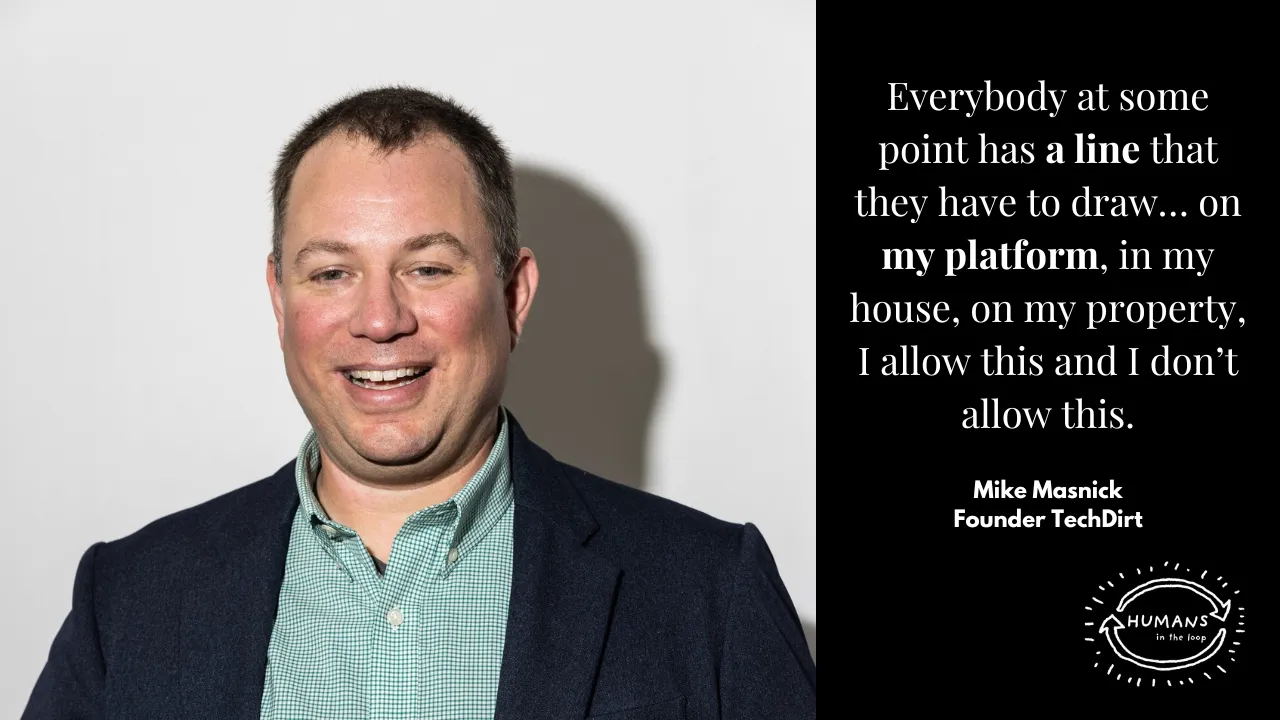
Yeah, so it actually started probably about four or five years earlier when, right? you know, sort of early social media, I mean, it depends on where you want to date early social media to, but sort of, you know, if you think sort of 2010 to 2012, 13 timeframe, you know, there was a lot of talk about how, you know, social media was this sort of… you know, wonderful things, enabling free speech around the world. It was connecting people. There was this, you know, period of optimism around that. And in particular, how it was going to enable more speech. And there was this sort of conflation, I think, of a few different ideas around speech and technology, in some ways that were good, in some ways that were problematic. And then around 2014, 2015, people began to realize the sort of, there are some limitations on that. So there were two big controversies and I don’t even remember, I should go back and figure out which the controversies were. I know there was a big controversy with Twitter and a big controversy with Reddit in terms of what they were platforming and what they were allowing. And the reality is that, know, the question of, Free speech is a concept is incredibly important, but we often conflate the idea of private entities having to host third party speech with the concept of free speech. And those are two different things. And it’s important to understand the difference because if you want to argue that every, website should allow all speech and any attempt to take down any kind of speech is anti free speech, you quickly begin to realize the sort of limitations of that idea. When you realize that your platform fills up with spam and scams and just, you know, pure nonsense, right? Everybody at some point has a line that they have to draw, which says on my platform in my house on my property, I allow this and I don’t allow this.
Seb (09:30)
Mm-hmm.
Mike Masnick (09:40)
you have certain rules and some of them are legally enforceable. Child sexual abuse material you cannot have. Copyright infringing material is very risky to have. There are certain things that are legally thing but then you have things like spam where you realize like, if I just allow spam to live on my platform, then that’s gonna make everybody go away. Nobody wants to be on a platform that’s overrun by spam and scam.
Seb (09:53)
Mm-hmm.
Mike Masnick (10:10)
nonsense. And so everybody puts in place rules that’s gone by different names, but now it’s sort of settled under the brand of trust and safety. And then you can start from a spot where you say, okay, there’s like the obvious things, obviously, the legal stuff, you have to deal with that, you have to process that and remove that in some form or another. Then there’s the stuff that’s not quite, that’s not illegal, but which almost everybody agrees is really problematic. That’s often like spam. and also probably abuse and harassment though, depends on who you talk to. Some people feel differently about that. And then you start to get into grayer and grayer areas. And what you begin to realize if you run a platform, especially one at scale where you have millions and millions of users is that the gray spaces, the ones that are not clear, but not clear in either direction, not, obviously we allow this or obviously this needs to be taken down. is a very, very broad area of space. There’s way more content in that space than most people who don’t run platforms realize. And therefore, every platform is going to have to make a large number of decisions. And every one of those decisions is gonna piss someone off, no matter what, whether it’s leaving up content or taking down content or doing some other intervention. know, people will add fact checking or…
Seb (11:11)
Mm-hmm.
Seb (11:33)
Mm-hmm.
Mike Masnick (11:35)
flag it where you have to click through or whatever else it might be. There’s all different interventions you can take and every one of them, some people are going to disagree with. And so you run into, know, if you run a platform, you’re constantly being yelled at no matter what decisions you make. And you’re sort of trying to deal with things and where it comes down to the issue is that when you have a private platform, you effectively have one decision maker who gets to make those decisions. And therefore, because everybody’s going to be mad about them, there’s going to be constant pressure applied to that one central decide decision point. Even if that decision point is really, you know, a team of however many trust and safety employees who are trying to make those decisions and trying to, trying to do them in a way that is consistent and repeatable according to a policy, right? Because especially as you grow and as you have that kind of scale, you also will need a team and to have a team, you have to have policies and you have to try and create policies that are clearly articulated in a way that you can apply them equally across different scenarios. But even that is much, much more difficult than most people realize because no two scenarios are identical. There’s always some other element and often it’s context, which you can’t see. If you’re just looking at the content on a site, you know, it might violate the rules in some contexts, but not violate the rules in other contexts. And oftentimes there’ll be things like in jokes, or there’ll be something that is happening totally off platform that makes it mean something different. And the people who are trying to judge these things don’t have all that context and don’t have the time to figure out all of the context. And so there’s a whole bunch of problems here where a whole bunch of different mistakes are being made. And so that blew up into… two different ways with both Twitter and Reddit somewhere around 2014 or 2015. And, you know, and I was kind of watching those explosions and thinking, huh, this is, this is interesting. It’s interesting to see how we went from just a few years ago where everyone was talking about the wonders of free speech and we’re enabling all this free speech. And now we have all these complaints and their complaints across the board. wasn’t just like, there were some complaints saying like, this was, you know, this content was taken down. That was unfair censorship.
Mike Masnick (13:59)
Then you complaints in the other direction, which was like, places are unsafe, that there’s abuse and harassment that is being allowed. There are all different kinds of complaints. And, and I was thinking through like, how did we shift from that world where everybody was excited about this stuff and the speech that it was enabling to this world where everybody is angry. And the thing that occurred to me was that you had this issue of like the one decider on these platforms, right? And, know, it’s a little different with Reddit. have all different subreddits and there’s, are a few different issues. But it came down to when you have this sort of one central decider, that seems to be, it’s almost like this bottleneck. You’ve added this friction to the system and that’s just where everybody pointed their anger. And so I started to think through like, you know, in the early days of the internet that I was excited about when I went back to the nineties, like we didn’t, don’t remember having those kinds of debates. We had discussions and there were different things that came up, but you didn’t have these kinds of debates. And so I started. to think through why and how that happened. And so I sort of made the argument that in the early days of the internet, it was, you didn’t have these giant services with centralized control points as being as dominant in areas of conversation. And I was thinking of places like Usenet or IRC that sort of predated, or even just the web itself. These all sort of predated the rise of modern social media. And they were all very decentralized systems where users, you you had some intermediaries, you know, who helped provide your Usenet servers or whatever it might be. But it wasn’t like one giant company that everybody could focus on and focus their attention on. And if you didn’t like the way things were going, you had some ability to change or to adjust or fix things on your end with, with Usenet. There were things like kill files that you could put in to sort of create your own block list effectively. And you could, you know, switch to different servers. There were a bunch of different interventions you could take, which didn’t, didn’t exist in the world where you had centralized players. And so I wrote a few articles at the time before the big paper, just sort of suggesting like, Hey, as everybody is struggling through this, the, the debate seemed to be people screaming either that,
Mike Masnick (16:26)
any website has to be forced to carry all content and I know that would be a disaster because that’s you know that then you’re just spam and scams and harassment and everything or the debate was going to this argument that like well we need to like legally require companies to remove any kind of bad content where bad is left really undefined or people would insert you know like this is my list of bad And it turns out everybody’s list of bad is different. No two people have the same list of bad. And you think you do. You think most people in the world agree with you on your list of bad, but the reality is it’s not. And so, you know, so I started sort of advocating for like, maybe there’s a different way that neither of these two sides is right. And both of their approaches would be problematic and we wouldn’t like the end result for a variety of reasons. So maybe there’s a way in which we can take a more technological approach, which is going back to this world where it’s more protocol based and push the power away from that one centralized friction point bottleneck to the edges of the network and allow for multiple different services or individual empowerment to sort of take control of those things. And so it was kind of a thought exercise in terms of, Hey, can we start thinking about this? And so I wrote a few articles on TechDirt about this and that led to more conversations and eventually I got asked to go present it at a conference at Columbia University. And then the Knight First Amendment Institute at Columbia University asked me to write a paper sort of laying out this idea. And so that was the paper that came out in 2019. I actually wrote most of it in 20, it came out in 2019. I wrote most of it in 2018 and we spent a lot of time editing it. I actually really appreciate. the Knight First Amendment Institute and the amount of editing that they made me go through, which was maybe a little frustrating at the time, because they were really like every paragraph, everything, were fact checking everything and really digging in and making me justify every little argument, which made the eventual paper much stronger. And then it came out in August of 2019. And sort of the culmination of maybe four or five years of.
Mike Masnick (18:51)
thinking about it and talking about it.
Interoperability and the Gmail lesson
Seb (18:53)
Yeah, yeah. So, I mean, there’s a lot here, I guess, just to kind of unpack it a little bit. there’s the free speech component of this, which, as you say, almost first pass, you might mention free speech and sort of think, well, we all have a pretty similar view of what that means. But I think increasingly, you know, it was true in 2019. It’s certainly true today that we have wildly different views across the spectrum of what free speech really means. And so as I understand it, and correct me if I’m wrong here, like your technological view of free speech in this scenario was almost like
Mike Masnick (19:20)
Yes.
Seb (19:36)
Well, if any one platform has like decision making power and kind of a monopoly on the data, like there’s always just inherently going to be a problem there. And so if we look at it from more of like a ecosystem point of view, where there are like fewer big dominant entities, then we almost don’t need to settle this universal definition of like what is and isn’t free speech. It’s kind of like people will migrate to their little portion of the world, where they find like what it is that they’re looking for.
Mike Masnick (20:13)
Yeah, kind of, with a little bit different than that. That’s almost exactly right, except for the idea of like, the nature of protocols is that they’re interoperable and that that world connects, right? So what you described could be that everybody kind of goes off into their own little cocoons and their own little regions of the internet entirely separated from the rest. And that’s not what I think is a good idea. The nature of what I’m proposing or what I propose and which we’re seeing various experiments in happening now. is that, you know, basically moving, yes, moving away from one centralized decider, but still allowing the network itself to interoperate. So giving people the ability to reach across these different groups, not be shuttled into some silo, but to have different things. And that also solves a whole bunch of other problems almost by accident, right? So it’s not even just the free speech thing, but, you begin to deal with like the competition question. Right now there’s like questions of like, we have these big dominant providers. Are we worried about them for other things? Not just the speech control aspect of it. And so like the traditional method of dealing with that is like antitrust. And that is big, slow and messy. And I’m not sure it’s very effective to be honest with you. I’m not against antitrust. I think it actually has a valuable role to play, but it’s often way too late in the process and sort of. clumsy and not particularly effective in how it works out. But if you have something that is based on protocols where if someone is, if a provider that you’re relying on is doing something bad in a protocol world, it’s very easy to change without much impact. And so, you one of the examples I use in the paper, which, you know, sort of demonstrates all this is email, right? Email, something that we all use is based on open protocols SMTP mainly and other you know, related protocols have been a part of that. and there are many different email providers. Lots of us, including myself, use Gmail. Gmail came along from Google. It’s a very good email system. has a very good client, but it is based on an open protocol. And if you don’t like Google or you don’t trust Google, you can use somebody else. Proton mail is a, you know, private email provider. It’s very popular.
Mike Masnick (22:38)
And it’s used by a lot of people who don’t trust Google. But if you’re using ProtonMail, you can still email everyone that you could email before. You can email people on Gmail. It doesn’t take you away from them, right? If you leave Facebook and all your relatives or friends or whatever, classmates, you know, use Facebook, you lose the ability to stay in touch with them because you’re not on there anymore. But with email, you can go to a a different provider and there’s still room for big businesses. mean, Gmail is a successful part of Google, certainly, and a ton of people use it. But I would also argue that the fact that it is an open protocol and the fact that people can leave and use someone else has actually been a really powerful forcing function to keep Google from making Gmail bad. There are debates about how good or bad Gmail is, but like, it’s not like overloaded with advertisements. It’s not you know, it hasn’t like really enshittified is the, know, Cory Doctorow’s famous term Gmail has stayed decently good in part because I think Google realizes that if they keep making it worse in some form, it’s very easy for me, you know, there’s some friction, but it’s relatively easy for people to switch somewhere else. And so that is a really important part of the equation when you’re thinking through the, the, you know, this protocol-based system is that it actually incentivizes the providers that are in there, even if they’re big, to actually behave better and maybe not go down the enshittification curve of making the actual product worse for users. But it also empowers the users themselves to make different decisions about how do they use it. And there are people who use Gmail just as a client, but use somebody else’s email server. There are people who use… Gmail, the entire stack, there are people who use Gmail, but then use a third party client. Like there are different layers. You can pull in different pieces of it and you can choose for yourself. And many people don’t, many people just use the defaults and many people don’t even want to know about this, but it still creates much stronger incentives for there to be a better product for actual users. So I think you can do that with other internet services as well. Create this world that is stronger and better by empowering the users, including empowering them to
Mike Masnick (25:01)
leave if they don’t like the way the provider that they’re using is doing stuff. I think your general description is exactly right with the caveat that like the interoperability part of it and the ability to exit and move is a key component to that.
Seb (25:17)
Yeah, yeah. And I guess for people who are listening to this and maybe thinking of it almost as too kind of ideological, it’s important to note that this is the origin story of the modern internet, right? This protocol-based system. I’ve just read Tim Berners-Lee’s, his new book, Tracing.
Mike Masnick (25:29)
You
Mike Masnick (25:36)
Yes.
Seb (25:46)
creation of the World Wide Web. you know, it’ll, in many ways, it’s something kind of miraculous that this kind of protocol based system that sort of set the standards of, you know, how should these services communicate with each other online? You know, what are the standards in this kind of green field, like Wild West? Like it’s kind of amazing reading that story that, that they did manage to kind of align on some, protocols and
Mike Masnick (26:13)
Yeah.
Seb (26:15)
and like some great stuff was produced along the way. I guess having read that book, one question I’ve been asking myself is like, where did we go wrong? know, we were in this sort of protocol, mean, hard fought wins. You know, that book tells it was not a straight road, but did a pretty damn good job of making it work. And so, you know, how do we get from this?
Mike Masnick (26:28)
Ha ha ha ha ha!
Mike Masnick (26:36)
Yeah. Yeah.
How the open web got walled in
Seb (26:45)
very protocol centric view of the web and innovation, et cetera, to the very platform centric, everyone has their own sort of data silo, won’t let you leave. Yeah, what’s your take on that?
Mike Masnick (27:00)
Yeah, I mean, there’s a bunch of different things. you know, and as you know, it wasn’t just hard fought Like it was not inevitable that the original sort of internet approach would win. There were, you know, private walled garden services. You had your AOLs and your CompuServs and your prodigies and they were very popular. And, you know, they sort of maybe at times connected to the edges of the internet, but were basically their own completely proprietary setup. But the… the internet and the World Wide Web in particular, thanks to Tim, were so vastly superior in terms of what they enabled. AOL, you had chat rooms and you had different sections, but it was a very controlled space and what individuals could do was fairly limited. The amazing part of the World Wide Web was how incredibly easy it was for anyone to create anything. could create your own web pages. And so eventually, because people were building such amazing things and such creative things and empowering all different kinds of amazing services, know, the walls fell and basically AOL and the others had to turn into, you know, connection points, internet access providers to the wider internet because they couldn’t do enough within their walls. And so then you have this flourishing moment where everyone is sort of discovering all the wonderful things that the internet can do. but because parts of it were sort of left too much to the end user that left a space for people to come in and say, okay, we’re gonna make this easy for you. We’re gonna design things for you. We’re going to, you know, just simplify the entire process for you, which is where you have companies like Facebook come in and say, okay, rather than setting up your own webpage and rather than figuring out how to… you know, send emails to all your friends and keep in touch. We’re going to make that easy for you. There’s this box you just put in your stuff, you connect with your friends and they’re always going to know. And they just sort of simplified that process. And early on they were, you know, believers in sort of openness and interoperability. But as they get larger, the incentive structure, often driven by kind of Wall Street’s interests, these companies have, you know,
Mike Masnick (29:23)
They go public, they have Wall Street investors who are demanding that the line goes up every quarter. And they have to start to do things to take what had been an open system that was about enabling people and start to enclose it and lock it in. you know, Facebook in particular was, was very big on that. You know, I, I point back to over and over again, there was a lawsuit that Facebook filed. I forget the year now is probably around 2011 or 2012. where there was a company called Power Ventures. And they had this interesting app, which was designed to give you a single unified dashboard interface of all of your social media setups. And the way it worked was you would log into it and you would give it your logins for other providers. So you could give it a login to Facebook and Twitter and… There were a bunch of others which we’ve all forgotten about now, but in the 2011, 2010 timeframe, there were a few other kind of upstart social media providers. And so you could log into all of them and have a single unified interface and you could post across them or whatever. And Facebook sued Power Ventures. And their argument was that it violated the CFAA, which is the Computer Fraud and Abuse Act in the US. This is the sort of anti-hacking law. There’s a whole history. with this law and there’s a whole bunch of problems with it. Somebody once described it as the law that sticks, which was that whenever there was any sort of bad thing that happened on the internet that somebody wanted to sue over, or there’s both a criminal and a civil component to the law, that if you wanted to sue somebody for doing something bad on the computer, you could find a way to wedge in a CFAA claim in there because it’s so broadly written. And basically,
Seb (31:17)
Okay.
Mike Masnick (31:20)
what it talks about is like authorized versus unauthorized access, which, know, conceptually maybe makes sense, but when you begin to think about what is unauthorized access. And so in that case, Facebook sued Power and claimed that it was unauthorized access. So I would argue that’s crazy because the individual user has the login. They are providing the login, right? If it was Power hacking into Facebook, you know, without… getting permission from the actual user, that would be a different story. Then I could understand a CFAA violation. But here the user is saying, act on my behalf. Basically you are my agent, act on my behalf, log into Facebook for me and access all this content. But Facebook sued, said it was a CFAA violation and the court agreed. And the court said, you can’t do this. And to me, that was like the big moment where the open internet that we had had before the door slam shut on it because then we started to see other similar lawsuits and you had other companies that where someone was trying to build a better version, a better interface. So build a better interface for Craigslist. There was a company that tried to do that got sued under the CFAA. There were other companies trying to do different things by, you know, what we had had in the early days of the internet was if you didn’t like the way something was being done, build a better version of it. That builds on top of it, right? Because it was all open and it was protocol based and you could, you know, everybody could share the underlying information. You could just build a new interface or a new, but then suddenly that became a violation of anti hacking laws. And then you had, you know, a whole bunch of other laws that sort of came into play that had been around, but started to ramp up and how they were used, like how we were using copyright law to block certain uses. And so you had crazy cases, not directly on point, but, just as an example. I mean, close to it where you had like, there were claims that unlocking your mobile phone to switch to a different provider violated copyright law. It didn’t. It’s like, it’s just, you know, on its face, ridiculous to think about, like, what does that have to do with copyright? But that’s how it was argued was that unlocking your phone was a violation of copyright law. You had patent laws where you had these companies that, you know, in the early 2000s or whatever, were just filing every possible patent that they could think of.
Seb (33:27)
Yeah.
Mike Masnick (33:44)
matter how obvious no matter how you know, you know, most of these patents never should have been granted in the first place. But then once these companies start to have patents on like social media connections between your friends or whatever, then they can just threaten and shake down anyone else trying to do that. And so there was this era, you know, like 2010 to 2014 15 or so, where there are all these laws that had been around in some form or another often for decades. that were being used in a way to block out competition at the same time, you know, especially in the early part of that, they had provided a real service and brought people in, but then they sort of really locked the doors behind them and pulled up the ladder as well and just made it so that like, now you’re, you’re stuck. And I think that happened gradually and most people sort of didn’t recognize it. Even I didn’t quite recognize until looking backwards at it and, and realized that you know, this world that was built on this openness and open protocols to get away from the silos of the AOL and prodigies of the 1990s was suddenly back in a different form and sort of, you know, I think abusing laws that were in place to sort of lock people in and then, you know, and never let them out.
Seb (35:01)
Yeah, yeah. So we go from this kind of protocol open world to one where, okay, we’ve created something valuable now. You know, the pressures are on to kind of extract the value from it in an investor setting. And now we have these, well, these pre-existing laws and like legal frameworks that we’re going to start to kind of use to new effect to…
Mike Masnick (35:16)
Yep.
Seb (35:31)
know, put the, yeah, build the walls higher and keep everyone else out.
Mike Masnick (35:34)
Yep. Yeah, yeah. it’s, know, and it’s, there are natural incentives there. And, you know, some of them I think are problematic. And, you know, it’s funny to me the way people look at the problems of some of like the big tech companies today. And I think a lot of people agree that there are problems with the way that big tech companies operate. You know, some are worse than others, I think, but, you know, and they, there’s like this whole focus on like, well, you know, we need to, you know, break them up or change this. And there’s very little willingness to look back at, you know, how did we get here in the first place? Why did these things happen? Things like the CFAA, or, you know, problems with copyright law or patent law. And people don’t want to talk about that. They want to pass some brand new law and say like, now we’re going to change the way all of these things work without actually, you know, or, you know, the big one being being the demands of Wall Street and this idea that if you’re a public company, you have to have number go up every three months and you have to be able to show that and makes it very difficult for sort of longer term strategic planning and sustainability planning. And so, it’s a very, I think if you wanna look at why the internet sucks in some ways, I think it would be nice if people were willing to sort of take a look back, not just at like, these big companies are bad and therefore we need to punish them, which is often the way that people look at it. But, you know, what were the incentive structures that are still in place today that resulted in this? Because, you know, each individual decision that gets us there for the most part is understandable. And, you know, it’s nice and easy to say that any of these individuals, you know, they’re, they’re evil, horrible people and they might be, I don’t know them, but like some of them might be, but like you put most people into that, you know, if you put a lot of people into that, those same seats, you were going to get the same results. The natural incentive structure of the way that things are set up is you, that’s where it was kind of going to inevitably lead. And so if you want to change that, you have to really look at the overall incentive structures.
Mike Masnick (38:02)
and see where you can change those.
Can the internet go forward again?
Seb (38:04)
Yeah, yeah, I agree. I agree. I guess, you know, if we we trace this path from the early protocol driven to this more kind of extractive version of technology that we find ourselves in. What do you see? Like, can we go back? I guess is the is the the or maybe back is the wrong way to look at it. Can we go forward into a new version of
Mike Masnick (38:25)
You Yeah.
Seb (38:33)
know a protocol-based system and what what yeah what are your what are your thoughts about how this how this could realistically be better?
Mike Masnick (38:42)
Yeah, yeah, and I do. And you’re right. It’s not going back. is, but it’s going forward with kind of clear eyes about what it is that we’re trying to do with like, how can we take the good pieces of that early internet and bring them into a modern world? And I think that there are different components that we’re starting to see that will allow us to do that. And it depends on where you’re looking and how you’re looking, but there are a few different things. So one is that we have seen some development of protocol-based systems. There have been a few different attempts at social media, decentralized protocols. I’m biased because I am involved with Blue Sky, which has the at protocol or AT Proto, which is one version of that. I think it’s very thoughtful in how it works and what it is, which is sort of a decentralized identification system. that allows you to do a lot of really interesting things. I think as more and more people play around with it and discover it, we’re seeing more and more people realize how sophisticated and useful it is as a tool for building decentralized systems, not just social media. So we’re already starting to see new decentralized systems appearing because of that. So having those protocols in place, there are others too, just to be clear, there’s like Activity Pub and there’s things like Noster. Farcaster and a few others. So a bunch of people are sort of trying to do this. And I think having those experiments is really important. Learning from them and just having these systems in place as you have protocols, it also makes it much easier for people to experiment and build stuff. And all of this stuff is always experiments. You never know which ones are going to take off and which ones are going to succeed. But if you have that, those foundations that make it easy for more people to experiment, there’s more that you can do there. The second piece of the puzzle, I think, next to that is the rise of generative AI tools. And this is sort of a big open question. And some people react very, very negatively to these things because they’ve seen sort of AI slop and, you know, hallucinations and areas where that technology goes wrong. And all of that is true and worth being concerned about and thinking about. But as a tool,
Mike Masnick (41:07)
for doing useful things, there’s tremendous potential there if it’s used well. And I think most people don’t use it well, but where you can use it to empower, to go back to the same points that I was making earlier, when you can use it in a way that empowers the user to take control themselves away from a large company that might not have their best interests at heart, that can be really powerful. Now, there are different questions about, you know, which LLM technologies and who controls them and how they’re used. You can see where there’s this potential fear that we get back into that exact same position that we were in with social media and other areas where you have a few dominant players, they have control. And once they have control, then they start manipulating the algorithm to their advantage. That would be a concern. And I think we need to watch for that. But if the end users have more control and power over the algorithms themselves and can use the LLM technology for their own devices, you know, in a very simplistic form, like the concept of vibe coding, right? Like building a personalized app as opposed to like feeding all of your data into a commercial entity that is going to enshittify and wants to force you into certain paths and, you know, upsell you on different things, all of that is concerning. like, you know, this is a very lightweight example, but like I recently…
Seb (42:15)
Mm-hmm.
Mike Masnick (42:34)
vibe coded my own task management tool. And it’s different than I’ve used probably every task management tool on the planet. And they don’t match my brain. Like they just don’t work. Like I use them for a little while. And then I give up because they don’t quite fit what I’m trying to do. And I’ve used a few that were a little bit closer, but you know, maybe 60 % there. And finally, it’s like, well, what if I, you know, there’s all this vibe coding stuff going on. What if I could build my own? And so now I have this tool, which I use every day. And it’s like,
Seb (42:44)
Mm.
Mike Masnick (43:03)
my brain, but it’s not controlled by any big company. I coded it. I have it in my own private GitHub repo. like, it’s like, I don’t have to worry about somebody coming in and having to meet their numbers for the next quarter and or convince a VC to invest more in it. It’s mine. Right. Like, and people have asked me if they can use it because I wrote about it and showed pictures of it. They’re like, that looks perfect for me. It’s like, go build your own. Like I’m not giving you access to mine, but like,
Seb (43:29)
Mm-hmm. Mm-hmm.
Breaking free of platform lock-in with AI tools
Mike Masnick (43:32)
tools like that, you know, in the hands of the individual can be really empowering, I think is another piece of this puzzle. And it’s, you know, I understand deeply and I share some of the fears people have about some of the, large AI companies and what it is that they’re trying to do. And will they just become another silo sucking up all your data and doing things against you? And it’s a reasonable fear. And it’s one that I think we should watch out for. But I do think that the underlying technology, the LLM technology, when used as an empowering tool for the end user can be a really powerful way of trying to break free of that risk. So, you know, I’m pretty careful about not getting myself locked in to any one provider. I use a few different tools, but the tools I like best are the ones that actually let you bring in whichever foundation model you want and to switch between them. So I’m not feeding all of my information to OpenAI or to Google or to whichever company, but rather, I’m sort of using them as helping me, but I can switch between the different providers. I also find that there are different tools now that actually let you go into the system prompt. So, most, like if you’re using chat GPT or grok or, or, know, Gemini or whichever, like you don’t see the system prompt. That’s something that the company puts in there and it’s behind the scenes. So you don’t know sort of the details of how it’s trained. They’re sort of trained to be general, you know, help this person kind of thing. But there, there are other tools that let you go in and adjust the system prompt itself. And I find that to be really powerful when I have access to it. So I know like, DuckDuckGo, for example, has DuckDuckAI, which allows you to pull in whichever model they have. I don’t know if they have every model, but they have a bunch of different models. You can pull whichever one, but you can also go in and adjust see and adjust the system prompt. And the other tool that I use a lot for writing is called Lex, which is like, it sort of looks like a Google Docs, but it has a bunch of really nice AI-based features built in.
Mike Masnick (45:55)
for writing specifically, but for helping writers, not for writing. Like you can sort of push it to write for you, but that’s not the purpose of tool. It’s not really designed for that. It’s really designed to assist writers. use it to, I always write everything I write myself, but then I use it as a help for editing. But it lets me adjust the system prompt. So it gives you some ideas and defaults, but then you can go in and tweak them. So like I took one of its defaults that I thought was really useful for me as an editor. It’s very…
Seb (46:01)
Mm. Mm.
Mike Masnick (46:25)
it’s told to be very direct and no nonsense and, you know, get past the like praising you kind of stuff and like get right on it. But over time I keep tweaking it. Like I keep seeing little things that it keeps telling me to do and I say no. And the other aspect that that Lex in particular lets me do is add much more additional context. So like anything I write, if I’m writing something for tech dirt, it goes into a folder. where everything is judged against my 10 favorite Tech Dirt articles, as well as like this 12 page style guide of Mike Masnick style. So when it is editing, it is not editing it from a neutral passive, like this is a general way that this piece should look like it is editing from you are editing for me, Mike Masnick for Tech Dirt this blog. This is the kinds of things that we write. This is how we write it. This is our style. Like make sure you’re
Seb (47:01)
Mm-hmm.
Mike Masnick (47:22)
you know, when you’re doing an edit and you’re looking at stuff, because early on when I was using some of these tools, I would test them and it would make these suggestions. It’s like, sure, maybe that makes sense for like the New York times, but that’s not what tech dirt is. And that’s not the style that we would write in. So this is useless to me. When you can add that context and when you can add, get into the system prompt in those cases, then we’re, you know, I’m training the system to work for me, not for whoever is providing the model. And again, there I can, pull and change different models for different tasks. In those cases, I find it really, really valuable. And I find that I’m not just feeding more data into a giant LLM system that is going to eventually turn on me and be used against me. But in this case, like I have the power over the context and control and that. is an empowering tool rather than one that is sort of making me work for it.
Is Blue Sky just a friendlier Twitter?
Seb (48:22)
Yeah, yeah. Yeah, I think that that sort of theme about kind of empowerment and control is is is critical here. I guess to go back to the social media example. So, you know, there are some people who are kind of deep in the weeds of like the Fediverse and decentralization and they they they, you know, they’re they’re they’re right in that, you know, and then there are other people who are like, Oh, isn’t
Mike Masnick (48:43)
Mm-hmm.
Seb (48:51)
Blue sky that like Twitter that’s just a bit more friendly, you know, kind of version. So I guess if we’re focusing on social media specifically, like, because you know, blue sky, yeah, to the untrained eye, it kind of is, you know, like Twitter, but a bit more friendly. like, what is it that’s going on like underneath the hood if we were gonna kind of, you know, explain it to my mom or whoever.
Mike Masnick (48:54)
Hahaha.
Mike Masnick (49:01)
Yeah.
Mike Masnick (49:19)
Yeah.
Seb (49:20)
Right, like what is this like protocol decentralized thing and why is it actually important in this context?
Blue Sky’s origin story: Jack Dorsey and the AT Protocol
Mike Masnick (49:28)
Yeah, and again, just to clarify in terms of like, I am on the board of Blue Sky and Blue Sky also was partly inspired by the Protocols Not Platforms paper. So that just to give the quick history there, that came out in 2019. And a month or two after it came out, Jack Dorsey, who was still running Twitter at the time, saw that paper, decided that he really liked it and was inspired by it, which was… you know, very validating for me. And so I had a couple calls with him and spoke with him about it. And he then announced that Twitter was going to do what was in the paper and that they were going to build a protocol, but they were going to basically set up a Skunk Works kind of team, try and build social media protocol that would eventually, you know, hopefully be used by Twitter. That process of setting up that team took a lot of time. There was a whole bunch of things, including a pandemic that- came about in the interim. So was kind of a slow process. They finally really got that going in early 2022, at which point Elon Musk announced that he was buying Twitter. And then the people who set up Blue Sky somewhat presciently said that they wanted it to be an entirely independent organization, not within Twitter, which turned out to be really, really good when Elon Musk came in. And one of the first things he did on taking over Twitter was cancel the contract that they had. It was set up as a separate independent organization, but they had a contract between the two companies. And then they were entirely independent from Blue Sky, from Twitter. And so then it got built out. And a year or two later, I joined the board. even though like I had the paper, I sort of talked to Jack about it, then they went off and did all their things. And then I came back and joined the board actually when Jack stepped down from the board in 2024. And then I joined the board at that point. And so I think the point that you make about like when people look at Blue Sky just from the outside, it just looks like, you know, it looks like a different version of Twitter. And to some extent that is deliberate, right? Like, you know, they’re…
Mike Masnick (51:51)
There are people who believe who are strong believers in decentralization who believe in it ideologically, but they also feel that everybody who is using the system has to also be ideologically aligned. And I don’t think that, and I don’t think the blue sky team thinks that most people, this shouldn’t matter, right? Most people just want to use social media and they want to enjoy their experience and they don’t want to hate themselves afterwards. Right? Like that’s kind of a key point. And so you it was really important to the blue sky team to build a social media app that felt like any other social media app that felt like Twitter, that was easy to use, that if you don’t care about the decentralization, about protocols, that doesn’t matter. You can still use it. You don’t have to worry about it. You don’t have to understand anything. There’s no pick a server. There’s no, you know, complex this or that. But, if you do care about those things, There’s all sorts of stuff. There’s a whole world that begins to open up for things that you can do that are really cool and also create really strong incentives. This is the important part to me at least, really strong incentives for Blue Sky itself never to enshittify the product, right? Everyone is used to that curve that starts out nice and fun. And then all those incentives that we talked about earlier make it so that. You know, the company is always going to, oh, we got to twist this. We got to extract more from users. got to do these things. They’re a little bit worse, a little bit worse, a little bit worse, but nobody can leave. And therefore we can get away with it. Blue sky is set up from scratch to avoid that, that, know, if you don’t like the experience, there are third parties who will provide similar experiences. And that process is, it’s still early. So it’s still most people using blue sky are all on blue sky hardware, but it is not. entirely true and more and more people are now using third party, again, like different parts of the stack, just like I was talking about with email before, where maybe you can use this client, but have stuff hosted somewhere else or a different mail server or all different things, or you can use an entirely different setup. We’re starting to see that with blue sky and the, the, the atmosphere is the sort of call the, the at proto space. and that creates strong incentives for blue sky itself, not to get
Mike Masnick (54:11)
worse in bad ways because if they do people start to leave and you know, but they can leave easily and still remain in contact with the people that they were talking to. But there’s also, there’s a lot more underneath that make it really exciting because at its core, a lot of what app protocol is doing is building this decentralized identification system. And so you can begin to build really cool things on top of that, which we’re starting to see. So there’s something like called leaflet, which is an a third party services, effectively sort of blogging and newsletter tool that is connected to your, your AT protocol login, where there’s tangled, which is a sort of GitHub like tool for, know, for creating your, your repos for, for code that again is using the decentralized identity that is set up through blue sky or the AT protocol. And there’s a bunch of different services that are all coming online now where people are saying like, wait, like I don’t need to build my own identity system. don’t have to worry about logins or other things. can just build on that and also have access to the 40 million people who already signed up for blue sky. And so some people are just building, you know, another clone, you know, of, of blue sky slash Twitter, right? Micro blogging service, but other people like tangled with their sort of GitHub. a competitor are doing entirely different things. And, you know, if you begin to think about it, it’s nice when you can use a bunch of these services with your, you know, blue sky or at proto ID, but then also you can still retain control of that. If you don’t trust the company, you can move your, your whole identity and all of your content. We have, it’s this concept of a personal data store. personal data server, you can move that somewhere else. You can host it yourself. There are third party hosting companies that will host it as well. So that, you know, blue sky, the company or tangled or any of these particular companies don’t have, they’re not hosting your data. They don’t have control of your data. and that begins to open up the possibility space and it’s still very, very, very early. We’re just beginning to see what people can do with that, but it turns out that it’s pretty powerful and
Mike Masnick (56:34)
there’s like a lot of effort going on to make it even more powerful so that we’ll begin to see this wider ecosystem of the atmosphere grow and enable more and more that goes way beyond just social media, but creates an entire ecosystem of stuff where the users are in control, the users are empowered rather than big giant central companies. So even if you don’t care about, you know, microblogging, Twitter clone related stuff. the wider space that this is starting to enable and that we’re starting to see come into effect is really powerful and is going to enable a very different view of the world.
Building your own interface on decentralized data
Seb (57:14)
Yeah. Yeah. And particularly when you, I get, you know, you join it with what you talked about earlier around like the vibe coding type of example, Like, okay, I have this decentralized repository of my own data that I get to do with what I want. And one of those use cases, I guess, might be that, that I start to sort of plug that into my own, you know, my own custom application. So this idea that, that
Mike Masnick (57:22)
Mm-hmm.
Mike Masnick (57:42)
Yep.
Seb (57:44)
you know, in order for us to speak via blue sky, we both are limited to the user interface that’s sort of put in front of us kind of becomes almost irrelevant. It’s like, well, if the data is not limited to blue sky and all of a sudden I can kind of, well, I can build my own interface and like whatever it is that I want to do. And Mike can be doing his thing over there. And the fact that we’re most not like, you know, we’re not limited to.
Mike Masnick (57:56)
Yes.
Seb (58:12)
the options that were being served on the menu by the company of the day.
Mike Masnick (58:17)
Exactly, exactly. And so like, you know, one thing I just did recently, cause I was kind of curious if I could, you know, I remembered Google, the Google reader, right? The old RSS reader that was very popular in which Google shut down. So I built an interface for Blue Sky that is a combined at protocol reader and RSS reader. and I can bring in all of my, you one of the things that blue sky has, which is very cool. It’s like, you know, most social media has a for you feed, which is just the company deciding what it wants you to look at with blue sky. There’s there’s I don’t know how many there are now. Last I had heard, I think it was like 150,000 different custom feeds. There’s some that are provided by blue sky itself, but there are a bunch of others. You can go and search or find out from others, different kinds of feeds. rather than the one feed that the company tells you this is what you should be looking at. So if you don’t like the feed that the Blue Sky provides you, you can find others and there are some great ones, some of which are all just, you know, trying to find the best content for you. Somebody, there’s a popular one, which is also called for you, but it’s not from Blue Sky, it’s from some random user called Space Cowboy. And it’s really good and it’s better than the one that Blue Sky itself provides. And so I use that all the time, but there are also fun ones like there’s a… a quiet posters feed, which I find really useful. It basically, you know, goes to my feed of people that I follow who don’t post very often, but you know, they post like once a week or whatever. So I can just go into that feed and see the stuff. I would miss it otherwise. Cause with for you, that stuff is never going to surface, but the quiet posts that I can see, Oh, you know, Oh, my friend over there, he, you know, rarely posts, but he, when he does post is something interesting. So I’m seeing things like that, but I can pull all of that now into my sort of Google reader interface and see all the things that I’m following. And again, it’s just like something I just told an AI system to code for me in a weekend. And suddenly I had this totally new and unique interface. There’s all sorts of things that I think, know, Blue Sky and the app protocol set up allow and users to do if they want to, right? Again, like the point of this is like, if you don’t, and some people are like, I don’t want to do that.
Mike Masnick (01:00:37)
That’s fine. You don’t have to like you can experience things the way it is, also people are building stuff for you. So people are starting to build out these tools for you that for you feed by space cowboy. don’t know who space cowboy is, but he built a much better feed than the one that blue sky itself is providing. And I can just click and use it. and so we’re beginning to see, know, people are building stuff for other people, or you can build stuff on your own. And I think all of that becomes really empowered.
Can decentralization go mainstream?
Seb (01:01:02)
Yeah, yeah. I guess maybe last thing, last question here before we wrap up, Mike. So I get excited when thinking about this stuff and like this decentralized model, how that gets augmented with AI. The question that’s always sat in the back of my mind is from a kind of business model and let’s take the brutal capitalist lens of this and say like, okay, it’s one thing for this stuff to exist as this sort of like niche.
Mike Masnick (01:01:30)
Yeah.
Seb (01:01:38)
tech hobbyist corners of the internet. It’s another thing for it to be the mainstream and you know, to sit alongside, you know, in the social media example, the the the metas or the the twitters of this world in terms of sort of like scale and scope and impact in the world. So I guess I’m curious, you know, we’ve said it’s it’s all a big experiment right now. But like what’s what’s your your hope? What’s your thinking about how
Mike Masnick (01:01:44)
Sure.
Mike Masnick (01:01:56)
Yeah.
Seb (01:02:09)
how this stuff goes mainstream potentially over time.
Mike Masnick (01:02:11)
Yeah. I mean, nobody has a crystal ball, at least of all me. So I don’t know for sure, but I do think that one of the, know, if we look back at that early world of the web that took off that beat AOL and beat prodigy and beat CompuServe. When you know from the outside when people look at those say, those are big giant companies. They’re well capitalized. They had really nice user interfaces when you logged into AOL. It had that voice that said you’ve got mail right that the you know the the the rest of the internet didn’t have those things. But what the rest of the internet did have was the ability for anyone to build right. It wasn’t reliant on getting permission from AOL or cutting a deal some sort of contract with AOL which is the way it really worked. As people started building, the creativity and the power of what was enabled became clearer and clearer and clearer. And eventually it just became overpowering and the walled garden situation of an AOL became untenable to keep. I think we can see that same pattern. As we start to see people build and people being empowered and building cool new stuff that is enabled by these decentralized systems, then we’re going to see, because so many people can experiment and because It doesn’t have to wait for a, you know, CEO of a multi-billion dollar company to say, this is okay. This will help our bottom line or the, you know, we’re going to block this thing that hurts our bottom line that people can just build something, things that are actually useful and compelling and multiple people can build them and we can have different experiments and see how they work in the marketplace. We’re going to see the kind of innovation come out of it. That is way more powerful and way more useful. And that will continue to attract people until we reach that tipping point where people are like, wait, why am I spending my time in these systems that are designed just to extract from me and not to help me when there’s this open decentralized system that I’m empowered in where all this unique, wonderful innovation is happening that is super empowering and super interesting. we’ll hit that tipping point where it begins to go mainstream in the same way that AOL eventually basically
Mike Masnick (01:04:27)
you know, knocked over its own walls and allowed all of its users into the, into the open web.
Closing thoughts and where to find Mike
Seb (01:04:33)
I certainly hope so. certainly hope so. Well, Mike, that feels like a good place to bring us to a close. Tech Dirt, we’ve obviously referenced, I will include in the show notes, as the most prominent publication. if other people, sorry, if people want to sort of find you online, connect, learn more about what you do, anything beyond Tech Dirt that we should point them to.
Mike Masnick (01:05:01)
I’m on Blue Sky. I spend in terms of social media time, I spend most of my time on Blue Sky. You can certainly find me, Mike Masnick, on Blue Sky. That’s that is the main place to find me other than Tech Turf. Those are the two the two big ones.
Seb (01:05:16)
Awesome, awesome. Well, really enjoyed this conversation, Mike, and thanks so much for coming on.
Mike Masnick (01:05:21)
Yeah, thanks for having me here. It a fun discussion.


