/
/
57 min
Can you lift a country out of poverty?
Nick Allardice
CEO, GiveDirectly
About this episode
How to lift an entire country out of poverty?
Does philanthropy make a difference?
What if wealthy tech founders gave away their money?
Will AI make poor countries even poorer?
How does technology help a country to develop?
Those are some of the questions discussed into today’s episode of Humans in the Loop featuring Nick Allardice, CEO of GiveDirectly, a non-profit that’s sent over $1 billion in cash, directly to those living in poverty.
Full transcript
Humans in the Loop
Nick Allardice (00:00)
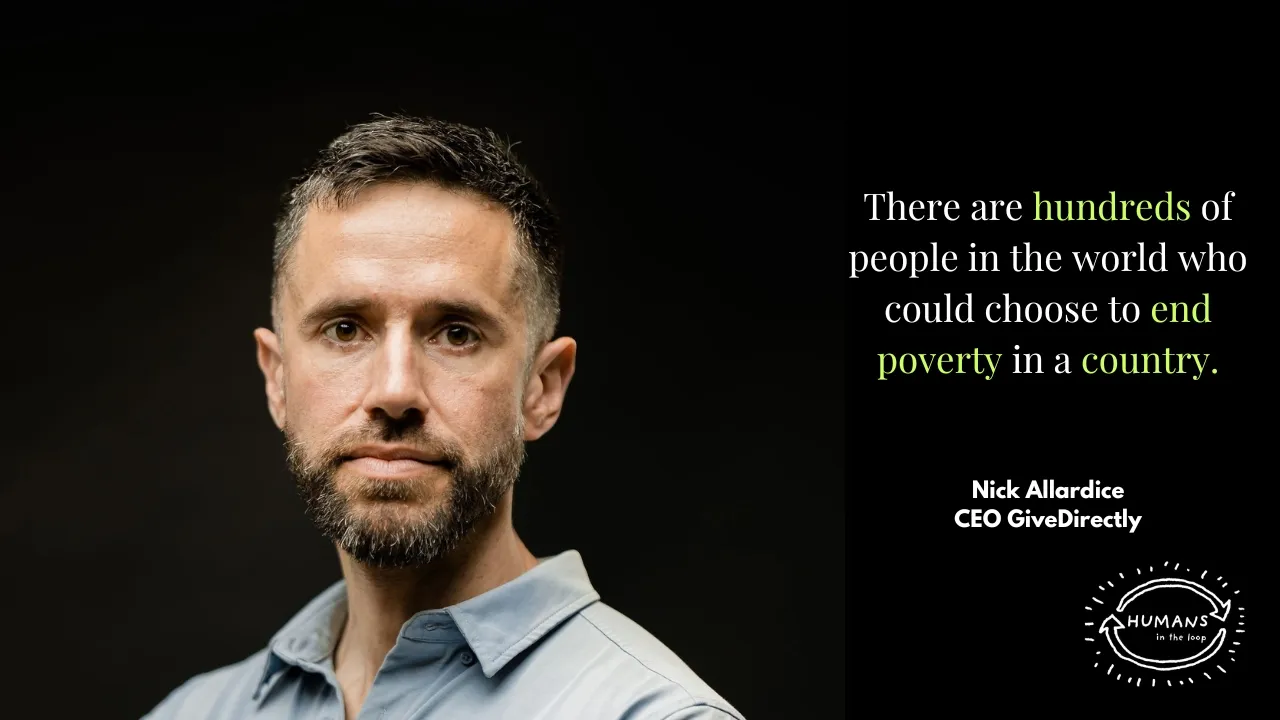
And too much of, doing good in the world is this like thinly disguised paternalism that says, I know better than you do. One of the most damaging stories in the world give a man a fish, you feed him for a day, teach a man a fish, you feed him for a lifetime. I think that it’s not widely understood that there are hundreds of people in the world who could, through their personal decision, choose to end poverty in a country.
Meet Nick Allardice and GiveDirectly
Seb (00:42)
Welcome back to Humans in the Loop. Today we’re going to be talking about philanthropy and I’m joined by Nick Allardyce, who’s had an illustrious career across nonprofit and social action, notably as a CEO of Change.org and now a CEO and president of GiveDirectly. Nick, welcome to the show.
Nick Allardice (00:58)
Thanks for having me, Seb.
Seb (00:59)
So let’s maybe kick things off with with give directly. How would you describe what give directly is and what it does?
Nick Allardice (01:06)
GiveDirectly sends money to people in poverty and crisis. It’s pretty simple, but you can think of GiveDirectly as maybe an organization in three parts. Part one is we’re a fintech organization, we’re fintech company. We build technology to find and reach and send money to people in some of the hardest to reach places in the world as efficiently as possible. And so we have a reasonably sized tech team. kind of spent a lot of time thinking about cross border payments and kind of targeting and various things. So we’re one part technology company. We’re one part economics research Institute. GiveDirectly really exists because a bunch of economics research 15, 20 years ago started figuring out that cash transfers work surprisingly well. And so we have done a bunch of studies over the years and we’re extremely data driven. We were founded by a bunch of economists to basically understand how does injecting cash and capital to individuals at particular moments in time work? What outcomes does it drive? What doesn’t it drive? And how do we do it? So that’s the second thing we do. And the third is that we’re a philanthropic organization. We’re a philanthropic advisory group in some ways. We’ve had more than 150,000 donors over the years. We’ve moved more than a billion dollars. We work with people who are giving $50 at a time and people that are giving $50 million at a time to figure out how they can have the most impact with their dollars. so take all of those things, mix them all together, shake it up a bit, and that’s what you get when you get gift directly.
Finding the poorest: satellites and telco data
Seb (02:53)
Amazing. How is it you find the people who need the cash first and foremost? I guess once you’ve found them, how do you decide how much money to give them?
Nick Allardice (03:05)
So there’s really two contexts in which we are finding people. The first context is people who are living in extreme poverty. And for those folks, we use a mixture of government data, poverty statistics. We use satellite imagery to identify communities of particularly like high poverty based on how buildings are constructed. sometimes use mobile phone data. And we basically combine all of these different data points together to identify communities that have really high rates of extreme poverty. And just to give a moment of context, extreme poverty is living on less than three US dollars a day. And there’s about 800 million people who live under the extreme poverty line. And that line is set as the… kind of measure of what’s the minimum you need to get your most basic needs met. So if you’re under that line, it means that you might be eating one meal a day and not having very good nutrition in that one meal. It means having to make hard, really impossible choices between, my kid’s sick and I need to buy medicine for them. But if I do so, means that the whole family goes hungry for two days. It means having to trade off, like having your kids earn, like work on a farm or go to school. And so the extreme poverty line is like the most basic needs, the most basic needs that you need to kind of get your needs met. And we take all of those data points that I was describing to identify communities where really high rates of extreme poverty exist, like 80%, 85 % of the communities in extreme poverty. And once we identify them, we come in and we basically give every single person in that community a one time cash transfer that is designed to catalyze them out of extreme poverty in an ongoing way without additional support from us. So that’s one context in which we’re finding people. The second context in which we’re finding people is in emergencies. So this is like a natural disaster has hit somewhere or say like conflicts has broken out, people have had to flee their homes. And in that context, we are looking for people that are sitting at the intersection of poverty and crisis. And so in those situations, we’re often using big machine learning models on telco data. So we partner and integrate deeply with telecommunication companies. to be able to identify people that might be fleeing conflicts. Like they might be in a community, it’s been attacked. And we were able to see through the telco data that there’s a certain set of people that are on the run based on the movement of their cell phones. And we’re able to predict what level of vulnerability do those people have based on the usage of those cell phones. Because if you’re living on $3 a day versus $10 a day, you actually use your cell phone in a different way. And so we’re able to kind of take some of that data run machine learning models over it in order to kind of predict, you know, who needs support. And then we reach out to them and we were there to help them. And so they’re the ways that we work.
Seb (06:30)
Yeah. And I guess as you’re describing that, like perhaps many people listening, the images that will spring to mind might be of war-torn countries in say, Sub-Saharan Africa. But I want to kind of check myself there. I mean, when we’re talking about these communities, I know they exist in those parts of the world. But are you also serving communities? know you’re based in New York. I’m here in France, in Europe. Are you also kind of serving or identifying any of those kinds of communities in countries that people would think of as being the kind of so-called developed world?
Nick Allardice (07:07)
Yeah, we disproportionately, so the most of our poverty focused work is in Sub-Saharan Africa,
Seb (07:13)
Mm-hmm.
Nick Allardice (07:14)
where you have really high concentrations of this extreme poverty. But our crisis work is around the world. And so when there is an emergency, no matter where it is, we will look for people who are at that intersection of high vulnerability for the context in which they are in. And so that can include developed countries, actually do a lot of emergency response in the US that includes middle income countries. We responded to a hurricane in Jamaica a few months ago and then also the high poverty countries as well.
Moving money: M-Pesa and mobile cash
Seb (07:47)
I’m interested to, to, to the double click on you mentioned the three parts of the company, the sort of technology company research Institute and then the sort of philanthropic arm. if we look at the, the technology company part of give directly from minute, minute, as someone in a former life worked in FinTech and spent many a head scratching afternoon figuring out how to move money around the world. So like, I know that’s a pretty complicated task at the best of times and imagine even more so in parts of the world that you’re covering and the situations that you’re covering. So yeah, mean, tell me a little bit more about that. You when you’re identifying these communities and you’re going and you talk about them receiving cash, I mean, is that a kind of, here’s a wedge of cash in a brown paper envelope, you’re do with it what you will or like how does the money get from A to B?
Nick Allardice (08:39)
Yeah, give directly really is we’re 15 years old and we really exist because of this big macro breakthrough of mobile money in the developing world. And so going back to the early 2010s, you essentially have this explosion in places like Kenya of things like M-Pesa. M-Pesa is a kind of company product that, or at least a product that is of the telcos there, where for the first time people became banked through their phone. And so for those of us in the developed world, this is like a PayPal wallet or a Venmo wallet or something like this, except it’s on a dumb phone. It’s on like one of those really old knockers that many of us grew up with, or maybe I’m showing my age. And so starting about 15, 20 years ago, you have hundreds of millions of people who have never had a bank account for their entire lives. They’ve been entirely unbanked, get mobile phones for the first time and on those mobile phones, get access to essentially a bank account, which is this mobile money account. And so for the first time ever, it becomes possible to reach people directly, purely digitally via technology. And so we never work with physical cash, it’s all digital cash. And from a technology perspective, our stack has to include cross border transfers, de duplication and verification at a kind of national level, a bunch of fraud protection, but then integration with a whole lot of mobile money providers so that we can essentially move money from our bank account in New York all the way to an individual in rural Malawi or Rwanda or Democratic Republic of Congo and be able to track that end to end with high confidence verification, auditability, all of those things. And so we do everything from a lot of verification technology and anti-fraud stuff, cross border payments. We do a bunch of work actually with stable coins at the moment because that helps us move money particularly quickly in the context of crisis. And that’s the kind of stuff that we’re working on.
Seb (11:02)
Yeah, it’s, I guess they say that, you know, necessity is the mother of all invention. Like I’ve always struck my mum is from Zimbabwe. I’ve spent quite a lot of time in Southern Africa and parts of it. And yeah, it always strikes me as kind of amazing that things like M-Pesa have existed on this very rudimentary technology foundation for decades. we in countries like France or the US are kind of where he’s still struggling sometimes day to day with the movement of money. And it’s just existed in this part of the world that people do not necessarily think of as technology forward for so much longer than we give it credit for.
Nick Allardice (11:46)
I think it’s a really good example of leapfrogging. It’s this idea that some technologies come along that allow you to leapfrog other phases of technology that other countries have essentially navigated. And so for many people in these countries, there will never be a need for a bank account because M-Pesa and mobile money essentially becomes that for them. And so they’re able to leapfrog that. Similarly, you know, most of these communities totally leapfrog desktop computers, like no need for them whatsoever, you know, to go straight to the mobile revolution. And I think that those types of transformative technologies that allow societies that are still kind of lagging a little bit to leapfrog previously what developed societies had done. sometimes allows them to catch up and innovate in ways that previously, like that we’re still struggling with.
No strings attached: trusting people with cash
Seb (12:40)
Yeah. Yeah. So we talked about how the money actually reaches them. You know, the end use of the money, as it were, the way that they then decide to spend, invest that money. I imagine that the options there are just too varied to name. But yeah, what visibility of what involvement do you have in, I guess, how the money is? eventually spent or is it just a no strings attached here you go kind of donation.
Nick Allardice (13:15)
It’s no strings attached and there’s two reasons for that. Number one, the research that we’ve done is that that actually works better. And I can say I’m a little bit more about why in a moment. But that’s the first reason. And then the second reason, which is just as important as at a values level, we think that there’s something incredibly important from a dignity and power perspective in saying you are the one to make the impossible choice, not us. Because the more that we or any organization says, you you should spend on this, or this is how you should use the money, the more we are putting ourselves in their position to kind of make these really impossible choices. When you’re, if you had to trade off between making an elderly parent slightly more comfortable and kind of providing care for them in the later stages of their life and investing in a business for today or being slightly more comfortable today or having your kid go to extra school, like what’s the right choice there? I don’t think there is one. That is a values question at its most fundamental. And so like, I can’t say with confidence what is the right answer for those types of choices. But what I can say is who gets to decide. And I don’t think I should decide that. I don’t think you should decide that. I think the person who is having to navigate that choice is the only one who should. And too much of, I guess, like doing good in the world is this like thinly disguised paternalism that says, I know better than you do. And so we kind of believe both at an evidentiary level, we think it actually has more impact and there’s good evidence to show that, but also at a values level. And the evidence one I think is really interesting though, because it’s kind of counterintuitive for many people that like, surely people don’t know how to use this money. You know, we should probably provide guidance or restrictions. Aren’t they all going to drink it away? You know, that’s very normal. And so most of the evidence at this point is extremely clear. First of all, people are extremely creative. I’m going to give you an example here. I came
Seb (15:25)
Mm.
Nick Allardice (15:25)
across a woman a few months ago. someone who received money from us. she’s like in her seventies. And when she got her cash transfer, she invested it in a 10,000 gallon water tank. And this is a giant, giant water tank. And she spent the vast majority of her money on it. She pays to get that filled with clean water every two weeks. And then she resells that water to her community at a small margin. And so now she has access to clean water. She was previously walking five to 10 kilometres a day in order to go and pick up clean water just for herself in her seventies. And now she has like this 10,000 gallon water tank that she’s reselling to her community. And so not only is she a provider of clean water to her community, but she’s owning a small margin on top of that and able to then reinvest that and look after herself better. Now there is no nonprofit in the world that would be like, you know what we’re going to do? We’re going to provide 10,000 gallon water tanks to elderly women in Western Kenya. You know, like
Seb (16:25)
Mm.
Nick Allardice (16:26)
it’s lunacy. and yet like her creativity, her ability to kind of look at her community and say, what does, what’s, what’s appropriate for my situation? What can I do that no one else can? What’s a need that my community has that like no one else has? is unmatched. And so she has the most information. She has all of the incentive to use that money as creatively as she possibly can. And so our ability in some top down method to kind of identify what is the best use of that money, I think is all the evidence says is actually just not as good as her making that choice for herself, which doesn’t mean that she’ll always get it right. There will be people who fail. There
Seb (17:06)
course.
Nick Allardice (17:06)
will be people who like try something and it doesn’t work out and that will be devastating. But what I can say with confidence is that it’s gonna succeed at a higher rate than if we tried to do it for them.
Seb (17:16)
Yeah, that that paternal tendency, shall we say, it kind of takes me back in my, in my younger days, actually, I studied economics, and I studied branch development economics in particular, and I remember vividly being kind of slapped down in a loving way, but by by a professor based on a comment I’d made, which to me at the time, know, 18, 19 year old me felt very well intentioned and innocent. can’t even remember the contents of the comment. And I remember her immediately sort of saying, well, don’t you think that’s a bit paternalistic? And I was like, it’s the first time like, oh yeah, I suppose it is. You know, I suppose I am, I am like making this assumption that like somehow I know better and smarter or whatever can figure out the situation. And so yeah, I guess that, that value you touch on about just ultimately trusting the person who is in the situation to make the best decision for them. Seems like a pretty powerful one.
Nick Allardice (18:16)
It is and it’s very counterintuitive. You know, like I think we all
Seb (18:19)
Yeah, yeah.
Nick Allardice (18:20)
have the best of intentions. People who have empathy and want to do the best, like it comes from a good place. Comes from a like, I don’t want to see the money wasted and like, do people really know what’s best for them and so on and so it comes from a good place. I have empathy for that. But all
Seb (18:33)
course.
Nick Allardice (18:34)
of the evidence at this point is that it’s just like very misguided.
The Malawi experiment: doubling a district’s GDP
Seb (18:38)
Yeah, yeah. Beyond this, you know, I imagine there are many, many individual incredible stories. If we zoom out and think kind of macro impact for a minute, I read about an experiment that you were running in Malawi, I believe, that was more of a kind of, can you lift a whole country or a whole mass community out of poverty in sort of one fell swoop? So can you tell me a little bit more about that?
Nick Allardice (19:07)
Yeah, so we have started as an organization thinking of cash transfers almost as an individual intervention where we identify individual people, transfer money to them, catalyze them out of poverty, and then they sustain that. We didn’t talk earlier about, I realize I didn’t answer your question about the size of the cash transfer, but to give a little bit of context on that, because I think it’s important, We transfer about $550 US dollars per individual. And that is the equivalent of about like 12 to 18 months worth of income. So it’s like a very substantial cash infusion for their level of income. And the reason that it’s that size is that’s enough for them to get their most basic needs met, like urgent healthcare needs, food security, etc. but then it’s enough for them to then have a substantial amount left over to make some sort of large productive investment. What is that productive investment? Varies widely. It could be the 10,000 gallon water tank. It could be a farm. It could be a barbershop, but it’s some sort of investment that generates ongoing return. And so we size the amounts that we transfer to allow them to get their most basic needs met in an immediate sense and then make a significant productive investment. that is then going to generate a long-term return because we only ever come once. We come and we say, we’re giving you this 550 US dollars. This is your chance. Don’t screw it up. Like think really carefully because we’re never going to come back because we don’t want to breed dependency. We think that there’s like much better evidence actually for these one-time cash transfers than ongoing cash transfers. And so that is the core of the model. Now in Malawi though, we have started to understand that cash transfers are not just about the individual. they’re about the impact on the wider community around them. And so starting, we had a big study, a randomized controlled trial. This is like a big A-B test that is done by development economists that the results came out a few years ago that showed that the general equilibrium effects, which is essentially the economy wide effects of a cash transfer. like even more significant than just the transfer to the individual. And so what we found is for every $1 that went in, $2.50 circulated in the local economy. And people who were nearby, who didn’t receive cash, but who were within say like 30 minutes of someone who did receive cash, benefited almost as much, like 80 or 90 % as much as the person who did receive the cash transfer because of the way in which people then spent locally. They bought goods, they hired people. They did all these different things and it’s that economy wide infusion that actually ends up having most of the most dramatic effects. And so in Malawi that causes to answer the question, well, what happens if we start doing this at like greater and greater scale? And so we focused on a sub-district. This was 75,000 adults and we transferred cash to them over the course of six months. This was a huge cash infusion. It was like the equivalent of more than doubling local GDP in the space of six months. We did this for a couple of reasons. We wanted to measure these economy wide effects. We also wanted to make sure we understood, know, where are we driving inflation? Could we put in place protections to ensure that inflation wasn’t happening as a result of that level of injection? And so the results of this was really interesting. So 12 months later from this one time transfer, the proportion of people above the poverty line more than doubled. So it went from 36 % of people above the poverty line to 79 % of people above the poverty line. And even for those below the poverty line, their living standard tripled. So they went from say like living on 71 cents a day to $2.10 or $2.20 a day. And so even if they
Seb (23:08)
Hmm.
Nick Allardice (23:08)
didn’t cross the poverty line of $3 a day, the standard of living still went substantially up.
Seb (23:14)
Mm.
Nick Allardice (23:14)
And so that is the… that like gives us the most excitement is the level of impact to have like this like crazy number of people catalyzed out of poverty, the poorest living much better than they once were. And we were measuring inflation and there was no inflation over the course of this 12 months. And that’s a pretty counterintuitive result. If you’re kind of an economics nerd, you might expect that doubling local GDP might drive inflation, but it turns out that in these economies, they’re There’s a lot of latent supply that is not being utilized on a regular basis. There’s a lot of what’s called slack in the economy where
Seb (23:54)
Mm-hmm.
Nick Allardice (23:55)
say a mechanic is doing one job a week and the rest of the time sitting idle. And so when you have this big injection of capital, the mechanic can take on another 25 jobs a week without needing to hire more people or to kind of increase prices or anything like that. And so these economies are actually like quite well suited. to this type of intervention because they can absorb and utilize all of the SXtra cache that’s floating around.
What cash can’t buy: the limits of cash transfers
Seb (24:24)
what does, you you talked about the kind of the individual level cash transfer, and then there’s this sort of community-based, larger scale, sounds like an experiment that sounds very successful in terms of the impacts that have been measured so far. What does cash transfer kind of not? solve for, you know, there’s almost one can kind of like look at the evidence of all of this and sort of think, well, if it’s that simple, right, if we just need to put cash in the hands of people and it like solves all these problems, it’s like, why does anything else philanthropically even exist? Should it not just all be cash transfer?
Nick Allardice (25:07)
I think a lot of interventions shouldn’t exist and should be replaced by cash. That said, there are a set of things that cash transfers just won’t Public goods in particular are unlikely to be driven by cash transfers. so cash will have the greatest impact where there is some degree of functioning healthcare system. It will have the greatest impact when there is some degree of infrastructure that allows people to move between towns and cities. So roads. cash is not going to build a functioning school system. And so there are public goods that I think it is like really important to keep investing in because cash amplifies their effects. It makes people like more successful within that environment and where they don’t exist, cash will have less impact. Cash will still have a significant impact, but it will have less of an impact. And so, You know, I’m a big supporter. I’m never going to say that cash is a silver bullet that will solve everything. That I am a big believer in investing in, particular healthcare systems and public infrastructure that unlocks markets. I think they’re the things that I think we still need to do a lot of. But on the whole, I think there’s an extraordinary number of well-intentioned, but ultimately totally ineffective kind of interventions out there. that sound good in theory,
Seb (26:44)
Mm-hmm.
Nick Allardice (26:46)
but in practice either don’t have impact or have less impact than just spending that money on a cash transfer. One of the most damaging stories in the world is the idea that this metaphor, give a man a fish, you feed him for a day, teach a man a fish, you feed him for a lifetime.
Seb (27:08)
Mm-hmm
Nick Allardice (27:09)
It sounds so intuitively attractive. And yet, all of the evidence
Seb (27:15)
you
Nick Allardice (27:16)
at this point says, number one, most people don’t wanna be fishermen. In a market economy, you need a mixture
Seb (27:22)
you
Nick Allardice (27:25)
of, you need like, probably need one or two fishermen, but you also need some taxi drivers. You also need some bakers. You wanna also need, and so the likelihood that anyone, central organization is going to effectively map and identify what are the needs in any one community is like close to zero. And so our ability to centrally plan local economies, I think we should have high degrees of skepticism of, but that’s what that story implies we should do. The second thing is our ability to teach people stuff is actually pretty bad. Study after study shows that you kind of teach people to fish and then six months later, they retain none of it and behavior hasn’t changed. And so even if you believed that we could centrally plan what roles you need in a community, our ability to effectively teach people is actually really poor. so study after study at this point shows, you know, those types of vocational training programs that make so much intuitive sense and it seems so attractive, just don’t work as effectively as take whatever it would cost. to deliver those programs and just give it to people as unconditional cash and they know what to do. They will get greater bang for
Could billionaires end poverty? Bregman and Canva’s bet
Seb (28:40)
Yeah. Yeah, that seems like an important thing to dispel based on based on on that evidence. I was in preparing for this episode, perhaps it’s the the algorithms know that I was particularly interested in give directly. But one of the things that sprung to my attention came up on some feed somewhere was video by Rutger Bregman, who for those not familiar, think his sort of academic background is his sort of economic historian. You might have come across him on social media. He’s a pretty outspoken guy, loves to rage bait billionaires at things like Davos for not paying enough tax and for global inequality and for, you know, flying their private jets in to an event that’s talking about climate issues. So yeah, he’s a lively character, shall we say. Anyway, in this video, he was talking about global inequality. there are various statistics that float out there, but I something like the top 1 % of the world’s riches hold something like 50 % of the world’s wealth. Depending on how slice the pie, the figures can differ, but I guess the sentiment is the same. his, what he says in this, in this video, and I’m not sure if you’ve, if you’ve come across it, but he says something like, well, it’s frustrating because we have the solutions for solving this already. If only, you know, the world’s billionaires would pick up the phone to Nick Allardyce of give directly and, start funneling money that way, you know, we could solve the problem. so I’m curious, well, firstly, how do you, how do you come across, Rukabreb and you know, that that statement and be you know, all those phone calls forthcoming from from those who are holding large amounts of wealth.
Nick Allardice (30:37)
I know Rukka, he’s a great guy and I appreciated the shout out that he gave us because I think that it’s not widely understood that there are hundreds of people in the world who could, through their personal decision, choose to end poverty in a country. Like it’s kind of a mind blowing idea. when you stop to think about it. But like our best estimate is that in Malawi, as an example, this is a country of 20, 21 million people. It’s the poorest peaceful country on earth. It would cost six or $7 billion to not fully eliminate, but for the vast majority of people in the country, like lift them above that $3 line. Which to be clear is not the same thing as saying we know how to solve economic growth. Because at the end of the day, the thing that is going to sustainably lift people’s living standards over time is going to be economic growth. The likes of which we’ve seen over the last 50 years in Southeast Asia, in China, in India, which have together collectively lifted billions of people out of poverty. So I think… The world of economists is still trying to figure out what’s the magic formula for that. But we do know how to sustainably lift people above that $3 line. And the difference between living on 70 cents a day and $3 a day is unimaginable for those of us in the global north. Getting people where there is a basic standard of living where you don’t go to bed hungry, where you don’t have to make choices between getting health care for your kid or sending them to school is like… something that is eminently achievable. And there are hundreds of people who can decide to do that for tens of millions of people at a time. And so I appreciate Ed Rutger kind of putting that word out there. I don’t think that’s widely understood. I see it as partially my role and the role of gift directly to give folks that have that level of opportunity, wealth and success a credible pathway to doing extraordinary amounts of good. And I am somewhat optimistic that that is going to increasingly happen over time. We work with some of the wealthiest people in the world. None of them are signing billion dollar checks yet, but like, Certainly like we’ve had in the hundreds of millions
Seb (33:20)
Mm.
Nick Allardice (33:22)
and part of our work in Malawi, this effort to kind of concentrate our focus in like a sub-district and now we’re actually moving to a district at the moment. have almost a $200 million project that is all about having that credible pathway to saying, no, we can effectively deploy millions of dollars quickly. efficiently with high confidence knowing exactly what they’re going to do. We’ve managed all of the negative externalities that might come from it. And we can be a place that people can confidently spend that kind of money to have the type of legacy that is like extraordinary impact for tens of millions of people. And in a time in which there is more wealth being created than at any time in human history, I think that, I hope. that we as a community of humans on this planet can use that extraordinary wealth to lift the floor of people’s experience.
Seb (34:22)
Yeah, I was curious as you were saying that I was like, wonder what the number, you know, what ballpark we’d be in. I wouldn’t be even be able to sort of pull a guess out of the air. And of course, six, seven billion is a huge sum of money. But in the grand scheme of global wealth, I’m not sure if you sort of stack that up versus the list of the world’s wealthiest, how far down that list you’d go before you sort of hit the cutoff. But certainly, you know, if we think of tech. many people listening to this podcast will probably be in and around that industry. Certainly the big figures in tech are not just north of that line, but north of that line by orders and orders and orders of magnitude in many cases. I know you can’t sort of name names nor would I expect you to, have you had, you said nobody has yet written the billion dollar checks, but have you had anyone come to you with that with the aspiration with the kind of, Hey, Nick, what would it take? I’ve got the money. What would it take me to give to actually take a whole country or whatever the unit is and lift everybody out of poverty?
Nick Allardice (35:37)
Yeah, some people that I’m really inspired by and that we have a pretty deep partnership with are Mel and Cliff, the co-founders of Canva. This is the design software. They made a $100 million commitment to give directly last year and… We’re on a really like long-term kind of journey with them because I know that they’re extremely committed to this idea of everyone in Malawi having their most basic needs met. And they consider that a lifelong goal. They have, I think, pledged to give the vast majority of their wealth. away, which includes a very, very, very significant portion of Canva, their equity in Canva. And, and that’s something that they’re working on in a way that I’m like, extremely inspired by. And, and there are a number of other people with that with similar levels of wealth that I see moving with a degree of intention and urgency to have as much impact as they possibly can in their lifetimes. And I think we need more people like that in the world. Because I think it’s totally, because
Seb (36:55)
Amen to that. Amen to that.
Nick Allardice (36:57)
it’s so easy to sit and like, here’s the pattern that I see. You have people who generate extraordinary wealth. They’re very successful founders or whatever, and they mean to do well. They have good intentions. They’re like, I would like to have… as much impact as I can, I would like to do good through this like extraordinary success that I’ve had, which does has come through hard work, but which also has come with an extraordinary amount of luck. And I want to do as much good as I can with that. But then they’re, then they’re busy running their company, you know, and they’re like, well, I want to make sure I do it well. And I don’t feel like I have enough information or the right deal flow or the kind of infrastructure and I don’t want to build a bloody philanthropy like institution like that sounds like a lot of work and a pain in the ass and so I’m gonna just like wait until later in my life and when I have time and attention to kind of put towards it and then with the best of intentions with the core intention being like hey I want to do this well but not having the time to then figure out how to do it well you then have this self-perpetuating cycle where your underlying assets appreciate people are getting wealthier. And so the decisions feel higher stakes. And so
Seb (38:11)
Hmm.
Nick Allardice (38:12)
they’re like, well, I can’t even I can’t give like that much money away because like, I don’t know enough about what I’m doing. And so the people that I am most inspired by like the people like Melloncliffe, who have said, I’m not gonna wait. I’m not gonna assume that I can get perfection. This has to be something that I do in an ongoing way, because that’s going to help me get smarter about how to do it well. And And the need is now and so I’m going to act with urgency now. And I wish that more people had that perspective.
Seb (38:44)
Yeah. Yeah. mean, I guess there are, you know, there are various sort of pledges and things that I believe exist out there about giving wealth away, but to your point, they all seem to be kind of putting everything on ice and maybe kicking that decision down the road. You one day I will give away a large proportion of my wealth. It’s like, well, that’s all well and good, but the problems exist today. And I guess what I hear you saying is, is yeah, maybe there is no perfect way to deploy the capital, but it sounds like the fact that GiveDirectly has such a simple mechanism that is proved to work, hopefully kind of cuts that argument down at the knees, know, of like, well, this is the way to do it.
Nick Allardice (39:26)
Certainly, certainly I hope so. you know, I certainly would be absolutely the person to say, think there’s a very, you know, give directly and cash transfers. In some ways I think of it as the S &P 500 of giving. Like it is the index fund that very high confidence and very high scale is going to consistently deliver. Now you could be a great hedge fund manager. You could be a great VC where you have the right deal flow. and the right time and attention to find the perfect bets that are actually might in individual circumstances have higher upside than cash transfers or something like that. But that’s going to take some combination of a lot of time and a lot of luck. And you’ve got to also be really good. And most people don’t beat the market. so, you know, I’m an advocate of like a portfolio of giving like, I do think that people should be making some high risk high return bets and like so on. But I think, you know, cash transfers in some ways are a little bit like the S &P 500 of giving. I think it is reliably consistently able to deliver impact at scale. And so I would make the case that it is a way to in a low effort way have a lot of impact. But even if someone wasn’t giving cash transfers, I would still be making the case that it’s an ongoing muscle to build. It’s an ongoing practice to get into. Because if you don’t, this self-perpetuating cycle of it always getting harder and never having enough time means that it’s just gonna wait forever.
AI’s double edge for the developing world
Seb (40:58)
I’m curious to turn our attention to, I mean, we talked a bit about the technology part of Give It Directly and some of the technologies that are enabling things like Compesa and movement of cash around the world. At this particular moment in time, we’re obviously all living through this kind of brave new frontier of technology that is posing everyone hard questions about how do we organize ourselves? What are the new opportunities of today and tomorrow and three years from now? And I’m conscious that most of the analysis and the lens through which that gets looked at is primarily in some hierarchy, probably Silicon Valley followed by other tech capitals around the world. And rarely if ever is it from the perspective of, I imagine the kinds of countries where give directly is funneling lots of cash. So yeah, I’m just interested to get your perspective as you think about what is going on in the world right now and being close to these economies that operate very differently. How do you see what is happening? How do you see the impact emerging? What are the implications of this all for those kinds of countries, do think?
Nick Allardice (42:20)
have both a lot of worry and a lot of optimism. I kind of hold these two things kind of simultaneously. And I guess like a lot of people who are like paying a lot of attention to how AI is unfolding have this combination of hope and optimism and fear and anxiety. The fear and anxiety I think comes from that the economic impacts and the labor market disruption that I think we have speculative fear of. in places like the US or Europe real and going to happen much faster in both low and emerging economies. There’s a lot of speculation right now. What’s AI going to mean for the future of software engineering? What’s it going to mean for the future of entry-level jobs and positions in these developed economies? If you go somewhere like the Philippines, if you go to other countries like that, where like a huge portion of the economy is actually driven by call centers, like that is not speculative that those call centers are like facing catastrophic wipeout right now. And that that
Seb (43:20)
Hmm.
Nick Allardice (43:20)
has been a kind of step on the kind of ladder out of poverty that huge numbers of people around the world have been able to access. And that that is probably going away. And So what is the future of like, is there a future of services led growth or even honestly like manufacturing led growth in a world where you’re able to kind of drive more automation more cheaply in global North countries? I don’t think we know what the answer is, but that’s where my fear is. Like, and when I talk to ministers in different countries around the world, like they are really grappling with this idea of What does the AI revolution mean for the future of job opportunities in our country? And how does it change how we’re looking to upskill young people? And I think they are more exposed and more vulnerable than countries like the US or places like Europe. And so that, think, gives me some fear. The things that give me some optimism are that AI has the potential to empower hundreds of millions of people with access to things that they otherwise would never have gotten in a way that is another one of those leapfrog moments. So in rural sub-Saharan Africa, access to healthcare is a huge problem. There might be one nurse or healthcare worker for tens, maybe even hundreds of thousands of people. And so the idea that you might actually have inside a really cheap smartphone, a diagnostic device that can guide you through healthcare decisions. Like that is an insane unlock from a healthcare perspective. The same is true for education, right? It’s like in places where access to education and quality teaching is so hard, like having personalized tutors. that have the ability to kind of unlock people’s like educational access in a way that is just totally different than what’s happened before is an insane unlock. And so that I think is like exciting. And that’s even before we talk about
Seb (45:37)
See you we talk.
Nick Allardice (45:38)
the like crazy levels of like wealth that are being generated in the global North by
Seb (45:46)
Mm-hmm.
Nick Allardice (45:47)
people who are like right on the inside of the kind of AI revolution. many of whom I think do really have kind of values around, hey, let’s make sure that people don’t get left behind. And let’s like use AI as long as we manage to avoid the catastrophic risks that might come with it. Like let’s use it to try and create abundance for everyone. there is a huge amount of opportunity that comes with that to use some of the wealth that’s being generated to. lift huge numbers of people out of poverty. And so I don’t know where I land on all of that. Honestly, I think like many
Seb (46:22)
Of course.
Nick Allardice (46:23)
people, I’m kind of confused. It’s like some days I wake up on one side of the bed and I’m like, God, all of these jobs and like, you know, what are we going to do about these economies? And then I wake up on the other side of the bed and I’m like, but holy shit, they’re like access to healthcare and education and so on is amazing. And I, you know,
Rwanda’s AI playbook
Seb (46:43)
I’m sure many people listening, certainly I can kind of, yeah, hard relate to the, you know, almost the bipolar kind of nature of the world right now and swinging between those extremes. I’m curious, mentioned the talking to ministers and I imagine you’re having conversations with leaders, with ministers and others in these parts of the world. As you say, it’s too… early to tell right now, I guess what we can see by the sounds of things is the eroding of these traditional ladders and pathways through which previous countries and communities have sort of trodden that path to become more prosperous. And I guess we’re just too early to see what any kind of replacement might look like. But what’s your sense from those kinds of conversations with ministers and governments and countries around the world. Are there any interesting examples, shining lights that have come to your attention of interesting experimental emerging things taking place?
Nick Allardice (47:49)
Look, I don’t think anyone thinks I have the answers. And the countries that I think are doing the most interesting things here, one, they’re leveraging the most obvious opportunities around healthcare, around education and things like that. They’re saying, okay, there is a clear pathway. to us like radically increasing access to high quality healthcare. There is a pathway to radically increasing access to high quality education. Let’s double down on that now because it’s clear. Even if we are not 100 % sure what the jobs of the future look like, like we can take that action now. Another one is actually entrepreneurialism. This is one of the things that is like strikingly different actually about some of these developing economies is that a greater portion of the economy is driven by informal and individual entrepreneurialism in ways that may actually end up making them more adaptive to kind of changes in the economy because a huge portion of the country are already entrepreneurial. Whereas in say the US or in Europe, you’ve got a much higher proportion in these kind of stable salaried positions that I think mean that people are actually less dynamic actually maybe in the way that they might respond if that job disappears. And so I think leaning into the kind of entrepreneurialism and supporting small business and so on and so forth and saying we can’t predict actually what the economy is going to need. But if we create the feedback loops, if we create the enabling environment for entrepreneurs to come up with their own opportunities and to adapt, then that is like probably an unequivocally good thing. Rwanda is a country that I think is doing this really well, actually, is like, think they’re thinking in a really smart, long-term way about the opportunities and risks that come with AI. And so they’re doing things like, you know, radically investing in overhauling the healthcare system to make AI first, thinking a lot about education. I know that they’re working with a bunch of the kind of model providers to basically make sure that it’s as performant in the kind of local languages as it is in English. And I think that’s like a good example of what I think smart countries are doing.
AI inside GiveDirectly
Seb (50:06)
Yeah. Yeah. And how about you as a leader of obviously a big organization? lots of organizations now, yeah, going through those, that same set of questions, thinking about what are the implications of the types of jobs we should be having, the way we should be organizing ourselves. where are you guys on that curve? Like, how are you thinking about it?
Nick Allardice (50:28)
Yeah, so we already use and have for some time used AI in our programmatic work. So I mentioned some of the ways in which we use big machine learning models. Like another thing that we do is we actually use disaster forecasting models that are getting increasingly accurate actually. So we can actually identify before a disaster hits that it’s going to hit and get support to people before the disaster hits to make them more resilient rather than after once they’ve already been hurt. It’s like a little bit minority report, but in a good way. And we work with Google.org on that because they’ve got these like really amazing moles that allow us to identify with pretty good accuracy communities that are going to get flooded in the next week or places that are going to be hit by drought. And so that I think is like some really interesting and exciting applications of AI that are just like unequivocally good. And we’ve already been working with them in a bunch of our work. But then there’s all of the kind of internal enablement and like workforce planning and things like that. And, you know, I try to keep, directly on the cutting edge of these things, but like everyone, it’s hard to keep up with literally like models changing every week.
Seb (51:39)
course.
Nick Allardice (51:39)
we, my philosophy here is kind of in a few parts. It’s like part one, enablement, just like I want everyone in the organization to have access to all of the best tools as quickly as possible with no friction whatsoever. Part two is I really believe in bottom-up enablement here, which is like my ability to predict what are the best use cases or to kind of impose on a team certain AI performance goals, like it’s pretty limited. And so I really believe in like, find the people in the organization that are early adopters that are doing really cool experimentation and then just like give them resources, spotlight their work, allow them to be the kind of champions to identify the bottom-up. opportunities within the organization. And so that’s kind of part two. And then part three is to, in a more top-down way, identify what are the big opportunities that we have that probably are about fundamentally redesigning systems from an AI first lens. It’s unlikely that this will happen just through, you know, bottom-up innovation because everyone’s operating within a system that already exists. And so for us, that’s in things like finance and compliance and legal and like various things where we’re like, we could totally reimagine how this is done in a way that is AI first, that is going to be far more agile, far more efficient and higher impact as a result. And so we try and identify some of those strategic places. Obviously one of those is gonna be in software engineering as well, where we’re like, we wanna be AI first in like all of the software engineering that we’re doing. And yeah, so those are the kind of three parts that I think about there. But, you know, everything changes every two months.
Nick’s pitch to the world’s wealthiest
Seb (53:25)
Of course, of course, of course. Nick, I normally ask people to sort of round things out about kind of optimistic view of the future. I think we’ve already touched a little bit on that, you know, optimism and some of the fears. So I’d be interested to just get your take on, imagine, you you were able to collate, I don’t know, the hundred wealthiest people in the world into one room and… someone handed you a mic and said, right, Nick, you’ve got five minutes to land your three key points with this audience. What is it you would want to say to them?
Nick Allardice (54:05)
We live at a time and in a moment in human history where we know more about doing good at scale than at any time in human history. The combination of technology, evidence and research and capital allow us to, with credibility, take bets that can catalyze tens of millions of people. out of extreme need and suffering and into a place of basic flourishing. And I think we just need people willing to take that bet. I can’t say with certainty that it’s gonna work, but I can say we have pretty high confidence that it’s got a good chance of working. what an opportunity, you know? Like I am a bit of an optimist. You’ve probably got a bit of a sense of this is that like I do see some of the some of the big challenges, but fundamentally, like I’m pretty hopeful. Like over the last 30 years, more people have exited extreme poverty than at any time in human history. If you had to choose any day in all of history to be born and you didn’t know where in the world you would be born. You would probably choose today. Like the world is on the whole getting better. I know that’s like actually a pretty unpopular opinion, but when it comes to like living standards, when it comes to access to healthcare, like the likelihood that you get to live a long life, like the world is actually getting better. Now I think we have an opportunity to dramatically accelerate that. And I think we have the… the tools, have the evidence, we have the capital. Like, we just need to start taking the bets. Like, I’m a shots on goal guy, let’s take more shots on goal. And let’s screw the incremental stuff. The stuff that’s like, yeah, we know it works, but like, it’s just kind of messing around the edges and on the margins. Like, I’m here to kind of swing big or go home. And like, I hope that there are some more people out there that are excited to take some of those swings as well.
Seb (56:24)
Well, that seems like a great place to wrap us up. hope, yeah, should that conversation ever take place, I hope those wealthy folks will hear you. Nick, thank you so much for showing your insights. It’s been great to dive into this together. So, appreciate you coming on the show.
Nick Allardice (56:40)
Thanks for having me, Seb. It’s been great.


