/
/
51 min
The Chinese tech economy
Selina Xu
AI & China researcher
About this episode
China is shaping the world. In direct ways, like innovation, foreign policy, investment. And indirectly, by provoking a response from countries such as the US who see it as a competitor. China’s transformation into one of the world’s superpowers is the most remarkable transformation of a single country in the history of the world. And yet it’s still poorly understood (including by me). Selina Xu is a writer, researcher and AI & China policy lead in the office of former Google CEO, Eric Schmidt and is here to shed light on China and its technology industry, dispelling some myths along the way.
Full transcript
Humans in the Loop
Selina Xu (00:00)
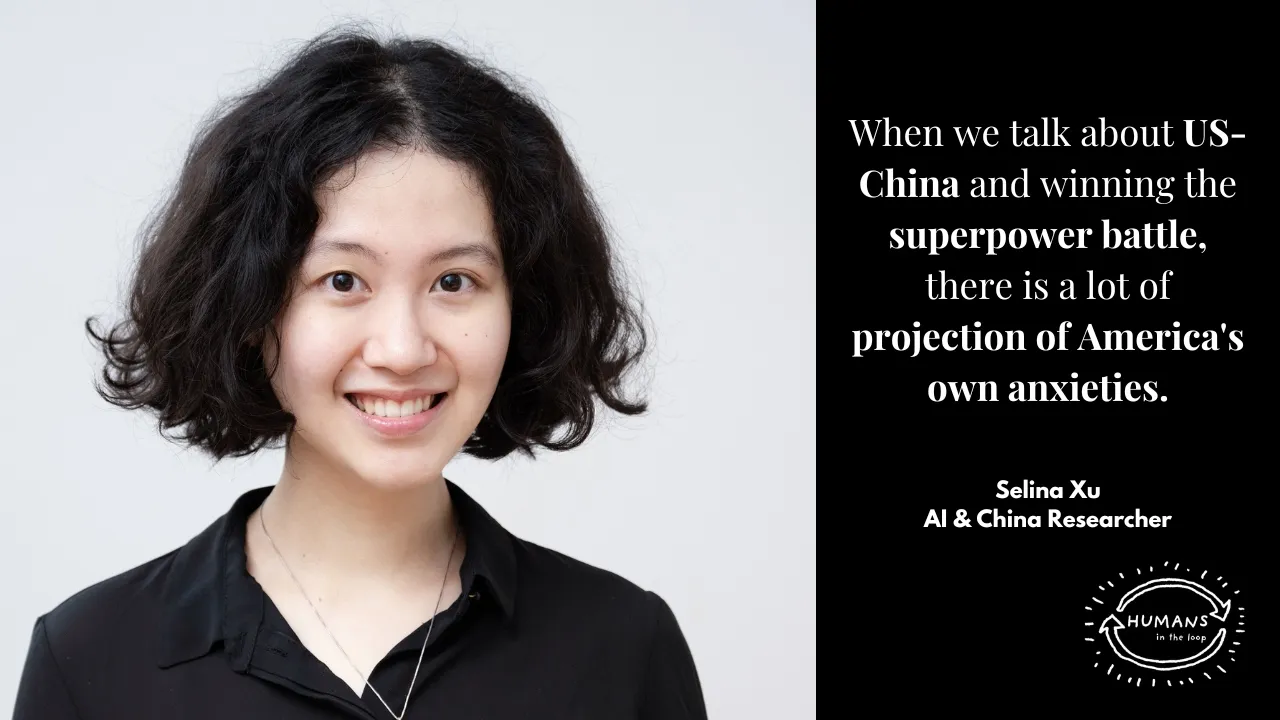
So I do think sometimes when we talk about US-China and like winning the superpower battle, there is a lot of projection of America’s own anxieties people have always seen Chinese tech as more of an imitator and copycat of Silicon Valley. But now I think it’s time to recognize that it’s very much an innovator in its own right. What I hope happens? I hope there’s no bombing of each other’s data centers. I hope there is no hot war over Taiwan.
From Copycat to Innovator
Seb (00:39)
Welcome back to Humans in the Loop. Today we’re going to be talking about China and the Chinese tech industry. And my guest is somewhat of an expert. Selena Xu is a writer and researcher who’s been featured in likes of the New York Times, the Atlantic, Time, The Guardian, and Fortune. Selena, welcome to the show.
Selina Xu (00:55)
Great, thanks for having me.
Seb (00:58)
So If someone came to you, Selena, who didn’t know much at all about China and the Chinese tech industry and said, help me understand how China and how the Chinese tech industry operates, what would you tell them?
Selina Xu (01:15)
Yeah, no, that’s a great question. I would say it has evolved a lot. I think the general impression back in the 2000s and 2010s was China’s tech industry seemed very much a derivative of Silicon Valley. People saw it as following closely to what was emerging from the US in terms of trends, in terms of companies. It was very much more of an imitator. People called them like copycat. So if you
Seb (01:40)
Mm-hmm.
Selina Xu (01:41)
think about some of the BAT tech giants, Back then, was Baidu Alibaba Tencent. Baidu was kind of like doing a search engine like Google. Alibaba was doing e-commerce, kind of similarly to eBay and Amazon. And then Tencent was trying to do like MySpace, know, QQ messaging. So this was, think, kind of the origins of China’s early internet ecosystem. But things really started to change a lot in the 2010s. And I would say the Chinese tech ecosystem really just headed down a very different trajectory. in the 2010s, you saw the flourishing of a lot of new consumer internet trends that when, you you could say even more ahead of the curve than Silicon Valley. So trends like live streaming, digital cashless payments, you could think of, you know, popularizing the recommendation algorithm and the short video scrolling format that we now all are so familiar with with TikTok. And then also, I think it started to combine its very hardware advantages from being the world’s factory floor into doing really cool hard tech. So you can think of DJI drones. You can think of Xiaomi, who has not just done smartphones and internet of things, smart home ecosystem, but also electric vehicles. So I think China’s tech has grown a lot. And then if you want to talk about AI, I’m happy to delve more into that. But I think. there’s kind of a same dynamic that’s playing out, which is people see China’s AI now as more of an imitator and like a copycat that who’s trying to catch up. And then after 2025 with a deep seek moment, I think that was a bit of a vibe shift and people start realizing, hey, maybe there are a lot of innovations that Chinese tech is doing. So if I have to TLDR it, would say people have always seen Chinese tech as more of an imitator and copycat of Silicon Valley. But now I think it’s time to recognize that it’s very much an innovator in its own right.
Seb (03:38)
Yeah, that copycat narrative, it’s one I’ve heard a lot. I wonder how true you think that is. Even rewind however many, 10, 15 or so years, I’ve never heard that coming out of the mouth of someone in the Chinese tech industry. It always seems to be coming out of the mouth of someone usually in the US or maybe European tech industries in somewhat of a derogatory way of sort of, you Western exceptionalism, they’re only copying us. yeah, what’s your take on that? Was it ever true?
Selina Xu (04:15)
think you could say it was true to some extent. think people like to say that the truly original ideas always comes out from the West, the zero to one, right? And then China was really good at one to 100. But one to 100 also takes innovations. It’s just less glamorous innovations, right? It’s not the moment of having like a Eureka idea. There is a lot of, for instance, that… when you think about the way we use an iPhone nowadays, and there’s a great book called Apple in China by Patrick McKee, that book talked a lot about how in the process of manufacturing, there were a lot of more tiny innovations that happened on the factory floor that’s needed in order to bring a physical artifact like the smartphone, the iPhone, into existence. And I think a lot of that innovation from the 1 to 100 phase tends to be ignored in favor of the 0 to 1. But then to go a step further, think the whole idea of China being unable to innovate, think no longer holds true. Back in the 2000s, fine, like there was a lot of copying, I would believe, but then a lot of iterations started happening and then genuine innovations happened in China in which you saw like really innovative companies that are doing new kinds of algorithmic techniques, such as for a Chinese AI. Or you could see, you know, very new consumer internet trends that started first in China and then to the rest of the world. And then also a lot of hardware innovations, right, that I think we tend to be able to appreciate less. So I do think this presumption of China being unable to innovate and only can copy the West actually harms and hurts, I think, the West more. It’s kind of like
Seb (05:54)
Mm-hmm.
Selina Xu (05:54)
that intellectual laziness, right? Like you just attribute everything to something like that and you fail to truly try to understand. the secrets behind China’s success. Like even if an idea were to emerge first in the West, why did it not take flight in Europe or the US? Why did it take, for instance, ByteDance to really popularize TikTok? And that’s a question that’s worth exploring and asking ourselves.
The State’s Guiding Hand
Seb (06:16)
And what about the role of the state? Because obviously China being a communist country and in this sort of strange brand of, know, communism, capitalism, some some merge of the two. what role does the Chinese state kind of play in technology and innovation?
Selina Xu (06:32)
I think a few different kinds of roles. So one, think the state is very much a guided, like it provides guidance and signaling to local governments on, hey, these are some priority areas that, you know, it’s a now five-year plan or something that we really want to push as we saw with internet plus and now with AI plus. I think. it is very good at showing what are the areas that it cares about. And these would be areas that would receive strong policy support. So on the local government level, once they get the signal, for instance, embodied intelligence or brain computer interface, or before that, electric needles, right, or clean energy, the local governments would jostle to find state champions that they could fund in their jurisdiction. And that sets off a really interesting dynamic in which, you know, Every province has its own, like, you know, EV giant, or every province has its own humanoid flagship company. And then these companies battle it out in China, which is why I think if you look at the recent, there was a marathon for humanoids, there were over 100 companies who were participating. So China is really just like flushing to the brim with competition just internally. And there is a Chinese term for it that’s called involution. which is excessive competition with diminishing returns. So this problem, you know, a lot of other people in the West have called it like over capacity. I think it’s definitely an issue that because of such strong state signaling that, you know, guides all the cash and the money into specific sectors, it results in over capacity in these sectors and then very strong domestic competition that really hurts the margins of these companies, which is why I think we’ve seen now that all of these companies are trying to go abroad, right? to
Seb (08:18)
Mm.
Selina Xu (08:19)
search for more, like better profit margins. So I think the state definitely plays a really strong role there. And then in some of the sectors, like electric vehicles, for example, I think the state can be very helpful in trying to bring about a trend earlier, right, with subsidies for consumers and buying electric vehicles and providing tech subsidies to companies who are doing that and providing subsidies down the whole value chain, including batteries, other kinds of rare earth inputs. So I think That kind of long horizon planning is something that China is very good at. And I think the EV industry is a great example of how they saw the sector as kind of a key emerging sector, decided to bet heavily on it, managed to reshape consumer preferences. And then China became the world’s top EV maker, exporter, and also buyer.
Seb (09:13)
Yeah, yeah. And I’ve heard on that, and I don’t know how true it is, but I’ve heard people say that Xi Jinping in particular really places a value on the physical, hard technologies, manufacturing, electricity generation for an electrified economy, robots and physical embodiments of things like AI over just pure software. Again, how true is that? What’s your understanding of Xi or the top of the CCP’s view on how they see kind of hardware versus software?
Selina Xu (09:51)
think there is definitely some truth to the statement that Xi himself cares a lot about what he calls the real economy, shi ti jing ji. So essentially it’s anything that you can see physically, right? So he has more of an aversion to what he calls the fictitious economy,
Seb (10:08)
Mm.
Selina Xu (10:08)
which is things that he thinks is more speculative. So finance. speculation, same thing with the housing, you know, housing market. And then also obviously things that he thinks are bad for like less good for the country’s long term competitiveness, like less essential, you know, video games, social media, all these software that really dominated, I think Silicon Valley, right, like the whole software eats the world kind of manifesto. think she is not a fan of that. He wants hardware to eat the world. So I think definitely some truth to that. I think he has realized that the transition cannot be so rough and abrupt such that it causes the private sector to lose its animal spirits. So one manifestation of how he was trying to force this shift in capital into the more hardware sector was during COVID, there was a series of brutal years long tech regulatory crackdown across sectors from ride hailing to FinTech, you know, with Ant Group’s IPO being scuttled, it was supposed to be the world’s biggest IPO, to video games, to, you know, all kinds of all these software dominant industries. And then at the same time, you know, there was a lot more remarks talked about to rein in the disorderly expansion of capital, common prosperity. And I think he very much was trying to bring people more into the new sectors, like, as you said, robotics, semiconductors, space. So a lot of these more hard tech that he believed would be more essential. So definitely that. But I think afterwards, China went through a few years of like, slowing economy, more pessimism. And then he’s kind of realized that, OK, hey, maybe it has to be a bit less top down. It has to be in alignment with the private sector. So the crackdown came to an end. And last year, as a reconciliation, he met with the top private sector CEOs, including Jack Ma from Alibaba, who at that point had vanished. So he reappeared and then there was a symposium with all of these private sector entrepreneurs in which he talked more about, the state will support you. So I think there’s been a bit of a warmth that has been reinjected into China’s private sector in which I think it is less just top down from Xi’s preference, but more now I think he’s realized he needs to take into account what the private sector also wants to pursue.
Where Did Jack Ma Go?
Seb (12:44)
Yeah. Do we know anything? It’s not something I’ve delved into. I remember the kind of Jack Ma has vanished story and suddenly
Selina Xu (12:51)
Yeah.
Seb (12:53)
Jack Ma had no longer vanished. Do we know anything really about what happened to Jack Ma in that time or is it all behind closed doors?
Selina Xu (13:00)
Yeah. Yeah, I mean, Jack Ma, like where where is Jack Ma was like the biggest headline, right? I was a reporter at that point. I remember the newsroom. Yeah, it like people had really bad thoughts. They thought he had been jailed. He had been disappeared. I think the truth was more of like he had been too outspoken and Once he saw how much his companies were suffering, he realized that he had to take a lower profile. And this was very much, I think, the crackdown to Jack Ma’s companies was also a signal to other billionaires, right? Like, hey, you are ultimately answerable to the Communist Party. So Jack Ma basically stepped back from his CEO position. I think there were some reports that he went to Japan and he was living in Ginza and just doing more of a behind the scenes role. And then I think he was basically, people expected him to just fade out, but he had made a few rare appearances where he would do some philanthropic appearances and supporting rural education. So that was seen as acceptable for the Common Prosperity Campaign. And then I think he reappeared because suddenly it was okay to do so again. And the state wanted him, him coming out was like a sign that the old crackdown era during COVID was over. Right. So, so it was very important to have him there. And I think with that, this new phase of like state company relationship, he’s now way more involved in Alibaba and trying to be more involved with its AI strategy. So, so yeah, so. things change fast in China. It’s hard to predict.
From Lodestar to Rival: How China Sees America
Seb (14:46)
Yeah, yeah. We’ve touched a little bit on some of the kind of the structures of how, you know, this idea of kind of involution and the way money flows, I guess, a bit of this bias towards the kind of real economy in Xi Jinping’s mind, as opposed to some of these more speculative technologies. How about the, the Chinese mindset It seems to me that a lot of US and European foreign policy right now focuses on China. And there’s a lot of the more anti-democracy politics we see emerging that seems to involve some level of fear and or jealousy potentially of China’s perceived dynamism. even if it’s not sort of wrapped in a kind of anti-democracy narrative, there is a lot of Western economies are looking to China and asking, you know, what it is we should maybe be learning from them, adopting, doing differently. I wonder how much, those same Western economies occupy the headspace of the Chinese leaders.
Selina Xu (15:58)
Hmm, interesting. I would say, so America has always occupied the minds of Chinese policymakers for the longest of times. Like this is like half a century, right? So I think there’s been, people used to call it in Chinese, Ba Yue Guang, which is like, like the lodestar, right? Like this is what people aspire towards. It was like the beacon, the shining city on the hill, right? Like it was very much aspirational. So that’s why you saw so many, like for decades, like generations of the best and the brightest Chinese students come to America. Chinese policymakers would come go to Harvard Kennedy School. would see Xi Jinping himself came for an exchange and I think was it Iowa? I think there was always that very fond. and like aspirational benchmarking that was happening in policymakers mindset. That took a hit first in, would say, like it took a hit a few times. It was not always like that, but very decisively in 2008 with the financial crisis, I think there was a shift in Chinese policymakers mindset in which they were like, oh, wow, like we always learn from you, but maybe we no longer should. So that was one. And then afterwards, I think with Xi Jinping taking over the reins, he had a much more, I think, ideological view of China’s place in the universe. He’s very like, I think he has a real chip on his shoulder, I would say. I think he believed very much in China’s place as this long standing civilization and national rejuvenation and leading China at the forefront of this fourth technological scientific wave. which he calls sometimes called the fourth industrial revolution. So he had that and then that brought him to a lot more contentions with the West, with like wolf warrior diplomacy, with people thought China was too confident in the COVID zero handling. And then I think now he’s gotten a lot more internally focused, I would say, with a lot of domestic issues that now seem a lot more pressing. I would never say that they would not think about. the US. think the US is always, a country that they have to take into calculus. But yeah, but I would say there’s been a bit of a like a waning in the way they view the US. It’s way less aspirational now. I think they see the US more as someone who is chaotic, fracturing the global world order that they built and that China benefited from, and no longer someone that they would want to learn from in the same way that they did 20 years ago.
Seb (18:42)
What about, you know, winning? There’s so much focus on competition, the other guy. I guess in the eyes of Xi in the eyes of the Chinese Communist Party, what does winning look like in this in this sort of battle of superpowers?
Selina Xu (18:58)
Yeah, the Chinese are very reluctant to use this framing. So they hate saying that this is Cold War 2.0. They
Seb (19:06)
Mm.
Selina Xu (19:07)
don’t like saying that this is like, you know, a rivalry. They dislike the idea of, you know, saying that like the two countries are competitors. So there is a bureaucratic aversion to these terms. I think in part it’s because, and obviously this is my interpretation and there are a lot of people who disagree. that they are less concerned with winning in the sense that often in DC you hear people talking about China wanting to overtake America and becoming the world’s number one superpower. I would actually inject some doubt and nuance into that. think China believes that it wants to be the number one power in Asia, Asia Pacific, like no problem. I think that is very hard to debate. But a lot of its own sense of national rejuvenation, that mission, is very much more of like, hey, we want to make sure that we are a technological and economic strong superpower, but not so much that they want to take over and shape politically the world order the way that the US had. And in fact, I think the example of how the US did it is a sign of overextension. When I talk to some Chinese academics and policy experts, they see it as a lesson that they should learn from to not do, right? Same thing with the Soviet Union. Both the Soviet Union and the US, in their view, overextended themselves in trying to win. And then that caused… kind of the downfall of the USSR and then in the US case, this backlash, right? And now de-globalization in America first. So I think that is the lesson they’re drawing from that. So I do think sometimes when we talk about US-China and like winning the superpower battle, there is a lot of projection of America’s own anxieties and own kinds of modes of thinking of the world view onto China. And China, think, Sometimes, like maybe sure they have a malevolent and long game 100 year strategy, but I would say just from talking to a lot of the people there more recently, definitely feels like they are thinking about it in a way that’s quite different. They would think if you have to use their frame of winning, a bit more as, know, they would win if China is able to emerge stronger and the CCP can enhance its stability and Xi Jinping can maintain this legacy as being one of the most powerful leaders. I think that’s how he’s thinking about it, his legacy, China’s place in the world, whether he has succeeded in rejuvenating China in the way that he’s talked about. So I think that’s how he’s thinking about it. The US plays a certain role here, but less so. I think they are more inclined to not clash unless needed.
Seb (21:52)
I might be totally off base here, but I believe I’m right in saying that in the 50 year plan, there was 50 year plan outline and there was something stated in there about effectively becoming the dominant global superpower by, was it 2049? But I suppose that was a plan that is now pretty
Selina Xu (22:14)
Yeah.
Seb (22:14)
out of date and maybe thinking has shifted a little bit over time.
Selina Xu (22:21)
They do want to be a, so I think they would like a G2 world, right? Like, but they would be very hesitant to even acknowledge that, right? So they were like, whoa, we didn’t want G2 when Trump said it, when he met Xi in Busan in October, right? I think China would be happy with that kind of, know.
China’s AI Playbook: Diffusion Over Frontier
Seb (22:40)
Yeah, I guess if we go back to, we’ve talked a bit about some of these kind of structural things within the tech economy and a little bit about the kind of the Chinese mindset there and how they’re viewing things. What is China doing differently do you think versus
Selina Xu (23:00)
Mm.
Seb (23:00)
US European tech economies?
Selina Xu (23:04)
I think China is leaning on their natural advantage of hardware and the economies of scale that they were able to create because of manufacturing the mobile phone, manufacturing electric cars. manufacturing cars at large, actually, and all the inputs and components that go into that, the actuators, the joints, the batteries, the revs, and then being able to move those valued supply chains into the next sector and the next sector. So right now, this is being really good for robotics. So I think that kind of proximity to hardware clusters where you are able to rapidly prototype new kinds of products. and then iterate it at the scale of days and weeks instead of months. I think it’s extremely helpful to turbocharge just the speed of innovation in anything that needs hardware. So when people talk about physical AI, not just humanoids, but also the robotic arms and factories, the drones, the service robots that will clean the streets, that will bring your food and the hotel to your room, all of these. And then drones, obviously. So I think all of this, like, physical AI will emerge on top of China’s hardware advantage. And I think this is what the rest of the world is finding very hard to replicate, right? So I think this is one. The other one is, think when it comes to AI, especially the government has been a lot more focused on widespread deployment and diffusion. So I think it’s very focused on people adopting AI and feeling… that AI is making their lives better. This is a bit different from, think, in the US. There’s so much anti-AI sentiment right now that I’m hearing. I’m based in New York. So it’s not as insulated as the Bay Area. And you can really hear a lot of people just in the US saying, hey, AI is going to take away my jobs. AI is going to make my kids more mentally ill. AI is going to increase my electricity prices and water prices. AI is terrible. We hate AI. Right. In China, there is some level of anxiety as well. But I think broadly speaking, people are a bit more optimistic about it because the narratives that they’re hearing from policymakers and also the companies is less about how AI is going to replace all of them, but more about like, hey, AI will make manufacturing better and lower your costs and help automation for places like sectors that have labor shortage. right now because of China’s declining demographics. AI is going to be an elderly companion for people, know, China’s aging population. AI will make your kids smarter because we have lack of teaching resources. But now, you know, kids can use AI. So I think there’s a very different kind of at least so far nascent approach to AI and that China is doing quite well with a focus more on diffusion, bit more focused on people’s livelihoods. And so far, I think there has been a gap in techno-optimism between China and the West.
Seb (26:16)
Mmm.
Selina Xu (26:16)
I’m sure how long it will hold, obviously, once people start getting laid off.
Seb (26:22)
Turns out if you don’t have tech billionaires telling everyone that AI is going to potentially end the world, that maybe they have a more positive outlook on it.
Selina Xu (26:30)
Yeah.
Seb (26:32)
So that strategy of diffusion, again, I’ve heard this idea before that China is much more focused on how do we get technologies into the hands of real people being utilized in the real world. more so than the kind of bleeding edge innovation invention for the, for the, you know, just moving the technological boundary forward. So I’m curious, what does that actually look like? How does the state in China actually, in a meaningful sense, influence AI adoption beyond the kind of very high level narrative framing of it?
Selina Xu (27:13)
No, great question. I think the state wants to do both. So if you look at the 15-five-year plan, they also talk about exploring pathways to AGI, potentially through agents or embodied intelligence. And then they talk a lot more about AI +, which is their grand plan for AI plus every sector, AI plus industrial transformation, AI plus scientific discovery, AI plus government efficiency. So what the government does exactly, I think we have to wait and watch and see. because this is something that’s emerging and maybe they won’t do it well, right? Like, it’s not necessarily true that China would be better at diffusion in some sectors. For instance, enterprise, like software that the US I think is much more ahead of that. What I think what the state can do beyond the narrative aspect is more of, think, provide some guidelines and rules for how like AI’s impact will be felt by the everyday population. So One example is, for instance, there was a, I think, labor arbitration case in Beijing in which someone was fired because the job was replaced by AI. And the court ruled that that did not constitute an unavoidable circumstance. So that sent a signal for other courts around the country for, OK, if you’re an employer and you’re trying to lay off your worker, this is one way in which you might slow down. Debatable if this is ultimately good in the long run for the economy. Another way they can do things is to basically try to promote. So in, for instance, the AI Plus plan, they talk a bit about want more AI Plus people’s livelihoods. We want to improve their welfare. So there has been a lot more AI Plus, for instance, elderly care products, or AI Plus things that maybe the market would not naturally gravitate to what’s funding. But now because it appears, there are more startups who are trying to do things like that, the silver economies, as people call it. And then another way to do it, I think, is the state can encourage, for instance, more industrial adoption through providing sites that can boost the quality of the models. So they do things like you can curate better high quality data sets. You can create what they call robotics training bootcamps in which you can collect standardized data across different kinds of environments. You can do things like curate really good in small open source industry specific models that then you can accelerate throughout a specific sector. So I think these things the party is trying to do, unclear how well it is able to accelerate diffusion. But I think these are things that you don’t really see, right? When you think of LLMs and general purpose LLMs, you’re not really seeing these very specific smaller models being built for specific purposes.
DeepSeek and the Open-Source Surge
Seb (30:03)
Yeah. Yeah. Let’s talk a bit about DeepSeek and maybe the, yeah, the Chinese state of AI right now. So, you know, for those, for those who missed it, I guess the high level summary is, U S big tech companies like your open AI is Anthropics, et cetera, you know, building these huge models, which were of course incredibly expensive to, to, to train. and, ultimately, I guess, liked to think that they had this great advantage versus what was happening in the likes of China. And then DeepSeat comes along and builds a model that seemingly performs at a pretty comparable level by all measures, maybe better in some areas and does so at sort of a fraction of the cost. And at the time seemed to cause widespread doubt and chaos, even if very temporarily. wiped a load of valuation off various companies. I, one, I since that moment have not heard a great deal about what is happening within the Chinese AI space. I have heard that China is taking more of a kind of open source type of approach or that is more common. But yeah, Since DeepSeek, I guess what’s been happening and what’s the latest state of the Chinese AI industry.
Selina Xu (31:26)
Yeah, everyone’s waiting for the next DeepSeek. It’s like a long waiting game. But I think the biggest good catalyst that kind of happened from DeepSeek R1 in January 2025 was that it galvanized the Chinese ecosystem into realizing, my god, this is such a great way to really publicize the company, raise prestige, attract talent, attract investor funding, and really get your models used by more people. It has had a very lasting effect in that a lot of companies that were previously closed, I think at the time, like Baidu was closed source. Many Macs might have also been closed source, decided to be open source. A lot more companies just decided to start open sourcing anyways from Jhipu Z.ai to like Moonshot with its Kimi models. So there has been a slew of nonstop open source Chinese model releases that if now you look at any benchmark of the most intelligent open source models, they’re predominantly all Chinese, So I think open source now is… heavily dominated by Chinese. The main, importance of that is probably just a matter of adoption and mindshare amongst global developers and countries or companies who are trying to use a model that they can do locally, they have constraints on their computer, their budget, and they’re trying to really run something locally, then open source is the thing to do. As to what is happening with DeepSeq, that’s a great question. Nobody really knows. I think people have debated if it’s a matter of like, there’s so much pressure and expectation for them to be able to do something like what they did last year. People have talked about whether it’s because they have to optimize their model to run entirely on potways ascent trips, and they’ve been having difficulties about that. Or if it’s a matter of just like, you know, the sheer rate of competition, right? Like Kimi, like 2.6 came out yesterday, like, you know, and now it’s the best Chinese model. So DeepSeek is probably like, like if we release V4, has to be better or it has to match like Claude, right? So, so I think, I think the Chinese AI space has just moved a lot faster post DeepSeek. And then the other big thing is that it’s now mostly open source. So I think those were the two things that have happened because of DeepSeek since last year.
Agentic AI, World Models, and China’s Next Bets
Seb (33:48)
Hmm. And since that sort of deep seat moment, we, so much happens, but if we cast our mind back to beginning of last year, you know, most of the kind of the applications of AI at that point, or most of the ways in which people were interacting with AI was, know, chat GPT or, or equivalent, uh, know, large language model, whatever you’re querying restaurant, you want to go eat in or in a meaning of the universe. in Western economies and in the circles in which I move, I guess the narrative and the emphasis seems to have shifted a lot towards, know, agentic AI and more and more of these applications. know, Claude Code seems to have sort of really rocked the world more recently, the software engineering world. And yet more and more of these kinds of like agentic applications of AI. I guess I wonder is China on that same trajectory or is it going in a different direction?
Selina Xu (34:55)
think largely on the same trajectory for some of these big companies or notable startups, I think Moonshot’s doing a lot of coding agents. And OpenClaw, when it made a splash, I think in China it was huge. In China, people were so enthusiastic. I think they called the whole thing lobster craze. There were people, I think the one that got reported a lot by English media was people lining up. outside of Tencent’s Shenzhen headquarters and just trying to get, because Tencent was offering to help people install on their computers. like lots of people did that. A lot of local governments got really excited and tried to push for more agent applications and startups in their districts. And then trying to support one person companies giving subsidies to companies that are started by a single person with the help of many agents. But then I think what kind of threw a wench into that was that there was some security concerns and basically the state announced that, if you are a state-owned enterprise or if you are using a computer from a work at a state-owned enterprise, you’re not allowed to install Over-and-Claw. So that craze slightly subsided. But I do think there is this… China does watch, I think, what is emerging in the West, and then they try to do it as well. The only caveat I would have for that is that I think they’re not just betting only on agentic systems. I think they’re very much also focused on physical AI. So there’s a lot more research that’s going into world models, into whatever may be the next paradigm after LLMs. So I think there is a lot of research and excitement around that when you talk to Chinese researchers.
Seb (36:44)
And what do you know about the frontier of that space right now? Is there anything emerging as the next big thing, as it were, that you can see emerging in China there?
Selina Xu (36:57)
Yeah, good question. There’s a lot of super smart people who are working on, you know, more of like vision models. So I think Tsinghua is definitely a hub for that. There is also some Beijing research institutes. There was, I think, a high profile scientist called Zhu Songchun, who returned from the US and then started this, now works at this big AI institute in which he is pursuing some form of like That’s something that’s not neural networks. So I would say nothing big has happened yet. It’s a bit like when you see Yan Le Kun or Fei Fei Li raise a lot of money for their world model projects. The same thing is kind of happening in China right now, but I think we are just not there yet in terms of the amount of data that you’re able to collect and you’re able to simulate. And then once the data problem is solved, then you might see a flywheel. that happened with LLMs for world models. But yeah, right now nothing too breakthrough-ish at the frontier, but worth watching.
Powering the Machine: Energy, Chips, and Data
Seb (38:03)
And just for those not familiar, Jan LeCun, for example, was chief AI officer or whatever his title was, led AI at Meta for a long time, seemed to have a bit of a falling out when Meta acquired Scale AI and a young 29-year-old, I think. founder was sort of put on top of Yanla Koon in the hierarchy. They seem to have a bit of a disagreement. Yanla Koon has since left and raised a huge amount of money. yeah, I guess seems to be part of this wave of, know, world models seems like this new we might call it a buzzword. it seems to be this kind of next phase of, well, the AI is limited by this kind of simplified or almost non-existent view of how the world actually operates. And therefore, that’s kind of the limitations of the system. And actually, we now need to build these sophisticated models of how the world works in order to be able to apply AI more broadly. let’s talk a bit about, beyond AI and some of the other areas we’ve sort of talked about within the Chinese tech economy. I guess what becomes clear is the, almost the infrastructure that an economy or in a country needs in order to support those industries, you know, its ability to generate affordable electricity, its access to. the right kind rare earth elements for things like EV motors and battery technology, computer chips. Talk to me a little bit about the supporting infrastructure here, because it does seem like deliberately or otherwise, it seems like China is in this very favorable position right now in terms of those kinds of infrastructural fundamentals for these different areas of technology. So yeah, I guess from your perspective, do think that’s been a very deliberate long-term view to get to this position?
Selina Xu (40:12)
Definitely for energy, yes. And also a very deliberate way to try to make it more green. I think, let me think of this step. It was something like last year, maybe one in three kilowatt hours. In China, we’re from renewable energy sources. And I think China’s state grid has invested a lot, like an unprecedented scale, to fortify the grid capacity. So there’s been a very long-term kind of plan leading up to that. Like, it doesn’t happen overnight, right? Like, you need investments in renewables. You need to constantly build it out. You need to make electricity really cheap. And now they’re also investing in what they call emerging technologies like fusion, like quantum. I think there is a focus on not just fortifying the current electricity grid, but also making sure that, okay, if there are new technologies that are emerging, China will also be on top of it. Beyond electricity, other infrastructural things, I think China’s definitely very worried about compute. no questions asked, but it is a bit more hamstrung on that front because it was so reliant on the West and with UX export controls, I think that just really pummeled China’s like compute capacity. But then it also stimulated China into like all in on its own domestic semiconductor industry. So right now, even though they’re still catching up, know, especially on semiconductor equipment, I think it seems like a matter of time, like in the next few years in which they will be able to achieve self-sufficiency at some level. So I think the domestic alternatives that are emerging are getting stronger and stronger. And there is a lot of state directives to use those at the tech companies. So now it seems like China is still catching up, but like on a better trajectory now than a few years ago when it comes to semiconductors. Other kinds of infrastructure. beyond like energy, compute, data I’m less familiar with, I think they’ve tried to set up recently a world data organization. And there’s been a lot of, there’s a section in the 15 five-year plan that talks a lot about like strengthening data as like building this national resource or like this general ledger for data and building better high quality data sets. I think they do want to do more there, but high quality data is definitely, I think currently not as I think not where they wish it can be. Beyond data, mean, talent is more of like a, it’s like a soft infrastructure, I guess, but they’ve I think they’ve done a lot of investments into talent and, and into STEM in particular. And that’s paid off a lot in terms of like what they call the engineer dividend, right? I think China has more STEM graduates than rest of the world. So
Taiwan and the Chip Chokepoint
Seb (43:13)
Yeah, yeah. And I’ve heard this statistic, I don’t know if it’s totally up to date or correct, but that China processes about 90 % of the world’s rare earth elements, at least some of them are crucial to things like motors and battery technology and science. China seems to have a real kind of, yeah, clearly has sort of strong hold on that industry. You talked about the, semiconductors, how, from your point of view, does Taiwan fit into the picture here from a chips perspective?
Selina Xu (43:44)
I think China wants Taiwan, regardless of the chips. The US would have more of an incentive to defend Taiwan because of the chips. So I think it really is. I think. despite like TSMC opening a faction of fab in like Arizona, think most of the world’s advanced AI chips, like maybe 90 % are still done and assembled in Taiwan. So I think this is gonna be, it just makes a already very tricky geopolitical issue even more like potentially high stakes for the rest of the world. It could be disastrous for the global supply chain, right? And like tech industry is both in China and in the US. So. Yeah, I mean, this kind of is is like the question like, what, what is possible to avert a war here, like in Taiwan, and it very much I think depends on, you know, see, Trump’s calculus, at least in the next two years. So I just think on the Chinese side, there’s so much baggage that’s not related at all to chips. And even if the fab self destruct, like China would want Taiwan to reunify. So so this is a matter of more like historical, civilizational significance to Xi Jinping than it is one about like, like semiconductors. Like I don’t think he is even thinking in that optimistic scenario in which he gets Taiwan with, know, TSMC, right, intact.
Seb (45:15)
Hmm. It sounds like from what you’re saying, and I guess I’d be inclined to believe this too, that it’s probably only a matter of time before China can manufacture the latest and greatest chips at home rather than depending on Taiwan.
Selina Xu (45:31)
Yeah, like I would not bet against them. It might not happen that fast, but they’re like pouring everything they can into it. So it feels like a matter of national survival. They call it choke points in Chinese is like choking someone by the throat. So they saw export controls in that way.
Bridging the Understanding Gap
Seb (45:49)
Before I come on to my last question, is there anything that we’ve not covered in relation to China and the Chinese tech industry that you feel is important or interesting at this particular moment in time?
Selina Xu (46:03)
Yeah, I would just say I think it would be so good if more people paid attention to China and the West and the way that Chinese people pay attention to America, right? Like people read about, they read the canonical like US startup memoirs, they read, you know, less wrong, they read sub stacks, right? They are on Twitter. I think there is that voraciousness and hunger for understanding and learning from the US. And I think when I sometimes talk to people here, there is so much more hubris and ignorance when it comes to China, despite. know, the successes that you can acknowledge with China’s own tech innovation. So the more understanding and less viewing of China as a monolith and conflating it with, you know, just like party documents and policy pronouncements, I think there’s so much exciting things happening on the ground with, you know, actual people on the ground in the Chinese tech industry that go beyond just the geopolitics and the national security and, you know, Xi Jinping’s grand strategy.
Seb (47:03)
And if people want to engage with that and want to learn more, are there any particular resources that you’d point them to?
Selina Xu (47:11)
Yeah, great question. There are, I do see there is a level of barrier, but there are some really great subtexts in English that translate, you know, Chinese articles and interviews. So Jeffrey Deng’s Chin AI, he does a lot of really great translations. So does I think Jordan Schneider’s China Talk. Some of them are more of like policy pieces, but he does like really good translations of interviews. And then I think also just like following more people who’s a lot of these Chinese founders. and engineers are on Twitter. So if you can find them, see what they’re talking about, I think that’s a really good way as well. And then beyond that, maybe I’ll write up a list on my blog as well for if people are more interested in books and stuff. think there’s a better way to understand the zeitgeist in China in some novels and books that have been translated actually.
Closing Thoughts: Hope Over Fear
Seb (48:07)
I typically ask guests about, you know, finish with something about their kind of their optimistic take of the future here. Before I, I guess, jump into that, I’m… conscious of like, it very much depends on your perspective, right? Like some somebody’s sat in China right now with a particular particular perspective, views the world very differently to someone’s in New York, or in my case, in France. But, know, caveats aside, I just be interested to get your view if you cast your mind forward, and think optimistically about what the future has in store in relation to tech industry and how China’s tech and role in the world evolves. What do you hope happens?
Selina Xu (48:53)
What do I hope happens? Not my prediction. Okay, interesting. What I hope happens? I hope there’s no bombing of each other’s data centers. I hope there is no hot war over Taiwan. I hope that AI can feel less like a technology that is a bubble and that might pop and that people can feel that AI can be beneficial and that it can be made safe and secure. there are a lot of you know, very highly important AI risks that you do need US and China to cooperate on. And then you also need the companies themselves to be able to self-regulate on, right? So these are very tough, tricky questions of like, what is the relationship between the companies and the government and then the relationship between the two governments and also companies on both sides of the Pacific. So in my optimistic scenario, I hope that there is a lot more. like shared norms and best practices and self-regulating safeguards. then between, and that might need the two governments to come, you know, into some kind of alignment of like, hey, red lines that we will not cross, areas that we think may benefit if we both work on it together. And then I think that that changes a lot of the AI narrative and fear, right? That I think everyday people feel and, and it will make the world safer. So I think that’s what I’m hoping to see.
Seb (50:24)
Great. Well, that seems like a great place to wrap us up, Selena. So I really appreciate you taking the time.


